Blessed Gomidas Keumurjian: Armenian Catholic Priest, Husband, Father and Martyr of Constantinople
A married Armenian priest of Constantinople who entered communion with Rome, was prosecuted in an Ottoman court and was beheaded in 1707.
At a Glance
- Born
- 1656, Constantinople (now Istanbul)
- Died
- November 5, 1707, Constantinople (some Armenian sources give October 25, a calendar difference); aged about 51
- Titles
- Blessed; priest and martyr; archpriest of Saint George at Sulu Monastir; husband and father
- Feast
- November 5 in the Catholic calendar; no Armenian Apostolic feast found
- Veneration
- Beatified June 23, 1929, by Pope Pius XI in Saint Peter's Basilica; not canonized
- Patronage
- No official patronage; courage under persecution is a devotional theme
- Who Was Blessed Gomidas Keumurjian?
- Family and Education in Constantinople
- Priest, Archpriest and the Turn Toward Rome
- Parish Priest, Preacher and Poet
- The Trial and Its Context
- Execution and Burial
- Miracles and Popular Devotion
- Beatification and the Documents
- A Grave in Istanbul and Pilgrimage
- Blessed Gomidas and the Eastern Churches
- Frequently Asked Questions
Who Was Blessed Gomidas Keumurjian?
Blessed Gomidas Keumurjian, also written Komitas Keomurchean or called Cosma da Carboniano in Italian sources, was an Armenian priest of Constantinople. He was born in 1656 and was beheaded on November 5, 1707. Pope Pius XI beatified him on June 23, 1929, and the Catholic Church honors him as a martyr and as a rare example of a married priest raised to the altars.
His case is unusual because an Ottoman court record about his trial has survived and has been published. That record allows a historian to say more about the legal side of his story than is possible for many saints of his era. Later Armenian writings add miracles and dramatic speeches, and those parts must be read as TRADITION and not as court evidence.
His story is also painful for Armenian Christians. The accusations against him were brought by the Armenian Apostolic patriarch of the city, and he was killed by the Ottoman state. This article tries to tell the story fairly, without blaming a whole Church for the acts of particular leaders, and it marks UNCERTAIN where sources disagree.
Family and Education in Constantinople
Gomidas was born in Constantinople in 1656 into an Armenian family. The Vatican biography says that his father, Martiros, was an Armenian Apostolic priest and that the father died while Gomidas was still young. His mother is said to have encouraged his education and his priestly vocation.
His older brother, Eremia Keomurchean, who lived from 1637 to 1695, was a well known Armenian writer and chronicler of Ottoman Constantinople. Eremia stayed in the Armenian Apostolic Church, while Gomidas later entered communion with Rome. The brothers therefore show that an educated Armenian family could be divided over church loyalties.
The Vatican describes Gomidas as a diligent student of Scripture who also learned Armenian religious literature, sacred music and rhetoric. It says that at about twenty he married a young woman from Cappadocia named Hurune and that they had five children. The dates of the marriage, the names and birth dates of the children and the sources for some personal details are not independently documented here (UNCERTAIN).
Priest, Archpriest and the Turn Toward Rome
Gomidas was ordained a priest of the Armenian Apostolic Church. The Vatican dates his ordination to 1683 and names his church as Saint George at Sulu Monastir in Constantinople, where he later became archpriest. A German reference work gives 1685, so the exact year is UNCERTAIN.
His move toward Catholic communion came through study and discussion. Catholic sources stress his acceptance of the Council of Chalcedon and of communion with the Bishop of Rome. The Vatican places his reception, with his family, between 1695 and 1697. The Enciclopedia Cattolica gives about 1696 and another reference gives 1694, so the safest statement is that it happened in the mid 1690s.
It would be misleading to call this a conversion from unbelief. Gomidas was already an Armenian Christian priest, and the change concerned communion with Rome and disputes between Armenian and Catholic authorities. As he preached and encouraged others to follow the same path, he gained supporters and also strong opponents. Historians place this within a wider movement in Ottoman Armenian society shaped by Catholic missionaries, contacts with Western Europe and shifting political loyalties.
Parish Priest, Preacher and Poet
His main work was that of a parish priest, preacher, teacher and confessor. The Vatican describes a ministry marked by care for the poor, devotion to Scripture and an effort to promote Christian unity. He did not found a monastery, school or charity that can be proven from the sources examined.
He was also a writer. The Vatican credits him with a poetic version of the Acts of the Apostles, known in Armenian by a title that may be rendered as Verses on the Acts of the Apostles. A later martyrology printed in 1798, written by Stepanos Avkereants, preserves a lament attributed to Gomidas from the time when he was in hiding, in which he mourns the state of his people.
That lament survives only through later copying, so the original text and its history are UNCERTAIN. A grave inscription, translated in a modern study, calls him a learned poet and composer of religious verses. Such an inscription shows his reputation but is a commemorative text, not a modern judgment of his poetry.
The Trial and Its Context
The most important discovery about his case is an Ottoman court record from the registers of Galata, which Henry Shapiro found and published with an English translation in 2021. It shows that the Armenian Apostolic patriarch of Constantinople, Hovhannes, brought charges against Gomidas and other Armenians. The charges said that they had left the Armenian community, taken up the religion of the Franks, held Catholic ceremonies and caused disorder.
According to the record, Gomidas and his companions denied the charges, but witnesses spoke against them. A careful biography should not describe the accusation as an admission. The register does not record the sentence, so the execution has to be pieced together from other sources.
The dispute was both theological and political. Recognized religious communities in the Ottoman Empire managed their own affairs, so a movement toward Rome challenged the authority of church leaders, and Ottoman officials often distrusted Catholic activity because of its link to European powers. The Vatican also says that Gomidas spent about two years in exile in Jerusalem before returning to Constantinople, where he was hidden, arrested and tried. The order of all his arrests is not resolved by the court record (UNCERTAIN). His death must not be used to condemn the whole Armenian Apostolic Church.
Execution and Burial
Gomidas was beheaded in Constantinople on November 5, 1707, according to the Catholic calendar. Some Armenian sources give October 25, which matches the difference between the old and new calendars at that time, and the two dates are not rival accounts of different events. He was about fifty one years old.
Catholic accounts say that he was offered his life if he would accept Islam and that he refused, and that he died reciting the Nicene Creed. The detailed story of the last negotiations, including a reluctant grand vizier, comes mainly from the later martyrology of Avkereants, and the exact words cannot be reconstructed from the court record (TRADITION).
Shapiro reports that he was buried in the Armenian cemetery at Balikli in Istanbul, where a tombstone with an inscription stood when the study was published. A separate reference work says that his remains were taken through the French ambassador to Lyon and placed in the church of the former Jesuit college. The sources do not show whether this means all of his remains, some relics or a mistaken tradition, so the present location of his relics is UNCERTAIN.
Miracles and Popular Devotion
Devotion at his grave began soon after his death. The tombstone inscription speaks of signs and miracles and of many pilgrims, and these claims show an early reputation for help from heaven, though they do not document any single healing (TRADITION). The martyrology also tells of a sudden change in the weather after the execution, which is part of the later narrative and not an independent record.
A religious dialogue in Armeno Turkish printed in Galata in 1844 describes a woman who visited the grave to seek help for a sick person. Because that book was part of a religious debate, the story shows how devotion to Gomidas was understood and defended, and it does not prove a healing.
Shapiro shows that visitors to the tomb included Armenian Catholics and Armenian Apostolic Christians, some Greek Christians and even Muslims. That shared devotion is historically interesting, but it does not mean that any of those communities placed him on their official calendar.
Beatification and the Documents
Pope Pius XI beatified Gomidas on June 23, 1929, in Saint Peter's Basilica. The apostolic letter, titled Martyrum Corona, appears in the Acta Apostolicae Sedis for 1929. It permits him to be called Blessed and allows an Office and Mass in the Armenian Catholic jurisdictions and churches named in the letter. Beatification does not give a universal feast to every parish.
The main modern study is the article by Henry Shapiro in the Journal of Ottoman Studies, volume 58, from 2021. Other useful works include the Enciclopedia Cattolica, an older biography by Riondel from 1929, the history of Patriarch Ormanean, and a study of the beatification process by Cesare Santus. Some of these were known to the research for this article only through citations.
No later canonization has been found, and the Vatican lists him as Blessed. The sources do not give the full text of the prayers approved in 1929, and we have not verified an Armenian hymn composed for him, so no such text is quoted here.
A Grave in Istanbul and Pilgrimage
The most concrete place linked with Gomidas is his tomb in the Armenian cemetery at Balikli in Istanbul. Shapiro traces how the grave became a place of pilgrimage and reports that the tombstone was still there when his study was published. Anyone who wishes to visit should check current local conditions and access.
The reported transfer of remains to Lyon is a separate matter. It rests on a hagiographical reference that has to be compared with stronger sources, so we do not claim that his complete remains are in either place.
His Catholic memorial is November 5, the date of his death in the Catholic calendar. Armenian Catholic parishes that keep the Office and Mass allowed in 1929 may mark the day, while readers elsewhere can remember him in private prayer.
Lord Jesus Christ, You gave Blessed Gomidas the courage to stay faithful to You in a time of fear and division. Through his prayers, give me an honest heart, strength for my family and parish, and love for all who follow You. Heal the wounds between Christians, and keep me firm in faith to the end. Amen.
This is a short original devotional prayer, not an official liturgical text, and it was not written by Blessed Gomidas Keumurjian.
Blessed Gomidas and the Eastern Churches
For Armenian Catholics, Gomidas is a sign that a person can enter communion with Rome without giving up Armenian faith, language and liturgy. He was ordained in the Armenian tradition and stayed Armenian in worship and culture. His married priesthood is also familiar in the Christian East, where married clergy have long served parishes.
For Armenian Apostolic and other Orthodox readers, his story is harder. His prosecution reflects a painful chapter in which rival church leaders and the Ottoman state were entangled in religious pressure. Fair treatment acknowledges this suffering and also separates the actions of particular leaders and witnesses from the teaching and identity of whole Churches.
It would be wrong to say that the Orthodox Churches or the Armenian Apostolic Church have canonized him. The sources show historical interest and some shared popular reverence at his grave, but no formal glorification or official feast. His story invites both traditions to remember faithfulness to conscience and the cost of division.
Frequently Asked Questions
Ask His Prayers
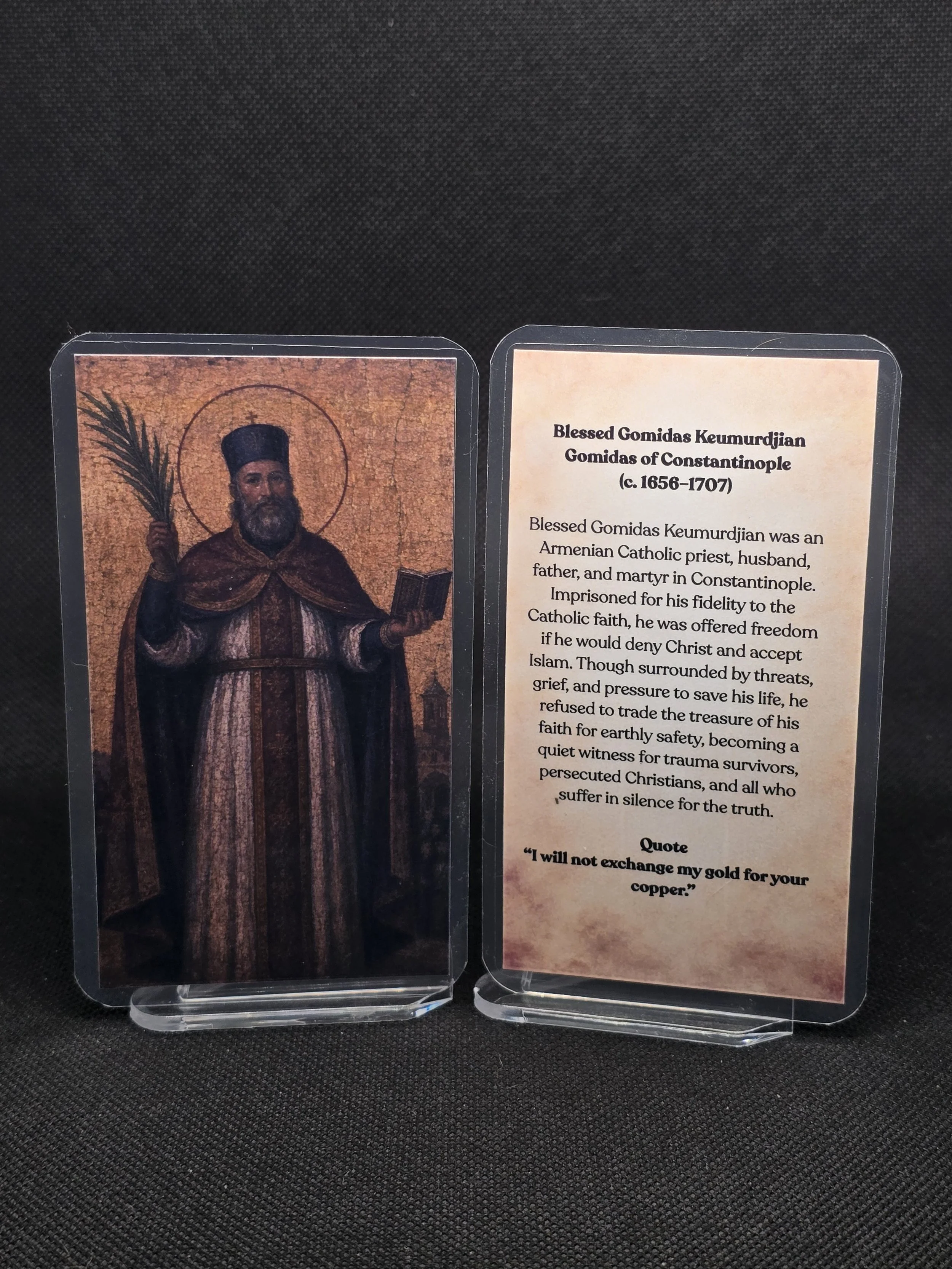
Blessed Gomidas offers the witness of a priest, husband and father who stayed faithful under pressure. If you wish to ask his prayers for courage, unity among Christians and the good of your family, you may keep his prayer card at home.
View Prayer Card