Saint Lucy: Patron Saint of the Blind, Eye Disease & Vision Loss
Virgin • Martyr • Patron of the Blind • Light-Bearer • December 13
Saint Lucy: The Complete Guide to the Patron Saint of the Blind, Eye Disease, and Vision Loss
Her name means light. She was martyred in darkness. And for seventeen centuries, people facing blindness, macular degeneration, cataracts, and every affliction of the eyes have turned to her — and found her listening.
If you are searching for Saint Lucy because your vision is failing — because you or someone you love is facing macular degeneration, cataracts, glaucoma, a retinal disease, or any condition that threatens sight — you have come to exactly the right place. Saint Lucy of Syracuse is one of the oldest and most beloved intercessors for eye conditions in all of Christian history. She has been prayed to for vision problems for over sixteen centuries. She is named in the Roman Canon of the Mass — one of only eight women to receive that honor. She was venerated across the entire known Christian world before the 5th century even ended. And she is still answering prayers today.
This guide covers everything: her remarkable life, the full account of her miraculous martyrdom, every patronage she holds, every historic prayer addressed to her in both the Catholic and Eastern Orthodox traditions, and how to pray to her specifically for eye diseases, blindness, and vision loss. Whether you are coming to Saint Lucy for the first time or deepening a devotion that has lasted years, this is the most complete resource on her available in English.
Her Name: Why "Lucy" and "Light" Are the Same Word
Everything about Saint Lucy begins with her name. Lucia comes from the Latin lux — light. Not metaphorical light, not spiritual light abstracted from the physical world, but the actual, tangible, life-giving phenomenon of light itself. The same root gives us the word lucid (clear, bright, comprehensible), lucent (shining, translucent), and illuminate. In the ancient world, where names were considered to carry the essence of the person who bore them, naming a girl Lucia was a statement: this is a child of light.
This is not a modern overlay imposed on a medieval legend. The connection between Lucy's name and her patronage of vision goes back to the very earliest layers of her veneration. In a world without electricity, where light was the most precious and fragile of daily necessities, the loss of sight was understood as being plunged into a permanent darkness that no candle could reach. The patron of those in that darkness was, naturally, the saint whose very name meant light. When you call on Saint Lucy in your blindness, you are calling on Light itself — and asking it to enter the darkness where you are.
Her feast day on December 13 was, under the old Julian calendar, the winter solstice — the longest night of the year. On the darkest day of the year, the Church celebrates the saint whose name means light. The timing is not accidental. Lucy's feast is a declaration that light does not abandon those in darkness, that the longest night is precisely the night when the saint of light is most present. For seventeen centuries, people facing the darkness of blindness have found this message directly addressed to them.
Her Life: Syracuse, a Sick Mother, and a Dream That Changed Everything
Lucy was born around 283 AD in Syracuse, Sicily — the great Greek city on the eastern coast of the island, one of the most important cities in the ancient Mediterranean world. Her family was wealthy, Christian, and, like all Christians in the early 4th century, living under the permanent shadow of possible persecution. The Emperor Diocletian had not yet launched his Great Persecution, but the threat was always present, and practicing Christianity required a combination of faith and prudence that shaped the texture of daily life.
Lucy's father died when she was young, leaving her to be raised by her mother, Eutychia. By the time Lucy was approaching adulthood — around 16 or 17, as was customary for girls of her social standing in the Roman world — Eutychia had arranged a marriage for her to a pagan suitor. The suitor was wealthy, respectable by Roman standards, and entirely unacceptable to Lucy, who had privately consecrated her virginity to God.
Lucy had not told her mother about her vow. She knew that Eutychia, who was practical and who loved her daughter and wanted her future secured, would not easily be moved by the spiritual reasoning of a teenage girl. Lucy needed a sign — something her mother could not dismiss. And her mother's illness gave her the opening she had been waiting for.
The Pilgrimage to Saint Agatha and the Dream
Eutychia had been suffering from hemorrhages for years — a condition that, in the ancient world, had no effective treatment and that was slowly weakening her. Lucy proposed a pilgrimage to the tomb of Saint Agatha in Catania, about 50 miles north of Syracuse. Saint Agatha had been martyred approximately 52 years earlier during the Decian Persecution and was already renowned throughout Sicily for miraculous healings at her tomb. It was a reasonable proposal — pilgrimage was a standard recourse for illness — and Eutychia agreed.
At the tomb, as the two women prayed fervently and at length, Lucy fell into a visionary sleep. Saint Agatha appeared to her in the dream, speaking words of extraordinary significance: her mother would be healed through Lucy's faith; and — the prophetic heart of the vision — just as Agatha was the glory and protector of Catania, so Lucy would become the glory and protector of Syracuse. The implication was clear: the same martyrdom that had made Agatha the saint of Catania awaited Lucy in Syracuse.
The Healing of Eutychia's Hemorrhages. When Lucy woke from her vision and embraced her mother, Eutychia's hemorrhages had stopped — completely and instantly. The woman who had suffered for years was healed in the moment her daughter received the prophetic vision of her own future martyrdom. This healing is the first recorded miracle of Saint Lucy's intercession.
With her mother now fully healed and emotionally indebted to Lucy's faith, Lucy pressed her advantage. She revealed her vow of virginity and asked permission to distribute her dowry to the poor. Eutychia, overwhelmed by what she had just witnessed, agreed. And Lucy — with characteristic precision about the theology of giving — offered her mother a memorable rebuke to the suggestion that the money might be better saved for a bequest: "Whatever you give away at death for the Lord's sake, you give because you cannot take it with you. Give now to the true Savior, while you are healthy, whatever you intended to give away at your death."
This phrase alone would be enough to mark Lucy as a person of unusual spiritual depth. She understood that the value of generosity lies in its cost to the giver — that giving from abundance is not really giving, and that true charity requires giving while it still hurts to do so.
The Vow of Virginity and the Suitor's Rage
The suitor was not informed of Lucy's decision in terms that made him sympathetic. He learned that the woman he intended to marry had given away her dowry — the very wealth that made the match attractive — to the poor. He was humiliated, financially cheated (in his view), and rejected. In the Roman world, being rejected by a woman was already an intolerable insult; being rejected in favor of a carpenter's son who had been executed two centuries earlier, with the dowry money scattered among beggars to boot, was something for which there was a satisfying recourse: denunciation.
The suitor went to the governor of Syracuse, Paschasius, and reported Lucy as a Christian. In 303–304 AD, this was not a vague accusation — it was a death warrant. Emperor Diocletian had launched his Great Persecution in 303 AD, issuing edicts requiring the destruction of churches, the burning of scriptures, and ultimately the execution of all Christians who refused to sacrifice to the Roman gods. Paschasius had the authority, the motivation, and the machinery to act.
Lucy was summoned before the governor. What followed was not the quiet capitulation Paschasius expected. Lucy — this teenager from a wealthy Syracusan family — stood before the Roman governor and gave as good as she got. She refused to sacrifice to the Roman gods. She accused Paschasius of being in the service of demons. She prophesied his condemnation before God. She told him that the Roman Empire itself was collapsing — and she was correct: Diocletian would abdicate within the year, Maximian would die shortly after, and the persecution would end.
Outraged, Paschasius ordered Lucy to be taken to a brothel — the standard imperial punishment for Christian women who refused to apostatize. The idea was that forced prostitution would defile a consecrated virgin, breaking her dignity and her vow simultaneously. What happened next became one of the most celebrated miracles in the entire history of Christian martyrdom.
Miracles During Her Life
The miracles that attended Lucy's passion were not subtle. They were the kind of miracles that converted bystanders on the spot — visible, unmistakable, and multiplying in proportion to the imperial power arrayed against her.
When the guards came to drag Lucy to the brothel, they found her immovable. This was not a matter of personal strength or resistance — one young woman against a detachment of Roman soldiers. The hagiography records that teams of oxen were brought to pull her, and still she could not be moved. The soldiers brought in additional men — thousands of them, according to the tradition — and still Lucy stood fixed where she was, rooted by divine power to the spot where she stood. The governor ordered her bound with ropes; the ropes were tied; nothing changed. She stood where she was, serene and unmovable, for as long as they tried to move her.
When brute force failed entirely, Paschasius ordered Lucy surrounded with wood and burned alive. The wood was stacked around her, oil was poured over it, and it was set alight. The fire burned. Lucy did not. She stood in the flames as if the fire were a spring breeze, unharmed and continuing to speak, completely impervious to the blaze that surrounded her. This miracle of immunity to fire belongs to a specific category of martyrdom miracles — the same phenomenon is recorded for the Three Young Men in the fiery furnace of Nebuchadnezzar in the Book of Daniel (3:19–27) — and it was understood by witnesses as direct divine protection of one who was wholly consecrated to God.
Fire having failed, a soldier thrust his sword into Lucy's throat. Even this did not silence her. According to the Acts of her martyrdom, Lucy continued to speak — to prophesy, to pray, to declare the glory of God — even after the fatal wound had been inflicted. She remained alive and conscious, still speaking, until she received the Eucharist from a priest who had made his way to her, and then she died. The tradition holds that she died peacefully, in the reception of the sacrament, after everything the empire could do to silence her had failed.


The Martyrdom: Everything the Empire Threw at Her
Lucy died on December 13, 304 AD, in Syracuse, Sicily, during what historians call the Diocletianic Persecution or the Great Persecution — the last and most savage systematic attempt by the Roman Empire to destroy Christianity. She was approximately 21 years old. Within a century, she would be named in the Roman Canon of the Mass. Within two centuries, she would be venerated across the entire Christian world. Her relics would eventually travel to Constantinople, to Venice, and across Northern Europe, leaving behind a trail of cures and miracles that continued for a thousand years after her death.
The specific circumstances of her martyrdom — the immovability, the fire, the sword that could not silence her — were preserved in the written Acts of her martyrdom and in the oral tradition of Syracuse, which was passed from generation to generation with the kind of local pride that communities reserve for the story of their greatest son or daughter. The archaeological evidence of her early veneration includes the grave stele of a 25-year-old woman named Euskia, discovered in the catacombs of Syracuse, who died on Saint Lucy's Day in the late 4th or early 5th century and was buried with an inscription invoking Lucy's name — testimony that her cult was already active in Syracuse within a generation of her death.
By the 6th century, Lucy's image was incorporated into the great mosaic procession of virgins in the Basilica of Sant'Apollinare Nuovo in Ravenna — one of the most important Christian monuments in the world — alongside Agnes, Agatha, Cecilia, and the Virgin Mary herself. By this point, she was no longer merely a Sicilian local saint. She was part of the universal Church's treasury of holy women, and her intercession for those suffering with their eyes was already well established.
The Story of Her Eyes: What Actually Happened and Why It Matters
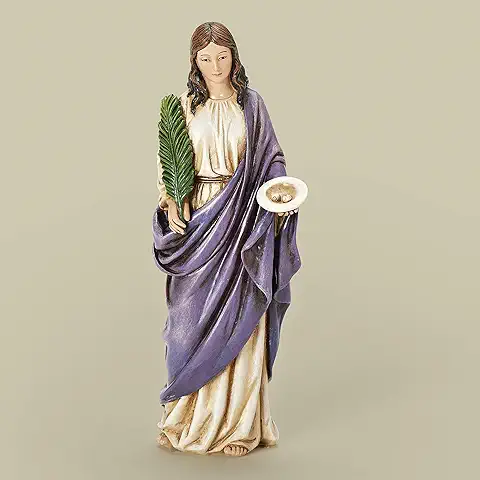
The image most people associate with Saint Lucy — a woman holding a dish containing two eyes — is one of the most striking and unforgettable images in all of Christian sacred art. Understanding where it comes from, and what it actually means theologically, is essential to understanding why she is the patron of the blind and all who suffer with their eyes.
The story of Lucy's eyes exists in two versions, neither of which appears in the earliest accounts of her martyrdom, but both of which became firmly established in medieval tradition and have been part of her veneration for over a thousand years.
Version One: The Eyes Torn Out by Her Persecutors
In the first version, which appears in medieval accounts and became the dominant tradition in Western art, Paschasius's soldiers gouged out Lucy's eyes as part of her torture before her execution. This version emphasizes her suffering as participation in Christ's Passion — the specific targeting of her eyes being understood as the persecutors' attempt to extinguish the very light that her name promised. In this version, God restored her eyes before her death, so that she died with her sight intact — a miracle that itself became part of her posthumous story.
Version Two: She Sent Her Own Eyes to Her Suitor
The second version is in some ways more theologically striking. In this tradition, the suitor who denounced Lucy had been particularly captivated by the beauty of her eyes — he admired them above all her features. When Lucy refused his advances, she cut out her own eyes and sent them to him on a dish, with the message asking to be left in peace. The theological logic of this act — an extreme but not entirely unprecedented form of voluntary disfigurement to preserve consecrated chastity — was understood as a radical enactment of Matthew 5:29: "If your right eye causes you to sin, pluck it out and cast it from you." In this version too, God restored her eyes completely, giving her back sight more beautiful than what she had surrendered.
What the Tradition Affirms Across Both Versions
Both versions agree on the central miraculous fact: Lucy's eyes were restored by God. Whether torn out by persecutors or surrendered voluntarily, she did not remain without sight. In the tradition of the early church, when her body was being prepared for burial, her eyes were found miraculously intact — restored as a divine sign of the reward awaiting those who surrendered even the most precious things for God's sake.
The theological architecture of Lucy's patronage of the blind and those with eye disease is beautifully coherent. She lost her eyes and God gave them back. This is not a metaphor. It is the specific, tangible, recorded content of her miracle. When a person with macular degeneration or cataracts or glaucoma prays to Saint Lucy, they are not asking a saint with a vague connection to vision to intercede for them. They are asking someone who has personally navigated the loss and restoration of sight — someone for whom the God who heals eyes is not an abstraction but a lived experience.
Lucy brings to her role as patron of eye conditions the only qualification that ultimately matters in intercessory prayer: she has been where the people who pray to her are. She knows what it is to lose the light. She knows what it is to have it restored. And she knows exactly who to ask.
Saint Lucy Prayer Card
Carry her intercession with you — or give it to someone whose eyes are failing and whose heart needs a reminder that light has never abandoned those who call upon it. Handcrafted Eastern Catholic and Orthodox sacred art, made for personal devotion, hospital rooms, and parish distribution.
Order the Prayer Card →Miracles After Her Death: Seventeen Centuries of Answered Prayers
Lucy's miracles did not end with her death. They multiplied. Her tomb in Syracuse became a place of pilgrimage within living memory of her martyrdom. Cures were reported from the earliest years of her veneration, particularly — though not exclusively — cures of eye conditions. The movement of her relics to new locations was invariably accompanied by new miracles at the places where they arrived.
The Syracuse Tradition
Syracuse itself became one of the most important pilgrimage destinations in early medieval Sicily specifically because of the miracles reported at Lucy's tomb. The catacomb where she was originally buried became a sacred site, and the church that grew up around it drew pilgrims from across the Mediterranean. Multiple miraculous healings of blindness and severe eye disease were reported there in the centuries following her death. The tradition of her intercession for eye conditions was so strongly established in Syracuse that she became, in effect, the city's primary medical intercessor for all conditions involving sight.
The Translation of Her Relics and New Miracles
In 1039, the Byzantine general George Maniaces transferred Lucy's relics from Syracuse to Constantinople — a move that was deeply controversial in Sicily and that the Syracusans never fully accepted. From Constantinople, her relics (or a significant portion of them) were later moved to Venice, where they were enshrined in the Church of San Geremia. Each translation was attended by miracles reported by those who came into contact with her remains. The Venetian tradition of her intercession developed its own rich history of cures, particularly of eye conditions and hemorrhages.
Her head relic, which remained in Syracuse, became the centerpiece of an annual procession that continues to this day — the feast day procession of her silver statue through the streets of Syracuse on December 13. The statue is said to have been miraculously preserved through multiple earthquakes and fires, and the procession itself is credited with protecting the city from harm.
Medieval Miracle Accounts
Medieval hagiographical accounts record numerous specific miracles attributed to Lucy's intercession. Among the most frequently reported were cures of blindness — both sudden, complete restoration of sight and gradual recovery from progressive vision loss — as well as healings of what contemporary medicine would recognize as hemorrhagic conditions, severe throat infections, and eye infections. The pattern of miracles attributed to her consistently mirrors her patronages: sight, blood, and voice, the three domains that her martyrdom specifically addressed.
The Jacobus de Voragine account in the Legenda Aurea (Golden Legend, c. 1260) — the most widely read collection of saints' lives in medieval Europe — describes Lucy as "a lamp giving light to the blind" and specifically names restoration of sight among her most frequently granted miracles. The Legenda Aurea was not merely popular reading; it was the devotional foundation of late medieval Catholic practice, and its description of Lucy shaped the prayers and expectations of millions of Christians for three centuries before the Reformation.
Modern Testimonies
The stream of miracles attributed to Lucy has not ceased. From the records at uCatholic and other devotional sites, contemporary accounts include a mother whose son was told at birth he would be permanently blind, who prayed to Lucy throughout his childhood — and who watched her son recover enough vision to attend college and graduate school, ultimately entering the seminary. Testimonies of improved vision after prayer to Lucy in cases of cataracts, severe dry eye disease, corneal damage, and macular degeneration appear regularly in Catholic devotional communities. These accounts are not scientifically verified miracles in the formal Catholic canonization sense — they are the living testimony of a community that has been praying to Lucy for eye conditions for seventeen centuries and continues to find her response.


All Her Patronages: The Complete List and Why Each One
Saint Lucy and Specific Eye Conditions: A Practical Guide to Praying for Healing
If you have come to this article because you or someone you love is facing a specific eye condition, this section is for you. Saint Lucy's patronage of eye disease is not generic. It has been applied to specific conditions by the faithful for seventeen centuries, and the prayers below reflect both the historical tradition and the practical needs of people facing the most common serious eye conditions today.
For Macular Degeneration (AMD)
Macular degeneration — the progressive deterioration of the macula, the central part of the retina responsible for sharp, detailed vision — is one of the most common causes of vision loss in adults over 50. Both the dry and wet forms, and the newer diagnoses of geographic atrophy and polypoidal choroidal vasculopathy, are conditions that people regularly bring to Saint Lucy. The specific aspect of Lucy's patronage that applies most directly is her experience of progressive loss — the gradual dimming that characterizes AMD mirrors the experience of those whose sight faded day by day in her story. Pray to her for: the slowing of progression, the success of anti-VEGF injections, the preservation of remaining vision, and the grace to live with diminished sight with faith and dignity.
For Cataracts
Cataracts — the clouding of the eye's natural lens — have a direct connection to the imagery of Lucy's miracle. The "white films" that covered Tobit's eyes in the Book of Tobit, healed by the archangel Raphael, are almost certainly cataracts (the Greek word leukoma describes exactly this condition), and Saint Lucy's own eye legend involves clouding and restoration. Those awaiting cataract surgery, those recovering from it, and those whose cataracts are not yet severe enough for surgery but progressive enough to affect daily life are all specifically within Lucy's care. Pray to her for: the success of surgery, smooth healing, clear vision post-operatively, and peace of mind in the waiting.
For Glaucoma
Glaucoma — the group of diseases involving damage to the optic nerve, most often associated with increased intraocular pressure — threatens peripheral vision first, gradually closing in toward the center. For those facing glaucoma, Lucy's patronage offers specific comfort: she is the saint whose own sight was under assault, and who stands before God interceding for those whose light is being narrowed from the edges. Pray to her for: stable intraocular pressure, the effectiveness of drops and surgical interventions, the preservation of the optic nerve, and the regular discipline of keeping medical appointments that glaucoma requires.
For Diabetic Retinopathy
Diabetic retinopathy — damage to the blood vessels of the retina caused by diabetes — is one of the leading causes of blindness in working-age adults. Its connection to hemorrhage (bleeding in the retina) links it specifically to Lucy's patronage on two fronts: her healing of her mother's hemorrhages and her patronage of all eye disease. Those managing diabetic retinopathy are dealing simultaneously with an eye condition and an underlying systemic disease, and Lucy's comprehensive patronage — including her ancient association with illness of the whole person — makes her an especially appropriate intercessor.
For Other Vision Conditions
Saint Lucy's patronage extends to every condition affecting vision: retinal detachment, optic neuritis, corneal disease, dry eye syndrome, uveitis, strabismus, amblyopia, and vision loss from stroke or traumatic brain injury. No eye condition is too specific or too obscure for her patronage — she is the saint set over all afflictions of sight, and every person whose vision is threatened is within the scope of her care.
A novena is nine days of prayer offered in preparation for a feast day or in urgent need. Saint Lucy's feast day is December 13, making December 4–12 the natural time for her novena. But you may begin a novena to Saint Lucy any time you feel the urgency of need — novenas do not require a feast day to be efficacious.
Each day for nine days: Light a candle if you are able (Lucy is the saint of light). Say the prayer below. Name the specific condition you are praying for — be specific, with details: the eye affected, the diagnosis, the treatment, the appointment you are praying will go well. Ask her intercession not only for healing but for peace, for the grace to face what you cannot change, and for the doctors treating you to have wisdom and skill. End by asking her to present your prayer before God as she presented the prayers of those she loved in life.
Every Historic Prayer to Saint Lucy: Catholic and Orthodox
The following prayers represent the full range of historic petitions addressed to Saint Lucy across both the Catholic and Eastern Orthodox traditions. They cover healing of eye disease, restoration of sight, spiritual clarity, protection against darkness of soul, and the general intercession of a martyr who stands permanently before God.
The Classic Catholic Prayer for Perfect Vision
This is the most widely used traditional prayer to Saint Lucy for eye conditions, found in Catholic prayer books from the medieval period through the present day:
O God, our Creator and Redeemer, mercifully hear our prayers. As we venerate your servant Saint Lucy for the light of faith you bestowed upon her, increase and preserve this same light in our souls, that we may be able to avoid evil, to do good, and to abhor nothing so much as the blindness and the darkness of evil and of sin.
Relying on your goodness, O God, we humbly ask you, through the intercession of your servant Saint Lucy, to give perfect vision to our eyes, that they may serve for your greater honor and glory and for the salvation of our souls in this world, that we may come to the enjoyment of your unfailing light of the Lamb of God in paradise.
Saint Lucy, virgin and martyr, hear our prayers and obtain our petitions. Amen.
The Prayer from the Roman Canon Tradition
Dear Sicilian Virgin and Martyr, whom the Church recalls in Eucharistic Prayer I, you valiantly rejected great promises and resisted several threats in remaining faithful to the Lord. You willingly accepted a most cruel martyrdom in order to win eternal life. Your name means light, and you received an even greater light through martyrdom — the light of Heaven itself.
Enable us to walk always as children of the light — the light of faith in our minds, the light of God's law in our actions, and the light of love in our hearts. Help us to come to that eternal light where you now dwell forever. Amen.
— From the Tradition of the Roman Canon (Eucharistic Prayer I)Prayer for Spiritual and Physical Sight Together
This prayer addresses both the physical and spiritual dimensions of Lucy's patronage — recognizing that blindness of the soul (inability to see God's will, truth, beauty) is as serious as blindness of the body:
Saint Lucy, you did not hide your light under a basket, but let it shine for the whole world, for all the centuries to see. We may not suffer torture in our lives the way you did, but we are still called to let the light of our faith illumine our daily lives.
I ask for your intercession for my eyes — these physical eyes that are failing, that are clouding, that are dimming. I ask you to carry my need before the throne of the God who restored your own sight. I also ask for the eyes of my soul: help me to see clearly what God is calling me to, help me to see the truth in situations where I am confused, help me to see the image of Christ in the people around me.
You were the one who saw through the darkness of the Diocletianic Persecution to the freedom that was coming. Help me to see through whatever darkness I am in right now — physical or spiritual — to the light that is always on the other side of it. Amen.
Eastern Orthodox Troparion for Saint Lucy (Tone 4)
Your lamb Lucy calls out to You, O Jesus, with a loud voice: I love You, my Bridegroom, and in seeking You I endure suffering. In baptism I was crucified so that I might reign in You, and I died so that I might live with You. Accept me as a pure sacrifice, for I have offered myself with love. Through her intercessions save our souls, as You are merciful.
— Eastern Orthodox Church, Troparion for Saint Lucy, Tone 4Short Prayers for Daily Use — For Those with Eye Disease
These brief prayers are designed to be used throughout the day — when taking eye drops, before looking at screens, at medical appointments, when light is painful, or when the fear of vision loss is most acute:
Saint Lucy, Bringer of Light, pray for my eyes. Amen.
Saint Lucy, patron of all who suffer with their sight, carry my need to God today. Amen.
Saint Lucy, you know what it is to lose the light and have it restored. Stand with me before the God who gave it back to you. Amen.
Saint Lucy, I am afraid of the darkness that is coming for my eyes. Teach me to trust the God of light who loved you through your own darkness. Amen.
Novena Prayer to Saint Lucy (Nine Days)
Saint Lucy, glorious virgin and martyr, you bore the name of light and let that light shine until the world could not put it out. You suffered the loss of your eyes and received them back from God. You were tortured for your faith and you did not break. You prophesied truth before the powers of the world and they came to pass.
I come to you in my need: (state your specific eye condition, the name of the person you are praying for, and any specific intention — an upcoming surgery, a medical appointment, a particular fear).
I ask you to bring this before God as you once brought the prayers of those you loved. You told Tobias's God — through Raphael — to heal what was broken. Ask the same God now to heal what is broken in me, or in the one I love. And if healing is not given, ask for the grace to carry what I am carrying without losing my faith in the light.
O God, hear the prayers of your martyr Lucy. As you restored her sight, restore what is lost in us. As you gave her the courage to stand in the darkness without fearing it, give us that courage too. We ask this through Christ our Lord, who is the Light of the world. Amen.
Saint Lucy, virgin and martyr, hear our prayers and obtain our petitions.

Feast Day Traditions Around the World
| Tradition / Location | Date | How It Is Celebrated |
|---|---|---|
| Roman Catholic Church | December 13 | Memorial feast day. Mass in her honor. Special prayers for those with eye disease. One of the few pre-Nicene martyrs whose name is retained in the modern Roman Calendar. |
| Eastern Orthodox Church | December 13 | Feast of the Holy Virgin-Martyr Lucia of Syracuse. Troparion, kontakion, and canon chanted. Venerated across Greek, Russian, Serbian, and other Orthodox traditions as a pre-schism martyr of the undivided Church. |
| Syracuse, Sicily | December 13 | The most spectacular celebration in the world. Lucy's silver statue is carried through the streets in a grand candlelit procession attended by thousands. The procession traces the route of her martyrdom. Her relics in the church of Santa Lucia al Sepolcro are exposed for veneration. The city shuts down for its most beloved saint. |
| Sweden, Norway, Denmark, Finland | December 13 | Sankta Lucia Day — one of the most beloved cultural and religious celebrations in Scandinavia. A young girl chosen to represent Lucia wears a white gown with a red sash and a crown of candles, leading a procession and bringing light, saffron buns (lussekatter), and gingerbread to her community. The tradition combines Christian devotion with ancient Nordic winter solstice celebration. |
| Venice, Italy | December 13 | Venice, which holds significant Lucy relics in the Church of San Geremia, celebrates with Masses and the exposition of relics. The church was built specifically to house her remains when they were brought from Constantinople. |
| Lutheran Church | December 13 | Saint Lucy is commemorated in many Lutheran traditions, particularly in Sweden and Germany, where the pre-Reformation devotion to her remains culturally significant. Lutheran celebrations often retain the candlelight procession traditions. |
| Anglican / Episcopal Church | December 13 | Commemorated in the Church of England and Episcopal Church calendars. Some Anglican traditions retain Lucia processions, particularly in parishes with Scandinavian cultural heritage. |
Her Symbols and How to Recognize Her in Sacred Art
Saint Lucy is one of the most instantly recognizable figures in Christian sacred art. Her iconographic attributes are so distinctive and so consistently used across seventeen centuries of Western and Eastern art that she is virtually impossible to confuse with any other saint.
Eyes on a Golden Dish
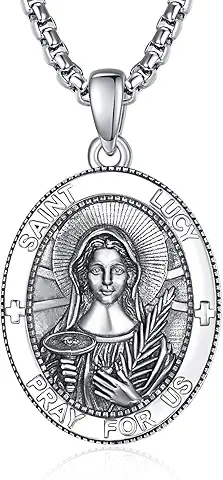
Her most famous attribute — two eyes resting on a gold plate or dish — appears in virtually every artistic depiction of her from the medieval period onward. It is the visual shorthand for her story, her martyrdom, and her patronage. Some artists show her holding the dish in her hands; others place it on a surface before her. The eyes are typically depicted as intact and serene — not horrifying but luminous, as if the light that left them is already being restored. When you see this image, you are in the presence of Lucy.
The Palm Branch
Like all martyrs, Lucy is depicted holding a palm branch — the ancient symbol of victory over death, of triumph through suffering. The palm says: this woman won. She was killed; she was not defeated.
The Crown of Candles
Particularly in Scandinavian art and in modern popular imagery, Lucy is shown wearing a crown of lit candles on her head. This imagery comes from the tradition of Lucy carrying food to Christians hiding in the Roman catacombs — unable to carry a torch because she needed both hands for the food, she wore a crown of candles on her head for light. Whether historical or legendary, the image is powerful: the saint of light literally wearing light, walking into the darkness with her hands full of gifts for those who are suffering.
The Sword at Her Throat
Many depictions show a sword piercing Lucy's neck — the instrument of her final martyrdom. This detail, while severe, is theologically important: it shows the wound that could not silence her. The sword is in her throat; she is still speaking. The Word cannot be killed.
The Lamp
An oil lamp or single candle appears in many older iconographic depictions of Lucy, particularly in Eastern Orthodox icons. The lamp references both her name (light) and her role as an intercessor who brings the light of Christ's healing to those in the darkness of illness and suffering.
Saint Lucy in Dante's Divine Comedy: The Messenger of Mercy
One of the most unexpected and illuminating testimonies to Lucy's significance in medieval Christian piety comes from an entirely unexpected source: Dante Alighieri's Divine Comedy, written between 1308 and 1321 and widely considered the greatest poem in the Italian language.
In the Inferno, Canto II, Dante is paralyzed with fear and unable to begin his journey through Hell. Virgil explains to him the chain of mercy that has been set in motion on his behalf: the Virgin Mary, moved with compassion for Dante, summoned Beatrice to help him. Beatrice came to Virgil in Limbo. But the key intermediary in this chain — the saint who was sent to Beatrice by Mary, who then went to Beatrice and moved her to act — was Lucy. Dante calls her "enemy of all cruelty," nimica di ciascun crudele. She is explicitly the agent of divine mercy set in motion by the Queen of Heaven.
Lucy appears again in the Purgatorio — she carries the sleeping Dante up the mountain of purgatory, an act of physical care that parallels her role in carrying prayers before God. And in the Paradiso, she appears in the celestial Rose, seated directly below the Virgin Mary, in one of the highest places of honor in all of Heaven.
Scholars debate the precise reasons for Dante's devotion to Lucy. The most compelling explanation is personal: Dante suffered from a serious eye ailment in his youth, which caused him to temporarily lose his vision. He attributed his recovery to Lucy's intercession. The entire theological architecture of his greatest poem — the journey from darkness into light — was made possible, in Dante's personal understanding, by the saint who carried him through his own darkness and restored his sight.
Further Reading: Books on Saint Lucy and the Healing Saints
Saint Lucy Prayer Cards for Your Parish
Give someone whose eyes are failing a reason to hope. Our handcrafted Eastern Catholic and Orthodox Saint Lucy prayer cards are ideal for hospital visits, parish distribution, eye surgery waiting rooms, and anyone walking through the darkness of vision loss who needs to know that the Light is listening.
Order Bulk Prayer Cards for Your Parish →Questions About Saint Lucy
The Light Has Never Gone Out
When the soldier drove his sword into Lucy's throat on December 13, 304 AD, he must have thought that was the end of it. He was wrong by seventeen centuries and counting. The young woman from Syracuse who gave away her dowry, who stood immovable before Roman soldiers, who continued speaking in the fire and through the wound — she is still speaking. Still carrying prayers. Still standing before God asking for light to be given to those in darkness.
If your eyes are failing, if someone you love is losing their sight, if you are afraid of the darkness that is coming — call on her. Her name is light. And light, however long the night, does not disappear. It waits to be called.
Saint Lucy, virgin and martyr, hear our prayers and obtain our petitions. Amen.
As an Amazon Associate, The Eastern Church earns from qualifying purchases.