Why Did God Create Humanity? A Theological Contemplation Through Scripture, the Fathers, and the Mystical Tradition
Scripture • Patristics • Scholasticism • Eastern Mysticism • The Full Answer
Why Did God Create Humanity? A Theological Contemplation Through Scripture, the Fathers, and the Mystical Tradition
This is one person's attempt to piece together what the tradition suggests — not a settled answer, not official doctrine, but a contemplation worth sitting with. It may be wrong in places. Read it as an invitation to think, not a claim to have arrived.
(Aquinas)
The question most people answer in thirty seconds deserves thirty centuries of attention. Why did God create humanity? The Sunday school answer — "to know, love, and serve God" — is true. The catechetical answer — "for union with God" — is truer. But there are threads in the tradition — things Augustine and Anselm and Aquinas and Maximus actually wrote — that most people have never encountered, and that complicate and deepen the answer in ways worth sitting with carefully.
What follows is a personal attempt to trace those threads. It draws heavily on patristic and scholastic sources, and it tries to represent them accurately. But it is also an act of theological contemplation, not a pronouncement of doctrine. There are places where the tradition is clear; there are places where I am reading between the lines or connecting dots that may not be as connected as they seem. The questions this article raises are worth raising even if the answers it proposes turn out to be partially or substantially wrong.
With that caveat held firmly in mind: here is what the tradition seems to be reaching toward — and why it is larger and stranger and more beautiful than the short answer suggests.
The Instinct Most People Have — and What the Tradition Might Be Saying About It
Many people, when they think seriously about human creation, arrive at an instinct they cannot quite articulate. It goes something like this: There is something about where humanity fits in the cosmic order that has to do with the angels who fell. The places they left behind — the roles they refused — somehow belong to us now. That is part of why we are here.
Most people who have this instinct dismiss it as unscholarly, over-literal, or theologically naive. What I found when I started digging is that this instinct appears — in some form — in Augustine, Gregory the Great, Anselm, and Aquinas. That does not make it correct, and it does not mean those authors are all saying the same thing. But it does mean the instinct is worth taking seriously rather than dismissing as folk belief. This article is an attempt to trace what those sources actually say and to think about whether and how the pieces fit together.
Here is the caveat I want to hold throughout: this is personal theological reflection. I am not a credentialed theologian, and I am reading these sources as carefully as I can but undoubtedly missing things. If you find errors or overclaims in what follows, please push back — that is exactly the kind of engagement this deserves.
The thread I am following is this: the tradition seems to suggest that God created humanity with full foreknowledge of all that would happen, and designed human existence as a unique mode of participation in divine life that proceeds through faith, struggle, and grace. Several major theologians seem to suggest that redeemed humanity is taken up into the angelic orders themselves (Aquinas, ST I.108.8), and that this somehow fulfills both humanity's own purpose and something left incomplete by the angelic fall.
I am not claiming this is the official Catholic or Orthodox position. I am not claiming this is certainly true. I am claiming it is a thread worth following — a contemplative possibility that the sources seem to support, and that changes the way I think about my own existence when I sit with it.
What the Fathers Actually Teach: Gregory the Great and the Numbered Citizens of Heaven
Gregory the Great (540–604) — Pope, Doctor of the Church, one of the four great Latin Fathers — preached a homily on the parable of the lost sheep (Luke 15:4–7) that became foundational to the medieval theological tradition on human creation. Gregory reads the ninety-nine sheep left on the mountain as the angels, and the one lost sheep as humanity. When the shepherd returns with the found sheep, he restores the perfect number.
The homily makes a claim that Gregory treats not as speculation but as straightforward reading of the scriptural record: the heavenly city has a specific number of citizens, that number was reduced by the fall of the rebel angels, and humanity was created so that the lost number might be restored and the heavenly fellowship made complete. Gregory preaches this in the context of eucharistic worship, to ordinary Roman Christians, as the self-evident meaning of the parable. He does not treat it as a difficult theological thesis requiring defense. He treats it as what everyone already knows.
This tells us something important about how deep this teaching goes. By the late 6th century, it was not a scholastic proposition but a presupposition of Christian piety — the kind of thing a pope preaches to laypeople on a Sunday morning because he assumes they already believe it. The tradition had established it as standard well before Gregory articulated it in its fullest form.
What "The Heavenly City Has a Specific Number" Actually Means
Gregory's teaching, and the entire strand of tradition it represents, rests on a cluster of scriptural texts that the Fathers read together: Wisdom 11:20 ("Thou hast ordered all things in measure and number and weight"), Deuteronomy 32:8 (the LXX reading: "He set the boundaries of the peoples according to the number of the angels of God"), and the various New Testament texts about a specific number of the elect. The reading these texts together produces is: the heavenly community has a definite size, known to God from before creation, and history moves toward the completion of that number.
This is not a teaching about predestination in the narrow, controversial sense. It is a teaching about the ordered beauty of God's creative intention. God does not create randomly or wastefully. He creates toward a fullness — a pleroma, to use the Greek of Ephesians — that was always intended, always foreseen, and always being drawn toward completion by every event in history, including the falls, the redemptions, and the deifications that follow.
Augustine of Hippo: Perhaps the Most Direct Statement in the Tradition
Augustine of Hippo (354–430) is among the most important theologians in the Latin tradition, and his statements on this question are — as best I can tell — among the most direct in the patristic corpus. Here is what he actually wrote, as precisely as I can represent it:
"It pleased God that the angels who fell should not be entirely lost, but that a portion [of humanity] would be restored and would fill up the loss which that diabolical disaster had caused in the angelic society."
Notice what Augustine is and is not saying. He is not saying that God was surprised by the fall of the angels and then improvised humanity as a solution. He is saying that God's pleasure — His eternal will — included humanity restoring and completing the heavenly society. The fall is incorporated into the plan, not a deviation from it. "It pleased God" is the language of eternal decree, not emergency response.
"The things which are in heaven are gathered together when what was lost therefrom in the fall of the angels is restored from among men; and the things which are on earth are gathered together, when those who are predestined to eternal life are redeemed from their corruption."
Here Augustine is explicitly commenting on Ephesians 1:10 — Paul's teaching that all things in heaven and on earth are gathered together (ἀνακεφαλαιώσασθαι) in Christ. Augustine reads the "things in heaven" as a direct reference to what was lost through the angelic fall and restored through humanity. He is not inventing this connection — he is following a reading of Ephesians 1:10 that goes back through the tradition to Irenaeus of Lyon, who made this gathering-together (recapitulation) the organizing principle of his entire theological system.
Augustine's "One Society" Teaching
One further dimension of Augustine's teaching is crucial and often overlooked. When Augustine describes humanity filling the places of fallen angels, he is not describing two separate societies — angels over here, humans filling in over there. He is describing the single heavenly city, the one eternal community, the City of God — and he is saying that its membership includes both unfallen angels and redeemed humans, who together constitute one body of the blessed. In City of God XII.9 (cited by Aquinas), Augustine writes: "there will not be two societies of men and angels, but only one; because the beatitude of all is to cleave to God alone."
This is the framework that makes everything else cohere. There are not angelic slots and human slots. There is one heavenly society, one communion of the blessed, and it was always designed to include both angels and humans — with the specific membership shaped by God's eternal foreknowledge of the entire drama of creation, fall, redemption, and glorification.


Anselm of Canterbury: The "Both/And" That Changes Everything
Anselm of Canterbury (1033–1109) — Archbishop, Doctor of the Church, one of the most precise theological minds in history — addresses the question of why humans were created with a characteristic analytical rigor in Cur Deus Homo (Why God Became Man), one of the most important theological works of the medieval period. His treatment of the question in chapters 16 through 18 of the first book is a masterclass in how to hold two truths together without letting either one swallow the other.
Anselm poses the question structurally. Either the original number of angels was complete — in which case humans exist to fill the places of the fallen — or the original number was incomplete, and humanity was always destined to complete a number that was never yet full. He explicitly prefers the second option, and for a reason that strengthens rather than weakens the connection to the angelic fall:
Read this carefully. Anselm is not pushing back against Augustine's "filling" teaching. He is not saying "no, humans don't fill the places of fallen angels." He is saying yes, and more than that. Humans fill what was lost AND complete what was always intended to be a fuller number. The angelic fall is incorporated into a larger design that was always moving toward a specific fullness that would include humanity.
Why Anselm's "Both/And" Is the Crucial Refinement
The practical implication of Anselm's position is significant for how we understand our own dignity. If humans exist only to replace the fallen angels, there is a contingent quality to human existence that feels uncomfortable — as if we are the second choice, the backup plan, called in when the original players walked off. Anselm refuses this reading. The number that humanity completes was never completely filled by angels alone. There was always a human-shaped space in the heavenly fullness — not merely the space left by Lucifer and his company, but the space that God had always designed for creatures who would love Him through the experience of time, body, and faith.
Human existence is not reactive to angelic failure. It is the fulfillment of an intention that was older than any angel's choice — an intention that God carried in Himself before anything was made.
Thomas Aquinas: A Text Worth Sitting With Carefully
There is a passage in the Summa Theologiae that I keep returning to, and that I have not seen widely discussed in popular theology despite being quite direct. Whether I am reading it correctly, I am genuinely uncertain — but it seems important enough to lay out in full and let you judge for yourself.
It is in Part I, Question 108, Article 8. The title, in Latin, is Utrum homines assumantur ad ordines angelorum: "Whether men are taken up into the angelic orders." The answer Aquinas gives, as far as I can tell, is unambiguous:
Aquinas writes: "By the gift of grace men can merit glory in such a degree as to be equal to the angels, in each of the angelic grades; and this implies that men are taken up into the orders of the angels."
He then cites Augustine (City of God XII.9): "there will not be two societies of men and angels, but only one; because the beatitude of all is to cleave to God alone."
The full weight of this teaching should settle on you slowly. Thomas Aquinas — the Angelic Doctor, the greatest systematic theologian in the Catholic tradition — is not saying that humans become vaguely "angellike" or "angelic" in heaven. He is saying that humans are taken up into the orders of the angels themselves. Into them. Not beside them — into them. And not just into the lower ranks: "in each of the angelic grades." Seraphim, Cherubim, Thrones, Dominations, Virtues, Powers, Principalities, Archangels, Angels — every grade can include human beings who by grace have merited that level of glory.
I want to be careful about how much weight I put on this. Aquinas is writing systematic theology, not defining dogma, and "men are taken up into the angelic orders" may mean something more technical than it sounds in a casual reading. But the text is there, in the Prima Pars, and it seems genuinely to be saying that humans by grace can occupy every grade of the angelic hierarchy. That is worth thinking about carefully.
What "Taken Up Into the Angelic Orders" Actually Means
In Aquinas's cosmology, the angelic hierarchy is not simply a list of powerful beings. It is a structured participation in the divine governance of creation. Each order has its specific office and relationship to God and to the created world. The highest hierarchy (Seraphim, Cherubim, Thrones) is oriented most immediately to God Himself. The middle hierarchy (Dominations, Virtues, Powers) governs the general administration of creation. The lowest hierarchy (Principalities, Archangels, Angels) is most immediately oriented toward humanity — guarding, guiding, ministering to human persons in their journey to God.
When Aquinas says humans are taken up into these orders, he is saying that redeemed humans enter into these very relationships — the direct contemplation of God at the highest levels, the participation in divine governance at the middle levels, and the ministry to others at the lower levels. The eschatological human being is not a spectator of the angelic order. They are a member of it, functioning within it, contributing to the life of the one heavenly city that Augustine described.
Aquinas on Love Above Knowledge — The Hidden Key
There is a second passage in the same section of the Summa that most people miss, and it is the intellectual key that unlocks the question of how humans contribute something irreplaceable to the heavenly order. In Summa Theologiae I.108.6, responding to the question of why love (Seraphim) ranks above knowledge (Cherubim), Aquinas writes:
The Angelic Doctor is explicitly teaching that love of God is greater than knowledge of God. This is the scholastic anchor for something the entire Eastern mystical tradition had been saying for centuries: the path to God that moves through love — through surrender, through self-gift, through the burning away of everything that is not God — is higher than the path that moves through pure intellect. Angels know God directly. Humans love God through faith. And love, in Aquinas's own hierarchy, is higher than knowledge.

Not Reactive Creation: Why the "Backup Plan" Objection Fails
At this point, a serious theological objection must be addressed — and addressed directly, because it is the one objection that initially seems to undermine the entire tradition we have been tracing. The objection is this: If God created humanity to fill the places left by fallen angels, does that not make human creation reactive? Does it not mean we are God's Plan B — the backup when Plan A (the angels) failed?
The answer, unequivocally, is no. And the reason comes not from dismissing the question but from understanding what the tradition actually means when it talks about God's foreknowledge in relation to creation.
The Distinction That Dissolves the Objection
The objection assumes two possible scenarios: either God had no idea the angels would fall and scrambled to adjust (reactive), or God knew exactly what would happen and designed the whole tapestry around it (foreknown). The tradition affirms the second, without qualification, and has done so since Augustine. The fall of the angels is not a problem that arrived and surprised God. It is an event that God foreknew before He made the first angel — and within which He foreknew the entire subsequent drama of human creation, fall, redemption, and theosis.
Augustine anchors this in Wisdom 11:20 — "Thou hast ordered all things in measure and number and weight" — and applies it directly in Enchiridion 29: the number of those who would fill the heavenly city "is known to the mind of the Maker, who calleth into existence things which are not, as though they were." The number was always known. The design was always complete. What looks to us like sequence — angels created, angels fall, humans created, humans fill the gap — is, from God's perspective, a single unified act of creative will that intended the final result from before any intermediate step.
A weaver designing a tapestry knows from the beginning what the finished image will look like. The individual threads do not know this — they are laid in sequence, one after another. Looking at the tapestry from the back, you see nothing but a confused tangle of threads crossing each other. But the weaver, who sees the design from above, is always weaving toward the finished image. The angelic fall, the human creation, the Fall, the Incarnation, the Redemption, the eschatological completion — these are not a sequence of problems and solutions. They are threads in a tapestry whose final image was always the same: the fullness of the heavenly city, centered on the Incarnate Christ, comprising unfallen angels and deified humans in one eternal communion.
Reactive creation is creation that didn't know what it was making. The tradition insists that God always knew. Which means humanity was never Plan B.
Blessed John Duns Scotus and the Absolute Primacy of Christ
The foreknowledge argument above clears the space for the most theologically profound answer to our question — an answer that does not merely defend against the "reactive creation" objection but positively reframes the entire question. It comes from the Franciscan school, culminating in Blessed John Duns Scotus (d. 1308), beatified by John Paul II in 1993, whose teaching has been explicitly affirmed as a legitimate theological position by Paul VI and Benedict XVI.
The Scotist thesis can be stated simply: the Incarnation of Christ was the primary and absolute purpose of creation, not a response to sin.
Scotus's argument runs as follows. God wills things in a specific order of greatness. The greatest possible created work — the highest thing God could will outside Himself — is the hypostatic union: God becoming man, the infinite taking on finite human nature without ceasing to be infinite. Therefore, Christ the God-Man was the first object of God's creative will. Everything else — the creation of angels, the creation of humans, the permission of the Fall, the entire economy of redemption — was willed in service of that first and supreme intention. The Fall did not cause the Incarnation. The Incarnation was always coming; the Fall only shaped its specific character as redemptive.
The Remarkable Convergence of East and West
What makes this theologically astonishing is that the Eastern tradition arrived at precisely the same conclusion from entirely different starting premises. Fr. Georges Florovsky — perhaps the greatest Orthodox theologian of the 20th century — demonstrated in his landmark essay "Cur Deus Homo? The Motive of the Incarnation" that Maximus the Confessor, writing in the 7th century and drawing on the entire Greek patristic tradition, taught exactly this: the Incarnation is the primary purpose of creation, and the Fall is permitted within that organizing intention, not the cause of it.
The agreement between the Scotist West and the Maximian East on this point is one of the most significant convergences in the entire history of Christian theology. East and West, separated by centuries and theological idiom, reached the same conclusion: Christ is the reason for creation. Angels exist for Christ. Humans exist for Christ. The entire cosmos exists for the one supreme event of God becoming flesh in Jesus of Nazareth.
For the question "Why did God create humanity?", the Scotist-Maximian answer is the fullest and most coherent one available: humanity exists to participate in the mystery of the Incarnation — to be united with Christ through theosis, to become what He is by grace as He became what we are by nature. The angelic hierarchy, the fall, the redemption, the eschatological fullness — all of it exists as the setting for this supreme exchange.
Faith vs. Sight: Why Human Love Is Qualitatively Different from Angelic Love
We come now to the most existentially powerful dimension of this question — the one that transforms it from a speculative theological puzzle into something deeply personal. It is the question of why the specifically human mode of loving God matters, what makes it irreplaceable, and why the tradition insists that humans bring something to the eternal community that angels — for all their splendor, their direct vision of God, their perfect knowledge and unstained love — cannot provide.
The key is in a pair of phrases from 1 Peter. The first comes from 1 Peter 1:8: "having not seen, you love him; though you do not now see him, you believe in him and rejoice with joy inexpressible and filled with glory." The second comes from 1 Peter 1:12, describing the gospel: "things into which angels long to look" (εἰς ἃ ἐπιθυμοῦσιν ἄγγελοι παρακύψαι).
Read together, these two verses make a single claim: there is a form of love for God that the angels long to understand but cannot themselves experience — the love of one who has not seen God directly, who walks by faith rather than sight, who loves a God who remains hidden from mortal eyes, and who loves Him with a "joy inexpressible and filled with glory." The angels look at this from the outside, marveling. They can watch it; they can minister to it; they can witness it with astonishment. But they cannot do it. They never had to.
What "Walking by Faith Not by Sight" Actually Means for Human Dignity
Paul's teaching in 2 Corinthians 5:7 — "for we walk by faith, not by sight" — is usually read as a description of a limitation: we can't see God directly, so we make do with faith. The patristic tradition reads it differently. It reads it as a description of a unique mode of participation in God — one that is not inferior to the angelic mode of direct vision but is qualitatively distinct from it, and in a specific sense more costly and therefore more revelatory of love.
Consider: a person who gives everything for someone they have seen face-to-face, who knows that person's love directly and receives constant reassurance of it, is doing something admirable. A person who gives everything for someone they have never seen, who believes in that person's love entirely on the basis of testimony and inner conviction and the experience of grace, who faces years of darkness, temptation, struggle, and doubt without ever receiving the direct vision that would settle all questions — and who loves through all of that — is doing something categorically different. The love of the second person has a depth that the first cannot quite replicate, because it is love tested by the full weight of hiddenness.
This is what Peter means when he says the angels "long to look" into the things of the gospel. They see redemption from the outside: a beautiful and astounding mystery, the greatest event in cosmic history. But they have never been redeemed. They have never been in the darkness and found it lit from within by a God they could not see. They have never experienced forgiveness, or the flood of joy that comes after repentance, or the way a life rebuilt on grace has a quality of gratitude that makes even ordinary things luminous.
Angels love God through direct knowledge. They have seen God face-to-face in the beatific vision. Their love is immediate, pure, and perfect — and it was settled in the first instant of their existence when they made their eternal choice. They have known nothing else since.
Humans love God through faith. They love a God who remains hidden, who speaks through Scripture and sacrament and prayer but rarely through direct vision, who seems absent in the darkest hours precisely when He is most present. They love through doubt, through failure, through repentance and repair, through the long accumulation of a life that is slowly shaped by grace into something that looks more and more like the image it was made in.
These are not the same kind of love. The tradition does not say human love is better than angelic love in an absolute sense. It says that human love is qualitatively distinct — that it generates a form of participation in God that emerges from the specific conditions of time, body, struggle, and grace, and that this form of participation was always intended as part of the eternal fullness of the heavenly community.
The Gift No Angel Can Give
There is one further asymmetry that the tradition notes and that deepens the human dignity enormously. Angels, when they made their eternal choice, made it once and irrevocably. There was no repentance after the fall of Lucifer, and there was no second chance to fall for the angels who stood firm. The drama of the angelic decision was over in a single instant.
Humans can fall and be raised. They can fall and be raised again. They can sin and repent and sin and repent and repent more deeply and love more fiercely precisely because they have had to fight for every inch of their love for God. The entire edifice of ascetic theology — the Philokalia, the hesychast tradition, the Desert Fathers — is built on this asymmetry: the struggle with the passions, the experience of failure and recovery, the way that a soul tempted and returned is stronger and more supple and more deeply rooted in God than one that never faced the fire. This is not a weakness of human nature. It is the mechanism by which the uniquely human form of love for God is forged.
Evagrius Ponticus, Hesychasm, and the Three Stages of the Long Road to God
Evagrius Ponticus (346–399) — monastic theologian, disciple of the Cappadocian Fathers, systematizer of Desert Father wisdom — constructed the most enduring theological map of the human path to God in the entire Eastern tradition. It has three stages, and its architecture is directly relevant to our question about why God made humanity.
The first stage is praktikē: the active life of ascetic struggle — combat with the passions, the demons, the ingrained habits of sin that weigh down the soul and keep it from God. The second stage is physikē: natural contemplation, the ability to see through created things to the divine logoi (rational principles) that God has placed within them, perceiving creation as a transparent window onto the Creator. The third stage is theologia: direct contemplation of the Holy Trinity — the pure, simple, unmediated vision of God that is the goal of the entire journey.
What matters for our question is the architecture of this path. Angels enter immediately, or very nearly so, into the second and third stages. They were never subject to the passions. They were not created with the tendency toward sin and disorder that the human person carries from the first moment of conscious experience. They did not need praktikē — did not need to spend years or decades or a lifetime fighting their way through the tangle of disordered desire before they could begin to see clearly.
Humans do need it. And the tradition insists that this need is not merely a deficiency to be overcome — it is the structure through which the uniquely human love of God is produced. A person who has reached theologia after twenty years of praktikē, who has fought through depression and temptation and long stretches of spiritual aridity and the dark night of the soul, who has come to God carrying all of that — arrives with a love that is shaped by everything they had to surrender to get there. This is not nothing. The tradition says it is something the angels can only marvel at.
Evagrius uses the word isangelos — "equal to the angels" — drawn from Jesus's own words in Luke 20:36, to describe the monk who has attained true prayer. But notice what this means. Humans become equal to angels through a process. Angels were equal to angels from the start. The equality of the destination is the same; the journey to reach it is entirely different — and the journey is what shapes the specific character of human love for God.
This strand runs through the entire Philokalic tradition. Diadochus of Photike, Maximus the Confessor, John Climacus, Symeon the New Theologian, Gregory Palamas — every major figure in the hesychast stream — retains this emphasis. Deification is attained through struggle, and that struggle is not a regrettable accident of human weakness. It is the crucible in which the specifically human mode of participating in God is formed. The Philokalia is, among other things, a record of what that struggle looks like in practice — and a demonstration that what comes through it is something irreplaceable in the eternal order.
Maximus the Confessor: The Incarnation as the Reason for Everything
Maximus the Confessor (580–662) is the single most important theologian for understanding the Eastern Christian answer to our question. He is the mind that synthesized the entire Greek patristic tradition — drawing on Irenaeus, Athanasius, the Cappadocians, Cyril of Alexandria, and Pseudo-Dionysius — and produced a theological vision of breathtaking coherence and depth. His answer to why God created humanity is embedded in his answer to an even deeper question: why did God become man?
"The blessed end for which all things were brought into existence" is the Incarnation of Christ. It is "the divine purpose conceived before the beginning of beings" — the "preconceived goal for the sake of which everything exists." The Incarnation is not the solution to a problem. It is the reason everything was made.
From this starting point, Maximus constructs an account of human creation that is simultaneously cosmological, Christological, and anthropological. Humanity was not an afterthought or a supplement to the angelic order. Humanity was created to do something that only a body-soul composite creature could do: to serve as the cosmic mediator between all the divisions in creation.
The Five Divisions and the Human Vocation
In Ambiguum 41, Maximus describes five divisions that run through created reality and that humanity was made to heal: the division between male and female; between paradise and the inhabited world; between heaven and earth; between the intelligible (spiritual) and the sensible (material) orders; and between the uncreated God and the created cosmos. The primal Adam was supposed to unite all five of these divisions in himself and offer creation — the whole cosmos, gathered and healed — back to God as a living liturgy of thanksgiving and love.
After the Fall, this mediation becomes possible only through Christ the God-Man. But the goal remains the same. The human vocation — to gather creation and offer it to God, to be the meeting point of the material and the spiritual, the finite and the infinite — is not cancelled by sin. It is made possible in a new and more astonishing way: through the Incarnation of the Second Person of the Trinity in a human nature, which means that the One who performs the supreme act of cosmic mediation does so in our flesh.
Maximus gives us the framework that makes everything else cohere. If the Incarnation is the reason for creation, then humanity exists in order to be the vessel of the Incarnation — the kind of creature in whom God could become man. Angels are pure spirits. God did not become an angel. He became a human being. This is the theological fact that gives redeemed humanity an unprecedented position in the eternal order: we are the species whose nature the Son of God took upon Himself and carries forever.
The filling of lost angelic places, the completion of the heavenly fullness, the taking up of humans into the angelic orders — these are all consequences of something larger: the fact that the Incarnation happened in a human nature, and therefore the eternal bond between God and humanity, sealed in the hypostatic union, gives redeemed humanity a participation in divine life that proceeds through Christ in a way that is uniquely ours.


Gregory Palamas and the Unique Dignity of the Embodied Human Person
Gregory Palamas (1296–1359) — Archbishop of Thessaloniki, one of the greatest theologians in the Eastern Orthodox tradition, canonized within a decade of his death — develops the implications of the Maximian theology in ways that are directly relevant to our question. His specific contribution is a theology of the human body that gives embodied human existence a dignity in the eternal order that pure spirits — the angels — cannot replicate.
The heart of Palamas's anthropology is his argument that humans, because they are body-soul composites, bear the image of God more fully in a certain respect than the angels do. His reasons are carefully argued, not asserted:
| Palamas's Argument | Why It Matters for Human Dignity |
|---|---|
| The human soul exercises a vivifying power over the body, animating and governing it from within | This mirrors the way God animates and governs creation — a relationship that has no angelic parallel, since angels have no body to govern |
| Humans possess sense perception — the ability to know God through the created material world | This is a real faculty for encountering the divine, not a limitation to be transcended. Creation is not a veil; it is a window |
| Human self-governance integrates body, soul, nous, logos, will, and heart in a unified person | This complex integration mirrors, at the creaturely level, the divine governance of the created order |
| Because humans are composites, they can be deified in their entirety — body and soul together | This total deification images the Incarnation itself, in which God took on a complete human nature, body and soul |
Palamas's most important contribution is his insistence that the body is not a lower or less important part of the human person that gets dragged along reluctantly into theosis. The body is the site of theosis — the place where the uncreated energies of God visibly manifest in the deified person. This is what happened at the Transfiguration: the Apostles saw uncreated divine light streaming through Christ's body. They did not simply hear a voice or receive an intellectual illumination. They saw light pouring through flesh. And Palamas argues that this is the model for what theosis means for every human being: a transformation that extends through the body, not past it.
What This Means for Humanity's Place in the Eternal Order
The practical implication is profound. In the eschatological order — in the heaven that the tradition describes — there are pure spirits (angels) and there are deified humans. The deified human is not a lesser version of an angel, nor a copy of one. They are something that the angelic order has never seen before and cannot produce from within itself: a body-soul composite, fully deified through the Incarnate Christ, participating in the uncreated divine energies through a complete human nature. The deified body of the resurrected saint radiates uncreated light in a way that mirrors the body of the Transfigured and Risen Christ — and this is a mode of participating in God that is specifically and permanently human.
To be clear about what Palamas is not saying: he is not claiming that humans are ontologically superior to angels in some absolute ranking. He is saying that deified humans, through the Incarnation, participate in the divine energies in a mode that angels cannot replicate — because the Incarnation happened in human nature, and because the resurrection of the body means that redeemed humanity brings its body into the eternal order in a way that pure spirits never will. The Incarnation gives humanity a unique relationship to the God-Man that no angel shares in the same way.
Scriptural Grounding: Every Key Text Explained
Every major teaching we have traced through the patristic and scholastic tradition has a direct scriptural anchor. This section assembles those anchors and shows how they form a coherent biblical theology of human creation and cosmic destiny.
1 Peter 1:8 — "Having Not Seen, You Love"
Peter addresses early Christians who have never seen Jesus in the flesh — who believe in and love a Lord they have never met face-to-face. His description of their love is extraordinary: "joy inexpressible and filled with glory." This is not the consolation prize for those who missed the direct encounter. It is the specific quality of love that faith produces — a love that is purified, deepened, and illuminated precisely because it walks without the visible reassurance that direct sight would provide. The tradition reads this verse as the scriptural foundation for the claim that human faith-love is not inferior to angelic sight-love but is a qualitatively distinct form of participation in God.
1 Peter 1:12 — "Into Which Angels Long to Look"
The full context of this verse is important: the prophets searched and inquired about the salvation they were prophesying, and the angels themselves — the messengers who announced that salvation and who minister within it — desire to peer into it from the outside. The Greek verb παρακύψαι (to stoop and look) implies a posture of intense, straining attention. The patristic consensus: angels are not frustrated outsiders who wish they could participate and are blocked. They are beholders who observe, with wonder, a form of love they have never experienced and cannot produce — the love of one who has been rescued, redeemed, forgiven, and raised.
Ephesians 1:10 — The Recapitulation of All Things in Christ
Paul's great word here is ἀνακεφαλαιώσασθαι — to sum up, to bring under one head, to recapitulate. Irenaeus of Lyon made this word the organizing principle of his entire theological system: Christ is the Head under whom all things in heaven and on earth are gathered. Augustine in Enchiridion 62 applies this directly to the question of human creation: "the things in heaven are gathered together when what was lost therefrom in the fall of the angels is restored from among men." The cosmic fullness — the complete gathering of all things under Christ's headship — requires the filling of what was lost. And that filling, in Augustine's reading, is accomplished through humanity's entrance into the heavenly community.
Hebrews 2:5–9 and 2:16 — The World to Come Belongs to Humanity
The Letter to the Hebrews makes two claims that are startlingly direct. First, in 2:5: "It is not to angels that he has subjected the world to come." The eschatological order — the new creation, the world that comes after the resurrection — is given to redeemed humanity, not to the angelic hierarchy. Second, in 2:16: "It is not angels he helps, but the offspring of Abraham." The Incarnation — the supreme act of God's condescension into creation — happened for humans, not for angels. God did not assume angelic nature. He assumed human nature. And that choice, made in eternity and executed in time, gives redeemed humanity a relationship to the Incarnate God that no angel possesses in the same way.
Luke 20:36 — "Equal to the Angels"
Jesus's own words in the discussion with the Sadducees: "for they are equal to the angels; and are children of God, being children of the resurrection." This is the scriptural base that Aquinas uses in ST I.108.8. The resurrected human being is ἰσάγγελος — equal to the angels. This is not metaphor. It is a promise of ontological elevation by grace — and the tradition, from Evagrius through Aquinas, reads it as a literal description of the place that redeemed humanity will occupy in the eschatological order.
Revelation 3:21 — Thrones with Christ
To the one who overcomes, Christ promises: "I will grant him to sit with me on my throne, as I also conquered and sat down with my Father on his throne." The plural "thrones" — the same imagery Paul uses in Ephesians 2:6, where he speaks of God having "seated us together in the heavenly places in Christ Jesus" — points to the eschatological exaltation of redeemed humanity into the very governance structure of the eternal order. Not as servants standing at the door. As those who share the throne.
Revelation 6:11 — The Number Must Be Fulfilled
The souls under the altar in Revelation are told to rest "until the number of their fellow servants and their brothers should be complete." The Greek indicates a specified, foreknown number — known to God, ordained before time, awaiting fulfillment. Patristic commentary (Primasius, Bede) reads this as confirmation that God has a fixed number of the elect whose completion triggers the eschaton. The implication is extraordinary: the fullness of the heavenly city is not yet complete. History is still moving toward a number that God has known from eternity. And when that number is reached, the final consummation comes. This means that every human person who says yes to the grace of God moves the cosmos closer to its appointed completion.


The Mystical Tradition's Witness: What the Saints Saw
The tradition we have been tracing through patristics and scholasticism is not merely an intellectual construction. It is corroborated — independently and experientially — by multiple canonized saints in the Western mystical tradition who received in prayer what the theologians had worked out through logic. Their testimonies are offered here not as doctrinal sources (private revelation is not on par with Scripture or defined doctrine) but as experiential confirmation that the theology is pointing at something real.
St. Faustina Kowalska
In her Diary, St. Faustina records words she received in prayer that are directly relevant to our question. Jesus tells her that if angels were capable of envy, they would envy human beings a single thing above all: the capacity to suffer for love of God. The specific quality of human love — shaped by suffering, by struggle, by the long journey through darkness toward light — is presented as something so remarkable that the angels themselves, from their position of immediate vision and perfect joy, would desire it if such a thing were possible for them. Faustina records this not as a theoretical position but as a revealed fact about the cosmic order.
St. Mary Magdalene de' Pazzi
This 16th-century Carmelite mystic, Doctor of the Church (not yet formally titled but recognized), reported receiving a teaching in which God the Father communicated that human beings, through the suffering they embrace for love of God, can attain a higher experiential knowledge of the Divine Essence than the angels possess — because the angels were not preserved in grace through struggle, and the specific form of knowledge that comes through suffering-for-love is one they have never had occasion to develop. The claim is striking: not that suffering humans become omniscient, but that the mode of knowing God that passes through the experience of suffering love opens a dimension of the divine life that direct, untroubled angelic vision does not reach.
Blessed Dina Bélanger
Bl. Dina Bélanger, the 20th-century Canadian mystic, wrote similarly: that the angels would desire to suffer if such a capacity were possible for them, specifically in order to know God through the crucible of loving sacrifice. Her testimony aligns with Faustina's and with Mary Magdalene de' Pazzi's — all three pointing independently toward the same theological truth the tradition had long articulated: that the specifically human mode of loving God, shaped by embodiment, struggle, and redemption, is something the angelic order observes with wonder and cannot replicate.
Private mystical experience is not doctrinal authority. The teachings we have traced — from Augustine, Anselm, Aquinas, Maximus, and Palamas — stand on their own merits without any mystical corroboration. But the convergence between what these three saints received independently in prayer and what the theological tradition worked out through centuries of intellectual labor is significant. It suggests that the theology is not merely clever construction. It is pointing at something in the actual structure of reality that the mystical tradition can perceive from the inside.


The Book of Enoch, the Angelic Cosmos, and the Eastern Biblical Canon
No discussion of the angelic hierarchy and human creation would be complete without acknowledging the tradition's wider biblical resources — particularly the texts that most Western Christians encounter only rarely but that have shaped Eastern Christian theology of angels and humanity for millennia.
The Book of Enoch (1 Enoch), preserved in full only in the Ethiopian Orthodox biblical canon, provides the most elaborate account of the angelic hierarchy in the entire ancient Jewish and Christian literary tradition. It describes in detail the structure of the heavenly court, the classes of angels and their specific functions, the nature of the angelic rebellion (the "Watchers" who descended to earth), and the consequences of that rebellion for both the angelic order and humanity. While 1 Enoch is not in the Catholic or Eastern Orthodox canons (it is canonical only for the Ethiopian Orthodox Tewahedo Church and the Eritrean Orthodox), it was widely read and cited in the early Church — Jude explicitly quotes it, and multiple patristic authors were familiar with it.
The broader Ethiopian biblical canon — 81 books, the most expansive Christian biblical canon in existence — includes not only 1 Enoch but also the Book of Jubilees, which provides additional material on the creation of the angels, their roles in the governance of creation, and their relationship to humanity. These texts do not determine doctrine, but they illuminate the background against which the patristic theology of angels and humans was developed, and they demonstrate that the question of humanity's place in relation to the angelic hierarchy was not a medieval scholastic invention. It was at the center of Christian cosmological reflection from the very beginning.
What the Angelic Hierarchy Framework Presupposes
The patristic teaching we have traced — that humans are taken up into the angelic orders, that humanity completes the fullness of the heavenly city, that the angelic hierarchy has specific offices and tasks — presupposes a cosmological framework that is deeply biblical in its roots. It assumes that the created order is not merely the physical universe we can measure, but a layered reality comprising multiple orders of intelligent beings, each with its own proper mode of existing and loving God. The "cosmic order" that Maximus describes, that Aquinas systematizes, that Palamas deepens — this is not Greek metaphysics awkwardly imposed on Christian faith. It is the Christian faith's own reading of what Scripture discloses about the structure of the reality God has made.
The Synthesis: One Plan, One City, One Christ
We have now covered the full range of the tradition's answer to why God created humanity. It is time to assemble the pieces into the complete picture — to show how the patristic evidence (Gregory, Augustine, Anselm, Aquinas), the Eastern theology (Maximus, Palamas, Evagrius), the Scotist framework (the Absolute Primacy of Christ), and the scriptural grounding all fit together into a single, coherent, magnificent answer.
Here, as best I can piece it together, is what the tradition seems to be pointing at. I offer it as a contemplation, not a conclusion.
1. God willed the Incarnation first — at least, that is what the Scotist and Maximian traditions suggest. Whether this is correct is a genuinely open question in Catholic theology; the Thomist tradition disagrees.
2. Humanity was always intended, not improvised. This seems to be what Anselm means when he says humans complete a number that was always incomplete — not merely fill gaps left by the angelic fall.
3. The angelic fall appears to be incorporated into the plan, not a deviation from it — if Augustine's reading of Ephesians 1:10 and his foreknowledge argument are correct.
4. Humans seem to be taken up into the angelic orders themselves — if Aquinas's ST I.108.8 means what it appears to mean.
5. What humanity brings may be irreplaceable: love through faith. This is perhaps the most speculative element — the claim that the specifically human mode of loving God is qualitatively distinct and permanently valuable. But it seems to be what 1 Peter 1:8 and 1:12, read through Aquinas on love above knowledge, are pointing toward.
6. Theosis is the mechanism through which all of this unfolds — the transformation of the whole person, body and soul, through Christ. This part is perhaps the least contested: it is clear in both Eastern and Western tradition that union with God is the goal of human life.
The tradition is not asking whether humans replace angels. It seems to be describing the fullness of the heavenly city — one society, one community of the blessed — and suggesting that redeemed humanity occupies the grades and offices of the angelic hierarchy (Aquinas) while also bringing something uniquely human: the love-through-faith that only struggling, embodied, redeemed creatures can produce.
Whether this is precisely right I cannot say with confidence. But the convergence of so many different voices — Augustine, Anselm, Aquinas in the West; Maximus, Palamas, Evagrius in the East — toward something like this picture feels like more than coincidence. It feels like the tradition is trying to say something true about why we are here.
What This Means for You: The Existential Implications
Theology of this depth is always, ultimately, personal. Every abstract claim we have traced has a concrete implication for the person reading it. Let us name those implications directly.
Your Existence Is Not Accidental
You were not made because anyone failed. The space your existence fills in the cosmic order was not created by a catastrophe. It was designed into the eternal plan before any catastrophe occurred — by a God who knew exactly what He was doing, exactly what would happen, and exactly what He intended to draw out of the whole of it. You are not Plan B. You are the specific intention of an intelligence that has never once improvised.
Your Struggles Are Not Mere Deficiency
The tradition we have traced insists that the specifically human path to God — which runs through struggle, temptation, failure, repentance, and the long work of theosis — is not merely a deficiency to be overcome. It is the crucible in which the uniquely human love for God is formed. The darkness is not an interruption of your journey. It is the texture of it. And what comes through that texture — the love of one who has walked through the fire and found God on the other side — is something the angels themselves regard with wonder.
Your Vocation Is Literally Cosmic
The hesychast tradition, the Philokalia, the entire stream of Eastern Christian mysticism — all of it is pointing at the same truth: your yes or no to grace does not affect only your own soul. It contributes to or withholds from the cosmic fullness that God is bringing to completion. When you say yes to theosis — when you open yourself to the transformation of grace, when you pray the Jesus Prayer and receive the sacraments and practice the ascetic disciplines and love the people around you with a love you had to fight to develop — you are doing something that matters at the level of the eternal order. The number spoken of in Revelation 6:11 is moving toward completion. Your deification is one thread in the tapestry of the one heavenly city that God has been weaving since before the first star was made.
Marriage as the School of the Human Love That God Made You to Give
The tradition places special emphasis on one institution as the particular school of the specifically human form of love: marriage. Covenant love — the love of two people who have chosen each other without knowing the full cost of that choice, who have kept that choice through darkness and difficulty and the long work of becoming genuinely one — is the most intense available form of the faith-love the tradition describes. It is love that does not wait for direct vision of the beloved's perfection. It is love that persists through failure and forgiveness and the slow revelation of who this person really is. It is love shaped by struggle, by the experience of being received and redeemed, by the daily practice of choosing someone again.
If you want to understand what the tradition means by "love that angels long to understand," marriage is the nearest approximation available in mortal life. The Eastern theology of marriage — which we have explored in depth elsewhere — sees the sacrament not as a merely social institution but as a participation in the very Trinitarian life that is the goal of all human existence.
Free Books on Marriage, Mysticism & the Eastern Christian Life
If this article has moved you to explore further — the theology of marriage as theosis, the Eastern mystical path, the practice of hesychastic prayer — we have a library of free books on all of these topics available at The Eastern Church. No email required. Simply read.
Explore the Free Library →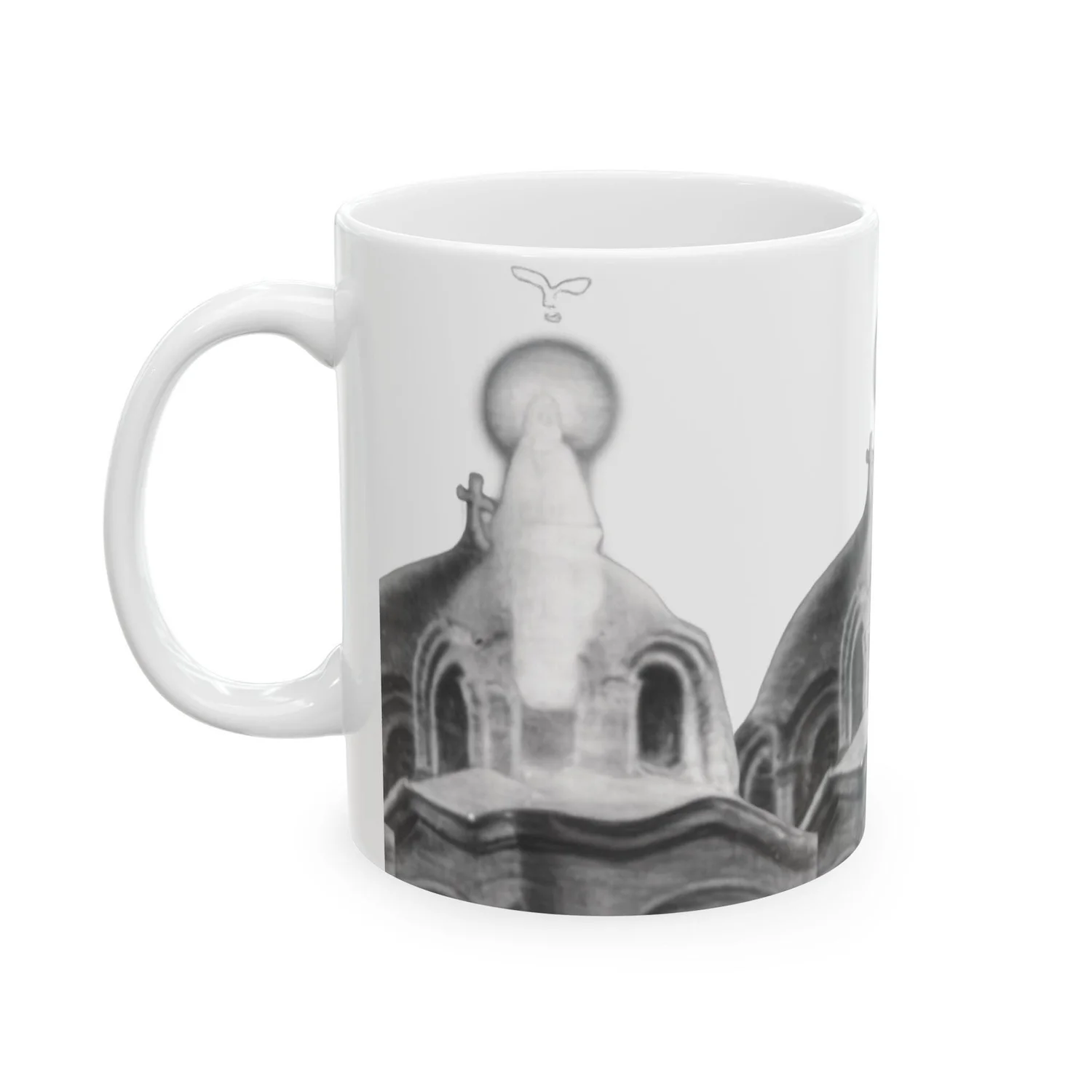
Our Lady of Zeitoun Coffee Mug — Real Photo of the 1968 Apparition
In 1968, the Virgin Mary appeared over a Coptic Orthodox church in Zeitoun, Egypt — witnessed by millions, photographed by news cameras, verified by Muslim and Christian alike. This mug carries one of those actual photographs. A remarkable piece of modern Marian history from the Coptic Orthodox tradition.
View the Mug →

Prayers for Those Contemplating Their Purpose Before God
The mystery we have been exploring is not merely an object of contemplation — it is a reason for prayer. If you are asking why you exist, the tradition's answer is not a theological argument to be stored in the memory. It is an invitation to enter the reality it describes. The following prayers are drawn from the Eastern Christian tradition and from the Philokalic stream, offered for those who want to pray their way into the mystery rather than merely think about it.
Lord Jesus Christ, Son of God, You who became man so that man might become God — I stand before You not knowing fully why I am here, but trusting that You do. The Fathers teach that You intended me before any failure occurred, that the space I fill in creation was designed for me, not improvised. I believe this. Help me to live it.
Grant me the courage to love You across the distance of faith — to walk the road that angels can only observe from the outside, to give You the love that suffering and struggle alone can produce. Let the years of my life that I have spent in darkness not be lost, but be what they were always meant to be: the crucible in which the love You created me to give You was being formed.
Draw me into theosis. Transform me, body and soul, through union with Your Incarnate humanity. Take me up, in the fullness of time, into the heavenly community You have been preparing since before the foundation of the world. And let me give You then, in that eternal fullness, the love that was always the reason You made me. Amen.
Lord Jesus Christ, Son of God, have mercy on me, a sinner.
— The Prayer of the Heart, from the Philokalic tradition, repeated continuously in rhythm with the breath until it descends from the mind into the heart. The core practice of the Eastern Christian path to theosis.The glory of God is a human being fully alive, and the life of the human being is the vision of God. If the manifestation of God through creation already gives life to all living beings on earth, how much more will the manifestation of the Father through the Word give life to those who see God.
— St. Irenaeus of Lyon, Against Heresies IV.20.7 (c. 180 AD)
Questions About Human Creation and Cosmic Purpose
You Were Not Made to Replace Anyone
You were made to love God across the distance of faith — to be transformed by that love into something uniquely human, and to be taken up, by grace, into a cosmic order that God ordained from eternity before the first light ever shone. An order that your love completes, not because God needed it, but because He willed, from before the foundation of the world, that it be yours to give.
The angels are watching. The Fathers who worked all of this out in prayer and contemplation and fierce intellectual labor are watching. The God who foreknew every struggle you would face — and designed you to face them exactly as the crucible of the love He is drawing out of you — is watching.
And the tradition says: He is not waiting to see how this turns out. He already knows. And He is glad.
"The glory of God is a human being fully alive, and the life of the human being is the vision of God."
— St. Irenaeus of Lyon
As an Amazon Associate, The Eastern Church earns from qualifying purchases.