Who Was Saint Marina the Monk? | Maronite & Orthodox Saint
Maronite Catholic • Eastern Orthodox • Coptic Orthodox
Saint Marina the Monk: The Complete Life, Miracles, Relics, and Churches of Lebanon’s Hidden Ascetic
The Lebanese saint who entered a men’s monastery in disguise, endured false accusation in silence, raised an abandoned infant in a cave, and whose incorrupt body has been venerated for fifteen centuries — the most complete account of her life, miracles, and legacy ever assembled in English
Saint Marina the Monk is one of the most remarkable figures in the entire Eastern Christian tradition and one of the most poorly served by the accounts that typically circulate about her. She is usually described in a paragraph or two: a woman who disguised herself as a monk, was falsely accused, and died with her secret intact. That is accurate as far as it goes. But it does not begin to capture the full weight of what she actually did, how long she endured it, what the tradition has preserved about her miracles, how her body survived fifteen centuries, or why the Maronites of Lebanon feel — still, today, more than fifteen hundred years after her death — what one scholar described as “a righteous anger against the injustice that was done to her.”
This article is the most complete account of Saint Marina the Monk available in English. It draws on the scholarly work of Guita G. Hourani (Maronite Research Institute, 2000), the hagiographic sources compiled by Léon Clugnet in 1904, the Maronite Synaxarium, the Golden Legend account, the Syriac manuscript tradition preserved at St. Catherine’s Monastery in Sinai, and the living traditions of the grotto in Al-Qalamoun and the Monastery of Qannoubine where Marina lived and died.

The World She Was Born Into: 5th-Century Lebanon, Maronite Monasticism, and the Tradition of Hidden Ascetics
Saint Marina lived in the 5th century, most likely between 430 and 500 AD. This was the era immediately following the Council of Chalcedon (451 AD) — one of the most consequential theological events in Christian history, which defined Christ as having two natures, divine and human, in one person. The Maronite Church, rooted in Antiochene Syriac Christianity and deeply influenced by Saint Maron (died c. 410 AD) and the Qadisha Valley monastic tradition, was in the process of consolidating an identity that would prove extraordinarily durable under subsequent invasions, persecutions, and occupations.
The Qadisha Valley — the “Holy Valley” of north Lebanon, whose name comes from the Aramaic word for “holy” — was already becoming what it would remain for a thousand years: the beating heart of Maronite Christian spirituality. The valley is dramatic in its geography, a deep gorge carved by the Qadisha River through the Mount Lebanon range, its walls dotted with hermitages, rock-cut chapels, and cave-monasteries that could only be reached by paths difficult enough to discourage casual visitors and invaders alike. The Monastery of Qannoubine — whose name derives from the Greek word for “cenobitic,” the communal form of monasticism established by Saint Pachomius and brought to Lebanon by Saint Theodosius the Cenobiarch — was already an established community when Marina and her father arrived.
The tradition of women adopting male monastic identity to pursue ascetic life in male communities was recognized, if unusual, in the 5th-century Eastern Christian world. Marina belongs to a specific group of saints the tradition calls “transvestite saints” in its scholarly literature — a group that includes Saints Euphrosyne (who disguised herself as Smaragdus), Theodora of Alexandria (who entered a monastery as Theodoros), Apollinaria of Antioch, Anastasia the Patrician, and others. What distinguishes Marina’s story from most of these is not the disguise itself but what happened during it: the false accusation, the years of exterior exile while she raised another person’s child, and the specific quality of the miraculous vindication that followed her death.
Born: c. 430–450 AD, Al-Qalamoun (Qalamoun), south of Tripoli, modern Lebanon
Died: c. 490–500 AD, Monastery of Qannoubine, Qadisha Valley, Lebanon. Approximately 40 years old.
Also known as: Marinos (monastic name), Marina the Syrian, Mary of Alexandria (Coptic tradition), Pelagia (Greek equivalent), Mariam
Father: Eugenius (also called Eugene, Ibrahim, or Euganius in variant traditions)
Venerated by: Maronite Catholic Church, Eastern Orthodox Church (Antiochian and others), Coptic Orthodox Church, Roman Catholic Church, Episcopal Church (from 2022)
Feast days: July 17 (Maronite, Eastern Orthodox, Venice); June 18 (Roman Catholic); February 12 (OCA, commemorated with her father Eugenius); Mesra 15 / August 21 (Coptic Orthodox); June 17 (Episcopal, from 2022)
Patronage: Those falsely accused; victims of slander; the falsely imprisoned; nursing mothers; those carrying invisible suffering; monastics; the Qadisha Valley
Early Life: Al-Qalamoun, the Death of Her Mother, and a Father’s Resolve
Marina was born in Al-Qalamoun, a coastal village on the eastern Mediterranean shore just south of Tripoli in what is now northern Lebanon. The village sits at the foot of the Lebanon range where the mountains descend to the sea, and it was a prosperous agricultural community in the 5th century, its fertile land worked by Christian families whose faith ran generations deep. Marina’s birth name was Mariam — or Marina in some traditions — derived from the Aramaic for “lady” or “bitter,” an echo of the Virgin Mary’s sorrows that would prove prophetic in her case.
Her father, Eugenius, was a man of wealth and deep piety. Her mother’s name is given as Theodora or Baddoura in different manuscript traditions; what all agree on is that she died when Marina was very young — the Maronite tradition says around age seven. The loss was defining. Eugenius, already inclined toward the ascetic life, found the death of his wife decisive. He resolved to renounce his possessions, distribute his wealth to the poor, and enter the Monastery of Qannoubine. He was, the tradition says, a man who had always belonged more to God than to the world. His wife’s death simply removed the last reason to stay.
The problem was Marina. Societal norms of 5th-century Christianity made it unthinkable to simply abandon a young daughter to fend for herself. Eugenius began to consider finding her a husband — arranging a match that would ensure her security — before withdrawing to the monastery. It was at this point that Marina demonstrated the quality that would define her entire life: she refused to accept a path chosen for her that did not include God.
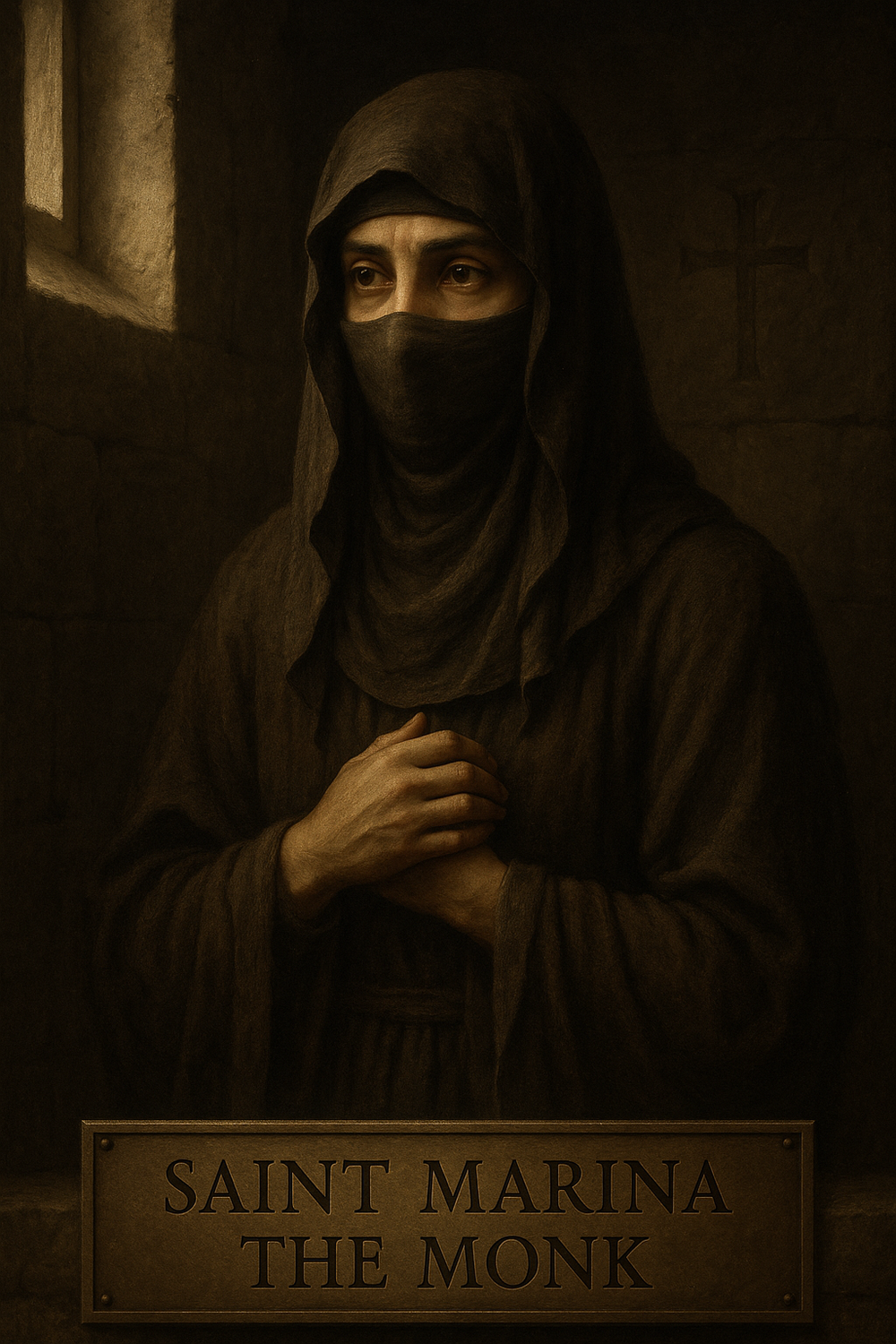
According to the Maronite tradition, Marina confronted her father with the question that the Eastern Orthodox tradition has preserved in its most striking form: “Why do you wish to save your own soul and destroy mine?” Eugenius responded that he did not know what to do with her, for she was a woman. Marina’s answer was immediate: they would both live as monks together. She shaved her hair, put on men’s clothing, and took the masculine form of her name — Marinos. Eugenius, confronted with his daughter’s absolute determination, gave all his remaining possessions to the poor and set out with “his son” for the Qadisha Valley.


The Disguise and the Monastery: How Marina Became Brother Marinos at Qannoubine
The Monastery of Qannoubine is one of the most extraordinary places in the Christian world. Carved into the north wall of the Qadisha Valley, it is accessible only by a steep path that descends from the village of Hasroun above or ascends from the valley floor below. The monastery itself — a complex of cells, a church, and ancillary spaces built directly into the rock face — sits above a sheer drop to the river hundreds of feet below. It would become the seat of the Maronite Patriarchs from 1440 to 1823, but in Marina’s time it was already an established community of monks living the cenobitic life: communal prayer, manual labor, fasting, shared meals, and the daily round of the Divine Office.
Eugenius petitioned the abbot to receive his “son,” and both father and child were admitted to the community. Marina and Eugenius shared a cell. The other monks noticed that the young Marinos had a particularly soft and beardless face; they attributed this to long hours of prayer, ascetic fasting, or the possibility that the young man was a eunuch. Marina’s extreme asceticism — the Maronite tradition notes that sustained fasting changes the body’s biology and reduces the visible markers of sex — made the concealment possible over many years. She lived in silence, kept her cowl low over her face, bowed her head in all interactions, and distinguished herself only in the quality of her prayer and the depth of her humility.
Syriac manuscripts from the tradition preserve a fragment of her interior prayer: “O Lord, veil my weaknesses as you veil the stars by day.” It is a prayer that captures her entire situation: the asking not for dramatic divine intervention but for the simple mercy of concealment, the same mercy she would later extend to the child she raised as her own, and the same mercy she asked of no one when she most needed it from her brothers.
Father and daughter lived together at Qannoubine for approximately ten years before Eugenius died. The tradition says that before his death he extracted from Marina a promise: she would maintain the disguise to the end, ensuring her safety and her ability to continue the vocation they had chosen together. Marina gave that promise and kept it absolutely, through every trial that followed.
Monastic Life: What Marina’s Daily Existence at Qannoubine Actually Looked Like
Maronite monasticism in the 5th century was shaped by the Antiochene Syriac tradition, which blended the Egyptian Desert Fathers’ emphasis on interior prayer with the Antiochene tradition’s more communal and liturgical character. The daily rhythm at Qannoubine included midnight vigils (the Night Office, prayed in the darkness of the valley before dawn), morning and evening prayer, manual labor during the middle hours of the day, fasting that in the strictest periods extended to one meal every two or three days, and the perpetual practice of interior prayer between all of these.
Marina’s specific tasks are mentioned in several manuscript variants: she washed the monks’ dishes, cleaned their cells, fetched water from the valley spring, carried heavy loads of wood from the forests on the valley slopes, and performed whatever was most humble and most invisible. The Desert Fathers’ tradition consistently records that the deepest ascetics sought the most menial work, not as penance but as the most reliable path to genuine humility — work that left no room for pride, that no one praised, and that needed to be done again the next day regardless of how perfectly it had been done today.
For twenty to thirty years — the tradition gives varying estimates — Marina lived this life in complete interior silence. No one knew her secret. Her father was dead. The promise she had made to him was the only external constraint; the interior motivation was something else entirely, something the monastic tradition would recognize as the voluntary embrace of kenosis — the self-emptying that Christ embodied and that the saints are called to imitate.
The False Accusation: How Marina Was Condemned for a Crime She Could Easily Have Disproven
The trial that defines Marina’s hagiography arrived through the ordinary machinery of human weakness and cowardice. The abbot sent a group of monks, including Marinos, on an errand for the monastery. As the journey was long, the monks spent the night at an inn. The Maronite tradition names the innkeeper Paphnotius; his daughter had been seduced by a soldier of the eastern Roman front who was also lodging there. When the soldier realized the girl was pregnant, he instructed her to blame the young monk Marinos rather than himself.
The innkeeper went to the abbot in fury. The abbot summoned Marinos and confronted the accusation. At this point Marina faced a choice that the entire tradition lingers over, because it is the hinge on which everything else turns: she could have revealed her female identity and been immediately and completely exonerated. The accusation would have collapsed on its face. She would have been vindicated, praised even, for the years of hidden ascetic devotion. And she would have been sent home from the monastery, because she was a woman, and the monastery was for men.
She did not reveal herself. She fell to her knees, wept, and said “I have sinned, holy father, have mercy on me.” The tradition records this moment with the weight it deserves: Marina chose disgrace over vindication because vindication would have ended the life she had promised her dying father she would protect. She chose the monastery over her reputation. She chose God over her good name.
The abbot, interpreting her silence as admission of guilt, expelled her from the monastery. He also — in a detail the tradition preserves as particularly significant — removed her belt, the monastic cincture that was the visible sign of chastity and membership in the community. To take someone’s belt was to say publicly: you are no longer one of us and no longer chaste. Marina accepted this too, in silence, and walked out the gate.
The Exile: Marina at the Gate, the Abandoned Child, and the Miracle of Nursing
Marina settled at the gate of the Monastery of Qannoubine and remained there. Different manuscripts give different durations for this exile: the Office of Saint Marina says five years; other accounts give three years, four years, or longer. All agree that it was years in the plural. Marina subsisted on whatever food the monks brought out to her as alms — leftovers from the community’s table, fragments of bread. She continued to pray. She did not seek admission elsewhere, did not travel to another monastery, did not appeal to anyone. She sat at the gate of the house that had expelled her, praying for the monks within it.
When the innkeeper’s daughter gave birth to a boy, Paphnotius brought the child to the monastery and thrust him at Marina: “Here is your son. Take him and raise him.” Marina took the child. What happened next is one of the most remarkable moments in the entire hagiography and one that is preserved in the local tradition of the Al-Qalamoun grotto to this day. Marina carried the infant to a cave in the hillside near the monastery — the grotto that local tradition now identifies as the place she lived during her exile. She had no milk. She was a woman who had never borne a child, who had been living on alms and fasting for years, whose body was worn by decades of ascetic practice. And yet, according to the tradition, when she held the child and tried to nurse him, milk flowed from her breasts.
The local tradition in Al-Qalamoun has preserved this miracle in living form: women of the area who suffer from nursing difficulties — who have no milk, or insufficient milk, or who have lost a nursing infant — come to the grotto of Saint Marina, bless themselves with the water that seeps from the cave walls into a small basin in the rock, and ask for her intercession. The practice continues to this day. The grotto contains a rock-cut tomb and this small basin of water, both objects of ongoing pilgrimage and devotion for mothers.
Marina raised the child. The shepherds who grazed their flocks in the Qadisha Valley brought her sheep’s milk for the infant. Some accounts say she raised the boy for four years; others say ten. The boy grew up at her knee, outside the monastery gate, raised by the most rigorous ascetic in the valley in the belief that his “father” was a disgraced monk who had accepted that disgrace without complaint.
Other accounts preserve an additional detail from this period: that at some point the monks within the monastery, unable to bear watching Marinos suffer day after day without admission, petitioned the abbot collectively to readmit her. The abbot refused for some time. Eventually the monks reportedly threatened to leave the monastery themselves if Marinos was not readmitted. The abbot relented, but imposed severe conditions: additional fasting, vigils, heavy labor, and penances that went beyond the normal monastic rule. Marina accepted all of them.
Readmission, Penance, and the Approach of Death
Back within the monastery, Marina threw herself into whatever was most demanding. She cooked, cleaned, carried water from the spring up the steep valley path, performed the labor of the most junior novice while outstripping the most senior monks in prayer and fasting. The boy grew up within the monastery community, raised by the monk everyone believed was his disgraced father. Some manuscript variants say Marina used to say to the boy: “The one who saves a soul shall be as the one who created it.”
Decades of extreme asceticism, years of exposure at the monastery gate, and the physical toll of raising a child in a cave had weakened her body beyond what the will could indefinitely sustain. Marina fell ill. The Maronite and Antiochian traditions say she was approximately forty years old. She was ill for three days, and on the third day she died.
The tradition records one final detail from her deathbed: in some manuscript versions, Marina wrote a note to her brothers that was found with her body. It read: “I am a woman and not a man. I embraced the monastic life with my father. I was falsely accused. I have raised this child with my care. I beg of you, my brothers, do not remove my habit.”
Death, Discovery, and the Tears of the Abbot: How God Vindicated What Silence Had Protected
The abbot ordered that Marinos’s body be prepared for burial. As the monks began to wash the body and prepare it for the funeral rites, they discovered what Marina had protected for her entire adult life. The realization hit the community with the force of something the tradition can only describe as shattering. The abbot, who had expelled Marinos for a crime she could not have committed, who had imposed years of penance for an offense that was impossible, fell to his knees beside her body and wept. The monks prayed over her in the church while crying and lamenting.
Then, according to the Maronite tradition, a voice was heard from heaven, addressed to the abbot: “Lift up your head from the ground. What you have done was not of your order or your will, but rather you have accomplished what the law commanded. Your sin is pardoned. Do not be sad anymore.”
The legend also records that when Marina died, the bells of the monastery rang on their own, without anyone touching them.
The abbot called for the innkeeper Paphnotius and informed him that Marinos was a woman. The innkeeper went to where her body lay and wept for the suffering he had unjustly brought upon her. His daughter, tormented by a demon God had allowed to afflict her because of her lie, eventually traveled to the monastery with the soldier who had seduced her, confessed their deception publicly before everyone, and asked for forgiveness at the tomb of the saint. The tradition records that the daughter spent the remainder of her life in tears and penance at Marina’s grave. The village of Tourza in north Lebanon, near Besharre, is identified in the tradition as the location of the inn where the sin took place; local legend holds that because of what happened to Marina, that village was repeatedly destroyed by earthquakes and remains poor to this day.
The Miracles of Saint Marina: During Her Life and After Her Death
The tradition of Saint Marina is unusually rich in specific miracles, both during her lifetime and after her death. What follows is a complete accounting of every miracle the hagiographic tradition records, with its source.
When the innkeeper Paphnotius handed Marina the newborn child of his daughter, Marina was a celibate woman who had lived as an ascetic for many years and had never borne a child. She carried the infant to a cave in the hills near the monastery. When she tried to nurse him, milk flowed from her breasts. The grotto of Saint Marina in Al-Qalamoun preserves this miracle in a basin of water that seeps from the cave walls, which nursing mothers bless themselves with to this day, seeking her intercession for milk supply and nursing difficulties.
During the funeral prayers immediately following the discovery of Marina’s identity, one of the monks who was blind in one eye touched the body of the saint and received full sight again. This is the first documented miracle at her relics and is recorded in every major tradition that preserves her story: the Wikipedia account, the Maronite Synaxarium, the Golden Legend, and the Coptic hagiographic sources all include it. It was immediate, visible, and witnessed by the entire community present.
God permitted a demon to torment the innkeeper’s daughter who had falsely accused Marina. Her affliction drove her eventually to travel to the monastery, confess her lie publicly, and ask for forgiveness at Marina’s tomb. The Golden Legend version of the story records explicitly: “Then she that infamed the servant of God was taken and vexed with a devil, and knowledging her sin came to the sepulchre of the blessed virgin, and there was delivered and made all whole.” Her deliverance from the demonic affliction upon confession and repentance is the tradition’s clearest statement about the saint’s posthumous power of intercession.
The Maronite tradition preserves the detail that when Marina died, the bells of the monastery rang on their own, without anyone having touched them. This is a traditional sign in the Eastern monastic tradition of a holy death — comparable to the fragrance of myrrh that often accompanies the death of saints in the Eastern church. The phenomenon alerted the community before any human messenger.
As the abbot prostrated himself in grief and remorse beside Marina’s body, a voice was heard from heaven: “Lift up your head from the ground. What you have done was not of your order or your will, but rather you have accomplished what the law commanded. Your sin is pardoned. Do not be sad anymore.” This detail is preserved in the Maronite Office of Saint Marina and is specifically noted by the Syriac manuscript tradition.
The Maronite Synaxarium records that at the hour of Marina’s death, “the features of his face glowed with a heavenly light.” The luminosity of the face at the moment of death is one of the most consistently recorded signs in the Eastern monastic tradition of a soul entering into union with the divine light. It was the first visible sign to the monks in the room that their dying brother was something other than what they had assumed.
The most sustained miracle of Saint Marina’s intercession is the preservation of her body from decomposition. Her relics were described as incorrupt when transferred from Lebanon to Constantinople and then to Venice, where the body was displayed in a glass coffin in the Church of Santa Marina and, after 1818, in the Church of Santa Maria Formosa. Orthodox pilgrims who visited the Church of Santa Maria Formosa in Venice reported seeing her body intact, displayed on her feast day. The Coptic Orthodox tradition similarly claims that Marina’s body at St. Mary’s Coptic Orthodox Church has not decomposed. Incorruption is one of the most significant signs of sanctity recognized by the Eastern Christian tradition.
The Maronite Synaxarium records that after Marina’s death, “the sanctity of Marina spread all over Lebanon, people from all its regions came to the Monastery of Qannoubine to be blessed by her body. Her tomb became a source of cures and graces.” The specific healings are not individually catalogued in the manuscript tradition, but the pilgrimage to the Qadisha Valley on July 17 — which continues to this day — is built on a centuries-long accumulation of testimony about the efficacy of her intercession at the site of her burial.
Following the translation of Marina’s relics to Venice in 1231, healings were reported at her relics in the Church of Santa Marina, which stood near the Rio di Santa Marina canal. The church became the center of a substantial Venetian cult; the feast of the translation of the relics on July 17 was observed with particular ceremony. After the Church of Santa Marina was demolished in 1818, the relics were transferred to the Church of Santa Maria Formosa, where they remained and where healings continued to be reported by the faithful.
The Relics of Saint Marina the Monk: A Complete Account
The relics of Saint Marina are among the most traveled of any Eastern saint, and the history of their movement reflects both the turbulence of the medieval Eastern Christian world and the breadth of her veneration. What follows is the complete account as compiled from Léon Clugnet’s 1904 scholarship, the Maronite Research Institute’s documentation, and subsequent sources.
Marina’s original place of burial was at the Monastery of Qannoubine. Her left hand was kept at the monastery as a relic. A rock-cut tomb in the grotto near Qannoubine — where she lived during her exile outside the gate — is identified by local tradition as her burial place. The grotto contains the tomb, ancient fresco paintings (partially damaged by water and by locals who defaced the figures), and the small basin of water that breastfeeding mothers bless themselves with. Each year on July 17, pilgrims descend into the Qadisha Valley for Mass at the grotto. Her body was returned from Venice to Lebanon for a period of veneration at the Patriarchal headquarters in Diman and then placed on her empty tomb in the grotto before being returned to Venice.
Marina’s body was transferred from Lebanon to Constantinople, and from Constantinople to Venice in 1231 (some sources say 1230), following the Fourth Crusade’s disruption of Byzantine ecclesiastical life in 1204. The relics were first placed in the Church of Saints Liberal and Alexis, which subsequently became known as the Church of Santa Marina; it stood near a canal renamed Rio di Santa Marina in her honor. When the Church of Santa Marina was demolished in 1818, the relics were transferred to the Church of Santa Maria Formosa, where they remain. The feast of the translation of the relics is observed in Venice on July 17, the same feast day honored by the Maronite Church. Venice considers Saint Marina its own patron, and the city observes her feast with civic celebration.
Cyprus is one of the three places where Saint Marina is venerated today, according to the Family of Saint Sharbel research. The village of Ayia Marina (Saint Marina) in the Turkish-occupied north of Cyprus is a Maronite village with both an old Church of Saint Marina (built 1650) and a new Church of Saint Marina (built 1972). The village itself is named for her. Due to the Turkish occupation since 1974, these churches are only accessible periodically, and the Maronite community that worshipped there has been largely displaced. There are also Saint Marina churches in the government-controlled south of Cyprus: in Kochatis (1975) and Limassol (1974).
Léon Clugnet documented in 1904 that churches in Greece, Belgium, and Saint Catherine’s Monastery in Sinai each claim to possess a left hand of Saint Marina. Since her left hand was also kept at Qannoubine, there are effectively four claimants for this relic. Clugnet does not adjudicate between these claims; he simply notes them as part of the saint’s widespread medieval veneration.
A small church dedicated to Saint Marina was located near the Cathedral of Notre-Dame de Paris and may have been built between the 10th and 11th centuries. It was mentioned by William of Paris in 1228 and held a hand relic of the saint. According to an inventory taken in 1627, the church had this relic. After the church was sold during the French Revolution in 1792, relics were preserved elsewhere. The Arch-Priest of Notre-Dame stated in 1902 that one of two clavicles (collar bones) of Saint Marina, preserved in a glass tube sealed by Monsignor Darboy, was among the treasures of Notre-Dame Cathedral. Those relics were present until the 2019 fire; their subsequent status has not been confirmed.
The Coptic Orthodox tradition claims that Marina’s body is kept at Saint Mary’s Coptic Orthodox Church and has not decomposed. It is displayed to the public on Marina’s feast day, Mesra 15 (approximately August 21 Gregorian). Scholars note that this may reflect the conflation of Marina the Monk with Marina the Martyr of Antioch, whose relics are separately documented. The Coptic tradition maintains both as distinct saints but celebrates them with similar devotion.
Among the Druze community of Lebanon, Marina is venerated under the name “Al-Sitt Sha’wani” (The Lady Sha’wani). Her shrine is located in Amiq on the slopes of Mount Barouk (Jebel el-Barouk), overlooking the Bekaa Valley with views toward Mount Hermon. This syncretism — a Christian saint venerated by a non-Christian community — reflects the depth of Marina’s rootedness in Lebanese spiritual culture across community lines.
Churches and Places Named for Saint Marina the Monk
The dedication of churches and places to Saint Marina constitutes one of the clearest measures of a saint’s historical footprint. What follows is a complete inventory of every church, village, and topographical feature documented as bearing Marina’s name.
The Monastery of Qannoubine (primary site of her death and original veneration). The grotto of Saint Marina near Al-Qalamoun (the cave where she lived during exile and where nursing mothers still seek her intercession). Annual Mass and pilgrimage on July 17 in the Qadisha Valley. The village of Tourza, identified in tradition as the location of the inn — traditionally held to have suffered divine punishment for what happened to Marina there.
The Church of Santa Marina (formerly Saints Liberal and Alexis), demolished 1818, which stood near the Rio di Santa Marina canal — a canal still named for her in the Castello sestiere of Venice. The Church of Santa Maria Formosa, where her relics have resided since 1818. Venice celebrates her feast on July 17 as the feast of the translation of her relics.
The village of Ayia Marina (Saint Marina), a Maronite village in the Kyrenia district of Turkish-occupied northern Cyprus. The old Church of Saint Marina in Ayia Marina (built 1650). The new Church of Saint Marina in Ayia Marina (built 1972). The Church of Saint Marina in Kochatis, government-controlled Cyprus (built 1975). The Church of Saint Marina in Limassol, government-controlled Cyprus (built 1974).
The Church of Saint Marina, located near Notre-Dame Cathedral, documented from the 10th–11th century until its sale during the French Revolution in 1792. The Cathedral of Notre-Dame held clavicle relics of Saint Marina in its treasury until at least 2019.
A church or institution in Belgium claiming a left hand of Saint Marina, documented by Clugnet in 1904. The specific location is not identified in the surviving scholarship.
Saint Catherine’s Monastery on the Sinai Peninsula claims a left hand of Saint Marina. The Syriac manuscript Nº 30 (dated 778 AD, folios 70r–76v) at Saint Catherine’s Monastery is one of the oldest surviving documentary witnesses to her story.

Feast Days of Saint Marina the Monk Across All Traditions
Saint Marina is one of a small number of saints honored across the full spectrum of Eastern and Western Christianity. The variety of her feast dates reflects the different manuscript traditions through which her story entered different communities.
July 17 — Maronite Catholic Church (primary feast day in the Lebanese tradition). Eastern Orthodox Churches including Antiochian Orthodox. Venice, Italy (feast of the translation of her relics from Constantinople, 1231).
June 18 — Roman Catholic Church. Listed in the Roman Martyrology. Also in the New Paris Breviary.
February 12 — Orthodox Church in America (OCA). Commemorated jointly with her father, Venerable Eugene (Eugenius).
Mesra 15 / August 21 (Gregorian) — Coptic Orthodox Church. The Feast of the Departure of Saint Marina, on the same Coptic date as the newly canonized Saint Habib Girgis and one day before the feast of the Assumption of the Theotokos.
June 17 — The Episcopal Church (USA). Added to the Episcopal liturgical calendar in 2022, the first new official recognition of Marina in an Anglican-tradition church.
The Manuscript Tradition: How Marina’s Story Has Survived Fifteen Centuries
The survival of Saint Marina’s story is itself a minor miracle of transmission. Her vita exists in more languages and more manuscript copies than the typical saint of her era, which explains both why she was so widely venerated in the medieval period and why the story could become the vehicle for so many local adaptations.
The oldest documentary witness to her story is the Syriac manuscript Nº 30 at Saint Catherine’s Monastery in Sinai, dated 778 AD (folios 70r–76v). This confirms that her story was already in written circulation by the late 8th century; scholarly consensus, following Clugnet and Nau, dates the original composition of the vita to between 525 and 650 AD, making the first written account of her life no more than a generation or two after her death.
Her account is found in Syriac, Coptic, Arabic, Greek, Latin, Ethiopian, Armenian, German, French, and Spanish manuscripts — a range of languages that maps almost exactly onto the full extent of medieval Christianity’s geographic spread. The 11th-century Islamic scholar Aba Al-Rayhan al-Bayrouni (died 1049) mentions her in his encyclopedic work “Al-Athar al-Baqiyat” when describing the Syriac calendar: “On the third of October is the feast of the Monk Maria, who wore the cloth of man and became monk, who hid her femininity from the monks, then was accused of adultery with a woman. She did not reveal her femininity until her death.” The fact that a Muslim scholar of the 11th century includes her in a scholarly encyclopedia on Syriac calendar traditions confirms that her story had thoroughly permeated the cultural life of the Levant across religious community lines.
The major manuscript repositories where her story survives include: the Bibliothèque Nationale in Paris; the Bibliothèque Royale in Brussels; the British Museum in London; the Bibliothèque Ambrosienne in Milan; Saint Catherine’s Monastery in Sinai; the Vatican Library in Rome; the Maronite Patriarchal Archive in Bkerke, Lebanon; and the Bibliothèque Orientale de Beyrouth. Léon Clugnet published the definitive French-language critical study of her manuscripts in the Revue de l’Orient Chrétien in 1904 (“Vie de Sainte Marine,” Vol. 9, pp. 560–594).
Patriarch Youssef Al-‘Akoury (1644–1648) composed an ode for the saint in 1641 consisting of 139 strophes in colloquial Lebanese Arabic, which Clugnet published in 1904. A Maronite Office of Saint Marina in Syriac was edited by Father Louis Cheikho and attributed variously to Patriarch Youssef Estphan (1766–1793) or Patriarch Estephan Douwayhi (1670–1704). The Office includes a version of her passion with details not found in the standard biographical accounts.
Distinguishing Saint Marina the Monk from Other Saints Named Marina
The name Marina generates significant confusion in hagiography because it belongs to at least six documented saints, several of whom are venerated by overlapping communities. A careful reader of this article should be able to distinguish Marina the Monk from each of the following.
Marina (Margaret) of Antioch the Great Martyr is entirely different: a 4th-century virgin martyr of Antioch in Pisidia (modern Turkey) who was tortured and beheaded for refusing to renounce her faith. She is venerated as Saint Margaret in the West and Saint Marina the Great Martyr in the Eastern Orthodox tradition. She is one of the Fourteen Holy Helpers in Roman Catholicism and the patron of over 250 churches in England, including Saint Margaret’s Westminster. Her feast is July 20 (Roman Catholic) or July 30 (Orthodox). She has nothing to do with Marina the Monk other than the name.
Marina of Alexandria is the name sometimes used in Coptic tradition for Marina the Monk; it is a geographic attribution added when the story was translated into Coptic, not a separate person. Marina of Spain and Marina of Sicily are local legends that Clugnet regards as variants of the Marina the Monk tradition adapted to local contexts, not historically distinct individuals. Marina the Cistercian is a medieval Western saint unconnected to the Eastern tradition.
Léon Clugnet’s 1904 conclusion remains the scholarly consensus: of all the saints named Marina, probably only two actually existed — Marina of Antioch the Great Martyr, and Marina the Monk of Qannoubine. All other Marinas are either variants of one of these two or local legend with no independent historical basis.
The Patronage of Saint Marina the Monk: Who She Prays For
Every aspect of Marina’s patronage grows directly from what she actually lived through. She is not a saint whose intercession was assigned to a cause by ecclesiastical committee; she is a saint whose life directly addresses specific forms of human suffering in a way the tradition recognized immediately and has preserved continuously.
She is invoked by those who have been falsely accused — people against whom lies have been told, reputations destroyed, charges brought that cannot be disproven without a cost too high to pay. Her response to false accusation — silence, acceptance, the refusal to save herself at the expense of what she valued more — makes her the most specific intercessor available to anyone in that situation.
She is invoked by victims of slander — people whose reputation has been destroyed by others’ words. The tradition surrounding the village of Tourza, where the lie was told, reflects the church’s theological certainty that God does not simply watch slander happen and move on. Marina’s story insists that slander has consequences, that truth eventually surfaces, and that the one who endures slander in silence is not forgotten.
She is invoked by nursing mothers and women with difficulties in nursing or lactation, specifically at the grotto of Al-Qalamoun, where the miracle of her nursing the abandoned infant is commemorated in the basin of water that mothers bless themselves with.
She is invoked by monastics and ascetics in the Maronite and Eastern Orthodox traditions, as one who perfected the monastic life under conditions of extreme difficulty.
She is invoked by those who suffer invisibly — people whose pain is hidden from those around them, whose holiness is seen only by God, who carry burdens they cannot explain to anyone. Her entire life was an act of invisible endurance, and the tradition’s ongoing righteous anger about what was done to her is a kind of institutional guarantee that those who suffer in secret are not, in fact, invisible to the church or to God.
Prayers to Saint Marina the Monk
O holy Marina, hidden servant of Christ, Your life was veiled in silence and suffering, Yet the God who sees in secret saw all that you endured. Grant us humility in adversity, Quiet courage in the face of injustice, And a heart ever devoted to God. Pray for those who suffer in silence, For those whose names have been dishonored, For those who carry burdens they cannot explain, And for those who nurse and tend the abandoned. Through your intercession, may the God of all hidden things Vindicate what is true, heal what is broken, And bring light to what the world cannot see. Pray for us, holy Marina. Amen.
Before the Epistle: Marina is greatly saddened To see her brothers and the superior of the convent Tormented and suffering painfully because of her. The virgin prayed for them And for her calumniators. Through her perfect patience She has saved her soul with theirs. After the Gospel: You have surpassed women with your combats, O excellent one in your patience and in your love, Humiliated is he who has calumniated you And increasingly esteemed is your dignity. Before the Kiss of Peace: They have judged you tyrannically, Without witnesses and interrogation; Outside the Monastery you lived in patience, Burdened by suffering for five years. Before the Small Elevation: O Mount Lebanon, your glory has been exalted; O Monastery of Qannoubine, your joy has increased, Because Marina, the pride of your monks, In this monastery has increased your fame. — From the Maronite Office of Saint Marina, manuscript copied c. 1720 by Father Boutros Makhlouf of Ghosta; attributed to Patriarch Youssef Estphan (1766–1793) or Patriarch Estephan Douwayhi (1670–1704). Published by L. Clugnet in Vie et Office de Sainte Marine, 1905.
Frequently Asked Questions About Saint Marina the Monk

The Light That Hid Itself and Could Not Stay Hidden
Saint Marina spent her entire life trying not to be noticed. She kept her cowl low, bowed her head, took the most menial work, said nothing when silence was crucifying her, and asked only to be allowed to continue praying. The world repaid this by accusing her of sexual assault and expelling her from the only home she had chosen. She accepted that too, without a word of complaint, and went and raised the abandoned infant in a cave.
And then God made the bells ring by themselves, and gave milk from a body that had no milk to give, and healed a blind monk’s eye at the touch of her dead hand, and preserved that body from decomposition for fifteen centuries. The light that hid itself could not stay hidden. It never does.
Get Her Prayer Card → Browse All Eastern Prayer Cards →