Saint Menas of Polotsk: Orthodox Bishop, Former Monk of the Kyiv Caves and Shepherd of Polotsk
A monk of the Kyiv Caves who became bishop of Polotsk in 1105 and died in 1116, with a short documented life and a long record of veneration.
At a Glance
- Born
- Unknown (UNCERTAIN); place and date not recorded
- Died
- June 20, 1116, recorded in the chronicles
- Titles
- Holy Hierarch; Bishop of Polotsk, 1105 to 1116
- Feast
- June 20 (Julian calendar), July 3 on the civil calendar; also with the Saints of Belarus on the third Sunday after Pentecost
- Veneration
- Orthodox; Russian Orthodox church-wide glorification in 2016; no formal Catholic canonization found
- Patronage
- No established patronage; the repentance theme is a devotional emphasis, not a documented one
- Who Was Saint Menas of Polotsk?
- Origins and Early Life
- The Monk of the Kyiv Caves
- Bishop of Polotsk
- Menas and the Wider Church of Rus
- Death and Burial
- Questions of Tradition and Legend
- What He Wrote and Founded
- Veneration Through the Centuries
- Saint Menas and the Eastern Churches
- Frequently Asked Questions
Who Was Saint Menas of Polotsk?
Saint Menas, also written Mina, was a monk of the Kyiv Caves Monastery who became Bishop of Polotsk in the early twelfth century. He is honored in the Orthodox Church as a holy hierarch and is counted among the saints of Belarus. The chronicles name him as bishop from 1105 until his death on June 20, 1116.
Very little else is recorded. We do not know where he was born, who his parents were, or what name he bore before he became a monk. This article sets out what the sources do say, marks what is TRADITION, and marks what is UNCERTAIN, so that the reader can see where history ends and devotion begins.
One point needs to be stated plainly. The prayer card for Saint Menas speaks of repentance after failure and hidden monastic struggle. The sources examined do not record any personal failure, public penance or abandoned vocation in his life. His documented life is that of a monk who accepted episcopal duty, and the repentance theme is best read as a devotional emphasis.
Origins and Early Life
The date and place of his birth are not known (UNCERTAIN). Since he was already a monk before 1105, he belonged to the generation that grew up in the first decades after the Christianization of Rus, but no responsible calculation of his birth year can be made from the surviving evidence.
Nothing reliable is preserved about his family or childhood. Medieval lives of saints often include stories of early piety, a vision or a dramatic departure from home. None can be attached to Menas, and a careful biography should not supply such details to fill the gap.
Some historians have suggested that he was of Greek origin and that his appointment reflected Byzantine influence on Polotsk. The Orthodox Encyclopedia treats this idea as insufficiently supported (UNCERTAIN). It remains a hypothesis and not a fact of his biography.
The Monk of the Kyiv Caves
The firmest early fact about Menas is his connection with the Kyiv Caves Monastery. The Kyiv-Pechersk Paterikon, a collection of stories about the monastery that took its early form in the thirteenth century, identifies him as a monk tonsured there. That monastery was the great school of asceticism in Rus, shaped by the memory of Saints Anthony and Theodosius.
It is reasonable to see his spiritual formation in that setting, with its rhythm of prayer, obedience, fasting and manual work. Yet the sources do not name his spiritual father, the date of his tonsure, or the location of his cell. These details are UNCERTAIN, and they should not be invented.
There is also no record of a conversion in the dramatic sense. No account tells of a period away from the Church, a sin that led to repentance, or a personal crisis that sent him back to the monastery. His turning point in the record is not a fall but a call, when the monk was chosen to become a bishop.
Bishop of Polotsk
The chronicles record that Menas was consecrated bishop on December 13, 1105, during the time of Metropolitan Nicephorus I of Kyiv. The Orthodox Encyclopedia considers Kyiv the likely place of consecration, but that is an inference. He then governed the see of Polotsk for about eleven years, in a region that is today part of Belarus.
Polotsk was an important princely and religious center. A bishop there was responsible for clergy, worship, the instruction of the faithful and the relations of his diocese with the metropolitan in Kyiv. Menas carried these duties as a man formed by monastic discipline, which gives his life its main shape: the monastery extended into pastoral service.
He is not necessarily the first bishop of Polotsk. Episcopal seals linked to a Bishop Seraphim suggest that the see existed earlier. It is therefore misleading to call Menas the founder of the diocese. A safer description is that he is among the earliest bishops of Polotsk known from written sources.
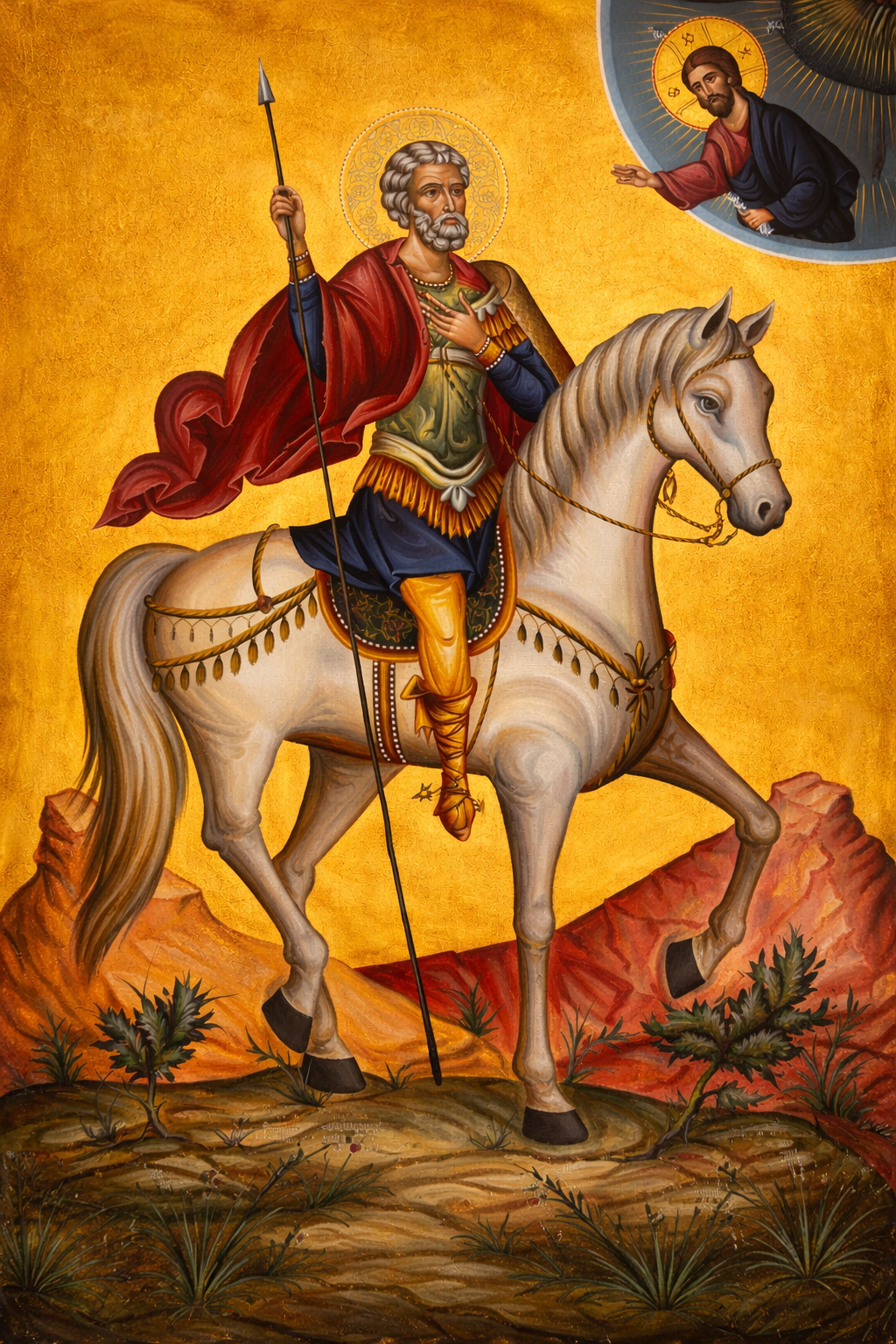
Menas and the Wider Church of Rus
The clearest event tied to his name took place in May 1115. According to the early Tale of Saints Boris and Gleb, Menas took part with Metropolitan Nicephorus, other bishops, princes and nobles in the solemn translation of the relics of the two holy princes to their new church at Vyshhorod near Kyiv. This shows that he stood among the senior churchmen of Rus.
In 1108 the name of Saint Theodosius of the Caves was ordered to be entered into church commemorations across Rus. Historians think it natural that a bishop formed at the Caves would have carried out this order in Polotsk. But his own act is inferred from the general order, and no surviving instruction from Menas confirms it (UNCERTAIN).
No source describes quarrels between Menas and the local princes, and none records exile, deposition or condemnation. The great difficulty in writing his life is not conflict between accounts but silence. Polotsk was politically complex, yet the sources leave his dealings with its rulers unrecorded.
Death and Burial
The chronicles record that Menas died on June 20, 1116. The Resurrection Chronicle preserves a notice of his death that names him and his office. The year is accepted by standard historians, and Polotsk is the probable place of death, though that location is marked UNCERTAIN.
No reliable account survives of his final illness, his last words or the days before his death. A reader should be wary of any popular retelling that offers a deathbed scene, because such a scene would not rest on the sources.
The location of his tomb is also unknown (UNCERTAIN). The Orthodox Encyclopedia considers the Church of the Holy Savior at Seltse near Polotsk the most probable burial place, because the Life of Saint Euphrosyne suggests that earlier bishops were buried there. That is a historical inference, and no identified relics of Menas are known.
Questions of Tradition and Legend
No miracle performed by Menas during his life can be securely established from the sources. Stories that he healed the sick, restored sight or received visions should not be repeated as fact. The cult of Saint Menas rests on his office, his monastic origin and his place in liturgical memory, and not on a collection of wonders.
TRADITION connects him with Saint Euphrosyne of Polotsk, who grew up during his episcopate. The overlap in time is real. It is plausible that his monastic background shaped the religious setting of her youth, but that he personally guided her vocation or tonsured her is not demonstrated (UNCERTAIN).
Another tradition identifies him with an early abbot named Menas of the Monastery of Saint Michael on Zverinets Hill in Kyiv. Shared name and monastic setting are not enough to prove this, and the link remains unproven. The better supported identification is with the Kyiv Caves.
What He Wrote and Founded
No sermon, letter, rule or hymn that can be securely attributed to Menas is known to survive. No monastery can be named as his personal foundation. Modern church biographies say in general terms that he encouraged church building and the instruction of his flock, but specific foundations lack documentary support.
He should therefore be described as a monastic bishop and a participant in the Christian development of Polotsk, not as an author or founder. That may seem a thin portrait, but it is an honest one, and it fits the way many early saints of Rus appear in the record, through office and memory rather than through a body of writings.
The main scholarly guide is the article on Menas in the Orthodox Encyclopedia, which draws on the Russian chronicles, the Kyiv-Pechersk Paterikon and the tale of Boris and Gleb. Historians also debate the date of his consecration, since December 13 was not a customary day for such an event. The date may be right, or the chronicle may contain an error (UNCERTAIN).
Veneration Through the Centuries
The evidence for the cult of Menas is liturgical. His name was kept in the commemorations of Saint Sophia Cathedral in Polotsk, and his memory lived on in the tradition of the Kyiv Caves. Around 1643 a canon honoring the saints of the Caves was composed under Metropolitan Peter Mohyla, and Menas appears among the holy bishops it remembers.
In 1984 a collective commemoration of the saints of Belarus was established, and a service to Menas was composed in connection with it. On February 2 and 3, 2016, the Council of Bishops of the Russian Orthodox Church approved the church-wide glorification of a group of locally venerated saints, and Bishop Menas of Polotsk was named among them.
There is no known shrine with his identified relics, so there is no established pilgrimage to a tomb. His memory is kept in icons of the saints of Belarus, including one at the cathedral in Grodno, and a lower church at Ivenets is reported to have been consecrated in his honor. Pilgrims who wish to honor him can do so in the services of the saints of Belarus.
O God, who called Your servant Menas from the monastery to shepherd Your people, grant me faithfulness in the calling You have given me. When I fail, bring me back to You with a humble heart. Through the prayers of Saint Menas, keep me steady in hidden struggle and quiet service. Amen.
This is a short original devotional prayer, not an official liturgical text, and it is not a prayer written by Saint Menas.
Saint Menas and the Eastern Churches
Menas lived before the later divisions that shaped the Catholic and Orthodox communities of the region. For this reason Byzantine Catholics and Orthodox Christians can both study him as part of the shared Kyivan inheritance, in which the monasticism of the Caves and the Church of Polotsk belonged to one tradition.
The honest limits must be stated. His veneration is Orthodox and well documented. No formal Roman Catholic beatification, canonization or universal feast was found, and the fact that his story belongs to the common Kyivan past does not mean that every Eastern Catholic calendar lists him.
His spiritual message lies in fidelity to vocation. In his life the monastic calling and the episcopal service were not rivals, since the second grew out of the first. A reader who seeks repentance and return to God may pray with him, remembering that this is a personal devotion and not an established patronage.
Frequently Asked Questions
Ask His Prayers
Saint Menas offers a quiet example of a monk who accepted a heavy duty and carried it faithfully. If you wish to ask his prayers for perseverance and for the grace to return to God, you may keep his prayer card near your place of prayer.
View Prayer Card