 Image 1 of 1
-
THE LIFE & STORY OF THE KUPYATITSKAYA ICON
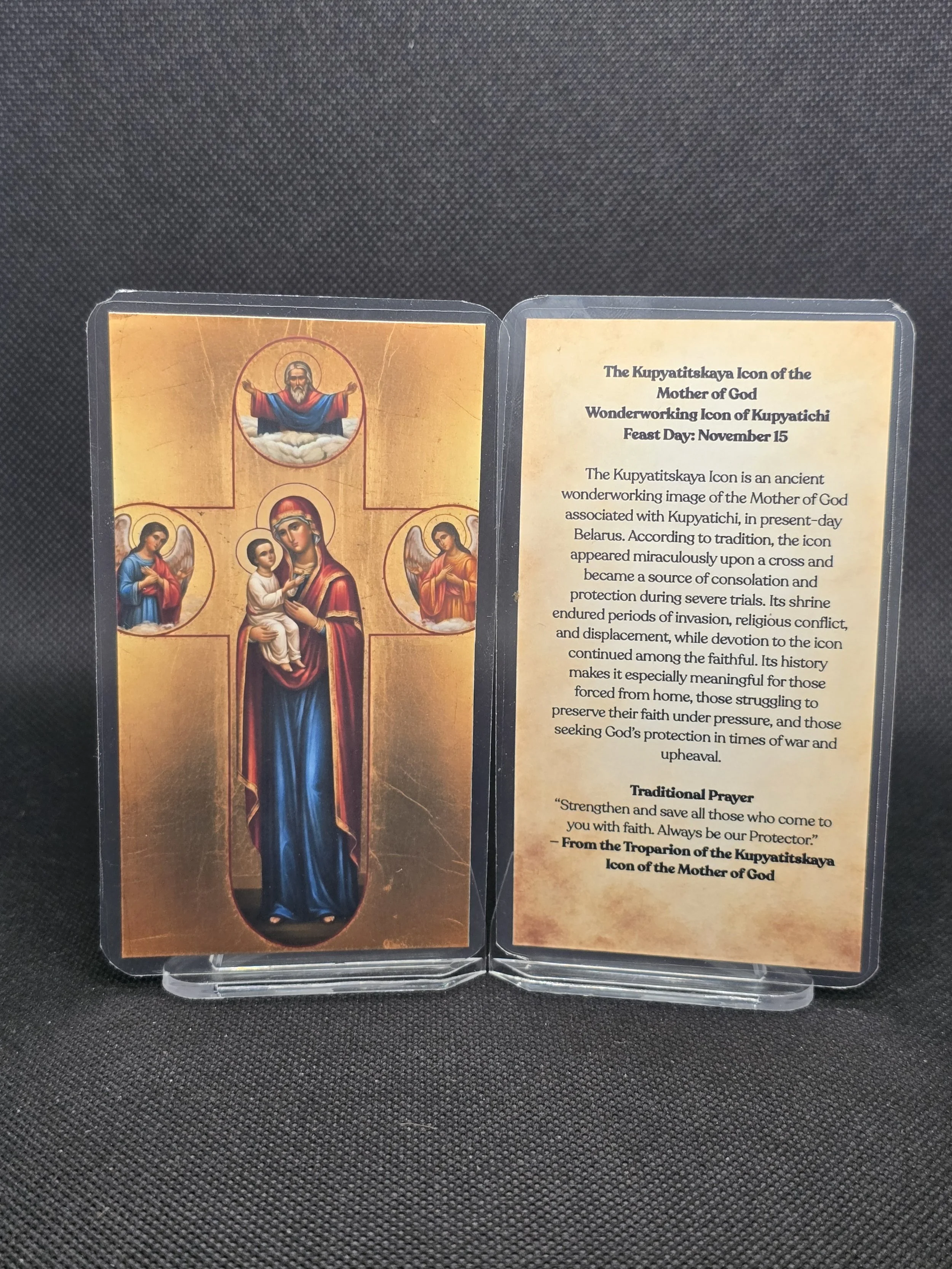
The Kupyatitskaya Icon first entered recorded history in 1182 in what is now southern Belarus.
A shepherdess named Anna discovered the small copper relief while tending animals near Kupyatichi. The icon was reportedly shining with light, drawing attention despite its modest size. The faithful recognized the event as sacred, and the icon was brought into the community.
A church was later constructed at the place of its appearance, establishing Kupyatichi as an early Marian devotional site.
For several decades, the icon remained in the region.
Then history intervened.
During the Mongol invasions of Eastern Europe in the 1200s, much of the surrounding territory was destroyed. Churches were burned. Villages were emptied. In response to the advancing devastation, the Kupyatitskaya Icon was carried away for protection.
It was eventually brought to Kyiv and placed at Kyiv Pechersk Lavra, where it became part of the monastery’s sacred treasury and continues to be honored today.
The icon never returned to Kupyatichi.
Its story became one of movement rather than location.
It belongs to the long Christian memory of sacred objects preserved during war, displacement, and cultural collapse. It represents the survival of faith when geography changes, borders fall, and communities scatter.
The Kupyatitskaya Icon stands as a quiet witness to continuity across catastrophe.
-
MIRACLES & PATRONAGE
Historically, the Kupyatitskaya Icon is primarily associated with preservation during invasion and continuity of devotion through displacement.
While later devotional traditions speak broadly of intercession, the earliest records emphasize protection of the icon itself and its survival through wartime upheaval.
For this reason, the icon is traditionally approached in prayer for:
Associated Intercessions:
• Protection during displacement or forced relocation
• Perseverance of faith during war or political collapse
• Spiritual stability when familiar life is uprooted
• Continuity of prayer across generations
• God’s presence during historical upheavalThe Kupyatitskaya Icon does not come to us through stories of spectacle.
It comes through survival.
Its miracle is endurance.
-
PRAYERS TO THE KUPYATITSKAYA ICON OF THE MOTHER OF GOD
Traditional Invocation
Most Holy Mother of God of Kupyatichi, pray for us.
Preserve our faith.
Guard us in upheaval.
Remain with us in exile.Amen.
Personal Devotional Prayer
Most Holy Theotokos, Mother of Kupyatichi, I come to you carrying uncertainty about what lies ahead.
You were found in the wilderness.
You were carried through invasion.
You remained present even when your people were scattered.Teach me how to remain faithful when life changes suddenly.
Stand beside me when familiar ground disappears.
Intercede when fear rises in times of instability.
Cover my loved ones when safety feels fragile.You who traveled far from your place of appearing, teach me trust.
You who endured history with quiet dignity, teach me perseverance.
You who remained with the faithful through devastation, teach me hope.Help me carry Christ within my heart wherever I am led.
Mother of God of Kupyatichi, pray for me.
Pray for the displaced.
Pray for every soul searching for stability.Amen.
-
FAQ
What is the Kupyatitskaya Icon known for?
It is known as one of the oldest Marian icons connected to Belarus, discovered in 1182 and later preserved during the Mongol invasions by being transferred to Kyiv Pechersk Lavra.When is the Kupyatitskaya Icon commemorated?
It is celebrated on September 14 in the Orthodox calendar, corresponding to September 27 on the Gregorian calendar. Eastern Catholic communities honor the icon on these same dates locally.Which Christian traditions venerate this icon?
It is venerated in Eastern Orthodoxy and honored within Eastern Catholic devotional life.Why do people pray before the Kupyatitskaya Icon during displacement or upheaval?
Because its entire history is tied to survival through invasion and forced relocation, making it a powerful symbol of faith preserved during instability.