 Image 1 of 1
Saint Euphrosynos the Cook
Saint Euphrosynos the Cook is an Orthodox saint for every person whose work is necessary, exhausting, hidden, and rarely thanked. He is the saint of the monastery kitchen, the dish pit, the prep station, the hot line, the back room, and every unnoticed place where humble labor keeps other people fed, comforted, and alive.
In Orthodox tradition, Saint Euphrosynos is remembered as a humble monastery cook whose holiness went entirely unnoticed by his brother monks until God revealed the sanctity hiding in plain sight in their own kitchen. He had no powerful position, no celebrated education, no public ministry, and no reputation for greatness. He simply cooked, served, endured mockery, and obeyed God in the work placed before him.
For this reason, Saint Euphrosynos is especially meaningful as the unofficial patron saint of kitchen workers and thankless labor. His story speaks directly to dishwashers, line cooks, prep cooks, chefs, bakers, restaurant workers, cafeteria workers, food service staff, parish kitchen volunteers, home cooks, and anyone doing essential invisible work that nobody seems to notice. His life gives a direct promise to the overlooked worker: God sees what the kitchen does not.
Saint Euphrosynos was born into a poor peasant family and had no formal schooling. As an adult, he worked as a cook and was known for self-denial and charity. Later, he entered a monastery, where his obedience was to prepare meals for the brethren. Some of the monks looked down on him because of his simple background and lowly work, but Euphrosynos accepted humiliation quietly and continued serving with humility.
His hidden holiness was revealed through a miraculous vision. A devout priest in the monastery had prayed to see the blessings prepared for those who love God. One night, in a vision, the priest found himself in Paradise and saw Saint Euphrosynos standing there in glory. When the priest asked where they were, Euphrosynos explained that this was the place prepared for God’s elect. The priest asked for something from the garden, and Euphrosynos gave him fragrant apples from Paradise.
When the priest awoke, the apples were physically present with him, still carrying the fragrance of Heaven. He went to church, questioned Euphrosynos, and eventually told the other monks what had happened. When the brethren rushed to the kitchen, Euphrosynos had already left the monastery to escape praise and attention.
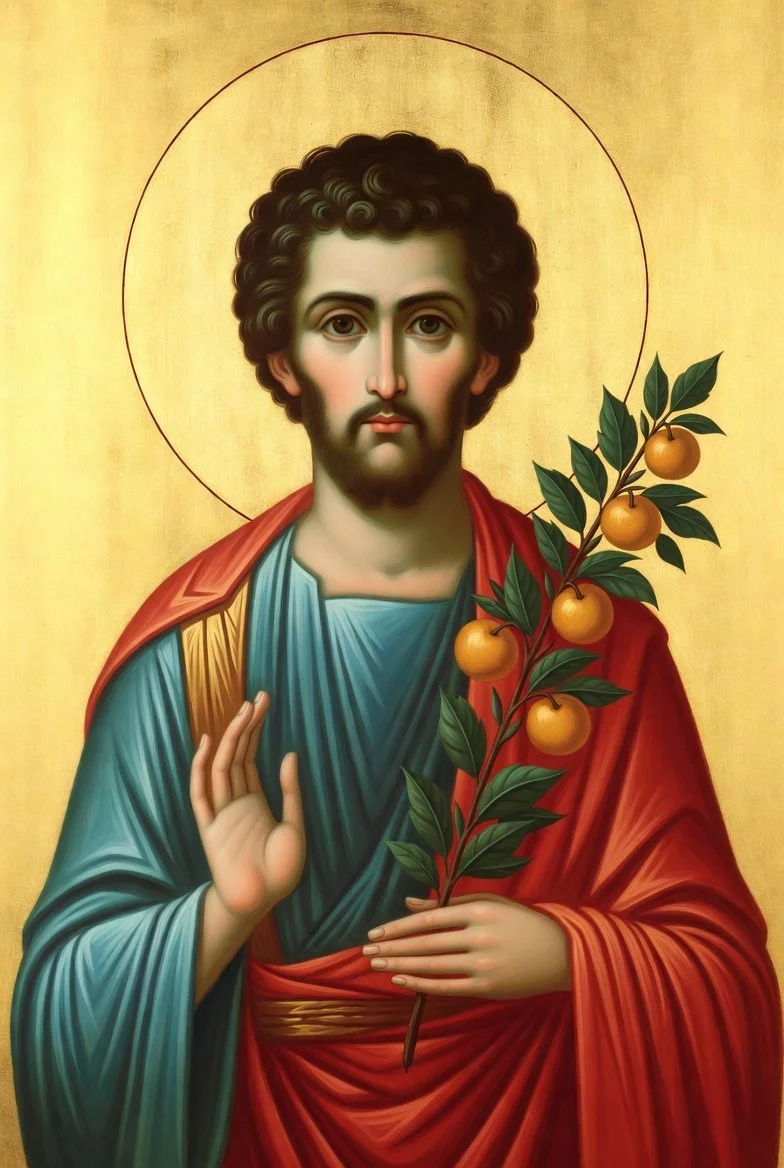
This is why icons of Saint Euphrosynos often show him holding apples from Paradise. Those apples are not merely a symbol of a beautiful miracle. They are a sign that hidden labor bears eternal fruit, that God honors humble service, and that a person can become holy in the most ordinary and overlooked place imaginable.
Saint Euphrosynos is a powerful intercessor for cooks, chefs, bakers, dishwashers, line cooks, kitchen workers, restaurant workers, food service workers, hospitality workers, homemakers, monastic cooks, and everyone whose work is unseen, underpaid, exhausting, or taken for granted. He is also a saint for anyone who feels mocked, dismissed, underestimated, or trapped in work that others treat as lowly.
His life teaches that holiness is not limited to the altar, the pulpit, the classroom, or the monastery cell. Holiness can be found at the stove, over a sink full of dishes, beside a cutting board, in the heat of a restaurant kitchen, in the quiet preparation of family meals, and in every act of service done with humility before God.
This prayer card is created for kitchen workers, restaurant workers, cooks, bakers, dishwashers, food service staff, homemakers, parish volunteers, monastics, and anyone carrying thankless labor with patience. Saint Euphrosynos reminds the soul that hidden work is not hidden from God, humble service is not wasted, and the kitchen can become a place of prayer.
Saint Euphrosynos’ patronage includes cooks, chefs, bakers, kitchens, dishwashers, line cooks, restaurant workers, food service workers, cafeteria workers, hospitality workers, home cooks, monastic cooks, humble laborers, thankless labor, hidden servants of God, and those who feel unseen in their work.
Each card is handmade in Austin, TX and created to order. We do not keep stock, because every prayer card is treated as a unique devotional offering. They are printed on museum-quality photo paper, not cardstock. Every card is made slowly, during prayer, with intentional reverence for the saint or holy image and for the person who will receive it. Names are lifted before Christ. Intentions are held carefully. Each piece is handled multiple times in prayerful silence, asking God for mercy and asking the saint to intercede for the soul it is being made for. This is not production work. It is devotional craftsmanship shaped with patience, care, and spiritual responsibility, because every soul and every prayer matters.
THE LIFE & STORY
Saint Euphrosynos the Cook, also known as Saint Euphrosynos of Alexandria, is remembered in the Orthodox Church as a hidden saint of humble service. He was born into a poor peasant family and received no formal education, yet his soul was shaped by simplicity, faith, obedience, and love for God. His lack of schooling did not keep him from holiness, because the wisdom God gave him was not the wisdom of worldly status, pride, or recognition.
As an adult, Euphrosynos became a cook. In that work, he could have pursued comfort, indulgence, or selfish gain, but he practiced self-denial and gave alms to others. Later, he entered a monastery, where he was assigned to the kitchen and served the brotherhood by preparing their food. In the eyes of many, this was lowly work. In the eyes of God, it became the place where a saint was formed.
The monastery kitchen was Saint Euphrosynos’ hidden desert. He cooked plain meals, labored quietly, endured the heat and repetition of daily service, and accepted the complaints and contempt of others with meekness. Some of the monks mocked him because of his rough background and simple obedience. They saw a cook who could be dismissed, not a holy man standing before them in the very place where their own meals were prepared.
Euphrosynos did not defend himself or demand to be recognized. He did not insist that his work mattered. He simply continued to serve. That is part of what makes him so powerful for kitchen workers and people doing thankless labor today. His life does not romanticize hard work or pretend that being overlooked does not hurt. Instead, it reveals that God sees the worker whom others ignore.
In the same monastery there was a devout priest who desired to know what good things God had prepared for those who love Him. One night, as he slept, he saw himself in a beautiful garden filled with heavenly wonder. There he saw Euphrosynos, the monastery cook, standing in Paradise. The priest was astonished that the humble cook whom others had mocked was revealed in glory.
When the priest asked how he had come to be there, Saint Euphrosynos explained that this was the place prepared for God’s elect. The priest then asked if he could receive something from the garden, and Euphrosynos gave him apples. When the priest awoke, he found the apples still with him, fragrant and real, as a physical sign that the vision had truly come from God.
The priest questioned Euphrosynos, and when the humble saint finally acknowledged what had happened, the truth spread among the brethren. The monks who had looked down on the cook now understood that sanctity had been hidden in their own kitchen. But Saint Euphrosynos wanted no praise. Before they could honor him, he fled the monastery and disappeared into obscurity.
The apples from Paradise became the lasting sign of his hidden holiness. In icons, Saint Euphrosynos is often shown holding them, reminding the faithful that the fruit of humble service may only be fully revealed in the Kingdom of God. The kitchen worker, the dishwasher, the cook, the exhausted servant, and the person doing invisible labor are not forgotten by Heaven.
Saint Euphrosynos’ life is a direct rebuke to every worldly judgment that treats humble labor as unimportant. The monks thought the cook was beneath them. God showed that the cook was already standing in Paradise.
MIRACLES & PATRONAGE
The great miracle associated with Saint Euphrosynos is the vision of Paradise and the apples given to the priest. This miracle is especially meaningful because it did not reveal a famous leader, a celebrated teacher, or a public wonderworker. It revealed a kitchen worker. It revealed the man everyone had overlooked. It revealed that the one serving meals in humility was already known by God as a citizen of Paradise.
The apples are central to his story and iconography. They symbolize heavenly joy, hidden virtue, spiritual sweetness, and the eternal fruit of humble service. In the vision, the priest asked for something from Paradise, and Euphrosynos gave him apples. When the priest awoke and found the apples still with him, God made visible what had been hidden: the cook’s labor, patience, and humility were precious in Heaven.
Saint Euphrosynos is especially loved as a patron of cooks and kitchen workers. His patronage naturally extends to chefs, bakers, dishwashers, line cooks, prep cooks, restaurant workers, cafeteria workers, food service workers, hospitality workers, monastic cooks, home cooks, parish kitchen volunteers, and anyone who feeds others. He is also deeply meaningful for people whose labor is essential but treated as invisible.
His unofficial patronage of kitchen workers and thankless labor is one of the most powerful ways to understand his story today. Many people work in places where the pressure is high, the thanks are rare, the pay is low, and the labor is constant. Dishes pile up. Orders come in. Food must be prepared quickly. Complaints are common. Praise is not. Saint Euphrosynos stands beside those workers as a witness that God sees what others ignore.
He is also a saint for anyone doing overlooked work outside the kitchen. Janitors, cleaners, caregivers, stockroom workers, delivery drivers, maintenance workers, parents, homemakers, volunteers, and quiet servants of every kind can recognize themselves in his story. He belongs to every person who has wondered whether invisible work matters when nobody says thank you.
People ask Saint Euphrosynos to intercede for peaceful kitchens, patient service, protection for food workers, humility in hidden labor, blessing over meals, strength during exhausting shifts, and the grace to serve without bitterness. He is a saint for anyone who wants ordinary labor to become an offering to God.
Saint Euphrosynos teaches that a kitchen can become a place of prayer, food can become an act of mercy, and thankless labor can become a hidden path to Paradise. His story promises that no act of humble service is lost when it is done before God.
PRAYERS
A simple invocation may be prayed often: Saint Euphrosynos the Cook, pray for us.
The Orthodox Church preserves hymns for Saint Euphrosynos that honor his humility, ascetic labor, service as a cook, heavenly joy, and intercession for those who honor him. These hymns are especially fitting for those who want their devotion rooted in the living prayer of the Church.
For cooks and kitchen workers, one may pray: Saint Euphrosynos the Cook, pray for all who prepare food, wash dishes, clean kitchens, serve meals, and feed others. Ask Christ to give them patience, strength, peace, and the grace to see their labor as an offering to God.
For thankless labor, one may pray: Saint Euphrosynos, humble servant of God, pray for all who work without recognition, all who serve without being thanked, and all who feel unseen in the labor placed before them. Ask the Lord to comfort them with the truth that their work is seen by Heaven.
Before cooking, one may pray: Saint Euphrosynos, pray that this food may be prepared with gratitude, humility, cleanliness, peace, and love. May those who receive it be strengthened in body and reminded of the goodness of God.
For restaurant workers, one may pray: Saint Euphrosynos, pray for dishwashers, line cooks, prep cooks, servers, bakers, chefs, and all who labor in food service. Ask Christ to protect them from exhaustion, bitterness, injury, and discouragement, and to bless the work of their hands.
For hidden service, one may pray: Saint Euphrosynos, who was mocked on earth and revealed in Paradise, pray for me when my work feels invisible. Help me serve with humility, endure with patience, and remember that God sees what the world does not.
For hospitality, one may pray: Saint Euphrosynos, pray that our tables may become places of peace, mercy, welcome, nourishment, and thanksgiving. Teach us to feed others with love and to receive every meal as a gift from God.
FAQ
Who is Saint Euphrosynos the Cook?
Saint Euphrosynos the Cook, also called Saint Euphrosynos of Alexandria, is an Orthodox saint remembered as a humble monastery cook whose hidden holiness was revealed through a vision of Paradise. He was born into a poor peasant family, had no formal schooling, became a cook, and later served in a monastery kitchen with humility and patience.
Why is Saint Euphrosynos called “the Cook”?
He is called “the Cook” because his monastic obedience was to serve in the kitchen and prepare meals for the brethren. His title matters because it shows that holiness can be found in practical, humble, hidden work that the world often overlooks.
Is Saint Euphrosynos Orthodox?
Yes. Saint Euphrosynos the Cook is especially venerated in the Orthodox Church. His story, feast day, icons, and hymns are deeply rooted in Orthodox tradition.
What is Saint Euphrosynos the patron saint of?
Saint Euphrosynos is especially loved as a patron of cooks, chefs, bakers, kitchens, food service workers, restaurant workers, dishwashers, line cooks, hospitality workers, monastic cooks, home cooks, and those who serve others through food. He is also meaningful for anyone who feels unseen, mocked, underestimated, or taken for granted.
Is Saint Euphrosynos the official patron saint of kitchen workers and thankless labor?
Saint Euphrosynos is best described as an unofficial patron saint of kitchen workers and thankless labor. His life as a humble monastery cook, mocked and overlooked by others yet revealed by God as holy, makes him a powerful intercessor for every person doing essential invisible work.
Why is Saint Euphrosynos a good saint for dishwashers and line cooks?
Saint Euphrosynos is a good saint for dishwashers, line cooks, prep cooks, and kitchen workers because his own path to holiness was hidden in the kitchen. He understands difficult, repetitive, unseen labor and reminds workers that God sees the service others fail to thank.
What is the story of Saint Euphrosynos and the apples?
A priest in the monastery prayed to see the blessings prepared for those who love God. In a vision, he found himself in Paradise and saw Saint Euphrosynos there. Euphrosynos gave him fragrant apples from the heavenly garden, and when the priest awoke, the apples were still physically present. This miracle revealed the hidden holiness of the humble cook.
Why does Saint Euphrosynos hold apples in icons?
Saint Euphrosynos is often shown holding apples because of the miracle in which he gave apples from Paradise to a priest in a vision. The apples symbolize heavenly joy, hidden virtue, and the eternal fruit of humble service.
When is Saint Euphrosynos’ feast day?
Saint Euphrosynos the Cook is commemorated on September 11 in the Orthodox Church.
Can I give this prayer card to a cook or restaurant worker?
Yes. This prayer card is especially fitting for cooks, chefs, bakers, dishwashers, line cooks, prep cooks, restaurant workers, food service staff, cafeteria workers, and anyone who works in a kitchen or feeds others.
Is this prayer card good for someone who feels unseen at work?
Yes. Saint Euphrosynos is one of the most meaningful saints for people who feel invisible, underappreciated, or dismissed in their work. His story directly promises that God sees what others overlook.
What does Saint Euphrosynos teach us?
Saint Euphrosynos teaches that hidden labor can become holy when it is offered to God. His life reminds us that humble service is not wasted, thankless work is not unseen, and the person serving quietly may be closer to Paradise than anyone realizes.
What is the main message of Saint Euphrosynos’ life?
The main message of Saint Euphrosynos’ life is that God sees hidden holiness. The monks saw only a cook, but God revealed a saint. His life is a promise to every overlooked worker that their labor matters before Heaven.
Saint Euphrosynos the Cook is an Orthodox saint for every person whose work is necessary, exhausting, hidden, and rarely thanked. He is the saint of the monastery kitchen, the dish pit, the prep station, the hot line, the back room, and every unnoticed place where humble labor keeps other people fed, comforted, and alive.
In Orthodox tradition, Saint Euphrosynos is remembered as a humble monastery cook whose holiness went entirely unnoticed by his brother monks until God revealed the sanctity hiding in plain sight in their own kitchen. He had no powerful position, no celebrated education, no public ministry, and no reputation for greatness. He simply cooked, served, endured mockery, and obeyed God in the work placed before him.
For this reason, Saint Euphrosynos is especially meaningful as the unofficial patron saint of kitchen workers and thankless labor. His story speaks directly to dishwashers, line cooks, prep cooks, chefs, bakers, restaurant workers, cafeteria workers, food service staff, parish kitchen volunteers, home cooks, and anyone doing essential invisible work that nobody seems to notice. His life gives a direct promise to the overlooked worker: God sees what the kitchen does not.
Saint Euphrosynos was born into a poor peasant family and had no formal schooling. As an adult, he worked as a cook and was known for self-denial and charity. Later, he entered a monastery, where his obedience was to prepare meals for the brethren. Some of the monks looked down on him because of his simple background and lowly work, but Euphrosynos accepted humiliation quietly and continued serving with humility.
His hidden holiness was revealed through a miraculous vision. A devout priest in the monastery had prayed to see the blessings prepared for those who love God. One night, in a vision, the priest found himself in Paradise and saw Saint Euphrosynos standing there in glory. When the priest asked where they were, Euphrosynos explained that this was the place prepared for God’s elect. The priest asked for something from the garden, and Euphrosynos gave him fragrant apples from Paradise.
When the priest awoke, the apples were physically present with him, still carrying the fragrance of Heaven. He went to church, questioned Euphrosynos, and eventually told the other monks what had happened. When the brethren rushed to the kitchen, Euphrosynos had already left the monastery to escape praise and attention.
This is why icons of Saint Euphrosynos often show him holding apples from Paradise. Those apples are not merely a symbol of a beautiful miracle. They are a sign that hidden labor bears eternal fruit, that God honors humble service, and that a person can become holy in the most ordinary and overlooked place imaginable.
Saint Euphrosynos is a powerful intercessor for cooks, chefs, bakers, dishwashers, line cooks, kitchen workers, restaurant workers, food service workers, hospitality workers, homemakers, monastic cooks, and everyone whose work is unseen, underpaid, exhausting, or taken for granted. He is also a saint for anyone who feels mocked, dismissed, underestimated, or trapped in work that others treat as lowly.
His life teaches that holiness is not limited to the altar, the pulpit, the classroom, or the monastery cell. Holiness can be found at the stove, over a sink full of dishes, beside a cutting board, in the heat of a restaurant kitchen, in the quiet preparation of family meals, and in every act of service done with humility before God.
This prayer card is created for kitchen workers, restaurant workers, cooks, bakers, dishwashers, food service staff, homemakers, parish volunteers, monastics, and anyone carrying thankless labor with patience. Saint Euphrosynos reminds the soul that hidden work is not hidden from God, humble service is not wasted, and the kitchen can become a place of prayer.
Saint Euphrosynos’ patronage includes cooks, chefs, bakers, kitchens, dishwashers, line cooks, restaurant workers, food service workers, cafeteria workers, hospitality workers, home cooks, monastic cooks, humble laborers, thankless labor, hidden servants of God, and those who feel unseen in their work.
Each card is handmade in Austin, TX and created to order. We do not keep stock, because every prayer card is treated as a unique devotional offering. They are printed on museum-quality photo paper, not cardstock. Every card is made slowly, during prayer, with intentional reverence for the saint or holy image and for the person who will receive it. Names are lifted before Christ. Intentions are held carefully. Each piece is handled multiple times in prayerful silence, asking God for mercy and asking the saint to intercede for the soul it is being made for. This is not production work. It is devotional craftsmanship shaped with patience, care, and spiritual responsibility, because every soul and every prayer matters.
THE LIFE & STORY
Saint Euphrosynos the Cook, also known as Saint Euphrosynos of Alexandria, is remembered in the Orthodox Church as a hidden saint of humble service. He was born into a poor peasant family and received no formal education, yet his soul was shaped by simplicity, faith, obedience, and love for God. His lack of schooling did not keep him from holiness, because the wisdom God gave him was not the wisdom of worldly status, pride, or recognition.
As an adult, Euphrosynos became a cook. In that work, he could have pursued comfort, indulgence, or selfish gain, but he practiced self-denial and gave alms to others. Later, he entered a monastery, where he was assigned to the kitchen and served the brotherhood by preparing their food. In the eyes of many, this was lowly work. In the eyes of God, it became the place where a saint was formed.
The monastery kitchen was Saint Euphrosynos’ hidden desert. He cooked plain meals, labored quietly, endured the heat and repetition of daily service, and accepted the complaints and contempt of others with meekness. Some of the monks mocked him because of his rough background and simple obedience. They saw a cook who could be dismissed, not a holy man standing before them in the very place where their own meals were prepared.
Euphrosynos did not defend himself or demand to be recognized. He did not insist that his work mattered. He simply continued to serve. That is part of what makes him so powerful for kitchen workers and people doing thankless labor today. His life does not romanticize hard work or pretend that being overlooked does not hurt. Instead, it reveals that God sees the worker whom others ignore.
In the same monastery there was a devout priest who desired to know what good things God had prepared for those who love Him. One night, as he slept, he saw himself in a beautiful garden filled with heavenly wonder. There he saw Euphrosynos, the monastery cook, standing in Paradise. The priest was astonished that the humble cook whom others had mocked was revealed in glory.
When the priest asked how he had come to be there, Saint Euphrosynos explained that this was the place prepared for God’s elect. The priest then asked if he could receive something from the garden, and Euphrosynos gave him apples. When the priest awoke, he found the apples still with him, fragrant and real, as a physical sign that the vision had truly come from God.
The priest questioned Euphrosynos, and when the humble saint finally acknowledged what had happened, the truth spread among the brethren. The monks who had looked down on the cook now understood that sanctity had been hidden in their own kitchen. But Saint Euphrosynos wanted no praise. Before they could honor him, he fled the monastery and disappeared into obscurity.
The apples from Paradise became the lasting sign of his hidden holiness. In icons, Saint Euphrosynos is often shown holding them, reminding the faithful that the fruit of humble service may only be fully revealed in the Kingdom of God. The kitchen worker, the dishwasher, the cook, the exhausted servant, and the person doing invisible labor are not forgotten by Heaven.
Saint Euphrosynos’ life is a direct rebuke to every worldly judgment that treats humble labor as unimportant. The monks thought the cook was beneath them. God showed that the cook was already standing in Paradise.
MIRACLES & PATRONAGE
The great miracle associated with Saint Euphrosynos is the vision of Paradise and the apples given to the priest. This miracle is especially meaningful because it did not reveal a famous leader, a celebrated teacher, or a public wonderworker. It revealed a kitchen worker. It revealed the man everyone had overlooked. It revealed that the one serving meals in humility was already known by God as a citizen of Paradise.
The apples are central to his story and iconography. They symbolize heavenly joy, hidden virtue, spiritual sweetness, and the eternal fruit of humble service. In the vision, the priest asked for something from Paradise, and Euphrosynos gave him apples. When the priest awoke and found the apples still with him, God made visible what had been hidden: the cook’s labor, patience, and humility were precious in Heaven.
Saint Euphrosynos is especially loved as a patron of cooks and kitchen workers. His patronage naturally extends to chefs, bakers, dishwashers, line cooks, prep cooks, restaurant workers, cafeteria workers, food service workers, hospitality workers, monastic cooks, home cooks, parish kitchen volunteers, and anyone who feeds others. He is also deeply meaningful for people whose labor is essential but treated as invisible.
His unofficial patronage of kitchen workers and thankless labor is one of the most powerful ways to understand his story today. Many people work in places where the pressure is high, the thanks are rare, the pay is low, and the labor is constant. Dishes pile up. Orders come in. Food must be prepared quickly. Complaints are common. Praise is not. Saint Euphrosynos stands beside those workers as a witness that God sees what others ignore.
He is also a saint for anyone doing overlooked work outside the kitchen. Janitors, cleaners, caregivers, stockroom workers, delivery drivers, maintenance workers, parents, homemakers, volunteers, and quiet servants of every kind can recognize themselves in his story. He belongs to every person who has wondered whether invisible work matters when nobody says thank you.
People ask Saint Euphrosynos to intercede for peaceful kitchens, patient service, protection for food workers, humility in hidden labor, blessing over meals, strength during exhausting shifts, and the grace to serve without bitterness. He is a saint for anyone who wants ordinary labor to become an offering to God.
Saint Euphrosynos teaches that a kitchen can become a place of prayer, food can become an act of mercy, and thankless labor can become a hidden path to Paradise. His story promises that no act of humble service is lost when it is done before God.
PRAYERS
A simple invocation may be prayed often: Saint Euphrosynos the Cook, pray for us.
The Orthodox Church preserves hymns for Saint Euphrosynos that honor his humility, ascetic labor, service as a cook, heavenly joy, and intercession for those who honor him. These hymns are especially fitting for those who want their devotion rooted in the living prayer of the Church.
For cooks and kitchen workers, one may pray: Saint Euphrosynos the Cook, pray for all who prepare food, wash dishes, clean kitchens, serve meals, and feed others. Ask Christ to give them patience, strength, peace, and the grace to see their labor as an offering to God.
For thankless labor, one may pray: Saint Euphrosynos, humble servant of God, pray for all who work without recognition, all who serve without being thanked, and all who feel unseen in the labor placed before them. Ask the Lord to comfort them with the truth that their work is seen by Heaven.
Before cooking, one may pray: Saint Euphrosynos, pray that this food may be prepared with gratitude, humility, cleanliness, peace, and love. May those who receive it be strengthened in body and reminded of the goodness of God.
For restaurant workers, one may pray: Saint Euphrosynos, pray for dishwashers, line cooks, prep cooks, servers, bakers, chefs, and all who labor in food service. Ask Christ to protect them from exhaustion, bitterness, injury, and discouragement, and to bless the work of their hands.
For hidden service, one may pray: Saint Euphrosynos, who was mocked on earth and revealed in Paradise, pray for me when my work feels invisible. Help me serve with humility, endure with patience, and remember that God sees what the world does not.
For hospitality, one may pray: Saint Euphrosynos, pray that our tables may become places of peace, mercy, welcome, nourishment, and thanksgiving. Teach us to feed others with love and to receive every meal as a gift from God.
FAQ
Who is Saint Euphrosynos the Cook?
Saint Euphrosynos the Cook, also called Saint Euphrosynos of Alexandria, is an Orthodox saint remembered as a humble monastery cook whose hidden holiness was revealed through a vision of Paradise. He was born into a poor peasant family, had no formal schooling, became a cook, and later served in a monastery kitchen with humility and patience.
Why is Saint Euphrosynos called “the Cook”?
He is called “the Cook” because his monastic obedience was to serve in the kitchen and prepare meals for the brethren. His title matters because it shows that holiness can be found in practical, humble, hidden work that the world often overlooks.
Is Saint Euphrosynos Orthodox?
Yes. Saint Euphrosynos the Cook is especially venerated in the Orthodox Church. His story, feast day, icons, and hymns are deeply rooted in Orthodox tradition.
What is Saint Euphrosynos the patron saint of?
Saint Euphrosynos is especially loved as a patron of cooks, chefs, bakers, kitchens, food service workers, restaurant workers, dishwashers, line cooks, hospitality workers, monastic cooks, home cooks, and those who serve others through food. He is also meaningful for anyone who feels unseen, mocked, underestimated, or taken for granted.
Is Saint Euphrosynos the official patron saint of kitchen workers and thankless labor?
Saint Euphrosynos is best described as an unofficial patron saint of kitchen workers and thankless labor. His life as a humble monastery cook, mocked and overlooked by others yet revealed by God as holy, makes him a powerful intercessor for every person doing essential invisible work.
Why is Saint Euphrosynos a good saint for dishwashers and line cooks?
Saint Euphrosynos is a good saint for dishwashers, line cooks, prep cooks, and kitchen workers because his own path to holiness was hidden in the kitchen. He understands difficult, repetitive, unseen labor and reminds workers that God sees the service others fail to thank.
What is the story of Saint Euphrosynos and the apples?
A priest in the monastery prayed to see the blessings prepared for those who love God. In a vision, he found himself in Paradise and saw Saint Euphrosynos there. Euphrosynos gave him fragrant apples from the heavenly garden, and when the priest awoke, the apples were still physically present. This miracle revealed the hidden holiness of the humble cook.
Why does Saint Euphrosynos hold apples in icons?
Saint Euphrosynos is often shown holding apples because of the miracle in which he gave apples from Paradise to a priest in a vision. The apples symbolize heavenly joy, hidden virtue, and the eternal fruit of humble service.
When is Saint Euphrosynos’ feast day?
Saint Euphrosynos the Cook is commemorated on September 11 in the Orthodox Church.
Can I give this prayer card to a cook or restaurant worker?
Yes. This prayer card is especially fitting for cooks, chefs, bakers, dishwashers, line cooks, prep cooks, restaurant workers, food service staff, cafeteria workers, and anyone who works in a kitchen or feeds others.
Is this prayer card good for someone who feels unseen at work?
Yes. Saint Euphrosynos is one of the most meaningful saints for people who feel invisible, underappreciated, or dismissed in their work. His story directly promises that God sees what others overlook.
What does Saint Euphrosynos teach us?
Saint Euphrosynos teaches that hidden labor can become holy when it is offered to God. His life reminds us that humble service is not wasted, thankless work is not unseen, and the person serving quietly may be closer to Paradise than anyone realizes.
What is the main message of Saint Euphrosynos’ life?
The main message of Saint Euphrosynos’ life is that God sees hidden holiness. The monks saw only a cook, but God revealed a saint. His life is a promise to every overlooked worker that their labor matters before Heaven.