 Image 1 of 1
-
THE LIFE & STORY
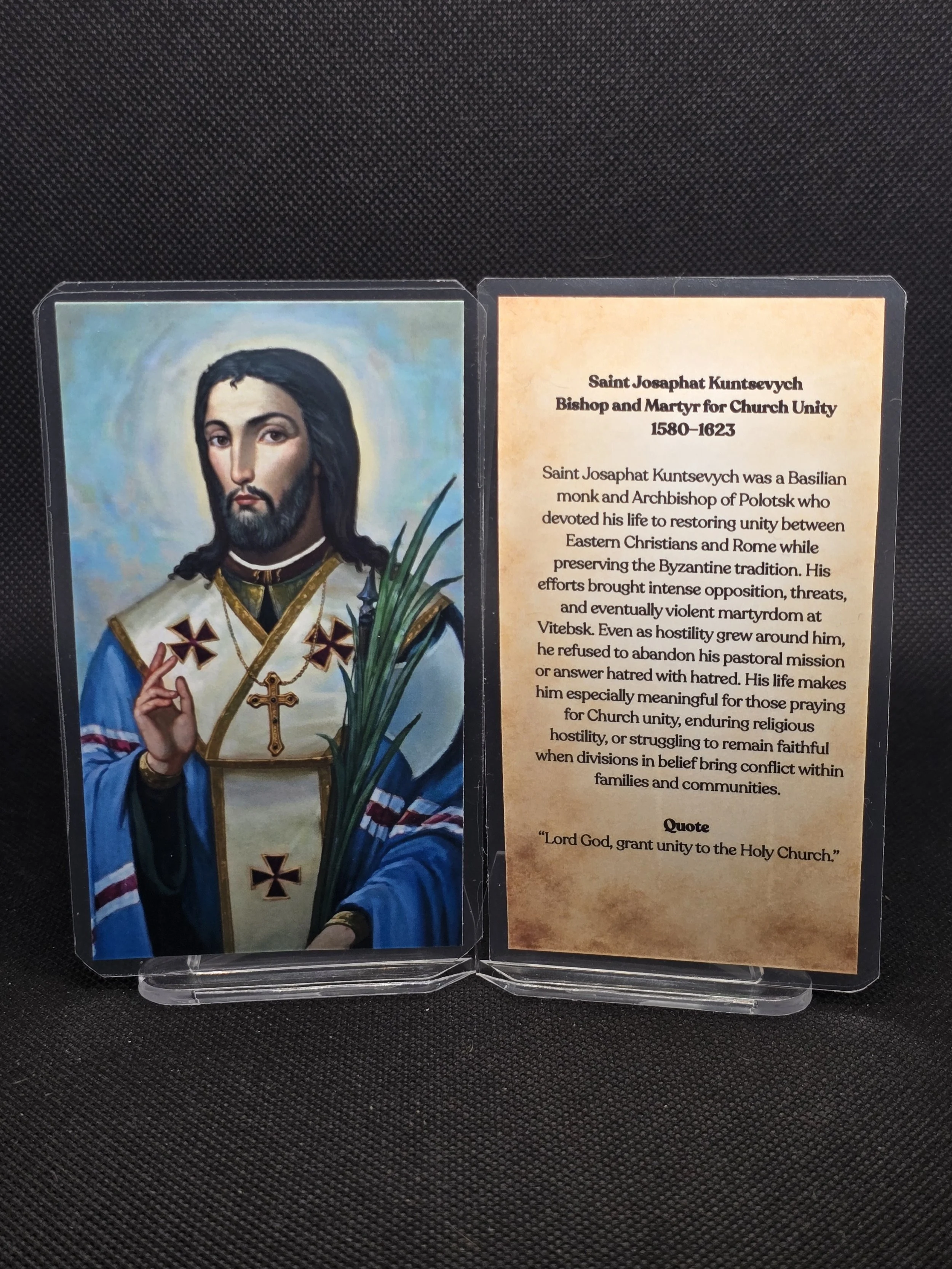
Josaphat was born Ivan Kuncevic in 1580 in Volodymyr, within the Polish-Lithuanian Commonwealth. Raised in a devout Ruthenian family, he grew up in the Byzantine liturgical tradition. As a young man, he entered the Basilian monastic order and took the name Josaphat.
He embraced monastic discipline with seriousness.
He fasted.
He prayed.
He studied.
The Union of Brest in 1596 had brought segments of the Ruthenian Church into communion with Rome while preserving Byzantine liturgy and spirituality. This union, however, was fiercely opposed by many who saw it as betrayal.
Josaphat became a passionate advocate for reform and unity within the Church. He was appointed Archbishop of Polotsk in 1618, where tensions between Orthodox and Greek Catholic communities ran high.
He preached reconciliation.
He also enforced discipline.
His firmness earned him both admiration and resentment.
Opposition grew violent. His residence was attacked. He was warned repeatedly to flee. He refused.
In 1623, an enraged mob broke into his residence. He was beaten, shot, and killed. His body was thrown into the Dvina River.
His martyrdom shocked the region.
Even some of his opponents were moved by the brutality of his death. Over time, his blood became a symbol of the cost of unity.
He was canonized in 1867 by Pope Pius IX.
Saint Josaphat teaches that unity pursued without love becomes politics.
Unity pursued with sacrifice becomes witness.
-
MIRACLES & PATRONAGE
Patron Saint Of:
Church unity and reconciliation
Courage during religious conflict
Perseverance under persecution
Healing from ecclesial division
Strength for clergy and bishops
Saint Josaphat’s martyrdom became itself a catalyst for reconciliation in some communities. His relics were venerated, and over time, devotion to him softened hostility.
Miracles have been reported through his intercession, particularly in matters of healing and reconciliation. His life continues to inspire prayers for unity between East and West.
He is invoked especially by clergy navigating division, by believers wounded by church conflict, and by those praying for Christian unity.
His miracles often appear as softened hearts.
Bitterness easing.
Dialogue reopening.
Courage strengthening amid hostility.He remains a sign that unity sometimes costs blood.
-
PRAYERS
Short Traditional Invocation
Saint Josaphat, martyr for Christian unity, pray for us.
Traditional Catholic Prayer to Saint Josaphat
O Saint Josaphat,
who gave your life for the unity of the Church,
obtain for us from Christ the grace to love unity
with courage and humility.Intercede for divided Christians.
Strengthen those who suffer for reconciliation.
Grant us patience in conflict
and fidelity in truth.May your martyrdom bear fruit in our time,
and may Christ bring His Church
into visible and lasting unity.Amen.
-
FAQ
What is Saint Josaphat known for?
He is known as a Ukrainian Greek Catholic bishop martyred for promoting unity between the Ruthenian Church and Rome.When is his feast day?
November 12 in both the Byzantine Catholic and Roman calendars.Which Christian traditions venerate Saint Josaphat?
He is venerated by the Catholic Church, particularly within the Ukrainian Greek Catholic tradition.Why do people pray to Saint Josaphat for unity?
Because he sacrificed his life advocating reconciliation between divided Christian communities.