 Image 1 of 1
Saint Josephine Bakhita
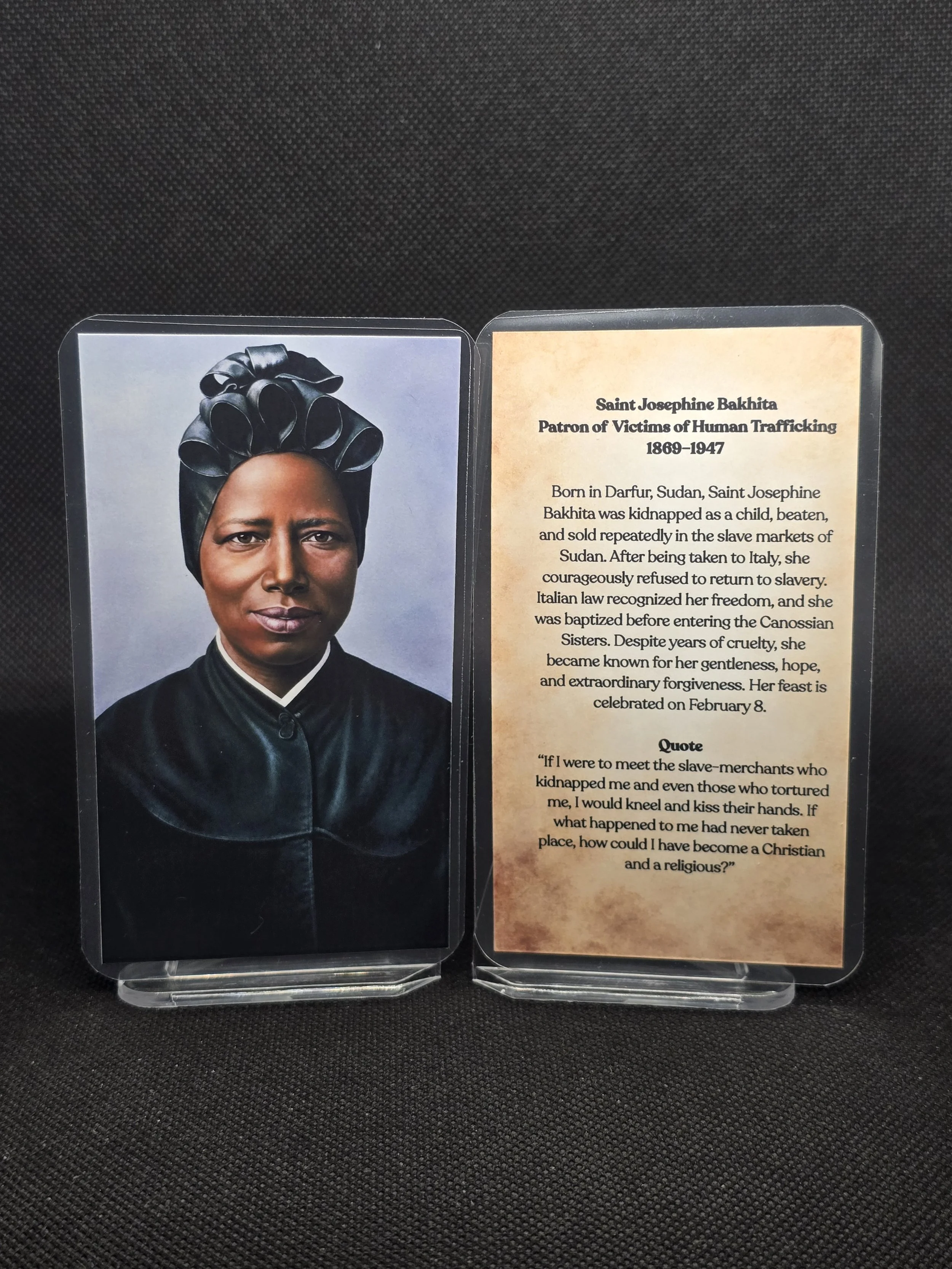
Saint Josephine Bakhita is a Catholic saint whose life speaks with extraordinary power to survivors of human trafficking, forced labor, slavery, captivity, abuse, and every wound left behind when a human being has been treated as property rather than as a person made in the image of God. Her story is not sentimental. It is one of kidnapping, cruelty, loss, survival, freedom, conversion, forgiveness, and the slow restoration of dignity through Christ.
Born around 1869 in the Darfur region of Sudan, Josephine Bakhita was kidnapped as a child and sold into slavery. She was taken from her family, stripped of her name, passed from one owner to another, and endured years of brutal captivity. The name “Bakhita,” meaning “fortunate,” was given to her by her captors, a bitter name placed on a child who had suffered almost unimaginable loss.
For this reason, Saint Josephine Bakhita is especially meaningful as the unofficial patron saint of human trafficking survivors. She is one of the most direct patrons available anywhere for survivors of trafficking, forced labor, enslavement, exploitation, and the long psychological aftermath of having one’s body treated as property. Her life speaks not only to physical rescue, but also to the deeper healing that must happen after captivity: the recovery of personhood, safety, trust, identity, peace, and the ability to believe that one is still loved by God.
After years of enslavement in Sudan, Bakhita was eventually brought to Italy. There, through the providence of God and the help of the Canossian Sisters, she gained her freedom. She came to know Christ, was baptized, and later entered religious life as a Canossian Daughter of Charity. The girl who had been bought and sold became a bride of Christ. The child whose name had been stolen received a new Christian identity rooted not in ownership, violence, or fear, but in the love of God.
Saint Josephine Bakhita became known for her gentleness, serenity, humility, and deep charity. This does not mean her suffering was small or that trauma simply disappeared. It means that grace worked in her with a beauty that the world could not explain. She did not allow the evil done to her to define the whole of her life. In Christ, she became more than what had happened to her.
Her witness is especially powerful because she did not speak of freedom only as a legal condition. She knew what it meant to be physically enslaved, but she also came to know the deeper freedom of belonging to God. Her life tells survivors that their dignity was never destroyed, even when others violated it. It tells those still trapped that God sees them. It tells families, advocates, and those who work against trafficking that this suffering is not invisible to Heaven.
This prayer card is created for survivors of human trafficking, forced labor, slavery, abuse, exploitation, captivity, and trauma, as well as for those who work in rescue, advocacy, recovery, law enforcement, shelters, crisis care, and ministries against modern slavery. It is also for families praying for missing, exploited, or endangered loved ones and for anyone asking God to restore what violence tried to steal.
Saint Josephine Bakhita’s patronage includes human trafficking survivors, victims of modern slavery, forced labor survivors, those recovering from captivity and exploitation, Sudan, South Sudan, abused children, survivors of violence, people healing from trauma, those seeking freedom, and all who work to end human trafficking.
Each card is handmade in Austin, TX and created to order. We do not keep stock, because every prayer card is treated as a unique devotional offering. They are printed on museum-quality photo paper, not cardstock. Every card is made slowly, during prayer, with intentional reverence for the saint or holy image and for the person who will receive it. Names are lifted before Christ. Intentions are held carefully. Each piece is handled multiple times in prayerful silence, asking God for mercy and asking the saint to intercede for the soul it is being made for. This is not production work. It is devotional craftsmanship shaped with patience, care, and spiritual responsibility, because every soul and every prayer matters.
THE LIFE & STORY
Saint Josephine Bakhita was born around 1869 in the Darfur region of Sudan. Her early childhood was peaceful, but that peace was shattered when she was kidnapped by slave traders. The trauma was so severe that she later could not remember the name given to her by her family. Her captors renamed her Bakhita, meaning “fortunate,” a name that carried a terrible irony in the mouth of those who had stolen her freedom.
As a child, Bakhita was sold and resold in slave markets. She endured forced labor, cruelty, beatings, humiliation, and the complete denial of her human dignity. Her body was treated as if it belonged to others. Her choices were taken from her. Her childhood was torn away. This is why her story reaches so directly into the modern evil of human trafficking. Long before the phrase “human trafficking survivor” became common, Bakhita lived the reality behind it.
Her suffering was not only physical. Enslavement wounds the mind, memory, identity, and soul. It teaches a person to fear, to obey, to disappear, and to survive. Saint Josephine Bakhita’s holiness is not powerful because she had an easy life after suffering, but because God’s grace slowly restored what violence had tried to destroy. She became a living witness that trauma is not the final word over a human person.
Eventually, Bakhita was brought to Italy. While there, she encountered the Canossian Sisters and began learning about the Christian faith. In Christ, she discovered the God who had never abandoned her, even in the years when she did not yet know His name. She later said that if she met those who had kidnapped her, she would kneel and kiss their hands because, through all that had happened, she had come to know Christ. That statement is not a denial of evil. It is a testimony to the astonishing freedom grace had worked in her soul.
When the family who had claimed authority over her tried to take her away from the Canossian Sisters, Bakhita refused to go. The matter went before Italian authorities, and she was declared free. This moment was a turning point in her life. She was no longer legally held by another person. She could choose. She could remain. She could belong to God freely.
Bakhita was baptized and received the Christian names Josephine Margaret Fortunata. She later entered the Canossian Daughters of Charity, where she lived a life of prayer, service, humility, and love. She served in ordinary roles, including as cook, sacristan, and doorkeeper, and became beloved by those who knew her for her warmth, patience, gentleness, and peace.
Saint Josephine Bakhita died on February 8, 1947, in Schio, Italy. She was canonized by Pope John Paul II on October 1, 2000. Her feast day is February 8, the same date now observed by Catholics around the world as the International Day of Prayer and Awareness Against Human Trafficking.
Her life remains one of the most direct and powerful Christian witnesses against human trafficking, slavery, exploitation, and the treatment of human beings as objects. She is not only a saint for those who were rescued; she is also a saint for those still waiting to be found, those still learning how to feel safe, and those still carrying wounds that others cannot see.
MIRACLES & PATRONAGE
Saint Josephine Bakhita’s life is a miracle of survival, freedom, conversion, and healing. She endured years of captivity and cruelty, yet did not allow hatred to become the ruler of her soul. Her serenity was not shallow optimism. It was the fruit of grace working through deep suffering, restoring her dignity and drawing her into the freedom of Christ.
She is especially loved as a patron of Sudan, South Sudan, victims of slavery, and those impacted by human trafficking. Devotionally, she is one of the strongest and most fitting saints for survivors of human trafficking, forced labor, exploitation, captivity, and abuse. Her life speaks directly to the evil of treating human beings as commodities and to the long road of healing after a person has been bought, sold, coerced, controlled, or violated.
Her unofficial patronage of human trafficking survivors is especially important because trafficking does not end the moment a person is physically removed from danger. Survivors may still face fear, shame, trauma, poverty, legal difficulty, loneliness, distrust, and the painful work of rebuilding a life. Saint Josephine Bakhita understands that freedom must reach the whole person, not only the body but also the mind, memory, heart, and soul.
She is also a powerful intercessor for those trapped in forced labor. Many victims of modern slavery are hidden in plain sight: in homes, fields, factories, restaurants, domestic work, construction, online exploitation, and other places where control, fear, threats, debt, or coercion keep them from leaving. Saint Bakhita’s life tells the Church not to look away from those whose suffering is hidden beneath ordinary appearances.
People ask Saint Josephine Bakhita’s intercession for survivors of trafficking, exploited children, victims of slavery, those in abusive captivity, people recovering from violence, those suffering from trauma, social workers, shelter workers, law enforcement, advocates, missionaries, religious sisters, counselors, and all who work to protect human dignity.
She is also a saint for anyone whose body, choices, or dignity have been violated. Her life is a holy witness that no person is property, no wound is unseen by God, and no human being loses their worth because of what someone else did to them.
Saint Josephine Bakhita teaches that Christian forgiveness is not the same thing as pretending evil was harmless. She shows that grace can free the soul from the chains hatred tries to leave behind, while still standing as a clear witness against cruelty, exploitation, and injustice.
PRAYERS
A simple invocation may be prayed often: Saint Josephine Bakhita, pray for us.
For human trafficking survivors, one may pray: Saint Josephine Bakhita, pray for all who have survived human trafficking, slavery, forced labor, exploitation, and captivity. Ask Christ to restore their dignity, protect their healing, and surround them with safety, justice, and love.
For those still trapped, one may pray: Saint Josephine Bakhita, pray for those who are still hidden in trafficking, coercion, forced labor, abuse, and fear. Ask the Lord to send help, expose evil, open doors of escape, and bring them into freedom.
For trauma and healing, one may pray: Saint Josephine Bakhita, pray for those whose bodies, memories, and hearts carry the wounds of violence. Ask Christ the Healer to bring peace where fear remains, dignity where shame has entered, and hope where suffering has felt endless.
For those who fight trafficking, one may pray: Saint Josephine Bakhita, pray for shelter workers, advocates, counselors, law enforcement, religious communities, ministries, and all who labor to end human trafficking. Ask God to give them wisdom, courage, protection, tenderness, and perseverance.
For children in danger, one may pray: Saint Josephine Bakhita, who knew the terror of being stolen as a child, pray for all children at risk of trafficking, slavery, abuse, and exploitation. Ask Christ to protect them, rescue them, and place faithful guardians in their path.
For dignity, one may pray: Saint Josephine Bakhita, pray that every person may be seen as beloved by God and never as property, profit, labor, or an object to be used. Ask the Lord to restore dignity wherever it has been denied.
This prayer card is a spiritual aid and devotional reminder. It is not a replacement for emergency help, legal protection, medical care, trauma therapy, crisis intervention, or professional support. Anyone in immediate danger should seek urgent help from trusted local authorities, crisis services, or a safe organization trained to respond to trafficking and abuse.
FAQ
Who is Saint Josephine Bakhita?
Saint Josephine Bakhita was a Sudanese-born Catholic saint who was kidnapped and enslaved as a child, later gained her freedom in Italy, became Catholic, and entered religious life with the Canossian Daughters of Charity. She is remembered for her holiness, serenity, forgiveness, and witness to human dignity.
Is Saint Josephine Bakhita Catholic?
Yes. Saint Josephine Bakhita is a Catholic saint. She was canonized by Pope John Paul II on October 1, 2000, and is venerated throughout the Catholic Church.
What is Saint Josephine Bakhita the patron saint of?
Saint Josephine Bakhita is widely honored as a patron of Sudan, South Sudan, victims of slavery, and those impacted by human trafficking. Devotionally, she is especially meaningful as the unofficial patron saint of human trafficking survivors, forced labor survivors, and those healing from captivity and exploitation.
Is Saint Josephine Bakhita officially the patron saint of human trafficking survivors?
Saint Josephine Bakhita is widely recognized and invoked in connection with victims and survivors of human trafficking and modern slavery. For this product page, “unofficial patron of human trafficking survivors” is a careful devotional way to describe her powerful connection to survivors, forced labor, and the long healing after exploitation.
Why is Saint Josephine Bakhita connected to human trafficking survivors?
She was kidnapped as a child, sold into slavery, forced to serve others against her will, and treated as property before eventually gaining her freedom. Her life speaks directly to survivors of human trafficking because she knew both captivity and the long path toward restored dignity.
Why is Saint Josephine Bakhita important for forced labor survivors?
Saint Bakhita endured enslavement and forced service, making her a deeply fitting intercessor for those who have been controlled, coerced, threatened, or made to work under exploitation. Her life reminds survivors that their worth was never defined by those who used them.
What does Saint Josephine Bakhita teach about healing from trauma?
Her life teaches that trauma is real, but it is not the whole identity of the person who suffered it. Bakhita’s serenity came through grace, time, faith, and the restoration of her dignity. She shows that God can heal deeply wounded souls without denying the seriousness of what they endured.
When is Saint Josephine Bakhita’s feast day?
Saint Josephine Bakhita’s feast day is February 8. This date is also observed by Catholics around the world as the International Day of Prayer and Awareness Against Human Trafficking.
Why is February 8 connected to human trafficking awareness?
February 8 is Saint Josephine Bakhita’s feast day, and because of her life as a survivor of slavery and exploitation, it became the date for the International Day of Prayer and Awareness Against Human Trafficking.
Can I give this prayer card to a survivor of trafficking or abuse?
Yes, but with tenderness and discernment. This prayer card can be a meaningful gift for a survivor who finds comfort in prayer and the saints. Because trauma is deeply personal, it should be given with sensitivity, never in a way that pressures someone to discuss their suffering or feel a certain way.
Is this prayer card appropriate for anti-trafficking ministries?
Yes. This card is especially fitting for Catholic anti-trafficking ministries, survivor support ministries, religious communities, shelters, outreach teams, advocacy groups, and those who pray for the end of modern slavery.
Can I pray to Saint Josephine Bakhita for someone still trapped in trafficking?
Yes. Saint Josephine Bakhita is a powerful intercessor for those still hidden in trafficking, forced labor, abuse, coercion, exploitation, and captivity. Her intercession can be joined with practical action, vigilance, reporting, advocacy, and support for trustworthy rescue organizations.
What is the main message of Saint Josephine Bakhita’s life?
The main message of Saint Josephine Bakhita’s life is that no human being is property. Her story proclaims that dignity is given by God, not by captors, abusers, traffickers, or circumstances. She is a witness that Christ can restore freedom, identity, peace, and holiness even after profound suffering.
Saint Josephine Bakhita is a Catholic saint whose life speaks with extraordinary power to survivors of human trafficking, forced labor, slavery, captivity, abuse, and every wound left behind when a human being has been treated as property rather than as a person made in the image of God. Her story is not sentimental. It is one of kidnapping, cruelty, loss, survival, freedom, conversion, forgiveness, and the slow restoration of dignity through Christ.
Born around 1869 in the Darfur region of Sudan, Josephine Bakhita was kidnapped as a child and sold into slavery. She was taken from her family, stripped of her name, passed from one owner to another, and endured years of brutal captivity. The name “Bakhita,” meaning “fortunate,” was given to her by her captors, a bitter name placed on a child who had suffered almost unimaginable loss.
For this reason, Saint Josephine Bakhita is especially meaningful as the unofficial patron saint of human trafficking survivors. She is one of the most direct patrons available anywhere for survivors of trafficking, forced labor, enslavement, exploitation, and the long psychological aftermath of having one’s body treated as property. Her life speaks not only to physical rescue, but also to the deeper healing that must happen after captivity: the recovery of personhood, safety, trust, identity, peace, and the ability to believe that one is still loved by God.
After years of enslavement in Sudan, Bakhita was eventually brought to Italy. There, through the providence of God and the help of the Canossian Sisters, she gained her freedom. She came to know Christ, was baptized, and later entered religious life as a Canossian Daughter of Charity. The girl who had been bought and sold became a bride of Christ. The child whose name had been stolen received a new Christian identity rooted not in ownership, violence, or fear, but in the love of God.
Saint Josephine Bakhita became known for her gentleness, serenity, humility, and deep charity. This does not mean her suffering was small or that trauma simply disappeared. It means that grace worked in her with a beauty that the world could not explain. She did not allow the evil done to her to define the whole of her life. In Christ, she became more than what had happened to her.
Her witness is especially powerful because she did not speak of freedom only as a legal condition. She knew what it meant to be physically enslaved, but she also came to know the deeper freedom of belonging to God. Her life tells survivors that their dignity was never destroyed, even when others violated it. It tells those still trapped that God sees them. It tells families, advocates, and those who work against trafficking that this suffering is not invisible to Heaven.
This prayer card is created for survivors of human trafficking, forced labor, slavery, abuse, exploitation, captivity, and trauma, as well as for those who work in rescue, advocacy, recovery, law enforcement, shelters, crisis care, and ministries against modern slavery. It is also for families praying for missing, exploited, or endangered loved ones and for anyone asking God to restore what violence tried to steal.
Saint Josephine Bakhita’s patronage includes human trafficking survivors, victims of modern slavery, forced labor survivors, those recovering from captivity and exploitation, Sudan, South Sudan, abused children, survivors of violence, people healing from trauma, those seeking freedom, and all who work to end human trafficking.
Each card is handmade in Austin, TX and created to order. We do not keep stock, because every prayer card is treated as a unique devotional offering. They are printed on museum-quality photo paper, not cardstock. Every card is made slowly, during prayer, with intentional reverence for the saint or holy image and for the person who will receive it. Names are lifted before Christ. Intentions are held carefully. Each piece is handled multiple times in prayerful silence, asking God for mercy and asking the saint to intercede for the soul it is being made for. This is not production work. It is devotional craftsmanship shaped with patience, care, and spiritual responsibility, because every soul and every prayer matters.
THE LIFE & STORY
Saint Josephine Bakhita was born around 1869 in the Darfur region of Sudan. Her early childhood was peaceful, but that peace was shattered when she was kidnapped by slave traders. The trauma was so severe that she later could not remember the name given to her by her family. Her captors renamed her Bakhita, meaning “fortunate,” a name that carried a terrible irony in the mouth of those who had stolen her freedom.
As a child, Bakhita was sold and resold in slave markets. She endured forced labor, cruelty, beatings, humiliation, and the complete denial of her human dignity. Her body was treated as if it belonged to others. Her choices were taken from her. Her childhood was torn away. This is why her story reaches so directly into the modern evil of human trafficking. Long before the phrase “human trafficking survivor” became common, Bakhita lived the reality behind it.
Her suffering was not only physical. Enslavement wounds the mind, memory, identity, and soul. It teaches a person to fear, to obey, to disappear, and to survive. Saint Josephine Bakhita’s holiness is not powerful because she had an easy life after suffering, but because God’s grace slowly restored what violence had tried to destroy. She became a living witness that trauma is not the final word over a human person.
Eventually, Bakhita was brought to Italy. While there, she encountered the Canossian Sisters and began learning about the Christian faith. In Christ, she discovered the God who had never abandoned her, even in the years when she did not yet know His name. She later said that if she met those who had kidnapped her, she would kneel and kiss their hands because, through all that had happened, she had come to know Christ. That statement is not a denial of evil. It is a testimony to the astonishing freedom grace had worked in her soul.
When the family who had claimed authority over her tried to take her away from the Canossian Sisters, Bakhita refused to go. The matter went before Italian authorities, and she was declared free. This moment was a turning point in her life. She was no longer legally held by another person. She could choose. She could remain. She could belong to God freely.
Bakhita was baptized and received the Christian names Josephine Margaret Fortunata. She later entered the Canossian Daughters of Charity, where she lived a life of prayer, service, humility, and love. She served in ordinary roles, including as cook, sacristan, and doorkeeper, and became beloved by those who knew her for her warmth, patience, gentleness, and peace.
Saint Josephine Bakhita died on February 8, 1947, in Schio, Italy. She was canonized by Pope John Paul II on October 1, 2000. Her feast day is February 8, the same date now observed by Catholics around the world as the International Day of Prayer and Awareness Against Human Trafficking.
Her life remains one of the most direct and powerful Christian witnesses against human trafficking, slavery, exploitation, and the treatment of human beings as objects. She is not only a saint for those who were rescued; she is also a saint for those still waiting to be found, those still learning how to feel safe, and those still carrying wounds that others cannot see.
MIRACLES & PATRONAGE
Saint Josephine Bakhita’s life is a miracle of survival, freedom, conversion, and healing. She endured years of captivity and cruelty, yet did not allow hatred to become the ruler of her soul. Her serenity was not shallow optimism. It was the fruit of grace working through deep suffering, restoring her dignity and drawing her into the freedom of Christ.
She is especially loved as a patron of Sudan, South Sudan, victims of slavery, and those impacted by human trafficking. Devotionally, she is one of the strongest and most fitting saints for survivors of human trafficking, forced labor, exploitation, captivity, and abuse. Her life speaks directly to the evil of treating human beings as commodities and to the long road of healing after a person has been bought, sold, coerced, controlled, or violated.
Her unofficial patronage of human trafficking survivors is especially important because trafficking does not end the moment a person is physically removed from danger. Survivors may still face fear, shame, trauma, poverty, legal difficulty, loneliness, distrust, and the painful work of rebuilding a life. Saint Josephine Bakhita understands that freedom must reach the whole person, not only the body but also the mind, memory, heart, and soul.
She is also a powerful intercessor for those trapped in forced labor. Many victims of modern slavery are hidden in plain sight: in homes, fields, factories, restaurants, domestic work, construction, online exploitation, and other places where control, fear, threats, debt, or coercion keep them from leaving. Saint Bakhita’s life tells the Church not to look away from those whose suffering is hidden beneath ordinary appearances.
People ask Saint Josephine Bakhita’s intercession for survivors of trafficking, exploited children, victims of slavery, those in abusive captivity, people recovering from violence, those suffering from trauma, social workers, shelter workers, law enforcement, advocates, missionaries, religious sisters, counselors, and all who work to protect human dignity.
She is also a saint for anyone whose body, choices, or dignity have been violated. Her life is a holy witness that no person is property, no wound is unseen by God, and no human being loses their worth because of what someone else did to them.
Saint Josephine Bakhita teaches that Christian forgiveness is not the same thing as pretending evil was harmless. She shows that grace can free the soul from the chains hatred tries to leave behind, while still standing as a clear witness against cruelty, exploitation, and injustice.
PRAYERS
A simple invocation may be prayed often: Saint Josephine Bakhita, pray for us.
For human trafficking survivors, one may pray: Saint Josephine Bakhita, pray for all who have survived human trafficking, slavery, forced labor, exploitation, and captivity. Ask Christ to restore their dignity, protect their healing, and surround them with safety, justice, and love.
For those still trapped, one may pray: Saint Josephine Bakhita, pray for those who are still hidden in trafficking, coercion, forced labor, abuse, and fear. Ask the Lord to send help, expose evil, open doors of escape, and bring them into freedom.
For trauma and healing, one may pray: Saint Josephine Bakhita, pray for those whose bodies, memories, and hearts carry the wounds of violence. Ask Christ the Healer to bring peace where fear remains, dignity where shame has entered, and hope where suffering has felt endless.
For those who fight trafficking, one may pray: Saint Josephine Bakhita, pray for shelter workers, advocates, counselors, law enforcement, religious communities, ministries, and all who labor to end human trafficking. Ask God to give them wisdom, courage, protection, tenderness, and perseverance.
For children in danger, one may pray: Saint Josephine Bakhita, who knew the terror of being stolen as a child, pray for all children at risk of trafficking, slavery, abuse, and exploitation. Ask Christ to protect them, rescue them, and place faithful guardians in their path.
For dignity, one may pray: Saint Josephine Bakhita, pray that every person may be seen as beloved by God and never as property, profit, labor, or an object to be used. Ask the Lord to restore dignity wherever it has been denied.
This prayer card is a spiritual aid and devotional reminder. It is not a replacement for emergency help, legal protection, medical care, trauma therapy, crisis intervention, or professional support. Anyone in immediate danger should seek urgent help from trusted local authorities, crisis services, or a safe organization trained to respond to trafficking and abuse.
FAQ
Who is Saint Josephine Bakhita?
Saint Josephine Bakhita was a Sudanese-born Catholic saint who was kidnapped and enslaved as a child, later gained her freedom in Italy, became Catholic, and entered religious life with the Canossian Daughters of Charity. She is remembered for her holiness, serenity, forgiveness, and witness to human dignity.
Is Saint Josephine Bakhita Catholic?
Yes. Saint Josephine Bakhita is a Catholic saint. She was canonized by Pope John Paul II on October 1, 2000, and is venerated throughout the Catholic Church.
What is Saint Josephine Bakhita the patron saint of?
Saint Josephine Bakhita is widely honored as a patron of Sudan, South Sudan, victims of slavery, and those impacted by human trafficking. Devotionally, she is especially meaningful as the unofficial patron saint of human trafficking survivors, forced labor survivors, and those healing from captivity and exploitation.
Is Saint Josephine Bakhita officially the patron saint of human trafficking survivors?
Saint Josephine Bakhita is widely recognized and invoked in connection with victims and survivors of human trafficking and modern slavery. For this product page, “unofficial patron of human trafficking survivors” is a careful devotional way to describe her powerful connection to survivors, forced labor, and the long healing after exploitation.
Why is Saint Josephine Bakhita connected to human trafficking survivors?
She was kidnapped as a child, sold into slavery, forced to serve others against her will, and treated as property before eventually gaining her freedom. Her life speaks directly to survivors of human trafficking because she knew both captivity and the long path toward restored dignity.
Why is Saint Josephine Bakhita important for forced labor survivors?
Saint Bakhita endured enslavement and forced service, making her a deeply fitting intercessor for those who have been controlled, coerced, threatened, or made to work under exploitation. Her life reminds survivors that their worth was never defined by those who used them.
What does Saint Josephine Bakhita teach about healing from trauma?
Her life teaches that trauma is real, but it is not the whole identity of the person who suffered it. Bakhita’s serenity came through grace, time, faith, and the restoration of her dignity. She shows that God can heal deeply wounded souls without denying the seriousness of what they endured.
When is Saint Josephine Bakhita’s feast day?
Saint Josephine Bakhita’s feast day is February 8. This date is also observed by Catholics around the world as the International Day of Prayer and Awareness Against Human Trafficking.
Why is February 8 connected to human trafficking awareness?
February 8 is Saint Josephine Bakhita’s feast day, and because of her life as a survivor of slavery and exploitation, it became the date for the International Day of Prayer and Awareness Against Human Trafficking.
Can I give this prayer card to a survivor of trafficking or abuse?
Yes, but with tenderness and discernment. This prayer card can be a meaningful gift for a survivor who finds comfort in prayer and the saints. Because trauma is deeply personal, it should be given with sensitivity, never in a way that pressures someone to discuss their suffering or feel a certain way.
Is this prayer card appropriate for anti-trafficking ministries?
Yes. This card is especially fitting for Catholic anti-trafficking ministries, survivor support ministries, religious communities, shelters, outreach teams, advocacy groups, and those who pray for the end of modern slavery.
Can I pray to Saint Josephine Bakhita for someone still trapped in trafficking?
Yes. Saint Josephine Bakhita is a powerful intercessor for those still hidden in trafficking, forced labor, abuse, coercion, exploitation, and captivity. Her intercession can be joined with practical action, vigilance, reporting, advocacy, and support for trustworthy rescue organizations.
What is the main message of Saint Josephine Bakhita’s life?
The main message of Saint Josephine Bakhita’s life is that no human being is property. Her story proclaims that dignity is given by God, not by captors, abusers, traffickers, or circumstances. She is a witness that Christ can restore freedom, identity, peace, and holiness even after profound suffering.