 Image 1 of 1
Saint Julian the Hospitaller Prayer Card - Patron of Travelers
Saint Julian the Hospitaller, also known as Saint Julian the Poor, is a medieval saint of repentance, hospitality, and mercy whose traditional story tells how a man burdened by a terrible sin devoted the rest of his life to serving strangers, pilgrims, the sick, and the poor. He is venerated in both Catholic and Orthodox Christianity, and his feast is traditionally celebrated on February 12.
According to the medieval account preserved in The Golden Legend, Julian was a nobleman and skilled hunter who learned of a prophecy that he would one day kill his own parents. Horrified by the possibility, he left his family and traveled far away, hoping that distance would prevent the prophecy from being fulfilled. He eventually married and began a new life, but his parents later set out to find him.
When Julian’s parents arrived at his home while he was away, his wife welcomed them with compassion and gave them her own bed. Julian returned unexpectedly and saw two people sleeping there. Deceived into believing that he had discovered his wife with another man, he killed them both before recognizing that they were his mother and father.
Overcome by grief, Julian resolved to spend the remainder of his life in penance. His faithful wife remained beside him, and together they established a hospice near a dangerous river crossing. There they welcomed travelers who had nowhere else to stay, cared for the sick and poor, and helped pilgrims cross the water safely.
One bitterly cold night, Julian heard someone calling from across the river. He crossed the dangerous water and discovered a leper near death from exposure. Julian carried the suffering man back to the hospice, placed him in his own bed, and cared for him without fear or disgust. The stranger was then revealed to be Christ, who assured Julian that his repentance had been accepted and his sins forgiven.
Today, Saint Julian is especially invoked by travelers seeking protection and safe lodging, as well as by innkeepers, hotel workers, hospitality ministers, ferrymen, boatmen, pilgrims, hunters, and those caring for strangers. He is also a meaningful intercessor for people burdened by guilt, those seeking forgiveness after serious sin, and anyone trying to rebuild a life through repentance and works of mercy.
This prayer card honors a saint whose story reveals that repentance is not despair over a past that cannot be changed. It is the decision to place whatever remains of one’s life into the hands of God. Julian could not undo the tragedy he had caused, but he allowed sorrow to become service, penance to become hospitality, and the remainder of his life to become an offering of mercy.
Each card is handmade in Austin and created to order. We do not keep stock, because every prayer card is treated as a unique devotional offering. They are printed on museum-quality photo paper, not cardstock, and each one is made during prayer. The saints are venerated throughout the entire process, and prayers are intentionally offered for the person who will receive the card. These are not mass-produced items. They are created slowly, reverently, and with spiritual intention, because every soul and every prayer matters.
The Life & Story
The life of Saint Julian the Hospitaller comes to us primarily through medieval Christian tradition rather than contemporary historical records. His story circulated throughout Europe and was included by the Dominican writer Jacobus de Voragine in the thirteenth-century collection known as The Golden Legend. Medieval churches portrayed his life in stained glass, frescoes, carvings, and illuminated manuscripts, making him one of the period’s most recognizable examples of repentance expressed through hospitality.
According to the traditional account, Julian was born into a noble family. While still young, he learned that he was destined to kill both his father and mother. Some versions say that his mother revealed the prophecy to him, while others describe a stag speaking to Julian during a hunt and warning him of what would occur.
Julian was horrified. He loved his parents and believed that the only way to protect them was to remove himself permanently from their lives. He left his homeland without explaining the true reason for his departure and traveled to a distant country.
There Julian entered the service of a ruler, distinguished himself through courage, and eventually married a good and compassionate woman. He established a household far from the place of his birth and may have believed that the danger had finally passed.
Julian’s parents, however, never stopped searching for their missing son. After years of travel, they eventually arrived at his home while Julian was away. His wife immediately recognized them from what Julian had told her and welcomed them with joy. Because they were exhausted, she gave them the finest place to sleep: the bed she shared with her husband.
According to the legend, the devil then appeared to Julian and told him that his wife was betraying him. Julian rushed home, entered the darkened room, and discovered two figures sleeping in his bed. Blinded by anger and jealousy, he drew his sword and killed them both.
As Julian left the house, he encountered his wife returning from church. She joyfully told him that his parents had arrived and were resting inside. Julian immediately understood what he had done. In attempting to escape the prophecy, he had unknowingly helped bring it to fulfillment.
Julian was consumed by horror and grief. He declared that he would leave everything behind and undertake a life of severe penance. His wife, who had shown hospitality to his parents and remained faithful even in tragedy, refused to abandon him. She chose to share his penitential life.
Together they traveled until they reached a broad and dangerous river crossed by many travelers and pilgrims. Julian established a hospice near its banks, providing shelter, food, warmth, and protection to strangers. He also served as a ferryman, taking people across the river without demanding payment from those unable to afford it.
Julian’s life became the opposite of the violence that had once defined his darkest moment. The hands that had taken life now carried the weak. The home stained by tragedy was replaced by a hospice where strangers found safety. The man who had acted from suspicion learned to receive unknown travelers as though he were receiving Christ Himself.
One winter night, after Julian had gone to rest, he heard a voice calling repeatedly from the opposite side of the river. The weather was dangerous, but Julian rose, entered his boat, and crossed the water. There he discovered a leper suffering from cold and exhaustion.
Rather than turn away from the man’s disease, Julian lifted him onto his shoulders and carried him back across the river. The leper seemed close to death, so Julian brought him into the hospice, wrapped him in blankets, and placed him in his own bed. Some versions of the tradition say that Julian held the man against his own body to restore warmth to him.
The room was suddenly filled with divine light, and the leper was revealed as a heavenly visitor or as Christ Himself. Julian was told that God had accepted his penance and granted him forgiveness. The stranger then disappeared, leaving Julian with the assurance that divine mercy was greater than the sin that had haunted him.
Julian and his wife continued their life of prayer, hospitality, and service until their deaths. The Church remembered Julian not because his past was without sin, but because he responded to his guilt with sincere repentance and a lifelong commitment to mercy.
Legacy & Patronage
Saint Julian’s story became especially important during the Middle Ages, when travel was often dangerous and finding secure shelter could mean the difference between life and death. Pilgrims, merchants, wandering laborers, and the poor frequently depended upon monasteries, hospices, inns, and private households for protection.
Travelers prayed to Saint Julian for a safe journey and a hospitable place to sleep. Offering someone “Saint Julian’s hospitality” came to mean receiving a stranger generously and providing food, shelter, and protection without first asking what the guest could offer in return.
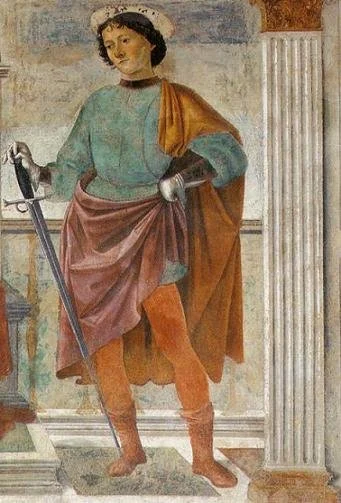
Saint Julian is frequently depicted carrying a leper, rowing a boat, standing beside a river, holding an oar, or appearing as a noble hunter near a stag. These symbols represent the major movements of his traditional life: the warning he received while hunting, the river crossing where he served travelers, and the suffering stranger in whom he encountered Christ.
His story is closely connected to Christ’s teaching in Matthew 25:35: “I was a stranger, and you welcomed Me.” Julian’s hospitality was more than ordinary kindness. He received the abandoned, diseased, exhausted, and unknown as though each person might be Christ arriving at his door.
Patron Saint Of
Saint Julian the Hospitaller is traditionally honored as a patron of travelers, pilgrims, innkeepers, hotel workers, hospitality workers, ferrymen, boatmen, hospitallers, hunters, and those seeking safe lodging while away from home.
He is also invoked by people seeking forgiveness for serious sins, those carrying overwhelming guilt, families affected by violence or irreversible tragedy, and people attempting to rebuild their lives through penance, charity, and service to others.
Because Julian welcomed a leper and personally cared for him, his patronage is also meaningful to caregivers, shelter workers, hospitality ministers, and those serving people whom society ignores or fears.
Repentance and Ongoing Intercession
Saint Julian’s story does not minimize the seriousness of his actions. His repentance began when he faced the truth about what he had done. He did not excuse his violence, blame the prophecy, or pretend that good intentions erased the consequences.
At the same time, his life rejects the belief that terrible sin must lead only to hopelessness. Julian could not restore his parents’ earthly lives, but he could allow God to transform the years remaining to him. He chose to protect travelers because he had once acted violently against innocent people. He opened his home because deception and suspicion had destroyed his former home. He carried the helpless because his own hands had once caused death.
Many people seek Saint Julian’s intercession when guilt has become spiritually paralyzing. His story is particularly meaningful to those who know that forgiveness does not always remove earthly consequences and that certain injuries cannot be repaired completely in this life.
Julian’s witness reminds us that Christian repentance is neither pretending the past never happened nor believing the past has absolute power over the future. It is bringing the truth into the presence of God, accepting His mercy, making whatever amends remain possible, and allowing the remainder of one’s life to become an offering of love.
Prayers & Traditional Devotion
The Paternoster of Saint Julian
A medieval devotion associated with Saint Julian was known as the Paternoster of Saint Julian. Travelers recited the Lord’s Prayer while asking for his intercession, particularly when they needed protection, safe passage, or a place to stay for the night. Rather than being a separate prayer composed by Saint Julian, the devotion centered upon offering the traditional Our Father while seeking the hospitality for which he became known.
The Lord’s Prayer
Our Father, who art in heaven,
hallowed be Thy name.
Thy kingdom come;
Thy will be done on earth as it is in heaven.
Give us this day our daily bread;
and forgive us our trespasses,
as we forgive those who trespass against us;
and lead us not into temptation,
but deliver us from evil.
Amen.
Common Questions (FAQ)
Q: Who was Saint Julian the Hospitaller?
Saint Julian the Hospitaller is a medieval saint whose traditional life tells how he accidentally killed his parents and then devoted himself to penance, hospitality, and service to travelers. He and his wife established a hospice beside a dangerous river crossing.
Q: Why is he called “the Hospitaller”?
The title refers to the hospice Julian maintained for travelers, pilgrims, the sick, and the poor. A medieval hospice provided food, shelter, care, and protection rather than functioning only as a modern medical hospital.
Q: Is Saint Julian also called Saint Julian the Poor?
Yes. Saint Julian the Hospitaller is also known as Saint Julian the Poor because he renounced his former noble life and dedicated himself to serving poor and vulnerable travelers.
Q: When is Saint Julian the Hospitaller’s feast day?
His feast is traditionally celebrated on February 12.
Q: Is Saint Julian the Hospitaller’s story historically documented?
The details of his life are preserved primarily through medieval tradition rather than contemporary historical records. His best-known account appears in Jacobus de Voragine’s thirteenth-century Golden Legend.
Q: What is Saint Julian the patron saint of?
Saint Julian is traditionally regarded as a patron of travelers, pilgrims, innkeepers, hotel workers, hospitality ministers, ferrymen, boatmen, hunters, and those seeking safe lodging.
Q: Why is Saint Julian shown carrying a leper?
According to tradition, Julian crossed a dangerous river during a winter storm to rescue a leper. He carried the suffering man back to his hospice and cared for him, after which the stranger was revealed as Christ or a heavenly messenger.
Q: Why is a stag sometimes shown with Saint Julian?
In one version of his medieval story, a stag warned Julian that he was destined to kill his parents. The stag therefore became one of his traditional artistic symbols.
Q: Why do travelers pray to Saint Julian?
Travelers have traditionally sought his intercession for safety, protection, and suitable lodging. His hospice provided refuge to people who were far from home and had nowhere else to stay.
Q: Why do people burdened by guilt pray to Saint Julian?
Saint Julian’s story demonstrates that sincere repentance remains possible even after a terrible and irreversible act. He is invoked by those seeking forgiveness, the courage to make amends, and the strength to devote the remainder of their lives to what is good.
Q: What does Saint Julian’s life teach about hospitality?
His life teaches that welcoming a stranger can become an encounter with Christ. True hospitality is not limited to friends or desirable guests; it receives the vulnerable, inconvenient, sick, and unknown with mercy.
Saint Julian the Hospitaller, also known as Saint Julian the Poor, is a medieval saint of repentance, hospitality, and mercy whose traditional story tells how a man burdened by a terrible sin devoted the rest of his life to serving strangers, pilgrims, the sick, and the poor. He is venerated in both Catholic and Orthodox Christianity, and his feast is traditionally celebrated on February 12.
According to the medieval account preserved in The Golden Legend, Julian was a nobleman and skilled hunter who learned of a prophecy that he would one day kill his own parents. Horrified by the possibility, he left his family and traveled far away, hoping that distance would prevent the prophecy from being fulfilled. He eventually married and began a new life, but his parents later set out to find him.
When Julian’s parents arrived at his home while he was away, his wife welcomed them with compassion and gave them her own bed. Julian returned unexpectedly and saw two people sleeping there. Deceived into believing that he had discovered his wife with another man, he killed them both before recognizing that they were his mother and father.
Overcome by grief, Julian resolved to spend the remainder of his life in penance. His faithful wife remained beside him, and together they established a hospice near a dangerous river crossing. There they welcomed travelers who had nowhere else to stay, cared for the sick and poor, and helped pilgrims cross the water safely.
One bitterly cold night, Julian heard someone calling from across the river. He crossed the dangerous water and discovered a leper near death from exposure. Julian carried the suffering man back to the hospice, placed him in his own bed, and cared for him without fear or disgust. The stranger was then revealed to be Christ, who assured Julian that his repentance had been accepted and his sins forgiven.
Today, Saint Julian is especially invoked by travelers seeking protection and safe lodging, as well as by innkeepers, hotel workers, hospitality ministers, ferrymen, boatmen, pilgrims, hunters, and those caring for strangers. He is also a meaningful intercessor for people burdened by guilt, those seeking forgiveness after serious sin, and anyone trying to rebuild a life through repentance and works of mercy.
This prayer card honors a saint whose story reveals that repentance is not despair over a past that cannot be changed. It is the decision to place whatever remains of one’s life into the hands of God. Julian could not undo the tragedy he had caused, but he allowed sorrow to become service, penance to become hospitality, and the remainder of his life to become an offering of mercy.
Each card is handmade in Austin and created to order. We do not keep stock, because every prayer card is treated as a unique devotional offering. They are printed on museum-quality photo paper, not cardstock, and each one is made during prayer. The saints are venerated throughout the entire process, and prayers are intentionally offered for the person who will receive the card. These are not mass-produced items. They are created slowly, reverently, and with spiritual intention, because every soul and every prayer matters.
The Life & Story
The life of Saint Julian the Hospitaller comes to us primarily through medieval Christian tradition rather than contemporary historical records. His story circulated throughout Europe and was included by the Dominican writer Jacobus de Voragine in the thirteenth-century collection known as The Golden Legend. Medieval churches portrayed his life in stained glass, frescoes, carvings, and illuminated manuscripts, making him one of the period’s most recognizable examples of repentance expressed through hospitality.
According to the traditional account, Julian was born into a noble family. While still young, he learned that he was destined to kill both his father and mother. Some versions say that his mother revealed the prophecy to him, while others describe a stag speaking to Julian during a hunt and warning him of what would occur.
Julian was horrified. He loved his parents and believed that the only way to protect them was to remove himself permanently from their lives. He left his homeland without explaining the true reason for his departure and traveled to a distant country.
There Julian entered the service of a ruler, distinguished himself through courage, and eventually married a good and compassionate woman. He established a household far from the place of his birth and may have believed that the danger had finally passed.
Julian’s parents, however, never stopped searching for their missing son. After years of travel, they eventually arrived at his home while Julian was away. His wife immediately recognized them from what Julian had told her and welcomed them with joy. Because they were exhausted, she gave them the finest place to sleep: the bed she shared with her husband.
According to the legend, the devil then appeared to Julian and told him that his wife was betraying him. Julian rushed home, entered the darkened room, and discovered two figures sleeping in his bed. Blinded by anger and jealousy, he drew his sword and killed them both.
As Julian left the house, he encountered his wife returning from church. She joyfully told him that his parents had arrived and were resting inside. Julian immediately understood what he had done. In attempting to escape the prophecy, he had unknowingly helped bring it to fulfillment.
Julian was consumed by horror and grief. He declared that he would leave everything behind and undertake a life of severe penance. His wife, who had shown hospitality to his parents and remained faithful even in tragedy, refused to abandon him. She chose to share his penitential life.
Together they traveled until they reached a broad and dangerous river crossed by many travelers and pilgrims. Julian established a hospice near its banks, providing shelter, food, warmth, and protection to strangers. He also served as a ferryman, taking people across the river without demanding payment from those unable to afford it.
Julian’s life became the opposite of the violence that had once defined his darkest moment. The hands that had taken life now carried the weak. The home stained by tragedy was replaced by a hospice where strangers found safety. The man who had acted from suspicion learned to receive unknown travelers as though he were receiving Christ Himself.
One winter night, after Julian had gone to rest, he heard a voice calling repeatedly from the opposite side of the river. The weather was dangerous, but Julian rose, entered his boat, and crossed the water. There he discovered a leper suffering from cold and exhaustion.
Rather than turn away from the man’s disease, Julian lifted him onto his shoulders and carried him back across the river. The leper seemed close to death, so Julian brought him into the hospice, wrapped him in blankets, and placed him in his own bed. Some versions of the tradition say that Julian held the man against his own body to restore warmth to him.
The room was suddenly filled with divine light, and the leper was revealed as a heavenly visitor or as Christ Himself. Julian was told that God had accepted his penance and granted him forgiveness. The stranger then disappeared, leaving Julian with the assurance that divine mercy was greater than the sin that had haunted him.
Julian and his wife continued their life of prayer, hospitality, and service until their deaths. The Church remembered Julian not because his past was without sin, but because he responded to his guilt with sincere repentance and a lifelong commitment to mercy.
Legacy & Patronage
Saint Julian’s story became especially important during the Middle Ages, when travel was often dangerous and finding secure shelter could mean the difference between life and death. Pilgrims, merchants, wandering laborers, and the poor frequently depended upon monasteries, hospices, inns, and private households for protection.
Travelers prayed to Saint Julian for a safe journey and a hospitable place to sleep. Offering someone “Saint Julian’s hospitality” came to mean receiving a stranger generously and providing food, shelter, and protection without first asking what the guest could offer in return.
Saint Julian is frequently depicted carrying a leper, rowing a boat, standing beside a river, holding an oar, or appearing as a noble hunter near a stag. These symbols represent the major movements of his traditional life: the warning he received while hunting, the river crossing where he served travelers, and the suffering stranger in whom he encountered Christ.
His story is closely connected to Christ’s teaching in Matthew 25:35: “I was a stranger, and you welcomed Me.” Julian’s hospitality was more than ordinary kindness. He received the abandoned, diseased, exhausted, and unknown as though each person might be Christ arriving at his door.
Patron Saint Of
Saint Julian the Hospitaller is traditionally honored as a patron of travelers, pilgrims, innkeepers, hotel workers, hospitality workers, ferrymen, boatmen, hospitallers, hunters, and those seeking safe lodging while away from home.
He is also invoked by people seeking forgiveness for serious sins, those carrying overwhelming guilt, families affected by violence or irreversible tragedy, and people attempting to rebuild their lives through penance, charity, and service to others.
Because Julian welcomed a leper and personally cared for him, his patronage is also meaningful to caregivers, shelter workers, hospitality ministers, and those serving people whom society ignores or fears.
Repentance and Ongoing Intercession
Saint Julian’s story does not minimize the seriousness of his actions. His repentance began when he faced the truth about what he had done. He did not excuse his violence, blame the prophecy, or pretend that good intentions erased the consequences.
At the same time, his life rejects the belief that terrible sin must lead only to hopelessness. Julian could not restore his parents’ earthly lives, but he could allow God to transform the years remaining to him. He chose to protect travelers because he had once acted violently against innocent people. He opened his home because deception and suspicion had destroyed his former home. He carried the helpless because his own hands had once caused death.
Many people seek Saint Julian’s intercession when guilt has become spiritually paralyzing. His story is particularly meaningful to those who know that forgiveness does not always remove earthly consequences and that certain injuries cannot be repaired completely in this life.
Julian’s witness reminds us that Christian repentance is neither pretending the past never happened nor believing the past has absolute power over the future. It is bringing the truth into the presence of God, accepting His mercy, making whatever amends remain possible, and allowing the remainder of one’s life to become an offering of love.
Prayers & Traditional Devotion
The Paternoster of Saint Julian
A medieval devotion associated with Saint Julian was known as the Paternoster of Saint Julian. Travelers recited the Lord’s Prayer while asking for his intercession, particularly when they needed protection, safe passage, or a place to stay for the night. Rather than being a separate prayer composed by Saint Julian, the devotion centered upon offering the traditional Our Father while seeking the hospitality for which he became known.
The Lord’s Prayer
Our Father, who art in heaven,
hallowed be Thy name.
Thy kingdom come;
Thy will be done on earth as it is in heaven.
Give us this day our daily bread;
and forgive us our trespasses,
as we forgive those who trespass against us;
and lead us not into temptation,
but deliver us from evil.
Amen.
Common Questions (FAQ)
Q: Who was Saint Julian the Hospitaller?
Saint Julian the Hospitaller is a medieval saint whose traditional life tells how he accidentally killed his parents and then devoted himself to penance, hospitality, and service to travelers. He and his wife established a hospice beside a dangerous river crossing.
Q: Why is he called “the Hospitaller”?
The title refers to the hospice Julian maintained for travelers, pilgrims, the sick, and the poor. A medieval hospice provided food, shelter, care, and protection rather than functioning only as a modern medical hospital.
Q: Is Saint Julian also called Saint Julian the Poor?
Yes. Saint Julian the Hospitaller is also known as Saint Julian the Poor because he renounced his former noble life and dedicated himself to serving poor and vulnerable travelers.
Q: When is Saint Julian the Hospitaller’s feast day?
His feast is traditionally celebrated on February 12.
Q: Is Saint Julian the Hospitaller’s story historically documented?
The details of his life are preserved primarily through medieval tradition rather than contemporary historical records. His best-known account appears in Jacobus de Voragine’s thirteenth-century Golden Legend.
Q: What is Saint Julian the patron saint of?
Saint Julian is traditionally regarded as a patron of travelers, pilgrims, innkeepers, hotel workers, hospitality ministers, ferrymen, boatmen, hunters, and those seeking safe lodging.
Q: Why is Saint Julian shown carrying a leper?
According to tradition, Julian crossed a dangerous river during a winter storm to rescue a leper. He carried the suffering man back to his hospice and cared for him, after which the stranger was revealed as Christ or a heavenly messenger.
Q: Why is a stag sometimes shown with Saint Julian?
In one version of his medieval story, a stag warned Julian that he was destined to kill his parents. The stag therefore became one of his traditional artistic symbols.
Q: Why do travelers pray to Saint Julian?
Travelers have traditionally sought his intercession for safety, protection, and suitable lodging. His hospice provided refuge to people who were far from home and had nowhere else to stay.
Q: Why do people burdened by guilt pray to Saint Julian?
Saint Julian’s story demonstrates that sincere repentance remains possible even after a terrible and irreversible act. He is invoked by those seeking forgiveness, the courage to make amends, and the strength to devote the remainder of their lives to what is good.
Q: What does Saint Julian’s life teach about hospitality?
His life teaches that welcoming a stranger can become an encounter with Christ. True hospitality is not limited to friends or desirable guests; it receives the vulnerable, inconvenient, sick, and unknown with mercy.