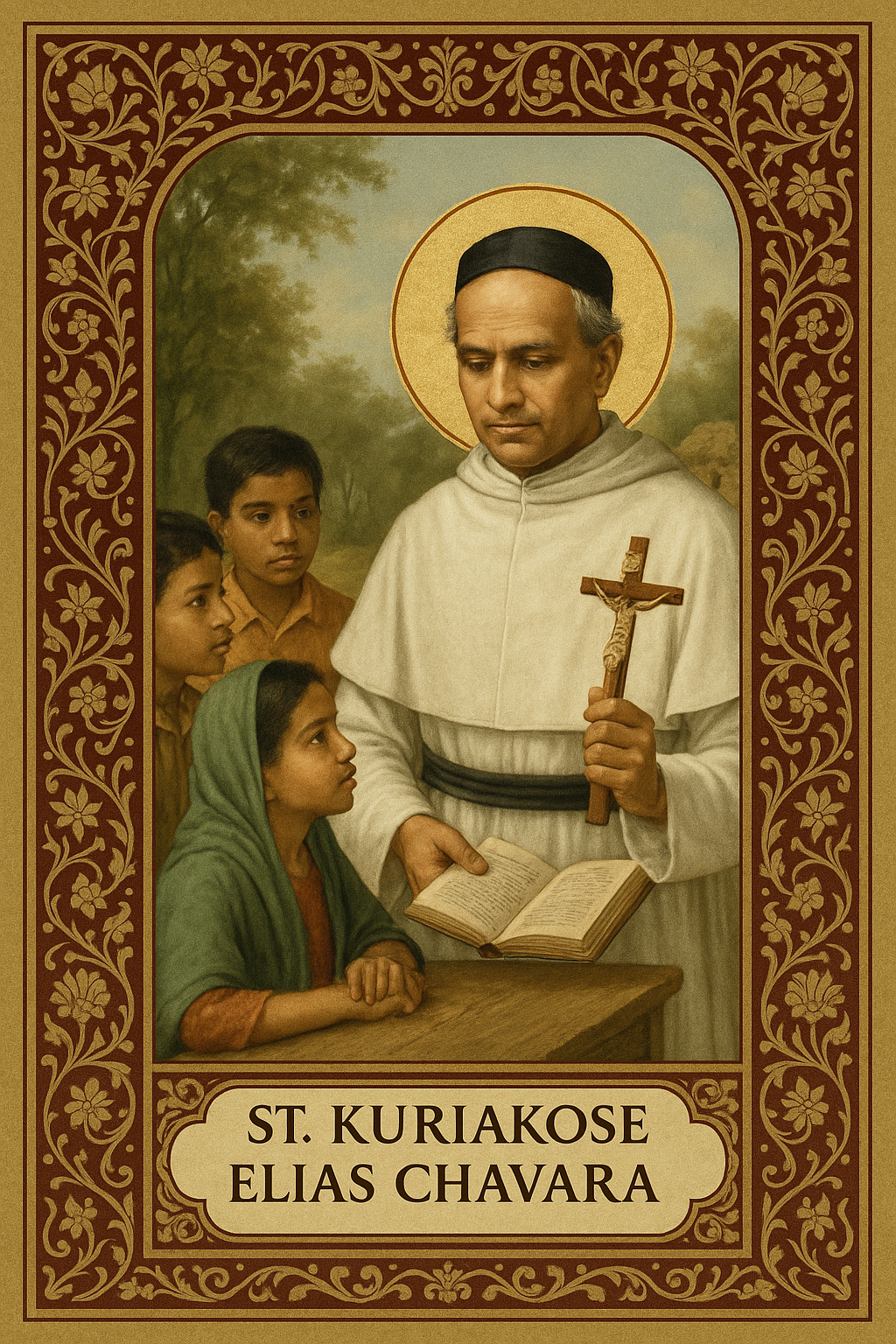
 Image 1 of 2
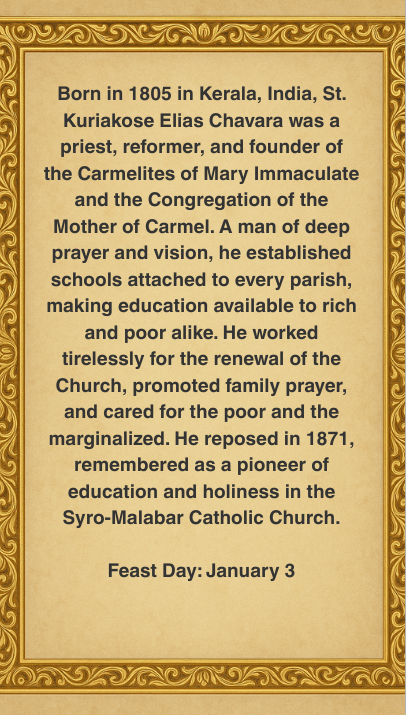 Image 2 of 2
-
The Life & Story
Kuriakose Elias Chavara was born into a devout Christian family in Kerala, India, a land where the faith traces its roots to the preaching of Saint Thomas the Apostle. From childhood he was immersed in prayer, Scripture, and liturgical life. His parents instilled discipline and tenderness in equal measure. Even as a boy, he showed unusual seriousness about spiritual matters, often retreating for prayer while other children played.
His turning point came through priestly formation during a period of instability within the Syro-Malabar Church. Colonial pressures and administrative conflicts created confusion in ecclesial governance. Communities felt uncertain. Authority was questioned. Families worried about the preservation of their liturgical and spiritual heritage.
Chavara did not respond with anger.
He responded with reform rooted in prayer.
Ordained a priest, he became one of the founders of the Carmelites of Mary Immaculate, the first indigenous religious congregation for men in India. Later, he supported the founding of a women’s congregation, recognizing the crucial role of consecrated women in education and family life. He believed that strong families required strong formation, and strong formation required access to schools.
Major suffering marked his leadership.
He carried responsibility during disputes between bishops and foreign missionaries. He endured criticism from multiple sides. At times he faced accusations and misunderstanding. The weight of protecting his community while remaining obedient to Rome pressed heavily on him. He wrote spiritual diaries that reveal an interior man wrestling with humility and responsibility, constantly asking Christ for clarity and patience.
His transformation was not dramatic but steady.
He chose unity over division. He chose obedience over rebellion. He chose constructive reform over destructive reaction. He opened the first Catholic Sanskrit school in Kerala and insisted that every parish should establish a school attached to the church. He also encouraged family prayer and devotion to the Sacred Heart, introducing the practice of placing an image of Christ in the home as a reminder that the household belongs to God.
Saint Chavara reposed in 1871. His legacy did not fade. The congregations he helped establish flourished. Schools multiplied. Families strengthened. His example became a blueprint for balancing tradition with reform without sacrificing charity.
He was canonized by Pope Francis in 2014, affirming his universal significance within the Catholic Church. Yet his heart always remained rooted in protecting ordinary families from spiritual erosion.
-
Miracles & Patronage
Saint Kuriakose Elias Chavara is known as a guardian of domestic stability and spiritual education.
Patron Saint Of:
Family unity during marital conflict
Protection of children from spiritual drift
Strength during financial hardship
Stability in times of church or community division
Educational success for children
Peace in troubled households
Miracles and Ongoing Intercession
During his lifetime, people testified to answered prayers through his counsel and blessing, especially in resolving family disputes and overcoming material poverty. After his death, stories emerged of families restored after serious conflict, children returning to faith after seasons of rebellion, and unexpected financial provision arriving when school fees or debts felt impossible to manage.
Parents often report clarity and peace after praying for his intercession. Teachers seek his help when guiding students. Couples ask for strength to remain faithful during seasons of tension. His miracles are rarely loud. They unfold as reconciliation conversations, restored patience, improved opportunities for children, and renewed hope inside homes that felt fragile.
Saint Chavara’s intercession carries the same spirit as his life. He strengthens quietly. He protects steadily. He anchors families in Christ.
-
Prayers & Traditional Devotion
Traditional Prayer
Saint Kuriakose Elias Chavara, faithful servant of Christ and guardian of families, intercede for us. Obtain for our homes unity, peace, and perseverance in faith. Amen.
Personal Devotional Prayer
Holy Saint Chavara, loving father and protector of Christian homes, pray for my family.
You saw how fragile households can become under pressure. You witnessed how financial stress, misunderstanding, and spiritual confusion can slowly erode love. I bring you my family today.
If conflict exists between us, soften our hearts.
If financial hardship burdens us, provide strength and provision.
If our children wander spiritually, guide them gently back to Christ.Teach us to enthrone Jesus in our home not only with images but with actions. Teach us patience when we disagree. Teach us forgiveness when words wound. Teach us courage when resources feel thin.
Saint Chavara, you founded schools so children would not lose hope. Intercede for every child in my family. Protect their minds, their faith, and their future. Guard them from despair, harmful influences, and confusion.
Help our home become a place of prayer rather than tension, of stability rather than fear, of generosity rather than scarcity.
By your intercession, may Christ reign in our house. May unity replace division. May provision replace anxiety. May peace replace unrest.
Amen.
-
Common Questions (FAQ)
Q: What is Saint Kuriakose Elias Chavara known for?
He is known for strengthening families, promoting Catholic education, founding religious congregations in India, and protecting the unity of the Syro-Malabar Church during turbulent times.Q: When is Saint Kuriakose Elias Chavara’s feast day?
His feast is celebrated on January 3 in the Syro-Malabar Catholic Church and recognized throughout the Catholic Church.Q: Which Christian traditions venerate this saint?
He is honored primarily in the Syro-Malabar Catholic Church, one of the Eastern Catholic Churches, and throughout the wider Roman Catholic Church.Q: Why do people pray to Saint Chavara for family unity or financial hardship?
Because his life was dedicated to protecting households from spiritual collapse, promoting education during poverty, and strengthening families during times of instability and division.