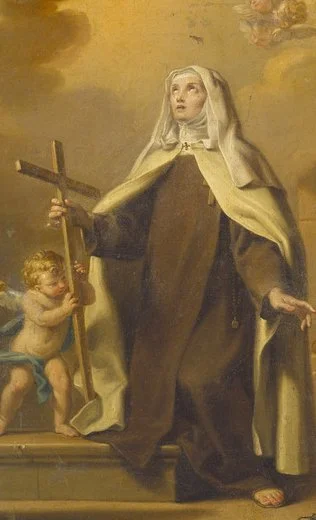
 Image 1 of 1
Saint Margaret of Cortona
Saint Margaret of Cortona is a Catholic saint for anyone who has ever feared that their past has ruined their future. Her life speaks with unusual tenderness to single mothers, women carrying shame, those returning to God after difficult relationships, and anyone who needs to know that repentance is not humiliation. It is the beginning of restoration.
Saint Margaret is especially meaningful as the unofficial patron saint of single mothers and repentance without shame. She bore a son outside of marriage during a difficult relationship, and after her dramatic conversion, she became known for radical penance, deep prayer, and tireless care for the sick poor. Yet the most important part of her story for many women today is that she did not erase her son from her life. Her child was not treated as a secret, an obstacle, or proof that she could never become holy. He remained part of her story, and Margaret’s sanctified life included her motherhood rather than denying it.
Born in 1247 in Laviano, Tuscany, Margaret lost her mother when she was young and struggled deeply under a difficult family situation. As a young woman, she entered a relationship with a nobleman named Arsenio and lived with him for years without marriage. They had a son together, and for a time Margaret lived in comfort, even as her conscience remained restless. Her conversion came suddenly and painfully when Arsenio was murdered and his dog led Margaret to his body. Faced with death, sin, love, loss, and the fragility of life, she turned toward God with a seriousness that changed everything.
After Arsenio’s death, Margaret returned with her son seeking shelter, but she was not welcomed. She eventually found refuge in Cortona, where two women helped her and introduced her to the Franciscan friars. There, Margaret began a life of repentance, prayer, poverty, and service. She became a Franciscan tertiary, gave herself to acts of charity, founded a hospital for the sick poor, and helped form a community of women who cared for the suffering.
Her life refuses the cruel shame narrative often attached to single motherhood. Margaret did repent of sin, but repentance did not mean pretending her child did not exist. It did not mean that motherhood outside a perfect situation made her unusable to God. Her son remained part of her life, and he eventually became a friar. Margaret’s story shows that God can bring holiness out of a complicated past without requiring a person to hate the child, the life, or the future that came from it.
Saint Margaret of Cortona is a powerful intercessor for single mothers, women raising children alone, those repenting after sexual sin, those healing from difficult relationships, those burdened by public shame, and those who feel judged by family, church, or society. She is also a saint for the poor, the homeless, the sick, the falsely accused, penitents, and people whose piety is mocked because others only remember who they used to be.
This prayer card is created for single mothers, women seeking healing after a painful relationship, those returning to confession, those afraid of being judged, and anyone who needs courage to repent without despair. Saint Margaret reminds the soul that a sinful past does not disqualify a holy future, and a child conceived in difficult circumstances is never a barrier to grace, dignity, or sanctity.
Saint Margaret’s patronage includes single mothers, penitents, women seeking repentance, mothers raising children alone, those healing from shame, the homeless, the poor, the sick, the falsely accused, those ridiculed for trying to live faithfully, and all who need the mercy of Christ to rebuild their lives.
Each card is handmade in Austin, TX and created to order. We do not keep stock, because every prayer card is treated as a unique devotional offering. They are printed on museum-quality photo paper, not cardstock. Every card is made slowly, during prayer, with intentional reverence for the saint or holy image and for the person who will receive it. Names are lifted before Christ. Intentions are held carefully. Each piece is handled multiple times in prayerful silence, asking God for mercy and asking the saint to intercede for the soul it is being made for. This is not production work. It is devotional craftsmanship shaped with patience, care, and spiritual responsibility, because every soul and every prayer matters.
THE LIFE & STORY
Saint Margaret of Cortona was born in 1247 in Laviano, Tuscany, into a farming family. Her mother died when Margaret was still young, and after her father remarried, life at home became painful and unstable. Margaret longed for affection, security, and escape, and as a young woman she entered into a relationship with a nobleman named Arsenio. She lived with him for years outside of marriage and bore him a son.
This part of Margaret’s life is often told only through the language of scandal, but her story should be handled with more care than that. She was young, wounded, and searching for love, and although her life with Arsenio was morally disordered, she was not a disposable woman and her child was not a shameful footnote. Even before her full conversion, there were signs of compassion in her heart, especially toward the poor. Grace was already reaching for her before she knew how to fully surrender.
Margaret’s conversion came through tragedy. One day Arsenio did not return home, and his dog came back without him. The animal led Margaret into the forest, where she found Arsenio murdered. The shock of discovering his body forced her to confront death, sin, judgment, and the condition of her own soul. She had loved a man who was now gone, and she did not know whether he had repented before death. That terror became the doorway through which she turned seriously toward God.
After Arsenio’s death, Margaret took her son and tried to return to her father’s home, but she was not welcomed. Rejected and vulnerable, she went to Cortona, where two charitable women helped her and connected her with the Franciscan friars. This was the beginning of her new life. She did not begin again as someone with a clean public record, an easy family situation, or a socially respectable story. She began again as a mother with a complicated past and a child to raise.
In Cortona, Margaret embraced a life of repentance and poverty. She became a Franciscan tertiary and placed herself under spiritual direction. Her penance was intense, sometimes so severe that her confessors had to moderate her. Yet her repentance did not turn inward in a self-hating way. It became charity. She nursed the sick poor, founded a hospital, helped form a community of women known as the Poverelle to care for the suffering, and became a source of counsel for sinners seeking their way back to God.
Margaret’s son remained part of her story. He was not hidden away so that she could appear more respectable. He was her child, and in time he entered religious life as a friar. This detail matters because it shows that Margaret’s conversion did not require her to disown her motherhood. Her past was redeemed, not erased. Her child was not a stain on her sanctity, but part of the life through which God worked.
Saint Margaret died in Cortona on February 22, 1297, and was canonized in 1728. She is remembered as a great penitent, a woman of prayer, a servant of the sick poor, and a saint whose life proves that God’s mercy can rebuild a soul without pretending the past never happened.
For single mothers and those carrying shame, Saint Margaret’s life is a profound comfort. She shows that repentance is not about becoming acceptable to cruel people. It is about returning to Christ, receiving mercy, and allowing grace to make the whole life holy, including the parts other people misunderstand.
MIRACLES & PATRONAGE
Saint Margaret of Cortona is remembered for radical conversion, deep prayer, service to the sick poor, and the spiritual counsel she gave to those seeking repentance. Her life drew many people because she knew what it meant to be a sinner in need of mercy. She could speak to the wounded without pretending sin was harmless, and she could speak about repentance without crushing the person who had fallen.
Her patronage of single mothers is especially powerful because she lived the reality of motherhood outside marriage and then walked the path of conversion without abandoning her child. In her, single mothers can find a saint who understands vulnerability, social judgment, financial insecurity, family rejection, and the painful fear that others will always define a woman by her most complicated season.
Her unofficial patronage of repentance without shame is just as important. Margaret did not teach that sin should be excused, minimized, or renamed. She repented deeply. But her repentance was not the same thing as despair, self-hatred, or social humiliation. She allowed God to transform her life, and that transformation bore fruit in love for the poor, care for the sick, and spiritual wisdom for others.
Saint Margaret is also meaningful for people healing from relationships that were painful, unequal, unstable, or morally complicated. She knew what it meant to long for love, to be bound to someone without the security of marriage, and to face the consequences of choices made in woundedness. Her story offers hope to those who need to return to God without denying the complexity of what happened.
People ask Saint Margaret’s intercession for single mothers, children born into difficult circumstances, women returning to faith, those afraid of confession, those healing from sexual shame, those recovering from unhealthy relationships, mothers rejected by family, and anyone who fears that their past has permanently marked them as less worthy of love.
She is also a patron for the homeless, the poor, the sick, the falsely accused, penitents, and those who are mocked when they try to change. Her life speaks to anyone who has heard others say, “We remember who you were,” while God is saying, “Come home and become who I made you to be.”
Saint Margaret teaches that repentance is not a public performance of shame. It is a return to the mercy of Christ. Her life proclaims that a woman’s past does not cancel her future, a child is never a disgrace, and God can make a saint from a life others thought was already ruined.
PRAYERS
A simple invocation may be prayed often: Saint Margaret of Cortona, pray for us.
For single mothers, one may pray: Saint Margaret of Cortona, pray for mothers raising children alone. Ask Christ to give them protection, provision, courage, tenderness, and the grace to know that they and their children are deeply loved by God.
For repentance without shame, one may pray: Saint Margaret, faithful penitent and servant of the poor, pray for those who are afraid to return to God because of shame. Ask the Lord to give them true repentance, honest confession, healing, and freedom from despair.
For women healing from painful relationships, one may pray: Saint Margaret, who knew love, loss, regret, and conversion, pray for those healing from relationships that wounded them. Ask Christ to restore their dignity, guide their future, and protect them from returning to what harms the soul.
For children of single mothers, one may pray: Saint Margaret, pray for children born into difficult or complicated circumstances. Ask God to protect them from shame, rejection, and fear, and to surround them with love, stability, and faith.
For those afraid of confession, one may pray: Saint Margaret, pray for me as I return to the mercy of God. Help me confess honestly, receive forgiveness with humility, and trust that Christ desires my healing more than my humiliation.
For care of the poor and sick, one may pray: Saint Margaret, who served the sick poor with love, pray that my repentance may bear fruit in charity. Teach me to love Christ not only with words, but through mercy toward those who suffer.
This prayer card is especially fitting for prayers by single mothers, mothers in difficult circumstances, women returning to faith, those seeking confession after many years, those healing from shame, and families praying for restoration, mercy, and a new beginning in Christ.
FAQ
Who is Saint Margaret of Cortona?
Saint Margaret of Cortona was a 13th-century Catholic saint, Franciscan tertiary, penitent, mother, mystic, and servant of the sick poor. She was born in Tuscany in 1247, experienced a dramatic conversion after the death of the man with whom she had lived outside marriage, and later became known for prayer, penance, charity, and care for the poor.
Is Saint Margaret of Cortona Catholic?
Yes. Saint Margaret of Cortona is a Catholic saint. She was a member of the Third Order of Saint Francis and was canonized in 1728.
What is Saint Margaret of Cortona the patron saint of?
Saint Margaret of Cortona is commonly associated with single mothers, penitents, the homeless, the falsely accused, the sick poor, stepchildren, those ridiculed for their piety, and people seeking conversion. She is especially meaningful for single mothers and those returning to God after a difficult past.
Is Saint Margaret of Cortona the official patron saint of single mothers?
Saint Margaret is widely listed and invoked as a patron saint of single mothers. In this product page, the phrase “unofficial patron saint of single mothers and repentance without shame” emphasizes the devotional meaning of her life for single mothers, women carrying shame, and those seeking mercy after complicated circumstances.
Why is Saint Margaret connected to single mothers?
Saint Margaret bore a son outside of marriage during her relationship with Arsenio. After her conversion, she raised her son while pursuing holiness, penance, and service to the poor. Her motherhood was not erased from her sanctity, which makes her a powerful saint for mothers raising children alone.
Why is Saint Margaret connected to repentance without shame?
Saint Margaret repented deeply, but her story is not one of hopeless shame. She returned to God, received spiritual direction, served the sick poor, and became a saint. Her life shows that repentance should lead to healing, mercy, charity, and holiness rather than despair or self-hatred.
Did Saint Margaret of Cortona have a child?
Yes. Saint Margaret had a son with Arsenio, the nobleman with whom she lived outside marriage. After Arsenio’s death, Margaret took her son with her as she began her new life, and he eventually became a friar.
Why is her son important to her story?
Her son is important because he shows that Margaret’s conversion did not require her to erase her motherhood. Her child remained part of her life and part of the story God redeemed. This is one reason she is so meaningful for single mothers and women who fear that their past makes them unworthy of holiness.
What happened to Saint Margaret’s lover?
Arsenio was murdered while away from home. His dog returned without him and led Margaret to his body. Discovering his death became the turning point that shocked Margaret into a serious conversion and a new life in Christ.
What did Saint Margaret do after her conversion?
After her conversion, Margaret went to Cortona, became connected with the Franciscan friars, entered the Third Order of Saint Francis, embraced a life of prayer and penance, cared for the sick poor, founded a hospital, and helped form a group of women who served the suffering.
When is Saint Margaret of Cortona’s feast day?
Saint Margaret of Cortona’s feast day is February 22, the date of her death in 1297.
Can I give this prayer card to a single mother?
Yes. This prayer card is especially fitting for single mothers, mothers raising children alone, women in difficult family situations, and anyone who needs the encouragement that motherhood in complicated circumstances does not disqualify a woman from grace, dignity, or holiness.
Can I give this prayer card to someone returning to confession?
Yes. Saint Margaret of Cortona is a beautiful saint for someone returning to confession or trying to come back to God after many years. Her life speaks directly to repentance, mercy, healing, and the hope that the past does not have to control the future.
Is this prayer card only for women?
No. While Saint Margaret is especially meaningful for women, single mothers, and those healing from shame, anyone who needs repentance, mercy, and a new beginning can ask for her intercession.
What is the main message of Saint Margaret of Cortona’s life?
The main message of Saint Margaret’s life is that the past does not disqualify the future. Her story teaches that repentance is not meant to crush a soul with shame, but to bring a person home to Christ, where even a complicated life can become holy.
Saint Margaret of Cortona is a Catholic saint for anyone who has ever feared that their past has ruined their future. Her life speaks with unusual tenderness to single mothers, women carrying shame, those returning to God after difficult relationships, and anyone who needs to know that repentance is not humiliation. It is the beginning of restoration.
Saint Margaret is especially meaningful as the unofficial patron saint of single mothers and repentance without shame. She bore a son outside of marriage during a difficult relationship, and after her dramatic conversion, she became known for radical penance, deep prayer, and tireless care for the sick poor. Yet the most important part of her story for many women today is that she did not erase her son from her life. Her child was not treated as a secret, an obstacle, or proof that she could never become holy. He remained part of her story, and Margaret’s sanctified life included her motherhood rather than denying it.
Born in 1247 in Laviano, Tuscany, Margaret lost her mother when she was young and struggled deeply under a difficult family situation. As a young woman, she entered a relationship with a nobleman named Arsenio and lived with him for years without marriage. They had a son together, and for a time Margaret lived in comfort, even as her conscience remained restless. Her conversion came suddenly and painfully when Arsenio was murdered and his dog led Margaret to his body. Faced with death, sin, love, loss, and the fragility of life, she turned toward God with a seriousness that changed everything.
After Arsenio’s death, Margaret returned with her son seeking shelter, but she was not welcomed. She eventually found refuge in Cortona, where two women helped her and introduced her to the Franciscan friars. There, Margaret began a life of repentance, prayer, poverty, and service. She became a Franciscan tertiary, gave herself to acts of charity, founded a hospital for the sick poor, and helped form a community of women who cared for the suffering.
Her life refuses the cruel shame narrative often attached to single motherhood. Margaret did repent of sin, but repentance did not mean pretending her child did not exist. It did not mean that motherhood outside a perfect situation made her unusable to God. Her son remained part of her life, and he eventually became a friar. Margaret’s story shows that God can bring holiness out of a complicated past without requiring a person to hate the child, the life, or the future that came from it.
Saint Margaret of Cortona is a powerful intercessor for single mothers, women raising children alone, those repenting after sexual sin, those healing from difficult relationships, those burdened by public shame, and those who feel judged by family, church, or society. She is also a saint for the poor, the homeless, the sick, the falsely accused, penitents, and people whose piety is mocked because others only remember who they used to be.
This prayer card is created for single mothers, women seeking healing after a painful relationship, those returning to confession, those afraid of being judged, and anyone who needs courage to repent without despair. Saint Margaret reminds the soul that a sinful past does not disqualify a holy future, and a child conceived in difficult circumstances is never a barrier to grace, dignity, or sanctity.
Saint Margaret’s patronage includes single mothers, penitents, women seeking repentance, mothers raising children alone, those healing from shame, the homeless, the poor, the sick, the falsely accused, those ridiculed for trying to live faithfully, and all who need the mercy of Christ to rebuild their lives.
Each card is handmade in Austin, TX and created to order. We do not keep stock, because every prayer card is treated as a unique devotional offering. They are printed on museum-quality photo paper, not cardstock. Every card is made slowly, during prayer, with intentional reverence for the saint or holy image and for the person who will receive it. Names are lifted before Christ. Intentions are held carefully. Each piece is handled multiple times in prayerful silence, asking God for mercy and asking the saint to intercede for the soul it is being made for. This is not production work. It is devotional craftsmanship shaped with patience, care, and spiritual responsibility, because every soul and every prayer matters.
THE LIFE & STORY
Saint Margaret of Cortona was born in 1247 in Laviano, Tuscany, into a farming family. Her mother died when Margaret was still young, and after her father remarried, life at home became painful and unstable. Margaret longed for affection, security, and escape, and as a young woman she entered into a relationship with a nobleman named Arsenio. She lived with him for years outside of marriage and bore him a son.
This part of Margaret’s life is often told only through the language of scandal, but her story should be handled with more care than that. She was young, wounded, and searching for love, and although her life with Arsenio was morally disordered, she was not a disposable woman and her child was not a shameful footnote. Even before her full conversion, there were signs of compassion in her heart, especially toward the poor. Grace was already reaching for her before she knew how to fully surrender.
Margaret’s conversion came through tragedy. One day Arsenio did not return home, and his dog came back without him. The animal led Margaret into the forest, where she found Arsenio murdered. The shock of discovering his body forced her to confront death, sin, judgment, and the condition of her own soul. She had loved a man who was now gone, and she did not know whether he had repented before death. That terror became the doorway through which she turned seriously toward God.
After Arsenio’s death, Margaret took her son and tried to return to her father’s home, but she was not welcomed. Rejected and vulnerable, she went to Cortona, where two charitable women helped her and connected her with the Franciscan friars. This was the beginning of her new life. She did not begin again as someone with a clean public record, an easy family situation, or a socially respectable story. She began again as a mother with a complicated past and a child to raise.
In Cortona, Margaret embraced a life of repentance and poverty. She became a Franciscan tertiary and placed herself under spiritual direction. Her penance was intense, sometimes so severe that her confessors had to moderate her. Yet her repentance did not turn inward in a self-hating way. It became charity. She nursed the sick poor, founded a hospital, helped form a community of women known as the Poverelle to care for the suffering, and became a source of counsel for sinners seeking their way back to God.
Margaret’s son remained part of her story. He was not hidden away so that she could appear more respectable. He was her child, and in time he entered religious life as a friar. This detail matters because it shows that Margaret’s conversion did not require her to disown her motherhood. Her past was redeemed, not erased. Her child was not a stain on her sanctity, but part of the life through which God worked.
Saint Margaret died in Cortona on February 22, 1297, and was canonized in 1728. She is remembered as a great penitent, a woman of prayer, a servant of the sick poor, and a saint whose life proves that God’s mercy can rebuild a soul without pretending the past never happened.
For single mothers and those carrying shame, Saint Margaret’s life is a profound comfort. She shows that repentance is not about becoming acceptable to cruel people. It is about returning to Christ, receiving mercy, and allowing grace to make the whole life holy, including the parts other people misunderstand.
MIRACLES & PATRONAGE
Saint Margaret of Cortona is remembered for radical conversion, deep prayer, service to the sick poor, and the spiritual counsel she gave to those seeking repentance. Her life drew many people because she knew what it meant to be a sinner in need of mercy. She could speak to the wounded without pretending sin was harmless, and she could speak about repentance without crushing the person who had fallen.
Her patronage of single mothers is especially powerful because she lived the reality of motherhood outside marriage and then walked the path of conversion without abandoning her child. In her, single mothers can find a saint who understands vulnerability, social judgment, financial insecurity, family rejection, and the painful fear that others will always define a woman by her most complicated season.
Her unofficial patronage of repentance without shame is just as important. Margaret did not teach that sin should be excused, minimized, or renamed. She repented deeply. But her repentance was not the same thing as despair, self-hatred, or social humiliation. She allowed God to transform her life, and that transformation bore fruit in love for the poor, care for the sick, and spiritual wisdom for others.
Saint Margaret is also meaningful for people healing from relationships that were painful, unequal, unstable, or morally complicated. She knew what it meant to long for love, to be bound to someone without the security of marriage, and to face the consequences of choices made in woundedness. Her story offers hope to those who need to return to God without denying the complexity of what happened.
People ask Saint Margaret’s intercession for single mothers, children born into difficult circumstances, women returning to faith, those afraid of confession, those healing from sexual shame, those recovering from unhealthy relationships, mothers rejected by family, and anyone who fears that their past has permanently marked them as less worthy of love.
She is also a patron for the homeless, the poor, the sick, the falsely accused, penitents, and those who are mocked when they try to change. Her life speaks to anyone who has heard others say, “We remember who you were,” while God is saying, “Come home and become who I made you to be.”
Saint Margaret teaches that repentance is not a public performance of shame. It is a return to the mercy of Christ. Her life proclaims that a woman’s past does not cancel her future, a child is never a disgrace, and God can make a saint from a life others thought was already ruined.
PRAYERS
A simple invocation may be prayed often: Saint Margaret of Cortona, pray for us.
For single mothers, one may pray: Saint Margaret of Cortona, pray for mothers raising children alone. Ask Christ to give them protection, provision, courage, tenderness, and the grace to know that they and their children are deeply loved by God.
For repentance without shame, one may pray: Saint Margaret, faithful penitent and servant of the poor, pray for those who are afraid to return to God because of shame. Ask the Lord to give them true repentance, honest confession, healing, and freedom from despair.
For women healing from painful relationships, one may pray: Saint Margaret, who knew love, loss, regret, and conversion, pray for those healing from relationships that wounded them. Ask Christ to restore their dignity, guide their future, and protect them from returning to what harms the soul.
For children of single mothers, one may pray: Saint Margaret, pray for children born into difficult or complicated circumstances. Ask God to protect them from shame, rejection, and fear, and to surround them with love, stability, and faith.
For those afraid of confession, one may pray: Saint Margaret, pray for me as I return to the mercy of God. Help me confess honestly, receive forgiveness with humility, and trust that Christ desires my healing more than my humiliation.
For care of the poor and sick, one may pray: Saint Margaret, who served the sick poor with love, pray that my repentance may bear fruit in charity. Teach me to love Christ not only with words, but through mercy toward those who suffer.
This prayer card is especially fitting for prayers by single mothers, mothers in difficult circumstances, women returning to faith, those seeking confession after many years, those healing from shame, and families praying for restoration, mercy, and a new beginning in Christ.
FAQ
Who is Saint Margaret of Cortona?
Saint Margaret of Cortona was a 13th-century Catholic saint, Franciscan tertiary, penitent, mother, mystic, and servant of the sick poor. She was born in Tuscany in 1247, experienced a dramatic conversion after the death of the man with whom she had lived outside marriage, and later became known for prayer, penance, charity, and care for the poor.
Is Saint Margaret of Cortona Catholic?
Yes. Saint Margaret of Cortona is a Catholic saint. She was a member of the Third Order of Saint Francis and was canonized in 1728.
What is Saint Margaret of Cortona the patron saint of?
Saint Margaret of Cortona is commonly associated with single mothers, penitents, the homeless, the falsely accused, the sick poor, stepchildren, those ridiculed for their piety, and people seeking conversion. She is especially meaningful for single mothers and those returning to God after a difficult past.
Is Saint Margaret of Cortona the official patron saint of single mothers?
Saint Margaret is widely listed and invoked as a patron saint of single mothers. In this product page, the phrase “unofficial patron saint of single mothers and repentance without shame” emphasizes the devotional meaning of her life for single mothers, women carrying shame, and those seeking mercy after complicated circumstances.
Why is Saint Margaret connected to single mothers?
Saint Margaret bore a son outside of marriage during her relationship with Arsenio. After her conversion, she raised her son while pursuing holiness, penance, and service to the poor. Her motherhood was not erased from her sanctity, which makes her a powerful saint for mothers raising children alone.
Why is Saint Margaret connected to repentance without shame?
Saint Margaret repented deeply, but her story is not one of hopeless shame. She returned to God, received spiritual direction, served the sick poor, and became a saint. Her life shows that repentance should lead to healing, mercy, charity, and holiness rather than despair or self-hatred.
Did Saint Margaret of Cortona have a child?
Yes. Saint Margaret had a son with Arsenio, the nobleman with whom she lived outside marriage. After Arsenio’s death, Margaret took her son with her as she began her new life, and he eventually became a friar.
Why is her son important to her story?
Her son is important because he shows that Margaret’s conversion did not require her to erase her motherhood. Her child remained part of her life and part of the story God redeemed. This is one reason she is so meaningful for single mothers and women who fear that their past makes them unworthy of holiness.
What happened to Saint Margaret’s lover?
Arsenio was murdered while away from home. His dog returned without him and led Margaret to his body. Discovering his death became the turning point that shocked Margaret into a serious conversion and a new life in Christ.
What did Saint Margaret do after her conversion?
After her conversion, Margaret went to Cortona, became connected with the Franciscan friars, entered the Third Order of Saint Francis, embraced a life of prayer and penance, cared for the sick poor, founded a hospital, and helped form a group of women who served the suffering.
When is Saint Margaret of Cortona’s feast day?
Saint Margaret of Cortona’s feast day is February 22, the date of her death in 1297.
Can I give this prayer card to a single mother?
Yes. This prayer card is especially fitting for single mothers, mothers raising children alone, women in difficult family situations, and anyone who needs the encouragement that motherhood in complicated circumstances does not disqualify a woman from grace, dignity, or holiness.
Can I give this prayer card to someone returning to confession?
Yes. Saint Margaret of Cortona is a beautiful saint for someone returning to confession or trying to come back to God after many years. Her life speaks directly to repentance, mercy, healing, and the hope that the past does not have to control the future.
Is this prayer card only for women?
No. While Saint Margaret is especially meaningful for women, single mothers, and those healing from shame, anyone who needs repentance, mercy, and a new beginning can ask for her intercession.
What is the main message of Saint Margaret of Cortona’s life?
The main message of Saint Margaret’s life is that the past does not disqualify the future. Her story teaches that repentance is not meant to crush a soul with shame, but to bring a person home to Christ, where even a complicated life can become holy.