 Image 1 of 1
Saint Mark of Ephesus - Defender of the Faith, Truth & Courage
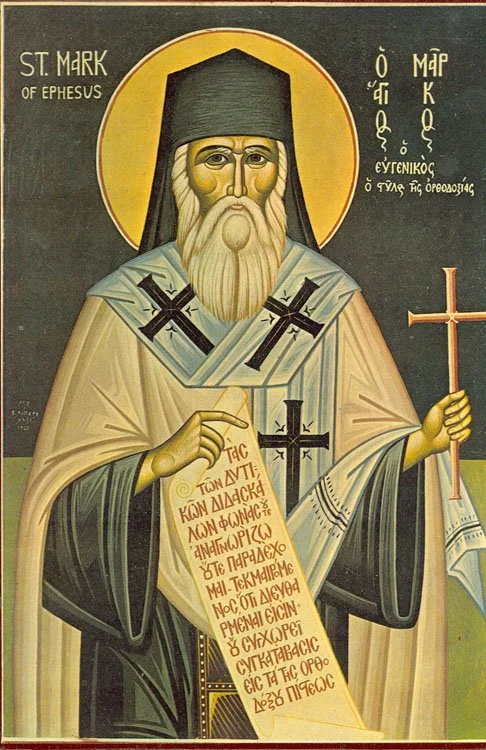
Saint Mark of Ephesus is an Orthodox saint for those who need courage to stand firm in the truth when compromise feels easier, safer, or more popular. He was a 15th-century bishop, monk, theologian, and confessor of the Orthodox Faith who became known as a fearless defender of Holy Tradition at the Council of Florence. In a moment when nearly everyone around him was willing to sign an agreement he believed compromised the faith of the Fathers, Saint Mark refused.
He is especially meaningful for Christians who are trying to remain faithful under pressure. His life speaks to those who feel alone in their convictions, those who are trying to discern truth from confusion, those who are tired of watered-down faith, and those who want the courage to obey God even when obedience costs them comfort, approval, or peace with the crowd.
Saint Mark of Ephesus does not teach stubbornness for its own sake. His witness is not about pride, argument, or loving division. His life is about holy conviction, love for the truth, faithfulness to the Church, reverence for the Fathers, and the courage to say no when the soul knows that saying yes would betray Christ. He reminds the faithful that real unity can never be built by pretending doctrine does not matter.
Born in Constantinople around 1392, Saint Mark was given the name Manuel or Emmanuel Eugenikos. He was raised in a pious and educated Christian family and became known for his intelligence, learning, and seriousness of faith. Though he could have pursued honor in the world, he chose the monastic life, giving himself to prayer, theology, ascetic discipline, and the life of the Church.
He later became Metropolitan of Ephesus and was sent to the Council of Ferrara-Florence, where leaders from East and West attempted to restore unity between the Orthodox and Roman churches. Saint Mark entered the council with hope for true reunion, but he became convinced that the proposed union required the Orthodox to accept teachings and claims that were not faithful to the apostolic and patristic tradition. When the time came to sign, he stood nearly alone and refused.
Because of this, Saint Mark became known as the Defender of Orthodoxy, the Pillar of Orthodoxy, and the Conscience of Orthodoxy. His stand was not comfortable. He faced pressure from emperors, bishops, political leaders, and those who believed compromise was necessary for survival. Yet he remained faithful, trusting that truth belongs to Christ and cannot be traded for earthly security.
This prayer card is created for Orthodox Christians, catechumens, converts, clergy, theologians, apologists, students of Church history, and anyone seeking courage, discernment, and faithfulness. It is also fitting for those facing pressure at work, in family life, online, in ministry, or in the world to soften, hide, or abandon what they know to be true.
Saint Mark of Ephesus reminds the soul that holiness is not always loud, but it must be faithful. Sometimes the most powerful witness is a quiet refusal to betray the truth. Sometimes one faithful voice, rooted in prayer and humility, can strengthen the whole Church.
Saint Mark’s patronage includes defenders of Orthodoxy, theologians, teachers, clergy, monks, catechumens, converts, apologists, those seeking doctrinal clarity, those resisting false compromise, those pressured to abandon their convictions, and all who desire courage to stand firm in the faith.
Each card is handmade in Austin, TX and created to order. We do not keep stock, because every prayer card is treated as a unique devotional offering. They are printed on museum-quality photo paper, not cardstock. Every card is made slowly, during prayer, with intentional reverence for the saint or holy image and for the person who will receive it. Names are lifted before Christ. Intentions are held carefully. Each piece is handled multiple times in prayerful silence, asking God for mercy and asking the saint to intercede for the soul it is being made for. This is not production work. It is devotional craftsmanship shaped with patience, care, and spiritual responsibility, because every soul and every prayer matters.
THE LIFE & STORY
Saint Mark of Ephesus, also known as Mark Eugenikos, was born in Constantinople around 1392, during the final generations of the Byzantine Empire. He grew up in a Christian world surrounded by beauty, theology, liturgy, learning, danger, and decline. Constantinople was still the great city of Orthodox Christian civilization, but the empire around it was weakening, and the pressure from the Ottoman Turks was growing stronger.
From an early age, Mark showed unusual intelligence and spiritual seriousness. He was well educated, trained in theology, philosophy, rhetoric, and the teachings of the Church Fathers. His learning was not merely academic. For Saint Mark, theology was not an intellectual game or a way to win arguments. Theology was the life of the Church expressed in truth. It was prayer, worship, doctrine, repentance, and communion with God.
As a young man, he turned away from worldly ambition and embraced monastic life. He became a monk and gave himself to prayer, ascetic struggle, study, and the defense of the Orthodox Faith. His mind was sharp, but his soul was formed by worship. This is part of what made him so powerful at Florence. He did not simply know theology as information. He had received it as a living inheritance.
Saint Mark was eventually ordained and became Metropolitan of Ephesus. Though the ancient city of Ephesus had once been one of the great centers of early Christianity, by Mark’s time the see was no longer what it had been in the age of Saint Paul or the Third Ecumenical Council. Still, the title carried deep spiritual weight. Ephesus was a place tied to the apostles, the Mother of God, the early Church, and the defense of true doctrine.
In the 1430s, the Byzantine emperor John VIII Palaiologos sought help from the West against the growing Ottoman threat. One hope was that reunion with Rome might bring military aid. This led to the Council of Ferrara-Florence, where Orthodox and Roman Catholic representatives discussed the possibility of restoring communion after centuries of division.
Saint Mark went to the council as one of the most important Orthodox theologians present. He was not opposed to true unity. He wanted the healing of schism if it could be achieved in truth. But as the council progressed, he became convinced that the proposed union required acceptance of teachings he believed departed from the faith of the Fathers, especially regarding the Filioque, papal claims, and the doctrine of purgatorial fire.
Many leaders were under enormous pressure. The empire was desperate. The political situation was terrifying. Some believed that signing the union was necessary for survival. Saint Mark understood the danger facing his people, but he also understood that the Church cannot be saved by betraying the truth that gives her life.
When the decree of union was signed, Saint Mark refused. He was nearly alone among the Eastern bishops present in refusing to place his name on the document. That refusal made him one of the most beloved saints in Orthodox memory. His courage strengthened the faithful, and when the delegation returned to Constantinople, many Orthodox Christians rejected the union and honored Saint Mark as the one who had preserved the faith.
After the council, Saint Mark continued to oppose the union. He suffered pressure, exile, illness, and hardship, but he did not surrender his conscience. He spent his final years defending Orthodoxy, encouraging the faithful, and calling the Church to remain rooted in the apostolic faith.
Saint Mark reposed in 1444. His earthly life ended before the fall of Constantinople in 1453, but his witness remained. In later generations, he came to be honored as a Pillar of Orthodoxy and a holy confessor who stood for the truth when almost everyone around him was willing to compromise.
His life still speaks with force today. In every age, Christians face pressure to make the faith smaller, softer, safer, or more acceptable to the world. Saint Mark of Ephesus reminds us that love and truth cannot be separated. He teaches that courage is not hatred, conviction is not pride, and faithfulness is not fanaticism when it is rooted in humility, prayer, and obedience to Christ.
MIRACLES & PATRONAGE
Saint Mark of Ephesus is remembered most of all for the miracle of his witness. He stood almost alone at one of the most important moments in Orthodox history, and his refusal to compromise became a source of strength for generations of Christians. His life shows that one faithful soul, when rooted in prayer and truth, can become a wall of protection for many.
There are also traditional accounts of healing associated with Saint Mark after his death. One story tells of a gravely ill woman who had been given up by physicians. After losing consciousness, she awoke and described being led by a bishop to a fountain, washed, and told that she no longer had her illness. When she asked who he was, he identified himself as Mark Eugenikos, Metropolitan of Ephesus. The woman was healed and later had an icon of him made in thanksgiving.
This healing story is beautiful, but Saint Mark’s deepest patronage remains courage in the truth. He is a saint for those who are trying to remain faithful when they feel surrounded by confusion. He is a saint for Christians who want unity, but not false unity. He is a saint for people who love peace, but know that peace without truth is fragile.
He is especially fitting for catechumens and converts who are trying to understand the faith deeply. Many people come to Orthodoxy after years of searching, reading, comparing, praying, and struggling. Saint Mark’s life helps them see that doctrine is not cold or lifeless. True doctrine protects worship, prayer, salvation, and the soul’s union with God.
He is also meaningful for theologians, writers, teachers, clergy, and apologists. Saint Mark’s example warns against using theology as a weapon of ego, but it also warns against treating truth as optional. He shows that holy learning must be joined to courage, humility, prayer, and love for the Church.
For people under pressure, Saint Mark is a powerful intercessor. Some are pressured by family to abandon their convictions. Some are pressured by work, culture, politics, social media, or fear of rejection. Some are tempted to stay silent when they should speak, or to agree outwardly with what they know is false. Saint Mark reminds them that faithfulness may feel lonely, but no one who stands with Christ stands alone.
People ask Saint Mark of Ephesus for courage, discernment, fidelity to the Orthodox Faith, protection from false teaching, strength in controversy, wisdom in theological study, humility in defending truth, and the grace to remain faithful without becoming harsh, bitter, or proud.
PRAYERS
A simple invocation may be prayed often: Saint Mark of Ephesus, pray for us.
For courage, one may pray: Saint Mark of Ephesus, pray for me when I am afraid to stand firm. Ask Christ to strengthen my heart, purify my motives, and help me remain faithful to the truth without pride, anger, or fear.
For discernment, one may pray: Saint Mark of Ephesus, defender of the Orthodox Faith, pray that I may recognize truth from confusion, humility from cowardice, and peace from false compromise. Help me cling to Christ and the faith handed down by the Fathers.
For catechumens and converts, one may pray: Saint Mark of Ephesus, pray for all who are seeking the fullness of the faith. Ask God to guide them with patience, wisdom, humility, and courage, and to protect them from confusion, discouragement, and spiritual pride.
For clergy and teachers, one may pray: Saint Mark of Ephesus, pray for bishops, priests, deacons, monks, teachers, writers, and all who explain the faith. Ask Christ to make them faithful, clear, gentle, courageous, and obedient to the truth.
For those under pressure, one may pray: Saint Mark of Ephesus, pray for those who feel alone in their convictions. Ask the Lord to give them peace, strength, wisdom, and love, so they may stand firm without hatred and speak truth without fear.
For unity in truth, one may pray: Saint Mark of Ephesus, pray that all Christians may seek true unity in Christ, not unity built on confusion or compromise. Ask the Lord to heal division, guard the Church, and lead all hearts into the fullness of His truth.
This prayer card is a spiritual aid and devotional reminder. It is not a replacement for pastoral guidance, catechesis, spiritual direction, or life in the Church. Anyone struggling with serious spiritual confusion, anger, bitterness, or fear should seek guidance from a trusted priest or spiritual father.
FAQ
Who is Saint Mark of Ephesus?
Saint Mark of Ephesus, also known as Mark Eugenikos, was a 15th-century Orthodox bishop, monk, theologian, and confessor. He is best known for his defense of the Orthodox Faith at the Council of Florence and his refusal to sign the decree of union.
Is Saint Mark of Ephesus an Orthodox saint?
Yes. Saint Mark of Ephesus is venerated in the Eastern Orthodox Church and is commonly known as a Pillar of Orthodoxy and Defender of the Orthodox Faith.
Is Saint Mark of Ephesus a Catholic saint?
Saint Mark of Ephesus is not generally venerated as a Roman Catholic saint. He is an Eastern Orthodox saint whose life is especially connected to the Orthodox rejection of the union proposed at the Council of Florence.
What is Saint Mark of Ephesus known for?
Saint Mark is known for standing firm at the Council of Florence when he believed the proposed union required compromise on essential Orthodox teaching. He refused to sign the union decree and became one of the most important defenders of Orthodoxy in Church history.
Why is Saint Mark of Ephesus called the Pillar of Orthodoxy?
He is called a Pillar of Orthodoxy because he defended the faith of the Fathers during a time of enormous political and religious pressure. His courage helped preserve Orthodox teaching and strengthened the faithful after the Council of Florence.
What is Saint Mark of Ephesus the patron saint of?
Saint Mark of Ephesus is a fitting intercessor for defenders of Orthodoxy, theologians, clergy, teachers, catechumens, converts, apologists, and those who need courage to stand firm in the truth.
When is Saint Mark of Ephesus’ feast day?
Saint Mark of Ephesus is commemorated on January 19 in the Orthodox Church.
Why is Saint Mark of Ephesus meaningful for converts and catechumens?
Saint Mark is meaningful for converts and catechumens because his life shows the importance of seeking truth with humility, seriousness, and courage. He reminds those entering the Church that doctrine is not merely academic, but deeply connected to worship, salvation, and faithfulness to Christ.
Can I give this prayer card to someone becoming Orthodox?
Yes. This prayer card is a meaningful gift for catechumens, converts, chrismations, baptisms, Orthodox study groups, clergy, seminarians, and anyone learning the Orthodox Faith.
Can I give this prayer card to someone who needs courage?
Yes. Saint Mark of Ephesus is especially fitting for someone who feels pressured, misunderstood, spiritually confused, or afraid to stand firm in their convictions. His life is a reminder that faithfulness to Christ is worth more than approval.
What does Saint Mark of Ephesus teach us today?
Saint Mark teaches that truth and love belong together. His life reminds Christians that unity must be rooted in truth, courage must be joined to humility, and faithfulness to Christ is more important than comfort, popularity, or political advantage.
Is this prayer card handmade?
Yes. Each prayer card is handmade in Austin, TX, printed on museum-quality photo paper, and created to order with prayerful care.
Saint Mark of Ephesus is an Orthodox saint for those who need courage to stand firm in the truth when compromise feels easier, safer, or more popular. He was a 15th-century bishop, monk, theologian, and confessor of the Orthodox Faith who became known as a fearless defender of Holy Tradition at the Council of Florence. In a moment when nearly everyone around him was willing to sign an agreement he believed compromised the faith of the Fathers, Saint Mark refused.
He is especially meaningful for Christians who are trying to remain faithful under pressure. His life speaks to those who feel alone in their convictions, those who are trying to discern truth from confusion, those who are tired of watered-down faith, and those who want the courage to obey God even when obedience costs them comfort, approval, or peace with the crowd.
Saint Mark of Ephesus does not teach stubbornness for its own sake. His witness is not about pride, argument, or loving division. His life is about holy conviction, love for the truth, faithfulness to the Church, reverence for the Fathers, and the courage to say no when the soul knows that saying yes would betray Christ. He reminds the faithful that real unity can never be built by pretending doctrine does not matter.
Born in Constantinople around 1392, Saint Mark was given the name Manuel or Emmanuel Eugenikos. He was raised in a pious and educated Christian family and became known for his intelligence, learning, and seriousness of faith. Though he could have pursued honor in the world, he chose the monastic life, giving himself to prayer, theology, ascetic discipline, and the life of the Church.
He later became Metropolitan of Ephesus and was sent to the Council of Ferrara-Florence, where leaders from East and West attempted to restore unity between the Orthodox and Roman churches. Saint Mark entered the council with hope for true reunion, but he became convinced that the proposed union required the Orthodox to accept teachings and claims that were not faithful to the apostolic and patristic tradition. When the time came to sign, he stood nearly alone and refused.
Because of this, Saint Mark became known as the Defender of Orthodoxy, the Pillar of Orthodoxy, and the Conscience of Orthodoxy. His stand was not comfortable. He faced pressure from emperors, bishops, political leaders, and those who believed compromise was necessary for survival. Yet he remained faithful, trusting that truth belongs to Christ and cannot be traded for earthly security.
This prayer card is created for Orthodox Christians, catechumens, converts, clergy, theologians, apologists, students of Church history, and anyone seeking courage, discernment, and faithfulness. It is also fitting for those facing pressure at work, in family life, online, in ministry, or in the world to soften, hide, or abandon what they know to be true.
Saint Mark of Ephesus reminds the soul that holiness is not always loud, but it must be faithful. Sometimes the most powerful witness is a quiet refusal to betray the truth. Sometimes one faithful voice, rooted in prayer and humility, can strengthen the whole Church.
Saint Mark’s patronage includes defenders of Orthodoxy, theologians, teachers, clergy, monks, catechumens, converts, apologists, those seeking doctrinal clarity, those resisting false compromise, those pressured to abandon their convictions, and all who desire courage to stand firm in the faith.
Each card is handmade in Austin, TX and created to order. We do not keep stock, because every prayer card is treated as a unique devotional offering. They are printed on museum-quality photo paper, not cardstock. Every card is made slowly, during prayer, with intentional reverence for the saint or holy image and for the person who will receive it. Names are lifted before Christ. Intentions are held carefully. Each piece is handled multiple times in prayerful silence, asking God for mercy and asking the saint to intercede for the soul it is being made for. This is not production work. It is devotional craftsmanship shaped with patience, care, and spiritual responsibility, because every soul and every prayer matters.
THE LIFE & STORY
Saint Mark of Ephesus, also known as Mark Eugenikos, was born in Constantinople around 1392, during the final generations of the Byzantine Empire. He grew up in a Christian world surrounded by beauty, theology, liturgy, learning, danger, and decline. Constantinople was still the great city of Orthodox Christian civilization, but the empire around it was weakening, and the pressure from the Ottoman Turks was growing stronger.
From an early age, Mark showed unusual intelligence and spiritual seriousness. He was well educated, trained in theology, philosophy, rhetoric, and the teachings of the Church Fathers. His learning was not merely academic. For Saint Mark, theology was not an intellectual game or a way to win arguments. Theology was the life of the Church expressed in truth. It was prayer, worship, doctrine, repentance, and communion with God.
As a young man, he turned away from worldly ambition and embraced monastic life. He became a monk and gave himself to prayer, ascetic struggle, study, and the defense of the Orthodox Faith. His mind was sharp, but his soul was formed by worship. This is part of what made him so powerful at Florence. He did not simply know theology as information. He had received it as a living inheritance.
Saint Mark was eventually ordained and became Metropolitan of Ephesus. Though the ancient city of Ephesus had once been one of the great centers of early Christianity, by Mark’s time the see was no longer what it had been in the age of Saint Paul or the Third Ecumenical Council. Still, the title carried deep spiritual weight. Ephesus was a place tied to the apostles, the Mother of God, the early Church, and the defense of true doctrine.
In the 1430s, the Byzantine emperor John VIII Palaiologos sought help from the West against the growing Ottoman threat. One hope was that reunion with Rome might bring military aid. This led to the Council of Ferrara-Florence, where Orthodox and Roman Catholic representatives discussed the possibility of restoring communion after centuries of division.
Saint Mark went to the council as one of the most important Orthodox theologians present. He was not opposed to true unity. He wanted the healing of schism if it could be achieved in truth. But as the council progressed, he became convinced that the proposed union required acceptance of teachings he believed departed from the faith of the Fathers, especially regarding the Filioque, papal claims, and the doctrine of purgatorial fire.
Many leaders were under enormous pressure. The empire was desperate. The political situation was terrifying. Some believed that signing the union was necessary for survival. Saint Mark understood the danger facing his people, but he also understood that the Church cannot be saved by betraying the truth that gives her life.
When the decree of union was signed, Saint Mark refused. He was nearly alone among the Eastern bishops present in refusing to place his name on the document. That refusal made him one of the most beloved saints in Orthodox memory. His courage strengthened the faithful, and when the delegation returned to Constantinople, many Orthodox Christians rejected the union and honored Saint Mark as the one who had preserved the faith.
After the council, Saint Mark continued to oppose the union. He suffered pressure, exile, illness, and hardship, but he did not surrender his conscience. He spent his final years defending Orthodoxy, encouraging the faithful, and calling the Church to remain rooted in the apostolic faith.
Saint Mark reposed in 1444. His earthly life ended before the fall of Constantinople in 1453, but his witness remained. In later generations, he came to be honored as a Pillar of Orthodoxy and a holy confessor who stood for the truth when almost everyone around him was willing to compromise.
His life still speaks with force today. In every age, Christians face pressure to make the faith smaller, softer, safer, or more acceptable to the world. Saint Mark of Ephesus reminds us that love and truth cannot be separated. He teaches that courage is not hatred, conviction is not pride, and faithfulness is not fanaticism when it is rooted in humility, prayer, and obedience to Christ.
MIRACLES & PATRONAGE
Saint Mark of Ephesus is remembered most of all for the miracle of his witness. He stood almost alone at one of the most important moments in Orthodox history, and his refusal to compromise became a source of strength for generations of Christians. His life shows that one faithful soul, when rooted in prayer and truth, can become a wall of protection for many.
There are also traditional accounts of healing associated with Saint Mark after his death. One story tells of a gravely ill woman who had been given up by physicians. After losing consciousness, she awoke and described being led by a bishop to a fountain, washed, and told that she no longer had her illness. When she asked who he was, he identified himself as Mark Eugenikos, Metropolitan of Ephesus. The woman was healed and later had an icon of him made in thanksgiving.
This healing story is beautiful, but Saint Mark’s deepest patronage remains courage in the truth. He is a saint for those who are trying to remain faithful when they feel surrounded by confusion. He is a saint for Christians who want unity, but not false unity. He is a saint for people who love peace, but know that peace without truth is fragile.
He is especially fitting for catechumens and converts who are trying to understand the faith deeply. Many people come to Orthodoxy after years of searching, reading, comparing, praying, and struggling. Saint Mark’s life helps them see that doctrine is not cold or lifeless. True doctrine protects worship, prayer, salvation, and the soul’s union with God.
He is also meaningful for theologians, writers, teachers, clergy, and apologists. Saint Mark’s example warns against using theology as a weapon of ego, but it also warns against treating truth as optional. He shows that holy learning must be joined to courage, humility, prayer, and love for the Church.
For people under pressure, Saint Mark is a powerful intercessor. Some are pressured by family to abandon their convictions. Some are pressured by work, culture, politics, social media, or fear of rejection. Some are tempted to stay silent when they should speak, or to agree outwardly with what they know is false. Saint Mark reminds them that faithfulness may feel lonely, but no one who stands with Christ stands alone.
People ask Saint Mark of Ephesus for courage, discernment, fidelity to the Orthodox Faith, protection from false teaching, strength in controversy, wisdom in theological study, humility in defending truth, and the grace to remain faithful without becoming harsh, bitter, or proud.
PRAYERS
A simple invocation may be prayed often: Saint Mark of Ephesus, pray for us.
For courage, one may pray: Saint Mark of Ephesus, pray for me when I am afraid to stand firm. Ask Christ to strengthen my heart, purify my motives, and help me remain faithful to the truth without pride, anger, or fear.
For discernment, one may pray: Saint Mark of Ephesus, defender of the Orthodox Faith, pray that I may recognize truth from confusion, humility from cowardice, and peace from false compromise. Help me cling to Christ and the faith handed down by the Fathers.
For catechumens and converts, one may pray: Saint Mark of Ephesus, pray for all who are seeking the fullness of the faith. Ask God to guide them with patience, wisdom, humility, and courage, and to protect them from confusion, discouragement, and spiritual pride.
For clergy and teachers, one may pray: Saint Mark of Ephesus, pray for bishops, priests, deacons, monks, teachers, writers, and all who explain the faith. Ask Christ to make them faithful, clear, gentle, courageous, and obedient to the truth.
For those under pressure, one may pray: Saint Mark of Ephesus, pray for those who feel alone in their convictions. Ask the Lord to give them peace, strength, wisdom, and love, so they may stand firm without hatred and speak truth without fear.
For unity in truth, one may pray: Saint Mark of Ephesus, pray that all Christians may seek true unity in Christ, not unity built on confusion or compromise. Ask the Lord to heal division, guard the Church, and lead all hearts into the fullness of His truth.
This prayer card is a spiritual aid and devotional reminder. It is not a replacement for pastoral guidance, catechesis, spiritual direction, or life in the Church. Anyone struggling with serious spiritual confusion, anger, bitterness, or fear should seek guidance from a trusted priest or spiritual father.
FAQ
Who is Saint Mark of Ephesus?
Saint Mark of Ephesus, also known as Mark Eugenikos, was a 15th-century Orthodox bishop, monk, theologian, and confessor. He is best known for his defense of the Orthodox Faith at the Council of Florence and his refusal to sign the decree of union.
Is Saint Mark of Ephesus an Orthodox saint?
Yes. Saint Mark of Ephesus is venerated in the Eastern Orthodox Church and is commonly known as a Pillar of Orthodoxy and Defender of the Orthodox Faith.
Is Saint Mark of Ephesus a Catholic saint?
Saint Mark of Ephesus is not generally venerated as a Roman Catholic saint. He is an Eastern Orthodox saint whose life is especially connected to the Orthodox rejection of the union proposed at the Council of Florence.
What is Saint Mark of Ephesus known for?
Saint Mark is known for standing firm at the Council of Florence when he believed the proposed union required compromise on essential Orthodox teaching. He refused to sign the union decree and became one of the most important defenders of Orthodoxy in Church history.
Why is Saint Mark of Ephesus called the Pillar of Orthodoxy?
He is called a Pillar of Orthodoxy because he defended the faith of the Fathers during a time of enormous political and religious pressure. His courage helped preserve Orthodox teaching and strengthened the faithful after the Council of Florence.
What is Saint Mark of Ephesus the patron saint of?
Saint Mark of Ephesus is a fitting intercessor for defenders of Orthodoxy, theologians, clergy, teachers, catechumens, converts, apologists, and those who need courage to stand firm in the truth.
When is Saint Mark of Ephesus’ feast day?
Saint Mark of Ephesus is commemorated on January 19 in the Orthodox Church.
Why is Saint Mark of Ephesus meaningful for converts and catechumens?
Saint Mark is meaningful for converts and catechumens because his life shows the importance of seeking truth with humility, seriousness, and courage. He reminds those entering the Church that doctrine is not merely academic, but deeply connected to worship, salvation, and faithfulness to Christ.
Can I give this prayer card to someone becoming Orthodox?
Yes. This prayer card is a meaningful gift for catechumens, converts, chrismations, baptisms, Orthodox study groups, clergy, seminarians, and anyone learning the Orthodox Faith.
Can I give this prayer card to someone who needs courage?
Yes. Saint Mark of Ephesus is especially fitting for someone who feels pressured, misunderstood, spiritually confused, or afraid to stand firm in their convictions. His life is a reminder that faithfulness to Christ is worth more than approval.
What does Saint Mark of Ephesus teach us today?
Saint Mark teaches that truth and love belong together. His life reminds Christians that unity must be rooted in truth, courage must be joined to humility, and faithfulness to Christ is more important than comfort, popularity, or political advantage.
Is this prayer card handmade?
Yes. Each prayer card is handmade in Austin, TX, printed on museum-quality photo paper, and created to order with prayerful care.