 Image 1 of 1
Saint Pelagia the Actress
Saint Pelagia the Actress was a celebrated performer of Antioch whose dramatic conversion transformed her from a woman surrounded by luxury, admiration, and temptation into one of Christianity’s most beloved models of repentance. After hearing Saint Nonnus of Edessa preach about judgment, mercy, and eternal life, she renounced her former way of living, received Holy Baptism, distributed her wealth among the poor, and devoted the remainder of her life entirely to God. Her feast is celebrated on October 8.
According to ancient Christian tradition, Pelagia was the leading actress and dancer of a theatrical company in Antioch. Known for her extraordinary beauty, elaborate clothing, jewels, and public performances, she lived at the center of a world that offered attention, wealth, and pleasure while drawing her further from God. Some accounts say that she was originally called Margarita, meaning “pearl,” because of the jewels she wore and the splendor with which she presented herself.
One day, Pelagia passed near a gathering of bishops while Saint Nonnus was speaking with them. The other clergy lowered their eyes, but Nonnus looked upon her with sorrow and spiritual concern. Rather than condemning her, he wept because she devoted more effort to pleasing the world than many Christians devoted to preparing their souls for God. He prayed that the beauty she possessed would one day be offered to Christ.
Pelagia later entered the church and heard Saint Nonnus preach about sin, judgment, repentance, and the mercy of God. His words pierced her heart. She sent a message asking to meet him, describing herself as a sinner who longed to be delivered from the power of evil. When she came before the bishop, she fell at his feet and begged for Baptism, refusing to believe that the Savior who welcomed sinners would turn her away.
After receiving Holy Baptism, Pelagia abandoned the wealth and identity that had defined her former life. She gave her possessions to Saint Nonnus so they could be distributed among widows, orphans, and the poor. She also freed those who had served her, removing their ornaments and releasing them from every obligation to her.
Pelagia eventually left Antioch and traveled to Jerusalem. Wearing a simple garment given to her by Saint Nonnus, she established a small cell on the Mount of Olives and lived there in prayer, fasting, poverty, and repentance. Concealing her former identity, she became known as the ascetic Pelagius. Only after her death did those preparing her body for burial discover that the revered hermit was the woman once known throughout Antioch as Pelagia the Actress.
Today, Saint Pelagia is especially invoked by those seeking repentance, freedom from sexual sin, deliverance from destructive habits, healing from shame, and the courage to leave behind a former way of life. She is a powerful intercessor for actors, dancers, performers, entertainers, converts, penitents, and anyone who fears that their past has placed them beyond the mercy of God.
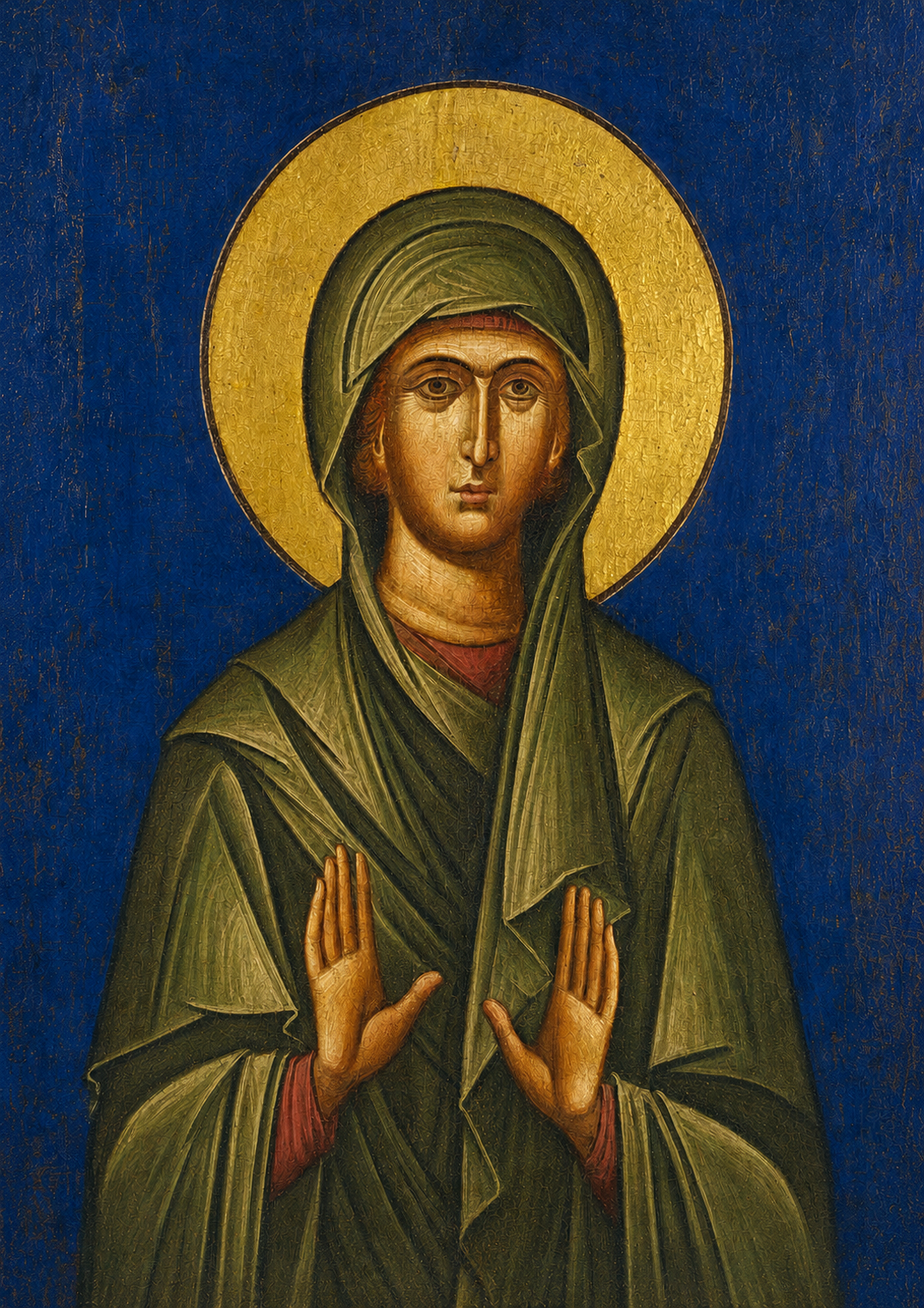
This prayer card honors a saint whose life reveals that repentance is not merely regret for the past. It is the complete reorientation of a human life toward God. Pelagia had been known for outward beauty, but through repentance she acquired the hidden beauty of a soul restored by grace. Her story assures every sinner that Christ does not define us by what we have been. When we sincerely turn toward Him, He opens the way to an entirely new life.
Each card is handmade in Austin and created to order. We do not keep stock, because every prayer card is treated as a unique devotional offering. They are printed on museum-quality photo paper, not cardstock, and each one is made during prayer. The saints are venerated throughout the entire process, and prayers are intentionally offered for the person who will receive the card. These are not mass-produced items. They are created slowly, reverently, and with spiritual intention, because every soul and every prayer matters.
The Life & Story
Saint Pelagia lived in Antioch during the fourth or fifth century, when the city was one of the largest, wealthiest, and most influential centers of the Roman world. Antioch was renowned for its magnificent buildings, public entertainments, theaters, festivals, and luxurious way of life. It was also home to an important Christian community whose members lived amid the temptations and spiritual dangers of a thriving pagan culture.
Ancient tradition describes Pelagia as the leader of a theatrical or dancing company. Acting and public performance in the ancient Roman world were often closely associated with pagan festivals, immodest entertainment, and sexual exploitation. Pelagia became famous for her beauty and performances, receiving considerable wealth and public attention.
The ancient account of her conversion says that a group of bishops had gathered in Antioch when Pelagia passed before them dressed in magnificent clothing and surrounded by attendants. Pearls, gold, and precious stones adorned her from head to foot, while perfume announced her approach. The bishops turned their eyes away, but Saint Nonnus, Bishop of Edessa, continued looking at her.
His response was not one of desire or self-righteous condemnation. He recognized that Pelagia had devoted enormous discipline, money, time, and attention to making herself beautiful for a world that would eventually pass away. Nonnus turned to the other bishops and asked whether Christians showed the same determination in cleansing and adorning their souls for their eternal Bridegroom.
Saint Nonnus later withdrew to his room and prayed with tears. He confessed his own spiritual negligence and asked God to receive the beauty of Pelagia, purify her, and make her a bride of Christ. That night, according to the traditional account, he dreamed of a dark and unclean bird that flew around him while he celebrated the Divine Liturgy. He caught it, cast it into the baptismal water, and watched it emerge clean and white before flying toward heaven.
The following day, Pelagia entered the church and heard Nonnus preach. His words concerning eternal judgment, the Kingdom of Heaven, and God’s mercy toward repentant sinners awakened her conscience. For perhaps the first time, she saw clearly what her outwardly glamorous life had done to her soul.
Pelagia sent servants to discover where Saint Nonnus was staying and then wrote to him, calling herself a disciple of the devil and asking whether the God whom he preached would show mercy to someone like her. Nonnus agreed to meet her only in the presence of the other bishops so that everything would be conducted openly and honorably.
When Pelagia entered their presence, she threw herself at the bishop’s feet and begged to be baptized. She feared that if she were sent away, temptation would reclaim her before she could return. Saint Nonnus assured her that God knew her life completely and that Baptism could not be treated lightly, but Pelagia continued pleading for the mercy promised to repentant sinners.
The bishop contacted the Church’s senior authority in Antioch, and the deaconess Romana was sent to assist Pelagia and serve as her spiritual sponsor. Pelagia confessed her sins, rejected her former life, received Holy Baptism, and was clothed in the white baptismal garment.
The ancient account says that Pelagia immediately faced spiritual temptation. The devil accused and tormented her, attempting to fill her with fear and regret over the life she had abandoned. Pelagia responded by making the Sign of the Cross and placing her trust in Jesus Christ, whose name she now bore as a Christian.
Three days after her Baptism, Pelagia summoned the steward responsible for her possessions and ordered him to produce a complete inventory. She surrendered her gold, jewels, clothing, and remaining wealth to Saint Nonnus, asking that nothing from her former life be kept for herself. The bishop instructed that everything be distributed among widows, orphans, and the poor rather than used by the Church, because the wealth had been gathered through a sinful way of life.
Pelagia also gathered the men and women who had served her. She removed their golden ornaments with her own hands, freed them from their obligations, and gave them what they needed to begin lives of their own. She asked them to remember that the world and its beauty would pass away and urged them to seek the God who had shown mercy to her.
After spending a short time under the guidance of the deaconess Romana, Pelagia quietly left Antioch. Wearing a simple garment belonging to Saint Nonnus, she traveled to Jerusalem and built a small cell on the Mount of Olives, near the place associated with Christ’s Ascension.
There she concealed her identity beneath the name Pelagius and lived as a solitary ascetic. The woman who had once been surrounded by crowds, attendants, perfume, music, and praise now chose silence, poverty, fasting, and uninterrupted prayer. Her former beauty faded through years of ascetic labor, but the people who encountered the mysterious hermit recognized profound holiness.
Near the end of her life, a deacon connected with Saint Nonnus visited Jerusalem and was instructed to seek the holy recluse Pelagius. He did not recognize the once-famous actress. Pelagia, however, recognized him and asked him to convey her gratitude and prayers to the bishop whose preaching had helped lead her to Christ.
When the deacon returned a short time later, he discovered that Pelagius had died. Monks and pilgrims gathered to prepare the revered ascetic for burial. Only then was it discovered that the hermit was a woman. The news spread throughout Jerusalem, and Christians came from the surrounding countryside to honor the former actress who had become a saint through complete repentance.
Pelagia was buried in her cell on the Mount of Olives. Her life became one of the Christian East’s great accounts of conversion, reminding generations of believers that no reputation, occupation, habit, or history of sin can prevent a person from becoming holy when the heart responds fully to the grace of God.
Legacy & Patronage
Saint Pelagia is remembered throughout the Eastern Christian tradition as Pelagia the Actress, Pelagia the Penitent, or Pelagia of Antioch. She should not be confused with the virgin-martyr Pelagia of Antioch or Saint Pelagia of Tarsus, who are different saints bearing the same name.
Her traditional life belongs to a beloved group of early Christian conversion stories in which people who had been publicly associated with sin became extraordinary ascetics and witnesses to divine mercy. Like Saint Mary of Egypt and Saint Thaïs, Pelagia demonstrates that the depth of a person’s former sin does not determine the height of holiness they may attain through grace.
Her story is not intended to teach that beauty, artistic ability, or performance is evil. Rather, it warns against allowing any gift to become separated from God or used in ways that damage the human soul. Pelagia’s beauty and strength of character were not destroyed by her conversion. They were purified and redirected toward Christ.
Patron Saint Of
Saint Pelagia the Actress is commonly honored as a patron and intercessor for actresses, actors, dancers, performers, entertainers, converts, penitents, and people leaving sexually exploitative professions. She is also invoked by those struggling with vanity, sexual temptation, addiction to attention, destructive relationships, shame about their past, or fear that they are unworthy of forgiveness.
Her intercession is especially meaningful for people whose public identity conflicts with the life to which God is calling them. She offers hope to those who believe they cannot change because others will always remember what they once did, as well as to those who fear losing money, security, relationships, or social standing if they begin following Christ seriously.
Repentance and Ongoing Intercession
Saint Pelagia’s conversion was immediate, but it was not superficial. She did not merely feel sorrow after hearing a moving sermon. She received Baptism, surrendered the wealth connected to her former life, released those who served her, left behind her public identity, and embraced a life centered entirely upon God.
Her story teaches that genuine repentance includes both receiving mercy and responding to it. Pelagia did not attempt to purchase forgiveness through suffering, nor did she imagine that asceticism could replace the grace given to her in Baptism. Her prayer, fasting, poverty, and solitude were her loving response to the mercy she had already received.
Many people seek her intercession for the courage to make a sincere confession, freedom from pornography or sexual sin, healing after exploitation, strength to leave an immoral occupation, detachment from vanity and public approval, protection against returning to former habits, and confidence in God’s willingness to forgive.
Saint Pelagia also offers a necessary answer to shame. Shame tells a sinner that the past is their permanent identity. Repentance acknowledges the truth about the past while allowing Christ to create something new. Pelagia did not deny who she had been, but neither did she remain imprisoned by it. The Actress of Antioch became the holy ascetic of the Mount of Olives.
Prayers & Traditional Devotion
Troparion to Saint Pelagia — Tone 8
In you, O Mother, was carefully preserved what is according to the image, for you took up the Cross and followed Christ. By so doing, you taught us to disregard the flesh, for it passes away, but to care instead for the soul, since it is immortal. Therefore, O venerable Pelagia, your spirit rejoices with the angels.
Prayer to Saint Pelagia the Actress
O venerable Saint Pelagia, you were surrounded by the praise, wealth, and pleasures of the world, yet when the voice of Christ reached your heart, you did not harden yourself against Him. You abandoned everything that separated you from God and offered your entire life in repentance, prayer, and love.
Pray for us when we are tempted to seek the approval of others more than the approval of God. Help us recognize the emptiness of sin, the danger of vanity, and the mercy of Christ, who came not to condemn the repentant but to restore them.
Intercede especially for those trapped in sexual sin, exploitation, destructive relationships, addiction, shame, or fear of beginning again. Obtain for them the courage to seek help, make an honest confession, leave behind what harms their souls, and trust that no sincere return to God is ever rejected.
Holy Pelagia, teach us that repentance is not hopelessness over what we have done, but hope in what God can still make of us. Pray that our outward lives and inward hearts may be purified, that every gift entrusted to us may be offered to Christ, and that we may persevere until we enter the joy of His eternal Kingdom.
Amen.
Common Questions (FAQ)
Q: Who was Saint Pelagia the Actress?
Saint Pelagia the Actress was a famous performer and dancer in Antioch who converted to Christianity after hearing Saint Nonnus of Edessa preach. She received Baptism, gave her wealth to the poor, freed her servants, and later lived as an ascetic on the Mount of Olives.
Q: When is Saint Pelagia’s feast day?
The feast of Saint Pelagia the Actress, also known as Pelagia the Penitent, is celebrated on October 8.
Q: Why is she called Pelagia the Actress?
She is called Pelagia the Actress because ancient Christian tradition remembers her as the leading performer of a theatrical or dancing company in Antioch before her conversion.
Q: Is Saint Pelagia the Actress the same person as the virgin-martyr Pelagia?
No. Several early Christian saints were named Pelagia. Pelagia the Actress or Penitent is the converted performer who became an ascetic on the Mount of Olives. Pelagia the Virgin of Antioch and Pelagia of Tarsus are different saints.
Q: Who helped bring Saint Pelagia to Christianity?
Saint Nonnus, Bishop of Edessa, helped lead Pelagia to Christ through his preaching, prayers, and willingness to receive her with mercy when she sought Baptism.
Q: What did Saint Pelagia do with her wealth?
After her Baptism, Pelagia surrendered her possessions to Saint Nonnus and asked him to distribute them among widows, orphans, and the poor. She also freed the men and women who had served her.
Q: Why did Saint Pelagia live under the name Pelagius?
After leaving Antioch, she lived in seclusion on the Mount of Olives disguised as a male ascetic and became known as Pelagius. Her identity was reportedly discovered only after her death.
Q: What is Saint Pelagia the patron saint of?
She is commonly invoked by actors, actresses, dancers, performers, converts, and penitents. People also seek her intercession for freedom from sexual sin, vanity, destructive habits, shame, and attachment to public approval.
Q: Why do people pray to Saint Pelagia?
People ask for her prayers when seeking genuine repentance, courage to confess serious sins, freedom from a former way of life, protection against returning to old habits, and confidence in the mercy of God.
Q: What does Saint Pelagia’s life teach?
Her life teaches that no sinner is beyond redemption and that a person’s past does not have to determine their future. Through grace, sincere repentance, and perseverance, even a life deeply entangled in sin can become a life of extraordinary holiness.
Saint Pelagia the Actress was a celebrated performer of Antioch whose dramatic conversion transformed her from a woman surrounded by luxury, admiration, and temptation into one of Christianity’s most beloved models of repentance. After hearing Saint Nonnus of Edessa preach about judgment, mercy, and eternal life, she renounced her former way of living, received Holy Baptism, distributed her wealth among the poor, and devoted the remainder of her life entirely to God. Her feast is celebrated on October 8.
According to ancient Christian tradition, Pelagia was the leading actress and dancer of a theatrical company in Antioch. Known for her extraordinary beauty, elaborate clothing, jewels, and public performances, she lived at the center of a world that offered attention, wealth, and pleasure while drawing her further from God. Some accounts say that she was originally called Margarita, meaning “pearl,” because of the jewels she wore and the splendor with which she presented herself.
One day, Pelagia passed near a gathering of bishops while Saint Nonnus was speaking with them. The other clergy lowered their eyes, but Nonnus looked upon her with sorrow and spiritual concern. Rather than condemning her, he wept because she devoted more effort to pleasing the world than many Christians devoted to preparing their souls for God. He prayed that the beauty she possessed would one day be offered to Christ.
Pelagia later entered the church and heard Saint Nonnus preach about sin, judgment, repentance, and the mercy of God. His words pierced her heart. She sent a message asking to meet him, describing herself as a sinner who longed to be delivered from the power of evil. When she came before the bishop, she fell at his feet and begged for Baptism, refusing to believe that the Savior who welcomed sinners would turn her away.
After receiving Holy Baptism, Pelagia abandoned the wealth and identity that had defined her former life. She gave her possessions to Saint Nonnus so they could be distributed among widows, orphans, and the poor. She also freed those who had served her, removing their ornaments and releasing them from every obligation to her.
Pelagia eventually left Antioch and traveled to Jerusalem. Wearing a simple garment given to her by Saint Nonnus, she established a small cell on the Mount of Olives and lived there in prayer, fasting, poverty, and repentance. Concealing her former identity, she became known as the ascetic Pelagius. Only after her death did those preparing her body for burial discover that the revered hermit was the woman once known throughout Antioch as Pelagia the Actress.
Today, Saint Pelagia is especially invoked by those seeking repentance, freedom from sexual sin, deliverance from destructive habits, healing from shame, and the courage to leave behind a former way of life. She is a powerful intercessor for actors, dancers, performers, entertainers, converts, penitents, and anyone who fears that their past has placed them beyond the mercy of God.
This prayer card honors a saint whose life reveals that repentance is not merely regret for the past. It is the complete reorientation of a human life toward God. Pelagia had been known for outward beauty, but through repentance she acquired the hidden beauty of a soul restored by grace. Her story assures every sinner that Christ does not define us by what we have been. When we sincerely turn toward Him, He opens the way to an entirely new life.
Each card is handmade in Austin and created to order. We do not keep stock, because every prayer card is treated as a unique devotional offering. They are printed on museum-quality photo paper, not cardstock, and each one is made during prayer. The saints are venerated throughout the entire process, and prayers are intentionally offered for the person who will receive the card. These are not mass-produced items. They are created slowly, reverently, and with spiritual intention, because every soul and every prayer matters.
The Life & Story
Saint Pelagia lived in Antioch during the fourth or fifth century, when the city was one of the largest, wealthiest, and most influential centers of the Roman world. Antioch was renowned for its magnificent buildings, public entertainments, theaters, festivals, and luxurious way of life. It was also home to an important Christian community whose members lived amid the temptations and spiritual dangers of a thriving pagan culture.
Ancient tradition describes Pelagia as the leader of a theatrical or dancing company. Acting and public performance in the ancient Roman world were often closely associated with pagan festivals, immodest entertainment, and sexual exploitation. Pelagia became famous for her beauty and performances, receiving considerable wealth and public attention.
The ancient account of her conversion says that a group of bishops had gathered in Antioch when Pelagia passed before them dressed in magnificent clothing and surrounded by attendants. Pearls, gold, and precious stones adorned her from head to foot, while perfume announced her approach. The bishops turned their eyes away, but Saint Nonnus, Bishop of Edessa, continued looking at her.
His response was not one of desire or self-righteous condemnation. He recognized that Pelagia had devoted enormous discipline, money, time, and attention to making herself beautiful for a world that would eventually pass away. Nonnus turned to the other bishops and asked whether Christians showed the same determination in cleansing and adorning their souls for their eternal Bridegroom.
Saint Nonnus later withdrew to his room and prayed with tears. He confessed his own spiritual negligence and asked God to receive the beauty of Pelagia, purify her, and make her a bride of Christ. That night, according to the traditional account, he dreamed of a dark and unclean bird that flew around him while he celebrated the Divine Liturgy. He caught it, cast it into the baptismal water, and watched it emerge clean and white before flying toward heaven.
The following day, Pelagia entered the church and heard Nonnus preach. His words concerning eternal judgment, the Kingdom of Heaven, and God’s mercy toward repentant sinners awakened her conscience. For perhaps the first time, she saw clearly what her outwardly glamorous life had done to her soul.
Pelagia sent servants to discover where Saint Nonnus was staying and then wrote to him, calling herself a disciple of the devil and asking whether the God whom he preached would show mercy to someone like her. Nonnus agreed to meet her only in the presence of the other bishops so that everything would be conducted openly and honorably.
When Pelagia entered their presence, she threw herself at the bishop’s feet and begged to be baptized. She feared that if she were sent away, temptation would reclaim her before she could return. Saint Nonnus assured her that God knew her life completely and that Baptism could not be treated lightly, but Pelagia continued pleading for the mercy promised to repentant sinners.
The bishop contacted the Church’s senior authority in Antioch, and the deaconess Romana was sent to assist Pelagia and serve as her spiritual sponsor. Pelagia confessed her sins, rejected her former life, received Holy Baptism, and was clothed in the white baptismal garment.
The ancient account says that Pelagia immediately faced spiritual temptation. The devil accused and tormented her, attempting to fill her with fear and regret over the life she had abandoned. Pelagia responded by making the Sign of the Cross and placing her trust in Jesus Christ, whose name she now bore as a Christian.
Three days after her Baptism, Pelagia summoned the steward responsible for her possessions and ordered him to produce a complete inventory. She surrendered her gold, jewels, clothing, and remaining wealth to Saint Nonnus, asking that nothing from her former life be kept for herself. The bishop instructed that everything be distributed among widows, orphans, and the poor rather than used by the Church, because the wealth had been gathered through a sinful way of life.
Pelagia also gathered the men and women who had served her. She removed their golden ornaments with her own hands, freed them from their obligations, and gave them what they needed to begin lives of their own. She asked them to remember that the world and its beauty would pass away and urged them to seek the God who had shown mercy to her.
After spending a short time under the guidance of the deaconess Romana, Pelagia quietly left Antioch. Wearing a simple garment belonging to Saint Nonnus, she traveled to Jerusalem and built a small cell on the Mount of Olives, near the place associated with Christ’s Ascension.
There she concealed her identity beneath the name Pelagius and lived as a solitary ascetic. The woman who had once been surrounded by crowds, attendants, perfume, music, and praise now chose silence, poverty, fasting, and uninterrupted prayer. Her former beauty faded through years of ascetic labor, but the people who encountered the mysterious hermit recognized profound holiness.
Near the end of her life, a deacon connected with Saint Nonnus visited Jerusalem and was instructed to seek the holy recluse Pelagius. He did not recognize the once-famous actress. Pelagia, however, recognized him and asked him to convey her gratitude and prayers to the bishop whose preaching had helped lead her to Christ.
When the deacon returned a short time later, he discovered that Pelagius had died. Monks and pilgrims gathered to prepare the revered ascetic for burial. Only then was it discovered that the hermit was a woman. The news spread throughout Jerusalem, and Christians came from the surrounding countryside to honor the former actress who had become a saint through complete repentance.
Pelagia was buried in her cell on the Mount of Olives. Her life became one of the Christian East’s great accounts of conversion, reminding generations of believers that no reputation, occupation, habit, or history of sin can prevent a person from becoming holy when the heart responds fully to the grace of God.
Legacy & Patronage
Saint Pelagia is remembered throughout the Eastern Christian tradition as Pelagia the Actress, Pelagia the Penitent, or Pelagia of Antioch. She should not be confused with the virgin-martyr Pelagia of Antioch or Saint Pelagia of Tarsus, who are different saints bearing the same name.
Her traditional life belongs to a beloved group of early Christian conversion stories in which people who had been publicly associated with sin became extraordinary ascetics and witnesses to divine mercy. Like Saint Mary of Egypt and Saint Thaïs, Pelagia demonstrates that the depth of a person’s former sin does not determine the height of holiness they may attain through grace.
Her story is not intended to teach that beauty, artistic ability, or performance is evil. Rather, it warns against allowing any gift to become separated from God or used in ways that damage the human soul. Pelagia’s beauty and strength of character were not destroyed by her conversion. They were purified and redirected toward Christ.
Patron Saint Of
Saint Pelagia the Actress is commonly honored as a patron and intercessor for actresses, actors, dancers, performers, entertainers, converts, penitents, and people leaving sexually exploitative professions. She is also invoked by those struggling with vanity, sexual temptation, addiction to attention, destructive relationships, shame about their past, or fear that they are unworthy of forgiveness.
Her intercession is especially meaningful for people whose public identity conflicts with the life to which God is calling them. She offers hope to those who believe they cannot change because others will always remember what they once did, as well as to those who fear losing money, security, relationships, or social standing if they begin following Christ seriously.
Repentance and Ongoing Intercession
Saint Pelagia’s conversion was immediate, but it was not superficial. She did not merely feel sorrow after hearing a moving sermon. She received Baptism, surrendered the wealth connected to her former life, released those who served her, left behind her public identity, and embraced a life centered entirely upon God.
Her story teaches that genuine repentance includes both receiving mercy and responding to it. Pelagia did not attempt to purchase forgiveness through suffering, nor did she imagine that asceticism could replace the grace given to her in Baptism. Her prayer, fasting, poverty, and solitude were her loving response to the mercy she had already received.
Many people seek her intercession for the courage to make a sincere confession, freedom from pornography or sexual sin, healing after exploitation, strength to leave an immoral occupation, detachment from vanity and public approval, protection against returning to former habits, and confidence in God’s willingness to forgive.
Saint Pelagia also offers a necessary answer to shame. Shame tells a sinner that the past is their permanent identity. Repentance acknowledges the truth about the past while allowing Christ to create something new. Pelagia did not deny who she had been, but neither did she remain imprisoned by it. The Actress of Antioch became the holy ascetic of the Mount of Olives.
Prayers & Traditional Devotion
Troparion to Saint Pelagia — Tone 8
In you, O Mother, was carefully preserved what is according to the image, for you took up the Cross and followed Christ. By so doing, you taught us to disregard the flesh, for it passes away, but to care instead for the soul, since it is immortal. Therefore, O venerable Pelagia, your spirit rejoices with the angels.
Prayer to Saint Pelagia the Actress
O venerable Saint Pelagia, you were surrounded by the praise, wealth, and pleasures of the world, yet when the voice of Christ reached your heart, you did not harden yourself against Him. You abandoned everything that separated you from God and offered your entire life in repentance, prayer, and love.
Pray for us when we are tempted to seek the approval of others more than the approval of God. Help us recognize the emptiness of sin, the danger of vanity, and the mercy of Christ, who came not to condemn the repentant but to restore them.
Intercede especially for those trapped in sexual sin, exploitation, destructive relationships, addiction, shame, or fear of beginning again. Obtain for them the courage to seek help, make an honest confession, leave behind what harms their souls, and trust that no sincere return to God is ever rejected.
Holy Pelagia, teach us that repentance is not hopelessness over what we have done, but hope in what God can still make of us. Pray that our outward lives and inward hearts may be purified, that every gift entrusted to us may be offered to Christ, and that we may persevere until we enter the joy of His eternal Kingdom.
Amen.
Common Questions (FAQ)
Q: Who was Saint Pelagia the Actress?
Saint Pelagia the Actress was a famous performer and dancer in Antioch who converted to Christianity after hearing Saint Nonnus of Edessa preach. She received Baptism, gave her wealth to the poor, freed her servants, and later lived as an ascetic on the Mount of Olives.
Q: When is Saint Pelagia’s feast day?
The feast of Saint Pelagia the Actress, also known as Pelagia the Penitent, is celebrated on October 8.
Q: Why is she called Pelagia the Actress?
She is called Pelagia the Actress because ancient Christian tradition remembers her as the leading performer of a theatrical or dancing company in Antioch before her conversion.
Q: Is Saint Pelagia the Actress the same person as the virgin-martyr Pelagia?
No. Several early Christian saints were named Pelagia. Pelagia the Actress or Penitent is the converted performer who became an ascetic on the Mount of Olives. Pelagia the Virgin of Antioch and Pelagia of Tarsus are different saints.
Q: Who helped bring Saint Pelagia to Christianity?
Saint Nonnus, Bishop of Edessa, helped lead Pelagia to Christ through his preaching, prayers, and willingness to receive her with mercy when she sought Baptism.
Q: What did Saint Pelagia do with her wealth?
After her Baptism, Pelagia surrendered her possessions to Saint Nonnus and asked him to distribute them among widows, orphans, and the poor. She also freed the men and women who had served her.
Q: Why did Saint Pelagia live under the name Pelagius?
After leaving Antioch, she lived in seclusion on the Mount of Olives disguised as a male ascetic and became known as Pelagius. Her identity was reportedly discovered only after her death.
Q: What is Saint Pelagia the patron saint of?
She is commonly invoked by actors, actresses, dancers, performers, converts, and penitents. People also seek her intercession for freedom from sexual sin, vanity, destructive habits, shame, and attachment to public approval.
Q: Why do people pray to Saint Pelagia?
People ask for her prayers when seeking genuine repentance, courage to confess serious sins, freedom from a former way of life, protection against returning to old habits, and confidence in the mercy of God.
Q: What does Saint Pelagia’s life teach?
Her life teaches that no sinner is beyond redemption and that a person’s past does not have to determine their future. Through grace, sincere repentance, and perseverance, even a life deeply entangled in sin can become a life of extraordinary holiness.