 Image 1 of 1
Saint Phanourios
Saint Phanourios is an Orthodox saint for every frantic search, every missing key, every lost document, every misplaced keepsake, and every heart that has quietly whispered, “Please, Lord, help me find it.” He is known and loved throughout the Orthodox world as a saint who helps reveal what has been lost, whether the lost thing is ordinary, necessary, sentimental, or painfully important.
Saint Phanourios is especially meaningful as the unofficial patron saint of finding lost things. He is known almost entirely from an icon discovered on the island of Rhodes rather than from a detailed written biography, yet he has become one of the most reliably invoked Orthodox saints for anything missing. People ask his intercession for lost keys, wallets, phones, documents, jewelry, family items, animals, opportunities, and even relationships or parts of life that feel spiritually misplaced.
His name itself is connected in popular devotion with revealing or making visible what is hidden. This makes his story especially beautiful: the saint who helps others find what is lost was himself “found” through an icon. In Orthodox tradition, Saint Phanourios is often called the Newly Revealed because his veneration began when his holy image was discovered after being hidden from memory.
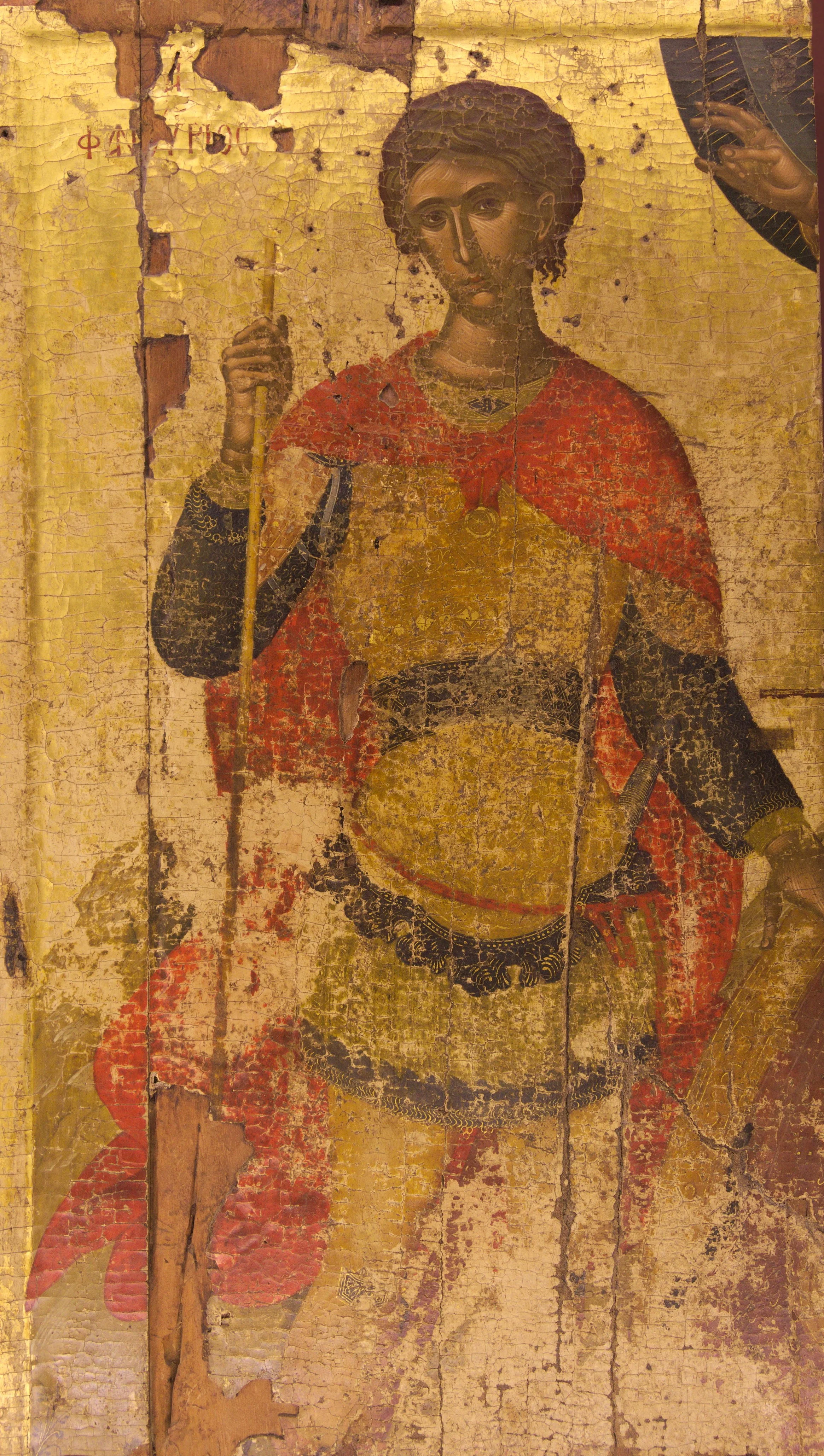
According to tradition, an ancient icon of Saint Phanourios was found among the ruins of a church on Rhodes. The icon showed him as a young soldier and martyr, surrounded by scenes of suffering that revealed he had endured torture for Christ. Although very little was known about his earthly life, the icon itself became the witness. The Church received him as a martyr, and devotion to him spread among the faithful.
Over time, Orthodox Christians began asking Saint Phanourios to intercede when something was missing. This devotion became especially strong in Greek households, where families still bake a special cake called Phanouropita in his honor when something is lost or when something has been found. The cake is often brought to church to be blessed and then shared with others, turning a personal search into thanksgiving, prayer, generosity, and remembrance.
Saint Phanourios is a powerful intercessor because his devotion is so practical. People do not usually pray to him in abstract moments. They pray when the document is due, the keys are gone, the ring is missing, the animal has wandered, the phone cannot be found, or the heart is anxious over something precious that has disappeared. His intercession meets people in the small emergencies of ordinary life, where frustration and panic can quickly take over.
This prayer card is created for those searching for lost things, those asking God to reveal what is hidden, those praying for the return of something valuable, and those who need peace while they look. It is also fitting for people who feel that something deeper is lost: direction, peace, relationship, vocation, faith, or the sense of where they belong.
Saint Phanourios’ unofficial patronage includes finding lost things, lost objects, lost documents, lost keys, lost wallets, lost phones, lost animals, lost keepsakes, hidden answers, misplaced belongings, lost relationships, and those seeking what has been forgotten, hidden, or buried.
Each card is handmade in Austin, TX and created to order. We do not keep stock, because every prayer card is treated as a unique devotional offering. They are printed on museum-quality photo paper, not cardstock. Every card is made slowly, during prayer, with intentional reverence for the saint or holy image and for the person who will receive it. Names are lifted before Christ. Intentions are held carefully. Each piece is handled multiple times in prayerful silence, asking God for mercy and asking the saint to intercede for the soul it is being made for. This is not production work. It is devotional craftsmanship shaped with patience, care, and spiritual responsibility, because every soul and every prayer matters.
THE LIFE & STORY
Saint Phanourios is one of the most beloved “hidden” saints of the Orthodox Church. Unlike many saints, whose lives are known through written biographies, sermons, letters, or martyrdom accounts, Saint Phanourios is known primarily through an icon discovered on the island of Rhodes. This makes his story unusual and deeply fitting for a saint associated with finding what has been lost.
The traditional account says that during work among ruins on Rhodes, an ancient church or chapel was uncovered. Among the damaged icons found there, one image remained clear. It depicted a young soldier holding a cross or candle, surrounded by scenes of martyrdom. The local bishop recognized the figure as a holy martyr named Phanourios, and from this discovery his veneration spread.
Because the icon showed scenes of torture, the Church remembers Saint Phanourios as a martyr. The details of his birth, family, and earthly life remain largely unknown, but the icon revealed what written history had not preserved. In this way, Saint Phanourios entered the living memory of the Church through an act of discovery. He was not invented by the devotion of the people. He was revealed through an image that had survived when much else had been forgotten.
This is part of what makes him so loved. Saint Phanourios is not only asked to help find lost things; his own memory was recovered from loss. The saint who had been hidden beneath ruins became known again, and the faithful came to trust that through his prayers, what is missing may be revealed by God’s mercy.
His feast day is celebrated on August 27. In many Greek Orthodox communities, the faithful bring Phanouropita, a simple fasting cake, to church in his honor. The cake is connected with requests that Saint Phanourios reveal something lost, and also with thanksgiving when the missing thing is found. It is usually shared with others, making the devotion communal rather than private.
There is also a tradition of praying for the soul of Saint Phanourios’ mother when eating the cake. The details of this tradition vary, and the stories around it are not the same as a formal biography. But the practice itself has become a living part of Orthodox devotion, especially in Greek families and parishes.
Saint Phanourios’ life, as far as we know it, teaches humility before mystery. We do not know every detail of his earthly story. We know that God revealed his holiness through an icon, that the Church honored him as a martyr, and that generations of faithful Christians have asked his intercession in the anxious, ordinary, and sometimes desperate work of finding what has been lost.
His story reminds us that not everything important is fully documented, not everything lost is gone forever, and not everything hidden is hidden from God.
MIRACLES & PATRONAGE
Saint Phanourios is especially loved for his intercession in finding lost things. Orthodox Christians often call upon him when something important has disappeared, and many families have stories of lost objects being found after asking his prayers. This is one reason he remains so beloved in everyday household devotion.
His unofficial patronage of finding lost things is broad and practical. People ask his help for lost keys, wallets, phones, documents, jewelry, tools, family heirlooms, passports, schoolwork, work files, animals, and other missing possessions. His intercession is often sought in moments that may seem small to others but feel urgent to the person searching.
The devotion also reaches deeper than physical objects. People sometimes ask Saint Phanourios to help reveal lost direction, lost peace, lost relationships, lost opportunities, lost faith, or a hidden answer they cannot yet see. While the devotion should not become superstition, it can be a beautiful way to ask God, through the prayers of His saint, to bring light into confusion.
The Phanouropita tradition is one of the most distinctive parts of devotion to Saint Phanourios. When something is missing, the faithful may ask his intercession and bake a cake in his honor. When the lost thing is found, the cake is brought to church to be blessed or shared with others in thanksgiving. This practice turns a simple household crisis into prayer, gratitude, and generosity.
Saint Phanourios is also meaningful because his own story began with discovery. His icon was found when his memory had been buried in time. That is why his intercession feels so fitting for anyone trying to recover what has disappeared. The saint himself was “revealed” after being hidden, and his name has become associated with revealing what cannot be found.
People ask Saint Phanourios to intercede when they are frustrated, anxious, rushed, or afraid that something important is gone. He is a saint for ordinary life, where holiness enters the search for a missing object, the worry over a document, the tears over a lost keepsake, and the hope that what is hidden may yet be restored.
His life teaches that God’s care reaches even into small human worries. The Lord who numbers the hairs of our heads is not indifferent to the little losses that disturb our peace. Saint Phanourios helps turn panic into prayer and searching into trust.
PRAYERS
A simple invocation may be prayed often: Saint Phanourios, pray for us.
For finding a lost object, one may pray: Saint Phanourios, holy martyr and newly revealed saint, pray that what has been lost may be found if it is for my good and according to the mercy of God. Help me search calmly, think clearly, and trust the Lord while I look.
For lost documents, one may pray: Saint Phanourios, pray for me as I search for these missing papers and important records. Ask Christ to reveal what is hidden, restore what is needed, and give me peace instead of anxiety.
For lost keys, wallet, phone, or daily necessities, one may pray: Saint Phanourios, pray for this small but urgent need. Help me find what is missing, and help me remember that even daily frustrations can become occasions for prayer.
For lost relationships, one may pray: Saint Phanourios, pray for relationships that feel lost, distant, wounded, or hidden beneath misunderstanding. Ask Christ to reveal what can be healed, restore what should be restored, and give peace where restoration is not possible.
For spiritual direction, one may pray: Saint Phanourios, pray for me when I feel lost in life, confused in vocation, or uncertain about the path ahead. Ask the Lord to reveal the next faithful step and to guide me with wisdom and peace.
Before baking or sharing Phanouropita, one may pray: Saint Phanourios, accept this offering of thanksgiving and intercede for us before Christ. Pray for the revealing of what is hidden, the finding of what is lost, and the salvation of all who ask your prayers with faith.
This prayer card is especially fitting for personal prayer, family devotion, Orthodox households, those who keep the Phanouropita tradition, and anyone who wants to remember that even searching for something lost can be turned toward God.
FAQ
Who is Saint Phanourios?
Saint Phanourios, also spelled Fanourios, is an Orthodox saint and martyr especially known for helping the faithful find lost things. He is often called the Newly Revealed because his veneration became known through an icon discovered on the island of Rhodes.
Is Saint Phanourios Orthodox?
Yes. Saint Phanourios is especially venerated in the Orthodox Church, particularly in Greek Orthodox tradition. His feast day, iconography, and the Phanouropita tradition are living parts of Orthodox devotion.
What is Saint Phanourios the patron saint of?
Saint Phanourios is best known as the patron saint, or unofficial patron, of finding lost things. People ask his intercession for lost keys, documents, wallets, phones, animals, keepsakes, and other missing items. Devotionally, some also ask his prayers for lost relationships, direction, peace, or hidden answers.
Is Saint Phanourios officially the patron saint of finding lost things?
Saint Phanourios is widely invoked in Orthodox devotion for finding lost things, though “unofficial patron of finding lost things” is careful wording for a product page. His connection to revealing what is lost is a strong and living tradition among the faithful.
Why is Saint Phanourios connected to lost things?
His name is associated in popular devotion with revealing or making visible what is hidden, and his own veneration began when his icon was discovered after being lost to memory. Over time, Orthodox Christians came to ask his intercession when objects or answers were missing.
What is Phanouropita?
Phanouropita is a traditional Greek cake baked in honor of Saint Phanourios, often when something is lost or after something has been found. It is commonly brought to church to be blessed and then shared with others as an act of thanksgiving and prayer.
Do people bake Phanouropita only on Saint Phanourios’ feast day?
Phanouropita is often baked for Saint Phanourios’ feast day on August 27, but it may also be baked at other times when someone is asking his intercession or giving thanks after something lost has been found.
Why do people pray for Saint Phanourios’ mother when eating Phanouropita?
In Greek Orthodox custom, there is a tradition of praying for the soul of Saint Phanourios’ mother when sharing Phanouropita. The stories behind this custom vary, but the practice remains a living devotional tradition in many families and parishes.
When is Saint Phanourios’ feast day?
Saint Phanourios is commemorated on August 27 in the Orthodox Church.
Can I ask Saint Phanourios to help me find lost keys, documents, or my phone?
Yes. These are exactly the kinds of everyday needs for which many Orthodox Christians ask Saint Phanourios’ intercession. The prayer should be offered with faith, calm, and trust in God, not as superstition or magic.
Can I ask Saint Phanourios to help with lost relationships or lost direction?
Yes, many people devotionally ask Saint Phanourios to intercede when something deeper feels lost, such as peace, direction, vocation, relationships, or clarity. His role is not to force outcomes, but to pray that God reveals what is hidden and guides the soul toward what is good.
What does Saint Phanourios teach us?
Saint Phanourios teaches that what is hidden is not hidden from God. His own memory was revealed through an icon, and his intercession reminds the faithful that even ordinary losses can become moments of prayer, trust, gratitude, and generosity.
What is the main message of Saint Phanourios’ life?
The main message of Saint Phanourios’ life is that God can reveal what has been lost. Whether the loss is a physical object, a forgotten memory, a hidden answer, or a confused path, his story reminds us to search with prayer rather than panic.
Saint Phanourios is an Orthodox saint for every frantic search, every missing key, every lost document, every misplaced keepsake, and every heart that has quietly whispered, “Please, Lord, help me find it.” He is known and loved throughout the Orthodox world as a saint who helps reveal what has been lost, whether the lost thing is ordinary, necessary, sentimental, or painfully important.
Saint Phanourios is especially meaningful as the unofficial patron saint of finding lost things. He is known almost entirely from an icon discovered on the island of Rhodes rather than from a detailed written biography, yet he has become one of the most reliably invoked Orthodox saints for anything missing. People ask his intercession for lost keys, wallets, phones, documents, jewelry, family items, animals, opportunities, and even relationships or parts of life that feel spiritually misplaced.
His name itself is connected in popular devotion with revealing or making visible what is hidden. This makes his story especially beautiful: the saint who helps others find what is lost was himself “found” through an icon. In Orthodox tradition, Saint Phanourios is often called the Newly Revealed because his veneration began when his holy image was discovered after being hidden from memory.
According to tradition, an ancient icon of Saint Phanourios was found among the ruins of a church on Rhodes. The icon showed him as a young soldier and martyr, surrounded by scenes of suffering that revealed he had endured torture for Christ. Although very little was known about his earthly life, the icon itself became the witness. The Church received him as a martyr, and devotion to him spread among the faithful.
Over time, Orthodox Christians began asking Saint Phanourios to intercede when something was missing. This devotion became especially strong in Greek households, where families still bake a special cake called Phanouropita in his honor when something is lost or when something has been found. The cake is often brought to church to be blessed and then shared with others, turning a personal search into thanksgiving, prayer, generosity, and remembrance.
Saint Phanourios is a powerful intercessor because his devotion is so practical. People do not usually pray to him in abstract moments. They pray when the document is due, the keys are gone, the ring is missing, the animal has wandered, the phone cannot be found, or the heart is anxious over something precious that has disappeared. His intercession meets people in the small emergencies of ordinary life, where frustration and panic can quickly take over.
This prayer card is created for those searching for lost things, those asking God to reveal what is hidden, those praying for the return of something valuable, and those who need peace while they look. It is also fitting for people who feel that something deeper is lost: direction, peace, relationship, vocation, faith, or the sense of where they belong.
Saint Phanourios’ unofficial patronage includes finding lost things, lost objects, lost documents, lost keys, lost wallets, lost phones, lost animals, lost keepsakes, hidden answers, misplaced belongings, lost relationships, and those seeking what has been forgotten, hidden, or buried.
Each card is handmade in Austin, TX and created to order. We do not keep stock, because every prayer card is treated as a unique devotional offering. They are printed on museum-quality photo paper, not cardstock. Every card is made slowly, during prayer, with intentional reverence for the saint or holy image and for the person who will receive it. Names are lifted before Christ. Intentions are held carefully. Each piece is handled multiple times in prayerful silence, asking God for mercy and asking the saint to intercede for the soul it is being made for. This is not production work. It is devotional craftsmanship shaped with patience, care, and spiritual responsibility, because every soul and every prayer matters.
THE LIFE & STORY
Saint Phanourios is one of the most beloved “hidden” saints of the Orthodox Church. Unlike many saints, whose lives are known through written biographies, sermons, letters, or martyrdom accounts, Saint Phanourios is known primarily through an icon discovered on the island of Rhodes. This makes his story unusual and deeply fitting for a saint associated with finding what has been lost.
The traditional account says that during work among ruins on Rhodes, an ancient church or chapel was uncovered. Among the damaged icons found there, one image remained clear. It depicted a young soldier holding a cross or candle, surrounded by scenes of martyrdom. The local bishop recognized the figure as a holy martyr named Phanourios, and from this discovery his veneration spread.
Because the icon showed scenes of torture, the Church remembers Saint Phanourios as a martyr. The details of his birth, family, and earthly life remain largely unknown, but the icon revealed what written history had not preserved. In this way, Saint Phanourios entered the living memory of the Church through an act of discovery. He was not invented by the devotion of the people. He was revealed through an image that had survived when much else had been forgotten.
This is part of what makes him so loved. Saint Phanourios is not only asked to help find lost things; his own memory was recovered from loss. The saint who had been hidden beneath ruins became known again, and the faithful came to trust that through his prayers, what is missing may be revealed by God’s mercy.
His feast day is celebrated on August 27. In many Greek Orthodox communities, the faithful bring Phanouropita, a simple fasting cake, to church in his honor. The cake is connected with requests that Saint Phanourios reveal something lost, and also with thanksgiving when the missing thing is found. It is usually shared with others, making the devotion communal rather than private.
There is also a tradition of praying for the soul of Saint Phanourios’ mother when eating the cake. The details of this tradition vary, and the stories around it are not the same as a formal biography. But the practice itself has become a living part of Orthodox devotion, especially in Greek families and parishes.
Saint Phanourios’ life, as far as we know it, teaches humility before mystery. We do not know every detail of his earthly story. We know that God revealed his holiness through an icon, that the Church honored him as a martyr, and that generations of faithful Christians have asked his intercession in the anxious, ordinary, and sometimes desperate work of finding what has been lost.
His story reminds us that not everything important is fully documented, not everything lost is gone forever, and not everything hidden is hidden from God.
MIRACLES & PATRONAGE
Saint Phanourios is especially loved for his intercession in finding lost things. Orthodox Christians often call upon him when something important has disappeared, and many families have stories of lost objects being found after asking his prayers. This is one reason he remains so beloved in everyday household devotion.
His unofficial patronage of finding lost things is broad and practical. People ask his help for lost keys, wallets, phones, documents, jewelry, tools, family heirlooms, passports, schoolwork, work files, animals, and other missing possessions. His intercession is often sought in moments that may seem small to others but feel urgent to the person searching.
The devotion also reaches deeper than physical objects. People sometimes ask Saint Phanourios to help reveal lost direction, lost peace, lost relationships, lost opportunities, lost faith, or a hidden answer they cannot yet see. While the devotion should not become superstition, it can be a beautiful way to ask God, through the prayers of His saint, to bring light into confusion.
The Phanouropita tradition is one of the most distinctive parts of devotion to Saint Phanourios. When something is missing, the faithful may ask his intercession and bake a cake in his honor. When the lost thing is found, the cake is brought to church to be blessed or shared with others in thanksgiving. This practice turns a simple household crisis into prayer, gratitude, and generosity.
Saint Phanourios is also meaningful because his own story began with discovery. His icon was found when his memory had been buried in time. That is why his intercession feels so fitting for anyone trying to recover what has disappeared. The saint himself was “revealed” after being hidden, and his name has become associated with revealing what cannot be found.
People ask Saint Phanourios to intercede when they are frustrated, anxious, rushed, or afraid that something important is gone. He is a saint for ordinary life, where holiness enters the search for a missing object, the worry over a document, the tears over a lost keepsake, and the hope that what is hidden may yet be restored.
His life teaches that God’s care reaches even into small human worries. The Lord who numbers the hairs of our heads is not indifferent to the little losses that disturb our peace. Saint Phanourios helps turn panic into prayer and searching into trust.
PRAYERS
A simple invocation may be prayed often: Saint Phanourios, pray for us.
For finding a lost object, one may pray: Saint Phanourios, holy martyr and newly revealed saint, pray that what has been lost may be found if it is for my good and according to the mercy of God. Help me search calmly, think clearly, and trust the Lord while I look.
For lost documents, one may pray: Saint Phanourios, pray for me as I search for these missing papers and important records. Ask Christ to reveal what is hidden, restore what is needed, and give me peace instead of anxiety.
For lost keys, wallet, phone, or daily necessities, one may pray: Saint Phanourios, pray for this small but urgent need. Help me find what is missing, and help me remember that even daily frustrations can become occasions for prayer.
For lost relationships, one may pray: Saint Phanourios, pray for relationships that feel lost, distant, wounded, or hidden beneath misunderstanding. Ask Christ to reveal what can be healed, restore what should be restored, and give peace where restoration is not possible.
For spiritual direction, one may pray: Saint Phanourios, pray for me when I feel lost in life, confused in vocation, or uncertain about the path ahead. Ask the Lord to reveal the next faithful step and to guide me with wisdom and peace.
Before baking or sharing Phanouropita, one may pray: Saint Phanourios, accept this offering of thanksgiving and intercede for us before Christ. Pray for the revealing of what is hidden, the finding of what is lost, and the salvation of all who ask your prayers with faith.
This prayer card is especially fitting for personal prayer, family devotion, Orthodox households, those who keep the Phanouropita tradition, and anyone who wants to remember that even searching for something lost can be turned toward God.
FAQ
Who is Saint Phanourios?
Saint Phanourios, also spelled Fanourios, is an Orthodox saint and martyr especially known for helping the faithful find lost things. He is often called the Newly Revealed because his veneration became known through an icon discovered on the island of Rhodes.
Is Saint Phanourios Orthodox?
Yes. Saint Phanourios is especially venerated in the Orthodox Church, particularly in Greek Orthodox tradition. His feast day, iconography, and the Phanouropita tradition are living parts of Orthodox devotion.
What is Saint Phanourios the patron saint of?
Saint Phanourios is best known as the patron saint, or unofficial patron, of finding lost things. People ask his intercession for lost keys, documents, wallets, phones, animals, keepsakes, and other missing items. Devotionally, some also ask his prayers for lost relationships, direction, peace, or hidden answers.
Is Saint Phanourios officially the patron saint of finding lost things?
Saint Phanourios is widely invoked in Orthodox devotion for finding lost things, though “unofficial patron of finding lost things” is careful wording for a product page. His connection to revealing what is lost is a strong and living tradition among the faithful.
Why is Saint Phanourios connected to lost things?
His name is associated in popular devotion with revealing or making visible what is hidden, and his own veneration began when his icon was discovered after being lost to memory. Over time, Orthodox Christians came to ask his intercession when objects or answers were missing.
What is Phanouropita?
Phanouropita is a traditional Greek cake baked in honor of Saint Phanourios, often when something is lost or after something has been found. It is commonly brought to church to be blessed and then shared with others as an act of thanksgiving and prayer.
Do people bake Phanouropita only on Saint Phanourios’ feast day?
Phanouropita is often baked for Saint Phanourios’ feast day on August 27, but it may also be baked at other times when someone is asking his intercession or giving thanks after something lost has been found.
Why do people pray for Saint Phanourios’ mother when eating Phanouropita?
In Greek Orthodox custom, there is a tradition of praying for the soul of Saint Phanourios’ mother when sharing Phanouropita. The stories behind this custom vary, but the practice remains a living devotional tradition in many families and parishes.
When is Saint Phanourios’ feast day?
Saint Phanourios is commemorated on August 27 in the Orthodox Church.
Can I ask Saint Phanourios to help me find lost keys, documents, or my phone?
Yes. These are exactly the kinds of everyday needs for which many Orthodox Christians ask Saint Phanourios’ intercession. The prayer should be offered with faith, calm, and trust in God, not as superstition or magic.
Can I ask Saint Phanourios to help with lost relationships or lost direction?
Yes, many people devotionally ask Saint Phanourios to intercede when something deeper feels lost, such as peace, direction, vocation, relationships, or clarity. His role is not to force outcomes, but to pray that God reveals what is hidden and guides the soul toward what is good.
What does Saint Phanourios teach us?
Saint Phanourios teaches that what is hidden is not hidden from God. His own memory was revealed through an icon, and his intercession reminds the faithful that even ordinary losses can become moments of prayer, trust, gratitude, and generosity.
What is the main message of Saint Phanourios’ life?
The main message of Saint Phanourios’ life is that God can reveal what has been lost. Whether the loss is a physical object, a forgotten memory, a hidden answer, or a confused path, his story reminds us to search with prayer rather than panic.