 Image 1 of 1
Saint Theophan the Recluse
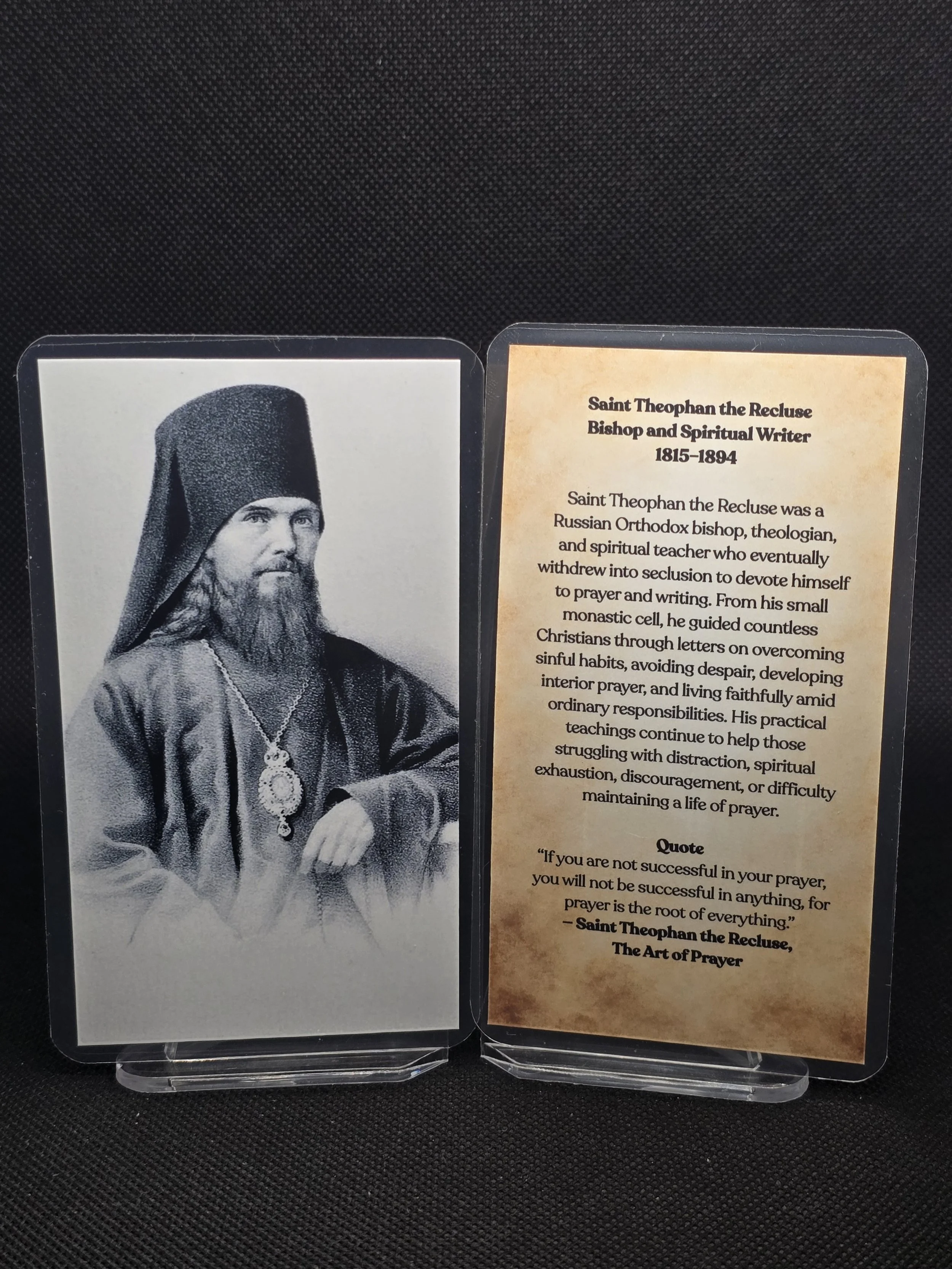
Saint Theophan the Recluse is an Orthodox saint for anyone who wants to pray but cannot seem to keep the mind still. He is a bishop, monk, recluse, theologian, translator, and spiritual father whose writings remain among the clearest and most practical guides to prayer in the Orthodox tradition. He speaks with unusual patience to the person who sits down to pray and finds, within seconds, that the mind has wandered into chores, worries, memories, arguments, distractions, plans, and scattered thoughts.
Saint Theophan is especially meaningful as the unofficial patron saint of distracted prayer, wandering thoughts, and learning the Jesus Prayer. He understood that prayer is not only a matter of saying words, but of gathering the mind and heart before God. His guidance is not vague or sentimental. He gives practical direction for ordinary people who are trying to pray in real life, with real distractions and restless minds.
Born George Govorov in 1815 in the Orlov province of Russia, the future Saint Theophan was raised in a priestly family and received a deep theological education. He became a monk, a teacher, a missionary, and eventually a bishop. He served as Bishop of Tambov and later of Vladimir, working faithfully in the public life of the Church before withdrawing from active episcopal service to the quiet of Vysha Hermitage.
There, Saint Theophan entered the life for which he is now most remembered. He withdrew into seclusion, devoting himself to prayer, spiritual writing, translation, correspondence, and guidance of souls. Though hidden from public life, he became a spiritual father to countless people through letters and books. His reclusion was not escape from love; it was a different form of service. From silence, he taught others how to pray.
Saint Theophan’s writings are especially helpful because he does not shame people for struggling. He knew that the mind wanders. He knew that attention must be trained. He knew that prayer often begins with effort long before it feels peaceful. His counsel repeatedly returns to the same simple movement: when the mind wanders, bring it back. Do not quit. Do not despair. Return again to God.
This makes him a powerful intercessor for those learning the Jesus Prayer: “Lord Jesus Christ, Son of God, have mercy on me, a sinner.” This ancient prayer of the Church is simple enough to be repeated by a beginner and deep enough to occupy a lifetime. Saint Theophan helped explain how repeated prayer can move from the lips, to the mind, to the heart, becoming a way of standing before God throughout the day.
His life speaks to converts, catechumens, Orthodox Christians learning prayer, Catholics drawn to Eastern spirituality, people with distracted minds, those overwhelmed by modern noise, and anyone frustrated by the gap between wanting to pray and actually being able to remain attentive. He is a saint for the person who has tried to pray and felt like a failure because their thoughts scattered immediately.
Saint Theophan reminds the soul that distraction is not the end of prayer. The return is part of prayer. Every time the wandering mind is brought back to Christ, the soul is learning fidelity. Prayer is not proved by never being distracted. Prayer is strengthened by returning to God again and again with humility.
This prayer card is created for those struggling with distracted prayer, wandering thoughts, spiritual dryness, restless minds, difficulty focusing, and those beginning or deepening the Jesus Prayer. Saint Theophan reminds the soul that attention can be trained, the heart can be warmed, and the scattered mind can slowly learn to stand before God.
Saint Theophan’s patronage includes distracted prayer, wandering thoughts, learning the Jesus Prayer, spiritual focus, Orthodox prayer, inner stillness, spiritual direction, writers, theologians, monastics, recluses, converts, catechumens, and all who are learning to pray with attention.
Each card is handmade in Austin, TX and created to order. We do not keep stock, because every prayer card is treated as a unique devotional offering. They are printed on museum-quality photo paper, not cardstock. Every card is made slowly, during prayer, with intentional reverence for the saint or holy image and for the person who will receive it. Names are lifted before Christ. Intentions are held carefully. Each piece is handled multiple times in prayerful silence, asking God for mercy and asking the saint to intercede for the soul it is being made for. This is not production work. It is devotional craftsmanship shaped with patience, care, and spiritual responsibility, because every soul and every prayer matters.
THE LIFE & STORY
Saint Theophan the Recluse was born George Govorov on January 10, 1815, in the village of Chernavsk in the Orlov province of Russia. His father was a priest, and from his earliest years he was formed in the life of the Church. He studied in religious schools and eventually at the Kiev Theological Academy, where he received a serious theological education and was prepared for a life of service to Christ.
In 1841, he was tonsured a monk and given the name Theophan. His life unfolded through teaching, missionary work, administrative service, and pastoral responsibility. He served in the Russian Ecclesiastical Mission in Jerusalem, taught in theological schools, and became known as a gifted theologian and spiritual writer. In 1859, he was consecrated Bishop of Tambov, and later he served as Bishop of Vladimir.
As bishop, Saint Theophan worked actively for the Church. He preached, taught, strengthened clergy, supported education, and cared for his flock. He was not a recluse because he was unable to serve publicly. He had already served publicly with seriousness and skill. His later withdrawal came from a deeper desire to give himself more completely to prayer, spiritual writing, and hidden labor before God.
In 1866, Saint Theophan retired to Vysha Hermitage. At first, he participated in the life of the monastery, but in time he withdrew more fully into seclusion. From this hidden life came much of the spiritual treasure for which he is now known. He wrote, translated, prayed, and answered letters from people seeking guidance. Though physically hidden, he became widely accessible through spiritual counsel.
His reclusion was not laziness, bitterness, or rejection of others. It was a form of concentrated spiritual labor. Saint Theophan gave himself to God in silence so that he could help others enter prayer more deeply. He translated spiritual works, including important texts connected with the Philokalic tradition, and wrote practical instructions for Christians seeking salvation in the ordinary conditions of life.
What makes Saint Theophan so beloved is his ability to speak to the actual experience of prayer. Many spiritual writers describe the heights of contemplation, but Theophan also addresses the beginning: how to stand for prayer, how to read prayerfully, how to gather attention, what to do when the mind wanders, how to fight distraction, and how to bring the heart into the words being prayed.
His counsel is especially helpful because it is both demanding and merciful. He does not pretend that prayer is effortless, but he also does not crush the beginner. He teaches that attention must be cultivated patiently. The wandering mind is not cured by self-hatred. It is trained by steady return. When thoughts scatter, the soul should not abandon prayer in frustration, but should quietly bring the mind back before God.
Saint Theophan reposed in 1894 and was glorified as a saint by the Russian Orthodox Church in 1988. He is commemorated on January 10. His writings continue to guide Orthodox Christians, catechumens, converts, monks, laypeople, and seekers who want to learn how to pray with the mind in the heart.
For anyone who feels spiritually scattered, his life is a great mercy. He does not say, “If you were holy, prayer would be easy.” He says, in effect, that the work of prayer is to return, to attend, to call on Christ, and to keep going.
MIRACLES & PATRONAGE
Saint Theophan the Recluse is not primarily known through dramatic public miracles, but through the enduring miracle of spiritual guidance. His writings have helped generations learn how to pray, repent, examine the heart, fight distraction, and live the Christian life with seriousness. In a world increasingly filled with noise, speed, and scattered attention, his guidance may be more needed now than ever.
His unofficial patronage of distracted prayer and wandering thoughts comes directly from the practical nature of his spiritual instruction. He wrote about the very common problem of beginning prayer and immediately finding that the mind has run somewhere else. For many people, this is one of the most discouraging parts of prayer. They assume that because they are distracted, they are not really praying. Saint Theophan offers a better understanding: attention must be trained, and returning to prayer after distraction is itself part of the struggle.
He is especially meaningful for those learning the Jesus Prayer. The Jesus Prayer is short, ancient, and powerful: “Lord Jesus Christ, Son of God, have mercy on me, a sinner.” Saint Theophan helped explain how this prayer can be repeated with attention, humility, repentance, and love. He warned against mechanical prayer, but he also encouraged faithful repetition as a way of turning the heart toward Christ.
His patronage is also fitting for restless minds in the modern world. Many people now live in constant distraction, moving from phone to task to message to memory to worry without ever truly becoming still. When such a person begins to pray, the hidden disorder becomes obvious. Saint Theophan is a saint for that moment. He teaches that prayer is not a performance. It is the work of gathering the scattered self and placing it before God.
People ask Saint Theophan’s intercession when they cannot focus during prayer, when they want to begin the Jesus Prayer, when their thoughts wander during services, when spiritual reading becomes scattered, when anxiety interrupts prayer, or when they feel discouraged because their inner life seems noisy. He is also a powerful saint for spiritual writers, Orthodox catechumens, converts, monks, hermits, theologians, and anyone seeking a more disciplined interior life.
Saint Theophan also helps people understand that prayer is not only something done at a prayer corner. He taught that the soul should learn to stand before God throughout the day. This does not mean constant emotional intensity, but a steady remembrance of God, a turning of the heart toward Christ, and a willingness to return again and again whenever the mind drifts away.
His life teaches that stillness is learned. Attention is learned. Prayer is learned. A scattered mind can become more obedient through grace, effort, patience, and humility. No one should despair because prayer is difficult at the beginning. The beginning is exactly where Saint Theophan is most useful.
PRAYERS
A simple invocation may be prayed often: Saint Theophan the Recluse, pray for us.
The traditional Jesus Prayer is especially fitting in connection with Saint Theophan: Lord Jesus Christ, Son of God, have mercy on me, a sinner. This prayer may be prayed slowly and attentively, with humility and repentance, returning to it whenever the mind wanders.
For distracted prayer, one may keep the prayer very simple: Lord Jesus Christ, have mercy on me. Saint Theophan, pray for me and help me return my attention to God.
For wandering thoughts, one may pray: Lord, gather my scattered mind and bring my heart before You. Saint Theophan the Recluse, pray for me.
For learning the Jesus Prayer, one may begin with a humble invocation: Lord Jesus Christ, Son of God, have mercy on me, a sinner. Saint Theophan, guide me toward attention, patience, repentance, and love.
For spiritual focus, one may pray: Lord, help me stand before You with attention. Saint Theophan, pray that I may not abandon prayer when my mind wanders, but may return to Christ with humility.
For beginners in prayer, one may pray: Lord Jesus Christ, teach me to pray. Saint Theophan the Recluse, pray for all who are learning to call upon the name of the Lord.
This prayer card is especially fitting for a prayer corner, beside a prayer rope, inside a Bible or prayer book, or as a gift for someone beginning the Jesus Prayer. It can also be a comfort for anyone who feels ashamed by distraction, reminding them that the struggle to return the mind to God is not failure but formation.
FAQ
Who is Saint Theophan the Recluse?
Saint Theophan the Recluse was a 19th-century Russian Orthodox bishop, monk, theologian, translator, spiritual writer, and recluse. He served as a bishop before withdrawing to Vysha Hermitage, where he spent his later life in prayer, seclusion, writing, translation, and spiritual correspondence.
Is Saint Theophan the Recluse Orthodox?
Yes. Saint Theophan the Recluse is an Orthodox saint, especially venerated in the Russian Orthodox tradition and throughout the Orthodox Church. He is known as one of the great modern Orthodox spiritual teachers.
Why is he called “the Recluse”?
He is called “the Recluse” because he withdrew from public episcopal life and eventually lived in deep seclusion at Vysha Hermitage. During this hidden life, he devoted himself to prayer, writing, translation, and spiritual guidance.
What is Saint Theophan the Recluse known for?
Saint Theophan is known for his practical spiritual writings, guidance on prayer, teaching on the inner life, counsel on guarding the mind and heart, and instruction on the Jesus Prayer. His works remain deeply valued by Orthodox Christians and others seeking serious spiritual direction.
Is Saint Theophan officially the patron saint of distracted prayer and wandering thoughts?
Saint Theophan is best described as the unofficial patron saint of distracted prayer, wandering thoughts, and learning the Jesus Prayer. His writings address these struggles so directly and practically that he is a natural intercessor for anyone trying to pray with a scattered mind.
Why is Saint Theophan helpful for distracted prayer?
Saint Theophan is helpful because he gives practical spiritual direction for what to do when the mind wanders. His counsel is patient and realistic: when attention is lost, bring it back to God. Do not despair, do not quit, and do not let distraction become an excuse to abandon prayer.
What is the Jesus Prayer?
The Jesus Prayer is the traditional prayer: “Lord Jesus Christ, Son of God, have mercy on me, a sinner.” It is central to Orthodox spirituality and is often prayed with a prayer rope, with attention, repentance, humility, and the desire to stand before God.
Is Saint Theophan a good saint for someone learning the Jesus Prayer?
Yes. Saint Theophan is one of the most helpful saints for someone beginning the Jesus Prayer because he wrote clearly about attention, repetition, inner prayer, and the need to pray with the mind and heart rather than merely with the lips.
Can I give this prayer card to someone who is new to Orthodox prayer?
Yes. This prayer card is especially fitting for catechumens, converts, people learning the Jesus Prayer, those beginning a prayer rule, and anyone who wants to grow in attention and spiritual focus.
Can Catholics benefit from Saint Theophan the Recluse?
Yes. While Saint Theophan is an Orthodox saint, many Christians from outside Orthodoxy find his writings deeply helpful for prayer, attention, repentance, and spiritual discipline. His guidance on distraction and the Jesus Prayer is accessible to anyone seeking Christ with humility.
What should I do when my mind wanders during prayer?
The simple answer in the spirit of Saint Theophan is to return. Do not panic, scold yourself endlessly, or quit. Notice that the mind has wandered, bring it back to the words of prayer, and continue. This returning is part of learning to pray.
Is distraction during prayer a sign that I am failing spiritually?
Not necessarily. Distraction is extremely common. It can reveal that the mind is untrained, tired, anxious, overstimulated, or attached to many concerns. The spiritual work is not to pretend distraction never happens, but to keep returning to God with humility.
Can the Jesus Prayer help with anxiety or scattered thoughts?
The Jesus Prayer can help gather the mind and turn the heart toward Christ, but it should not be treated as a magic technique or a replacement for medical or mental health care when serious anxiety is present. It is a prayer of repentance and mercy, not merely a calming exercise.
When is Saint Theophan the Recluse’s feast day?
Saint Theophan the Recluse is commemorated on January 10 in the Orthodox Church.
What is the main message of Saint Theophan’s life?
The main message of Saint Theophan’s life is that prayer can be learned through grace, attention, patience, and repeated return to God. A distracted mind is not beyond healing. A wandering heart can be gathered. The name of Jesus can become the center around which the soul slowly becomes still.
Saint Theophan the Recluse is an Orthodox saint for anyone who wants to pray but cannot seem to keep the mind still. He is a bishop, monk, recluse, theologian, translator, and spiritual father whose writings remain among the clearest and most practical guides to prayer in the Orthodox tradition. He speaks with unusual patience to the person who sits down to pray and finds, within seconds, that the mind has wandered into chores, worries, memories, arguments, distractions, plans, and scattered thoughts.
Saint Theophan is especially meaningful as the unofficial patron saint of distracted prayer, wandering thoughts, and learning the Jesus Prayer. He understood that prayer is not only a matter of saying words, but of gathering the mind and heart before God. His guidance is not vague or sentimental. He gives practical direction for ordinary people who are trying to pray in real life, with real distractions and restless minds.
Born George Govorov in 1815 in the Orlov province of Russia, the future Saint Theophan was raised in a priestly family and received a deep theological education. He became a monk, a teacher, a missionary, and eventually a bishop. He served as Bishop of Tambov and later of Vladimir, working faithfully in the public life of the Church before withdrawing from active episcopal service to the quiet of Vysha Hermitage.
There, Saint Theophan entered the life for which he is now most remembered. He withdrew into seclusion, devoting himself to prayer, spiritual writing, translation, correspondence, and guidance of souls. Though hidden from public life, he became a spiritual father to countless people through letters and books. His reclusion was not escape from love; it was a different form of service. From silence, he taught others how to pray.
Saint Theophan’s writings are especially helpful because he does not shame people for struggling. He knew that the mind wanders. He knew that attention must be trained. He knew that prayer often begins with effort long before it feels peaceful. His counsel repeatedly returns to the same simple movement: when the mind wanders, bring it back. Do not quit. Do not despair. Return again to God.
This makes him a powerful intercessor for those learning the Jesus Prayer: “Lord Jesus Christ, Son of God, have mercy on me, a sinner.” This ancient prayer of the Church is simple enough to be repeated by a beginner and deep enough to occupy a lifetime. Saint Theophan helped explain how repeated prayer can move from the lips, to the mind, to the heart, becoming a way of standing before God throughout the day.
His life speaks to converts, catechumens, Orthodox Christians learning prayer, Catholics drawn to Eastern spirituality, people with distracted minds, those overwhelmed by modern noise, and anyone frustrated by the gap between wanting to pray and actually being able to remain attentive. He is a saint for the person who has tried to pray and felt like a failure because their thoughts scattered immediately.
Saint Theophan reminds the soul that distraction is not the end of prayer. The return is part of prayer. Every time the wandering mind is brought back to Christ, the soul is learning fidelity. Prayer is not proved by never being distracted. Prayer is strengthened by returning to God again and again with humility.
This prayer card is created for those struggling with distracted prayer, wandering thoughts, spiritual dryness, restless minds, difficulty focusing, and those beginning or deepening the Jesus Prayer. Saint Theophan reminds the soul that attention can be trained, the heart can be warmed, and the scattered mind can slowly learn to stand before God.
Saint Theophan’s patronage includes distracted prayer, wandering thoughts, learning the Jesus Prayer, spiritual focus, Orthodox prayer, inner stillness, spiritual direction, writers, theologians, monastics, recluses, converts, catechumens, and all who are learning to pray with attention.
Each card is handmade in Austin, TX and created to order. We do not keep stock, because every prayer card is treated as a unique devotional offering. They are printed on museum-quality photo paper, not cardstock. Every card is made slowly, during prayer, with intentional reverence for the saint or holy image and for the person who will receive it. Names are lifted before Christ. Intentions are held carefully. Each piece is handled multiple times in prayerful silence, asking God for mercy and asking the saint to intercede for the soul it is being made for. This is not production work. It is devotional craftsmanship shaped with patience, care, and spiritual responsibility, because every soul and every prayer matters.
THE LIFE & STORY
Saint Theophan the Recluse was born George Govorov on January 10, 1815, in the village of Chernavsk in the Orlov province of Russia. His father was a priest, and from his earliest years he was formed in the life of the Church. He studied in religious schools and eventually at the Kiev Theological Academy, where he received a serious theological education and was prepared for a life of service to Christ.
In 1841, he was tonsured a monk and given the name Theophan. His life unfolded through teaching, missionary work, administrative service, and pastoral responsibility. He served in the Russian Ecclesiastical Mission in Jerusalem, taught in theological schools, and became known as a gifted theologian and spiritual writer. In 1859, he was consecrated Bishop of Tambov, and later he served as Bishop of Vladimir.
As bishop, Saint Theophan worked actively for the Church. He preached, taught, strengthened clergy, supported education, and cared for his flock. He was not a recluse because he was unable to serve publicly. He had already served publicly with seriousness and skill. His later withdrawal came from a deeper desire to give himself more completely to prayer, spiritual writing, and hidden labor before God.
In 1866, Saint Theophan retired to Vysha Hermitage. At first, he participated in the life of the monastery, but in time he withdrew more fully into seclusion. From this hidden life came much of the spiritual treasure for which he is now known. He wrote, translated, prayed, and answered letters from people seeking guidance. Though physically hidden, he became widely accessible through spiritual counsel.
His reclusion was not laziness, bitterness, or rejection of others. It was a form of concentrated spiritual labor. Saint Theophan gave himself to God in silence so that he could help others enter prayer more deeply. He translated spiritual works, including important texts connected with the Philokalic tradition, and wrote practical instructions for Christians seeking salvation in the ordinary conditions of life.
What makes Saint Theophan so beloved is his ability to speak to the actual experience of prayer. Many spiritual writers describe the heights of contemplation, but Theophan also addresses the beginning: how to stand for prayer, how to read prayerfully, how to gather attention, what to do when the mind wanders, how to fight distraction, and how to bring the heart into the words being prayed.
His counsel is especially helpful because it is both demanding and merciful. He does not pretend that prayer is effortless, but he also does not crush the beginner. He teaches that attention must be cultivated patiently. The wandering mind is not cured by self-hatred. It is trained by steady return. When thoughts scatter, the soul should not abandon prayer in frustration, but should quietly bring the mind back before God.
Saint Theophan reposed in 1894 and was glorified as a saint by the Russian Orthodox Church in 1988. He is commemorated on January 10. His writings continue to guide Orthodox Christians, catechumens, converts, monks, laypeople, and seekers who want to learn how to pray with the mind in the heart.
For anyone who feels spiritually scattered, his life is a great mercy. He does not say, “If you were holy, prayer would be easy.” He says, in effect, that the work of prayer is to return, to attend, to call on Christ, and to keep going.
MIRACLES & PATRONAGE
Saint Theophan the Recluse is not primarily known through dramatic public miracles, but through the enduring miracle of spiritual guidance. His writings have helped generations learn how to pray, repent, examine the heart, fight distraction, and live the Christian life with seriousness. In a world increasingly filled with noise, speed, and scattered attention, his guidance may be more needed now than ever.
His unofficial patronage of distracted prayer and wandering thoughts comes directly from the practical nature of his spiritual instruction. He wrote about the very common problem of beginning prayer and immediately finding that the mind has run somewhere else. For many people, this is one of the most discouraging parts of prayer. They assume that because they are distracted, they are not really praying. Saint Theophan offers a better understanding: attention must be trained, and returning to prayer after distraction is itself part of the struggle.
He is especially meaningful for those learning the Jesus Prayer. The Jesus Prayer is short, ancient, and powerful: “Lord Jesus Christ, Son of God, have mercy on me, a sinner.” Saint Theophan helped explain how this prayer can be repeated with attention, humility, repentance, and love. He warned against mechanical prayer, but he also encouraged faithful repetition as a way of turning the heart toward Christ.
His patronage is also fitting for restless minds in the modern world. Many people now live in constant distraction, moving from phone to task to message to memory to worry without ever truly becoming still. When such a person begins to pray, the hidden disorder becomes obvious. Saint Theophan is a saint for that moment. He teaches that prayer is not a performance. It is the work of gathering the scattered self and placing it before God.
People ask Saint Theophan’s intercession when they cannot focus during prayer, when they want to begin the Jesus Prayer, when their thoughts wander during services, when spiritual reading becomes scattered, when anxiety interrupts prayer, or when they feel discouraged because their inner life seems noisy. He is also a powerful saint for spiritual writers, Orthodox catechumens, converts, monks, hermits, theologians, and anyone seeking a more disciplined interior life.
Saint Theophan also helps people understand that prayer is not only something done at a prayer corner. He taught that the soul should learn to stand before God throughout the day. This does not mean constant emotional intensity, but a steady remembrance of God, a turning of the heart toward Christ, and a willingness to return again and again whenever the mind drifts away.
His life teaches that stillness is learned. Attention is learned. Prayer is learned. A scattered mind can become more obedient through grace, effort, patience, and humility. No one should despair because prayer is difficult at the beginning. The beginning is exactly where Saint Theophan is most useful.
PRAYERS
A simple invocation may be prayed often: Saint Theophan the Recluse, pray for us.
The traditional Jesus Prayer is especially fitting in connection with Saint Theophan: Lord Jesus Christ, Son of God, have mercy on me, a sinner. This prayer may be prayed slowly and attentively, with humility and repentance, returning to it whenever the mind wanders.
For distracted prayer, one may keep the prayer very simple: Lord Jesus Christ, have mercy on me. Saint Theophan, pray for me and help me return my attention to God.
For wandering thoughts, one may pray: Lord, gather my scattered mind and bring my heart before You. Saint Theophan the Recluse, pray for me.
For learning the Jesus Prayer, one may begin with a humble invocation: Lord Jesus Christ, Son of God, have mercy on me, a sinner. Saint Theophan, guide me toward attention, patience, repentance, and love.
For spiritual focus, one may pray: Lord, help me stand before You with attention. Saint Theophan, pray that I may not abandon prayer when my mind wanders, but may return to Christ with humility.
For beginners in prayer, one may pray: Lord Jesus Christ, teach me to pray. Saint Theophan the Recluse, pray for all who are learning to call upon the name of the Lord.
This prayer card is especially fitting for a prayer corner, beside a prayer rope, inside a Bible or prayer book, or as a gift for someone beginning the Jesus Prayer. It can also be a comfort for anyone who feels ashamed by distraction, reminding them that the struggle to return the mind to God is not failure but formation.
FAQ
Who is Saint Theophan the Recluse?
Saint Theophan the Recluse was a 19th-century Russian Orthodox bishop, monk, theologian, translator, spiritual writer, and recluse. He served as a bishop before withdrawing to Vysha Hermitage, where he spent his later life in prayer, seclusion, writing, translation, and spiritual correspondence.
Is Saint Theophan the Recluse Orthodox?
Yes. Saint Theophan the Recluse is an Orthodox saint, especially venerated in the Russian Orthodox tradition and throughout the Orthodox Church. He is known as one of the great modern Orthodox spiritual teachers.
Why is he called “the Recluse”?
He is called “the Recluse” because he withdrew from public episcopal life and eventually lived in deep seclusion at Vysha Hermitage. During this hidden life, he devoted himself to prayer, writing, translation, and spiritual guidance.
What is Saint Theophan the Recluse known for?
Saint Theophan is known for his practical spiritual writings, guidance on prayer, teaching on the inner life, counsel on guarding the mind and heart, and instruction on the Jesus Prayer. His works remain deeply valued by Orthodox Christians and others seeking serious spiritual direction.
Is Saint Theophan officially the patron saint of distracted prayer and wandering thoughts?
Saint Theophan is best described as the unofficial patron saint of distracted prayer, wandering thoughts, and learning the Jesus Prayer. His writings address these struggles so directly and practically that he is a natural intercessor for anyone trying to pray with a scattered mind.
Why is Saint Theophan helpful for distracted prayer?
Saint Theophan is helpful because he gives practical spiritual direction for what to do when the mind wanders. His counsel is patient and realistic: when attention is lost, bring it back to God. Do not despair, do not quit, and do not let distraction become an excuse to abandon prayer.
What is the Jesus Prayer?
The Jesus Prayer is the traditional prayer: “Lord Jesus Christ, Son of God, have mercy on me, a sinner.” It is central to Orthodox spirituality and is often prayed with a prayer rope, with attention, repentance, humility, and the desire to stand before God.
Is Saint Theophan a good saint for someone learning the Jesus Prayer?
Yes. Saint Theophan is one of the most helpful saints for someone beginning the Jesus Prayer because he wrote clearly about attention, repetition, inner prayer, and the need to pray with the mind and heart rather than merely with the lips.
Can I give this prayer card to someone who is new to Orthodox prayer?
Yes. This prayer card is especially fitting for catechumens, converts, people learning the Jesus Prayer, those beginning a prayer rule, and anyone who wants to grow in attention and spiritual focus.
Can Catholics benefit from Saint Theophan the Recluse?
Yes. While Saint Theophan is an Orthodox saint, many Christians from outside Orthodoxy find his writings deeply helpful for prayer, attention, repentance, and spiritual discipline. His guidance on distraction and the Jesus Prayer is accessible to anyone seeking Christ with humility.
What should I do when my mind wanders during prayer?
The simple answer in the spirit of Saint Theophan is to return. Do not panic, scold yourself endlessly, or quit. Notice that the mind has wandered, bring it back to the words of prayer, and continue. This returning is part of learning to pray.
Is distraction during prayer a sign that I am failing spiritually?
Not necessarily. Distraction is extremely common. It can reveal that the mind is untrained, tired, anxious, overstimulated, or attached to many concerns. The spiritual work is not to pretend distraction never happens, but to keep returning to God with humility.
Can the Jesus Prayer help with anxiety or scattered thoughts?
The Jesus Prayer can help gather the mind and turn the heart toward Christ, but it should not be treated as a magic technique or a replacement for medical or mental health care when serious anxiety is present. It is a prayer of repentance and mercy, not merely a calming exercise.
When is Saint Theophan the Recluse’s feast day?
Saint Theophan the Recluse is commemorated on January 10 in the Orthodox Church.
What is the main message of Saint Theophan’s life?
The main message of Saint Theophan’s life is that prayer can be learned through grace, attention, patience, and repeated return to God. A distracted mind is not beyond healing. A wandering heart can be gathered. The name of Jesus can become the center around which the soul slowly becomes still.