 Image 1 of 1
Saint Wilgefortis Prayer Card – Patron for Abusive Relationships, Ugly Women, Forced Marriage & Deliverance from Oppression
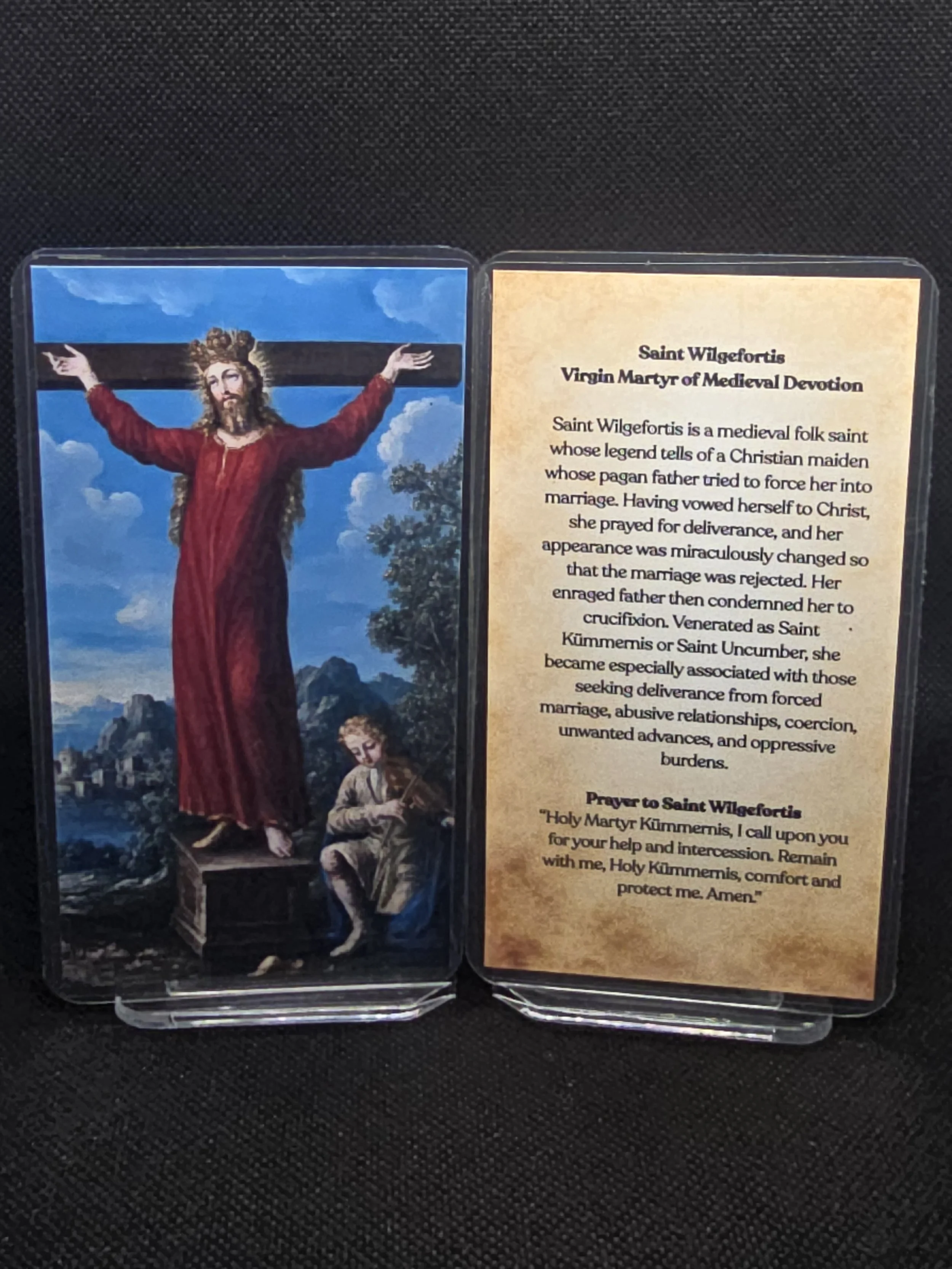
Saint Wilgefortis is a medieval Catholic folk saint traditionally depicted as a bearded young woman crucified for resisting a marriage imposed upon her by her father. Known in England as Saint Uncumber, she became a beloved intercessor for women seeking to be “unencumbered” from abusive husbands, unwanted marriages, coercion, and other forms of oppression. Her traditional feast is celebrated on July 20.
According to the medieval legend, Wilgefortis was the Christian daughter of a pagan king, often identified as the king of Portugal. Her father arranged for her to marry a pagan ruler, but Wilgefortis had privately consecrated herself to Christ and vowed to remain a virgin. When she refused the marriage, her father imprisoned her and attempted to force her into submission.
Unable to escape through her own strength, Wilgefortis prayed that God would alter her appearance so completely that the prospective husband would reject her. According to the tradition, a beard miraculously grew upon her face. The marriage was canceled, but her enraged father interpreted her transformation and continued resistance as defiance. He ordered her to be crucified, making her resemble the Christ to whom she had entrusted her life.
Her unusual image spread throughout medieval Europe. Women suffering under controlling husbands, coercive families, arranged marriages, and impossible domestic circumstances began praying for her intercession. In England, her name became Saint Uncumber because women asked her to “unencumber” them from burdens they could not escape. In German-speaking lands, she was called Saint Kümmernis, a name associated with grief, sorrow, and distress.
Modern historical research has found no reliable evidence that Wilgefortis existed as a historical martyr. Her legend probably developed when medieval Christians encountered images modeled upon the Holy Face of Lucca, an ancient crucifix showing Christ with a beard and dressed in a long tunic. Viewers unfamiliar with this style may have interpreted the robed figure as a crucified woman and created a sacred story to explain the image.
Saint Wilgefortis was never formally canonized by the Catholic Church, and she does not appear on the modern universal liturgical calendar. Nevertheless, devotion to her existed for centuries within Catholic communities, and churches, shrines, paintings, statues, breviaries, and local calendars preserved her memory. She is therefore best understood as a traditional Catholic folk saint whose story gave oppressed women a spiritual language for asking God for protection and deliverance.
Today, Saint Wilgefortis remains meaningful to those seeking freedom from domestic abuse, coercive control, forced marriage, family pressure, exploitation, and relationships governed by fear. Her image represents the courage to remain faithful to God when others attempt to claim authority over one’s body, conscience, or future.
This prayer card honors a powerful medieval devotion while remaining honest about its historical status. Whether Wilgefortis was a forgotten martyr or a sacred figure created through centuries of Christian storytelling, her image gave suffering people a name for their prayers and reminded them that God sees those who feel trapped, unheard, or unable to escape.
Each card is handmade in Austin and created to order. We do not keep stock, because every prayer card is treated as a unique devotional offering. They are printed on museum-quality photo paper, not cardstock, and each one is made during prayer. The saints are venerated throughout the entire process, and prayers are intentionally offered for the person who will receive the card. These are not mass-produced items. They are created slowly, reverently, and with spiritual intention, because every soul and every prayer matters.
The Life & Story
The legend of Saint Wilgefortis emerged in Europe during the later Middle Ages. Although the setting of her story was usually placed in Portugal or Galicia, her devotion became especially prominent in the Low Countries, Germany, Austria, Bavaria, northern France, and England.
According to the traditional account, Wilgefortis was born to a pagan king who arranged her marriage for political advantage. The young princess had secretly embraced Christianity and made a vow of virginity, dedicating her life entirely to Jesus Christ. Marriage to the pagan ruler would have violated both her conscience and her sacred promise.
Wilgefortis refused the arrangement, but her father would not accept her decision. In some versions, she was imprisoned and deprived of food until she agreed to obey. She remained firm and prayed that God would protect her vow by taking away the physical beauty that had made the marriage desirable.
When a beard miraculously appeared upon her face, her intended husband withdrew from the marriage. Her father was furious that his plans had been defeated and condemned his daughter to die in the same manner as the Christ she followed. Wilgefortis was nailed to a cross and became, within the legend, a virgin martyr.
Her beard was not presented as an object of ridicule. Within the medieval story, it was the visible sign that God had heard the prayer of a woman who possessed no earthly power over her own future. The very feature that made her unacceptable to her oppressors became the sign of her freedom and fidelity to Christ.
Another legend associated with Wilgefortis tells of a poor musician who played before her image. Having no money or valuable offering to leave, he gave the only gift he possessed: his music. The saint’s statue responded by dropping one of its golden shoes at his feet.
The musician was accused of stealing the shoe and sentenced to death. He asked to be taken before the image one final time. When he played again, the statue dropped its second shoe, proving that the first had been given freely. For this reason, Wilgefortis is sometimes depicted with only one shoe while a musician kneels beneath her cross.
The dropped shoe became a symbol of mercy toward those who possess little to offer. It also reflected the medieval belief that generosity is measured not by the monetary value of a gift but by the love and sincerity with which it is given.
The Origin of Her Image
The historical origin of Saint Wilgefortis appears to be connected to the Holy Face of Lucca, also called the Volto Santo. This ancient wooden crucifix portrays Christ alive upon the cross, wearing a long, sleeved tunic rather than the shorter garment found in later Western crucifixion art.
Copies of the image spread through Europe, but some communities lost knowledge of what the unusual clothing represented. Because the figure wore a long robe, viewers may have interpreted it as female. The beard then required an explanation, and the story of a Christian princess who miraculously grew facial hair developed around the image.
This origin does not mean that devotion to Wilgefortis was insincere. Medieval Christians frequently encountered sacred truths through legends, images, local customs, and oral traditions. For generations of suffering women, Wilgefortis became a powerful representation of resistance, deliverance, and Christ’s presence with those whose freedom had been taken from them.
Her image was included in churches and devotional artwork throughout Europe. A late-fifteenth-century triptych attributed to Hieronymus Bosch is now believed to portray her crucifixion. Surviving statues and paintings also testify to the extent of her former devotion.
Legacy & Patronage
Saint Wilgefortis was most commonly invoked by women trapped in abusive or unwanted marriages. Her English name, Saint Uncumber, expressed the hope that she could help “disencumber” a woman from an unbearable husband or domestic burden.
In the Low Countries she was known as Ontkommer, meaning one who helps another escape or become free. In German-speaking regions she was called Kümmernis, connecting her with grief, anxiety, trouble, and sorrow. In France she was sometimes known as Débarras, suggesting release or riddance from a burden.
She has also been confused or combined with Saint Liberata or Saint Librada, a female martyr honored in Spain, Italy, and parts of Latin America. Although their stories and images became intertwined, Wilgefortis and Liberata appear to have originated as distinct devotional figures.
Wilgefortis is not recognized as a formally canonized saint on the modern universal Catholic calendar. Her proper category is a Catholic folk saint whose centuries-old cult arose from medieval popular devotion. Her prayer card should therefore be presented honestly as an expression of traditional folk Catholicism rather than as devotion to a historically verified or officially canonized saint.
Patron Saint Of
Saint Wilgefortis is traditionally regarded as a patron of women seeking freedom from abusive husbands, forced marriages, coercive relationships, controlling families, unwanted suitors, and domestic oppression.
She is also invoked by those experiencing emotional abuse, manipulation, threats, family rejection, pressure to violate their conscience, or fear surrounding their physical appearance. Her story may offer particular comfort to people who have been mocked, rejected, or treated as undesirable because their bodies do not conform to the expectations of others.
Her image represents fidelity to God under pressure and the refusal to surrender one’s conscience merely to satisfy the demands of another person.
Deliverance and Ongoing Devotion
For medieval women who possessed few legal or financial means of escaping abusive marriages, Saint Wilgefortis represented a heavenly advocate who understood what it meant to have one’s future controlled by someone else. They approached her not because she offered an easy solution, but because her story assured them that their suffering was visible to God.
Her traditional devotion should never be used to tell someone to remain passively in physical danger. Anyone currently experiencing domestic violence should seek immediate protection from trusted family members, clergy, domestic-violence professionals, or emergency services. Prayer can accompany the search for safety, but it should never replace necessary action.
Wilgefortis represents the prayer of a person who feels trapped but refuses to believe that oppression has the final word. Her story gives sacred expression to the desire to be released from a burden, restored to dignity, and allowed to live faithfully before God.
Traditional Devotion
Historical records indicate that prayers and an antiphon honoring Saint Wilgefortis appeared in a sixteenth-century breviary associated with the Use of Sarum. However, a dependable English translation of those texts is not commonly available, and many modern prayers attributed to her cannot be verified as traditional.
For that reason, it is better not to present a newly written prayer as though it were ancient. Those seeking her intercession may instead offer the Lord’s Prayer or another established Catholic prayer for protection while asking God to remember all who are trapped in abusive, coercive, or dangerous situations.
The Lord’s Prayer
Our Father, who art in heaven,
hallowed be Thy name.
Thy kingdom come;
Thy will be done on earth as it is in heaven.
Give us this day our daily bread;
and forgive us our trespasses,
as we forgive those who trespass against us;
and lead us not into temptation,
but deliver us from evil.
Amen.
Common Questions (FAQ)
Q: Who was Saint Wilgefortis?
Saint Wilgefortis is a medieval Catholic folk saint traditionally described as a Christian princess who miraculously grew a beard after praying to escape a forced marriage. According to the legend, her pagan father then had her crucified.
Q: Was Saint Wilgefortis a real historical person?
There is no reliable historical evidence confirming her existence. Most scholars believe her legend developed around medieval copies of the Holy Face of Lucca, an unusual crucifix showing the bearded Christ wearing a long tunic.
Q: Is Saint Wilgefortis officially recognized by the Catholic Church?
She was never formally canonized and is not included on the modern universal Catholic calendar. She is best classified as a medieval Catholic folk saint with a once-widespread tradition of popular devotion.
Q: When is Saint Wilgefortis’s feast day?
Her traditional feast day is July 20, although it is not an obligatory or universal Catholic liturgical celebration.
Q: Why does Saint Wilgefortis have a beard?
According to the legend, she prayed to be made physically undesirable so that she could preserve her vow of virginity and escape an unwanted marriage. God answered her prayer by causing a beard to grow upon her face.
Q: Why was Saint Wilgefortis crucified?
Her father had arranged a politically advantageous marriage for her. When her beard caused the prospective husband to reject the arrangement, her father ordered her crucified as punishment for defying him.
Q: What is Saint Wilgefortis the patron saint of?
She is traditionally invoked by women seeking liberation from abusive husbands, forced marriages, unwanted suitors, controlling families, and other oppressive or coercive circumstances.
Q: Why is she called Saint Uncumber?
In England, women prayed for her help in becoming “unencumbered” from abusive husbands and unbearable domestic burdens. This gave rise to the name Saint Uncumber.
Q: Is Saint Wilgefortis the same as Saint Liberata or Saint Librada?
Their traditions became confused and combined in some regions, but they appear to have originated as separate devotional figures. Wilgefortis is characteristically depicted with a beard, while the older traditions of Liberata or Librada generally portray a beardless female martyr.
Q: Why is a musician sometimes shown beneath her cross?
According to a medieval legend, a poor musician played before her image, and the saint rewarded him by dropping a golden shoe. When he was accused of theft, the statue dropped its second shoe to prove his innocence.
Q: What does Saint Wilgefortis represent today?
Her image represents resistance to coercion, fidelity to conscience, deliverance from abusive relationships, and the dignity of people rejected because of their appearance or refusal to conform.
Saint Wilgefortis is a medieval Catholic folk saint traditionally depicted as a bearded young woman crucified for resisting a marriage imposed upon her by her father. Known in England as Saint Uncumber, she became a beloved intercessor for women seeking to be “unencumbered” from abusive husbands, unwanted marriages, coercion, and other forms of oppression. Her traditional feast is celebrated on July 20.
According to the medieval legend, Wilgefortis was the Christian daughter of a pagan king, often identified as the king of Portugal. Her father arranged for her to marry a pagan ruler, but Wilgefortis had privately consecrated herself to Christ and vowed to remain a virgin. When she refused the marriage, her father imprisoned her and attempted to force her into submission.
Unable to escape through her own strength, Wilgefortis prayed that God would alter her appearance so completely that the prospective husband would reject her. According to the tradition, a beard miraculously grew upon her face. The marriage was canceled, but her enraged father interpreted her transformation and continued resistance as defiance. He ordered her to be crucified, making her resemble the Christ to whom she had entrusted her life.
Her unusual image spread throughout medieval Europe. Women suffering under controlling husbands, coercive families, arranged marriages, and impossible domestic circumstances began praying for her intercession. In England, her name became Saint Uncumber because women asked her to “unencumber” them from burdens they could not escape. In German-speaking lands, she was called Saint Kümmernis, a name associated with grief, sorrow, and distress.
Modern historical research has found no reliable evidence that Wilgefortis existed as a historical martyr. Her legend probably developed when medieval Christians encountered images modeled upon the Holy Face of Lucca, an ancient crucifix showing Christ with a beard and dressed in a long tunic. Viewers unfamiliar with this style may have interpreted the robed figure as a crucified woman and created a sacred story to explain the image.
Saint Wilgefortis was never formally canonized by the Catholic Church, and she does not appear on the modern universal liturgical calendar. Nevertheless, devotion to her existed for centuries within Catholic communities, and churches, shrines, paintings, statues, breviaries, and local calendars preserved her memory. She is therefore best understood as a traditional Catholic folk saint whose story gave oppressed women a spiritual language for asking God for protection and deliverance.
Today, Saint Wilgefortis remains meaningful to those seeking freedom from domestic abuse, coercive control, forced marriage, family pressure, exploitation, and relationships governed by fear. Her image represents the courage to remain faithful to God when others attempt to claim authority over one’s body, conscience, or future.
This prayer card honors a powerful medieval devotion while remaining honest about its historical status. Whether Wilgefortis was a forgotten martyr or a sacred figure created through centuries of Christian storytelling, her image gave suffering people a name for their prayers and reminded them that God sees those who feel trapped, unheard, or unable to escape.
Each card is handmade in Austin and created to order. We do not keep stock, because every prayer card is treated as a unique devotional offering. They are printed on museum-quality photo paper, not cardstock, and each one is made during prayer. The saints are venerated throughout the entire process, and prayers are intentionally offered for the person who will receive the card. These are not mass-produced items. They are created slowly, reverently, and with spiritual intention, because every soul and every prayer matters.
The Life & Story
The legend of Saint Wilgefortis emerged in Europe during the later Middle Ages. Although the setting of her story was usually placed in Portugal or Galicia, her devotion became especially prominent in the Low Countries, Germany, Austria, Bavaria, northern France, and England.
According to the traditional account, Wilgefortis was born to a pagan king who arranged her marriage for political advantage. The young princess had secretly embraced Christianity and made a vow of virginity, dedicating her life entirely to Jesus Christ. Marriage to the pagan ruler would have violated both her conscience and her sacred promise.
Wilgefortis refused the arrangement, but her father would not accept her decision. In some versions, she was imprisoned and deprived of food until she agreed to obey. She remained firm and prayed that God would protect her vow by taking away the physical beauty that had made the marriage desirable.
When a beard miraculously appeared upon her face, her intended husband withdrew from the marriage. Her father was furious that his plans had been defeated and condemned his daughter to die in the same manner as the Christ she followed. Wilgefortis was nailed to a cross and became, within the legend, a virgin martyr.
Her beard was not presented as an object of ridicule. Within the medieval story, it was the visible sign that God had heard the prayer of a woman who possessed no earthly power over her own future. The very feature that made her unacceptable to her oppressors became the sign of her freedom and fidelity to Christ.
Another legend associated with Wilgefortis tells of a poor musician who played before her image. Having no money or valuable offering to leave, he gave the only gift he possessed: his music. The saint’s statue responded by dropping one of its golden shoes at his feet.
The musician was accused of stealing the shoe and sentenced to death. He asked to be taken before the image one final time. When he played again, the statue dropped its second shoe, proving that the first had been given freely. For this reason, Wilgefortis is sometimes depicted with only one shoe while a musician kneels beneath her cross.
The dropped shoe became a symbol of mercy toward those who possess little to offer. It also reflected the medieval belief that generosity is measured not by the monetary value of a gift but by the love and sincerity with which it is given.
The Origin of Her Image
The historical origin of Saint Wilgefortis appears to be connected to the Holy Face of Lucca, also called the Volto Santo. This ancient wooden crucifix portrays Christ alive upon the cross, wearing a long, sleeved tunic rather than the shorter garment found in later Western crucifixion art.
Copies of the image spread through Europe, but some communities lost knowledge of what the unusual clothing represented. Because the figure wore a long robe, viewers may have interpreted it as female. The beard then required an explanation, and the story of a Christian princess who miraculously grew facial hair developed around the image.
This origin does not mean that devotion to Wilgefortis was insincere. Medieval Christians frequently encountered sacred truths through legends, images, local customs, and oral traditions. For generations of suffering women, Wilgefortis became a powerful representation of resistance, deliverance, and Christ’s presence with those whose freedom had been taken from them.
Her image was included in churches and devotional artwork throughout Europe. A late-fifteenth-century triptych attributed to Hieronymus Bosch is now believed to portray her crucifixion. Surviving statues and paintings also testify to the extent of her former devotion.
Legacy & Patronage
Saint Wilgefortis was most commonly invoked by women trapped in abusive or unwanted marriages. Her English name, Saint Uncumber, expressed the hope that she could help “disencumber” a woman from an unbearable husband or domestic burden.
In the Low Countries she was known as Ontkommer, meaning one who helps another escape or become free. In German-speaking regions she was called Kümmernis, connecting her with grief, anxiety, trouble, and sorrow. In France she was sometimes known as Débarras, suggesting release or riddance from a burden.
She has also been confused or combined with Saint Liberata or Saint Librada, a female martyr honored in Spain, Italy, and parts of Latin America. Although their stories and images became intertwined, Wilgefortis and Liberata appear to have originated as distinct devotional figures.
Wilgefortis is not recognized as a formally canonized saint on the modern universal Catholic calendar. Her proper category is a Catholic folk saint whose centuries-old cult arose from medieval popular devotion. Her prayer card should therefore be presented honestly as an expression of traditional folk Catholicism rather than as devotion to a historically verified or officially canonized saint.
Patron Saint Of
Saint Wilgefortis is traditionally regarded as a patron of women seeking freedom from abusive husbands, forced marriages, coercive relationships, controlling families, unwanted suitors, and domestic oppression.
She is also invoked by those experiencing emotional abuse, manipulation, threats, family rejection, pressure to violate their conscience, or fear surrounding their physical appearance. Her story may offer particular comfort to people who have been mocked, rejected, or treated as undesirable because their bodies do not conform to the expectations of others.
Her image represents fidelity to God under pressure and the refusal to surrender one’s conscience merely to satisfy the demands of another person.
Deliverance and Ongoing Devotion
For medieval women who possessed few legal or financial means of escaping abusive marriages, Saint Wilgefortis represented a heavenly advocate who understood what it meant to have one’s future controlled by someone else. They approached her not because she offered an easy solution, but because her story assured them that their suffering was visible to God.
Her traditional devotion should never be used to tell someone to remain passively in physical danger. Anyone currently experiencing domestic violence should seek immediate protection from trusted family members, clergy, domestic-violence professionals, or emergency services. Prayer can accompany the search for safety, but it should never replace necessary action.
Wilgefortis represents the prayer of a person who feels trapped but refuses to believe that oppression has the final word. Her story gives sacred expression to the desire to be released from a burden, restored to dignity, and allowed to live faithfully before God.
Traditional Devotion
Historical records indicate that prayers and an antiphon honoring Saint Wilgefortis appeared in a sixteenth-century breviary associated with the Use of Sarum. However, a dependable English translation of those texts is not commonly available, and many modern prayers attributed to her cannot be verified as traditional.
For that reason, it is better not to present a newly written prayer as though it were ancient. Those seeking her intercession may instead offer the Lord’s Prayer or another established Catholic prayer for protection while asking God to remember all who are trapped in abusive, coercive, or dangerous situations.
The Lord’s Prayer
Our Father, who art in heaven,
hallowed be Thy name.
Thy kingdom come;
Thy will be done on earth as it is in heaven.
Give us this day our daily bread;
and forgive us our trespasses,
as we forgive those who trespass against us;
and lead us not into temptation,
but deliver us from evil.
Amen.
Common Questions (FAQ)
Q: Who was Saint Wilgefortis?
Saint Wilgefortis is a medieval Catholic folk saint traditionally described as a Christian princess who miraculously grew a beard after praying to escape a forced marriage. According to the legend, her pagan father then had her crucified.
Q: Was Saint Wilgefortis a real historical person?
There is no reliable historical evidence confirming her existence. Most scholars believe her legend developed around medieval copies of the Holy Face of Lucca, an unusual crucifix showing the bearded Christ wearing a long tunic.
Q: Is Saint Wilgefortis officially recognized by the Catholic Church?
She was never formally canonized and is not included on the modern universal Catholic calendar. She is best classified as a medieval Catholic folk saint with a once-widespread tradition of popular devotion.
Q: When is Saint Wilgefortis’s feast day?
Her traditional feast day is July 20, although it is not an obligatory or universal Catholic liturgical celebration.
Q: Why does Saint Wilgefortis have a beard?
According to the legend, she prayed to be made physically undesirable so that she could preserve her vow of virginity and escape an unwanted marriage. God answered her prayer by causing a beard to grow upon her face.
Q: Why was Saint Wilgefortis crucified?
Her father had arranged a politically advantageous marriage for her. When her beard caused the prospective husband to reject the arrangement, her father ordered her crucified as punishment for defying him.
Q: What is Saint Wilgefortis the patron saint of?
She is traditionally invoked by women seeking liberation from abusive husbands, forced marriages, unwanted suitors, controlling families, and other oppressive or coercive circumstances.
Q: Why is she called Saint Uncumber?
In England, women prayed for her help in becoming “unencumbered” from abusive husbands and unbearable domestic burdens. This gave rise to the name Saint Uncumber.
Q: Is Saint Wilgefortis the same as Saint Liberata or Saint Librada?
Their traditions became confused and combined in some regions, but they appear to have originated as separate devotional figures. Wilgefortis is characteristically depicted with a beard, while the older traditions of Liberata or Librada generally portray a beardless female martyr.
Q: Why is a musician sometimes shown beneath her cross?
According to a medieval legend, a poor musician played before her image, and the saint rewarded him by dropping a golden shoe. When he was accused of theft, the statue dropped its second shoe to prove his innocence.
Q: What does Saint Wilgefortis represent today?
Her image represents resistance to coercion, fidelity to conscience, deliverance from abusive relationships, and the dignity of people rejected because of their appearance or refusal to conform.