Blessed Dom Anton Muzaj: Albanian Priest and Martyr of Shkoder, Died in 1948 after Imprisonment
The young chancery priest of Shkoder who died of illness and torture in 1948 and was beatified in 2016.
At a Glance
- Born
- May 12, 1921, Vernakolle, Kosovo (other dates are also given)
- Died
- Spring 1948, Shkoder; exact date unknown
- Titles
- Blessed, priest and martyr
- Feast
- November 5, with Blessed Vincenc Prennushi and Companions
- Veneration
- Latin Catholic Church; beatified November 5, 2016; not canonized
- Patronage
- None formally designated
Who Was Blessed Anton Muzaj?
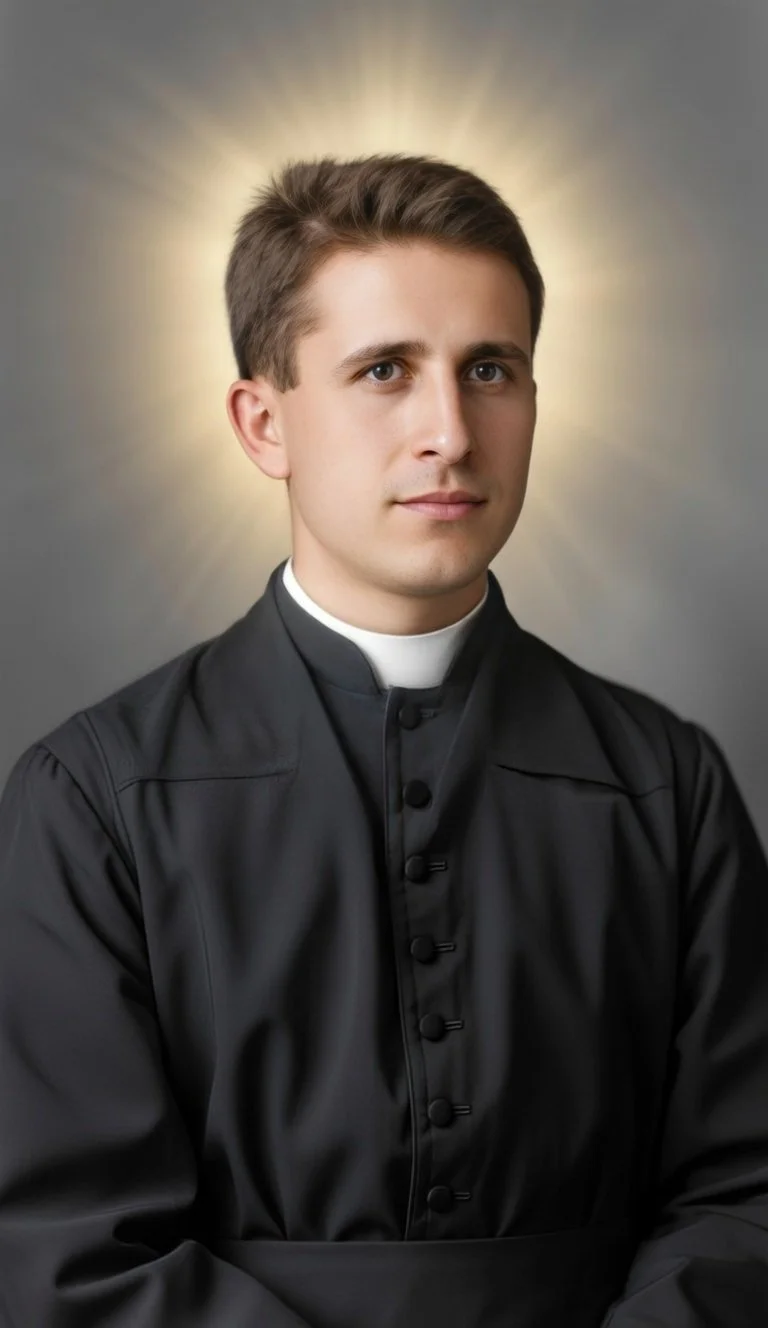
Blessed Anton Muzaj, called Dom Anton in Albanian, was a young Catholic priest who worked in the Archdiocese of Shkoder in northern Albania. He was born in Kosovo, studied in Shkoder and Rome, and came home after the Second World War to serve in a country that was becoming a communist state. He died in the spring of 1948, about twenty-six years old, after months of imprisonment and ill treatment.
The Church honors him as a martyr, one of thirty-eight Albanian Catholics beatified in Shkoder on November 5, 2016. Unlike many others in that group, he was not shot. The Vatican lists him among those who died from the effects of torture and mistreatment, and that is the basis of his recognition as a martyr.
He is a Blessed, not a canonized saint, and a priest of the Latin Catholic Church. Croatian sources spell his name Anton Muzic, which is the same man. His story is short, and much of it is known through the memory of fellow prisoners, which is why this article marks what is documented and what is uncertain.
From Kosovo to Shkoder
Vatican News and Bishop Ratko Peric give his birth as May 12, 1921, in Vernakolle, a village tied to the parish of Letnica in Kosovo. Other sources give May 15 or March 19. One account suggests that May 15 may be his baptism date. The original baptismal register has not been checked here, so the birth date remains uncertain.
Bishop Peric names his father as Dejko Muzic, of Croatian background, and his mother as Dilja, of Albanian background. Vatican News calls his mother his first teacher in the faith and says he served at the altar as a boy and loved the Virgin Mary. Both Croatian and Albanian Catholics therefore remember him as their own.
He had his early schooling in Kosovo and then went to Shkoder, where, according to Bishop Peric, he attended the Jesuit school called the Xaverianum from 1930. Some shorter lives speak more loosely of seminary study. A recommendation from Archbishop Gaspar Thaci dated November 12, 1938, is reported to have supported his move to Rome for priestly formation.
A Vocation Formed in Rome
There is no conversion in his story. He was raised Catholic and his vocation grew over time. In Rome he studied at the Urban College of the Propagation of the Faith, with philosophy and then theology. A Croatian study records that he finished his philosophy in 1940. The exact institutions that gave each degree are described differently in different sources.
The date of his ordination is uncertain. A detailed account by Bishop Peric, the Albanian archive Kujto and La Civilta Cattolica point to March 19, 1944, with Cardinal Pietro Fumasoni Biondi ordaining him. The Croatian Bishops' Conference gives March 19, 1945. Until the ordination register is checked, 1944 is the better-supported date but is not settled.
The turning point was his return. Vatican News says he traveled toward Albania in 1945 through Bari with other newly ordained priests, including Dede Macaj and Luigj Kolaj, and that they were warned about the danger facing clergy under the new government. He went on to Shkoder anyway. That choice to go back to a people who needed priests is the best-attested moment of his life.
A Young Priest in the Archdiocese
His active ministry was short. He founded no religious community and no school. The sources describe him in several roles in the archdiocese. Bishop Peric lists rector of the church of Saint Nicholas, cathedral chaplain, chancery work and care of the archdiocesan finances. Vatican News names him chancellor and administrator.
After Archbishop Gaspar Thaci died in April 1946, he took on further administrative duties while the archdiocese was under strain. That a priest barely in his twenties was trusted with such tasks says something about how his superiors saw him. Vatican News describes him as intelligent, gentle and zealous, and as devoted to the Immaculate Virgin.
No sermons, letters or spiritual writings by him have been found. Letters about him survive, such as the recommendation for his Roman studies, but not words written by him. Any claim that he published a book or left a written testament would need documents. His witness is his service and the way he met suffering.
Arrest, Interrogation and Illness
The communist authorities saw the Catholic Church, with its link to Rome, as an enemy. The Vatican describes a campaign of arrests, trials and killings against clergy and laypeople. Muzaj was arrested in May 1947, but the day is disputed: Kujto gives May 2, Bishop Peric gives May 19 with a warrant dated May 20, and the Croatian Bishops' Conference gives May 20.
He was held in the former Franciscan monastery at Gjuhadol in Shkoder, which the security police had turned into a prison. The charges included political activity and ties with the Vatican. Accounts reproduced by Bishop Peric say he was accused of encouraging young Catholics against the state and of helping organize the funeral of Archbishop Thaci.
Witnesses named by Vatican News, including Ana Kol Daja, Terezina Pali and the Franciscan Zef Pllumi, reported beatings, injuries to his legs, cold and repeated drenching with icy water, and the tuberculosis that followed. Bishop Peric records an account of fifteen days and nights standing against a wall from October 1, 1947. These are published claims that should be tested against prison records. A court judgment is dated January 8, 1948, in one account and January 14 in another, which may be different events.
Release and Death
By the spring of 1948 he was gravely ill. The sources agree that he was released when death was near, and Vatican News suggests this was done to keep him from dying in custody. He was taken to the archdiocesan residence in Shkoder, where he died soon after. Bishop Peric and the Croatian Bishops' Conference say he lay beneath a staircase in a building partly taken over by soldiers.
The date of his death is unknown. The Vatican says only spring 1948, and Bishop Peric admits that even the grave marker he describes does not give a certain day. No anniversary of death should be fixed for him without better evidence. His liturgical memorial is not tied to it.
His burial is also uncertain. Vatican News and Bishop Peric speak of Rrmaj Cemetery in Shkoder, where believers pray. The Albanian archive Kujto, citing a dictionary of the victims of communist terror, says police buried him at an unknown place. No authenticated relic or translation of remains has been recorded.
Devotion and Witness
Vatican News reports that Catholics visit the place thought to be his grave at Rrmaj and ask for his help. This is documented devotion and not proof of a miracle. The same page gives a modern prayer asking graces through his intercession and his canonization. No miracle has been verified for him, and none was needed for his beatification as a martyr.
One tradition, from the witness Ana Kol Daja, says he wanted his family to know that he was innocent and was dying for his faith. It is a reported memory and not a document in his hand, so it is given here only in substance and not as a quotation. Bishop Peric also gives prisoners' testimony that he called on the Holy Trinity and on Christ the King. The details of the words and setting need the original witness.
The memoir of Zef Pllumi, Live to Tell, is a valuable source. It describes how weak he was when brought before a court, so thin that he could hardly speak, and that the judges let him sit. This comes from a survivor, but it is a memoir written long afterward and should be read with care.
What the Sources Say
The official sources are the list of Albanian martyrs of the Dicastery for the Causes of Saints, the Vatican News profile of May 30, 2021, and the profile of the Croatian Bishops' Conference. The archdiocese of Shkoder also presents the martyrs of communism, and Vatican Radio reported the beatification of 2016.
The most detailed life comes from Bishop Ratko Peric, who draws on Pllumi's memoir and on trial records. The Albanian site Kujto uses the Institute for the Study of Crimes and Consequences of Communism and its dictionary of victims. La Civilta Cattolica discussed the group in 2025. Each has strengths, and they differ on dates.
What is firm is that he was a Catholic priest tied to Kosovo and Shkoder, was imprisoned and ill-treated, died in spring 1948 and was beatified in 2016. What is open is the birth date, the ordination year, the arrest day, the court dates, the day of death and the burial place. The strongest proof would be the baptismal and ordination registers, security and court files, and burial records.
Places to Remember Him
Shkoder is the center of his memory. The cathedral hosts the memorial each November, and the former Franciscan monastery at Gjuhadol, where he was held, is part of the story of the city's martyrs. The archdiocesan residence where he died stands in the same city.
Rrmaj Cemetery is reported as his burial place and as a place where people pray, although the identification of his remains is not documented. His birthplace in Kosovo, in the parish area of Letnica, links him to Kosovo Catholics, who remember him as one of their own.
Those who cannot travel can keep the memorial on November 5 with the other Albanian martyrs. A fitting prayer is for young priests, for the sick in prison, and for the Church in places where faith is still dangerous.
undefined
undefined
Muzaj and the Wider Christian East
Muzaj was a Latin Catholic priest. He was not an Eastern Catholic or Orthodox cleric, and the sources do not show any Byzantine feast or Orthodox commemoration for him. No Orthodox Church has glorified him, and he should not be called an Orthodox saint.
There is a real link in the group of martyrs to which he belongs. The Vatican list includes Blessed Josif Papamihali, a priest of the Albanian Greek Catholic tradition who died in 1948 after forced labor. Latin and Byzantine Catholic clergy therefore suffered under the same regime.
For Orthodox readers, the themes of faithfulness to Christ under pressure and of endurance in prison are well known in their own martyrs and confessors. His life can be honored with respect in that wider setting, without claiming a recognition that has not been given.
Frequently Asked Questions
Ask His Prayers
Blessed Anton Muzaj reminds us that a short life can carry a great witness. We ask his prayers for young priests, for those who are ill or imprisoned, and for the people of Albania and Kosovo. May his quiet courage help us to stay faithful when the cost is high.
View Prayer Card