Blessed Dom Mikel Beltoja: Albanian Priest and Martyr of Shkoder, Executed in 1974 for Keeping the Faith
The village priest who kept giving the sacraments in secret after religion was banned, and was shot in 1974.
At a Glance
- Born
- May 9, 1935, Beltoje, near Shkoder (civil records give other dates)
- Died
- February 10, 1974, by firing squad at Shkoder
- Titles
- Blessed, priest and martyr
- Feast
- February 10 (Vatican News); November 5 with Blessed Vincenc Prennushi and Companions
- Veneration
- Latin Catholic Church; beatified November 5, 2016; not canonized
- Patronage
- None formally designated
- Who Was Blessed Mikel Beltoja?
- Beltoje and a Hidden Vocation
- Studying for the Priesthood in Secret
- A Village Priest in Hiding
- Arrest, Trial and Sentence
- Execution and Beatification
- Devotion and Memory
- What the Sources Say
- Places to Remember Him
- Beltoja and the Wider Christian East
- Frequently Asked Questions
Who Was Blessed Mikel Beltoja?
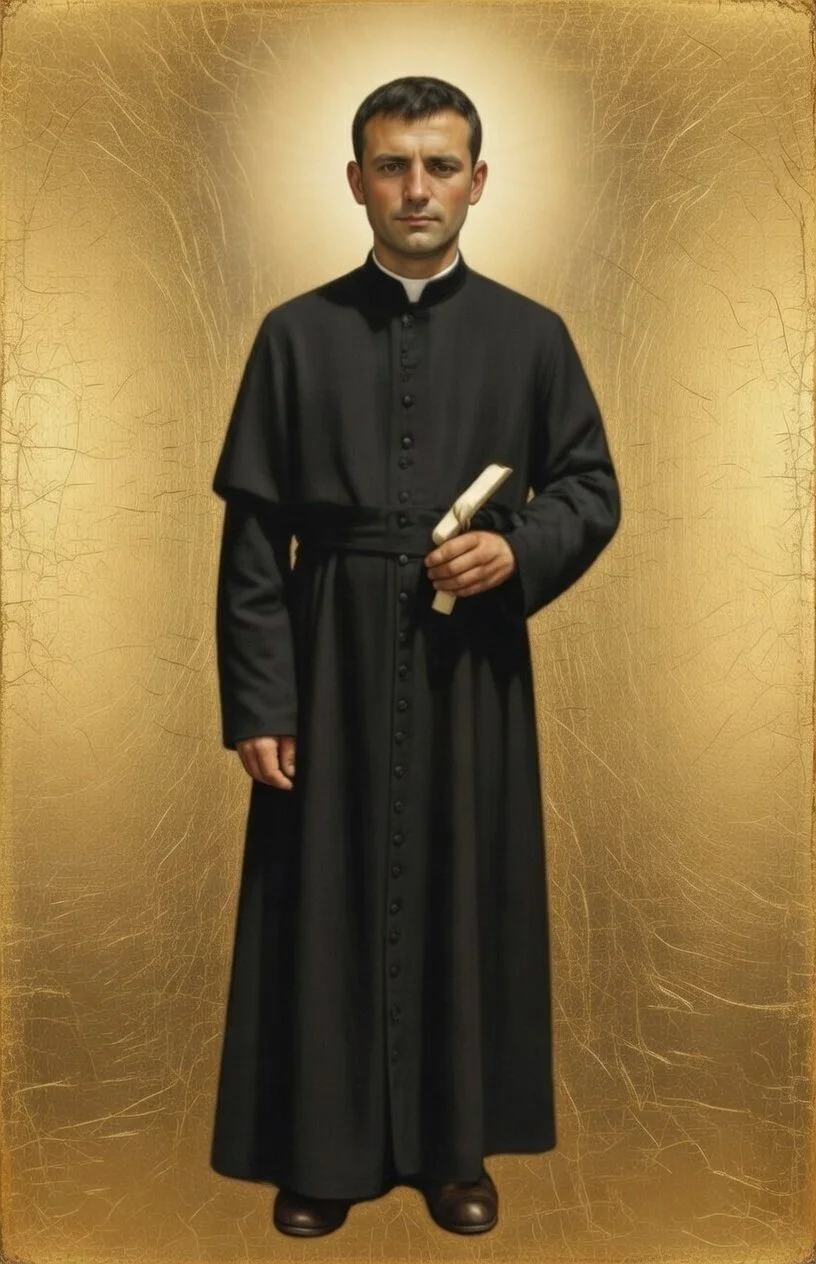
Blessed Mikel Beltoja, called Dom Mikel in Albanian, was a Catholic priest of the Archdiocese of Shkoder-Pult in northern Albania. He was born in the village of Beltoje, studied for the priesthood in secret after the seminary was closed, and was ordained in 1961. When the state banned public religion in 1967, he kept on serving his people quietly until his arrest in 1973.
He was shot on February 10, 1974, and the Church counts him among the thirty-eight Albanian martyrs beatified in Shkoder on November 5, 2016. He is one of the later martyrs of the group. Many of the others died in the 1940s and 1950s, so his story shows how long the persecution lasted.
He is a Blessed, not a canonized saint, and a priest of the Latin Catholic Church. This article marks what the sources document and what remains uncertain. Even his age at death is often misstated, as explained below.
Beltoje and a Hidden Vocation
The Archdiocese of Shkoder-Pult and several Catholic publications give his birth as May 9, 1935, in Beltoje near Shkoder. The Albanian archive Kujto records April 17, 1935 and mentions 1936 in civil records. The date is therefore uncertain, and May 9, 1935 is used here only as the best-supported Church date.
His names also vary. Sources call him Mikel Beltoja and Mikel Gjergji, and the historian Kastriot Dervishi records a further name form. How these relate, whether baptismal, civil, a father's name or a place name, has not been settled from the original records.
Kujto says he finished elementary school in his home village and in Berdice, gave the years 1948 to 1951, and then spent about seven months at a teacher training school in Tirana. Little reliable information about his parents, brothers and sisters, or childhood faith has been found, and none is invented here. The common claim that he died at twenty-nine does not fit his dates. If he was born in 1935 and died in 1974, he was thirty-eight.
Studying for the Priesthood in Secret
There is no conversion in his story. His turning point was the closing of the seminary. The communist authorities shut the seminary in Shkoder, so ordinary priestly formation was no longer possible. According to the archdiocese, Bishop Ernest Coba taught him philosophy and theology privately, as he did for another future martyr, Marin Shkurti.
The archdiocese's history of the interdiocesan seminary gives December 8, 1961, as the date on which both men were ordained. Which bishop ordained them is not clearly stated in the material examined, so that detail is left open. What is clear is that he became a priest by a hidden path, when being a priest was dangerous.
Kujto says he was sent to Dajc near the Buna River in December 1961 and became parish priest at Barbullush in November 1964. It dates the end of his official ministry there to February 22, 1967. After that came the state campaign against religion, and he faced the choice to stop or to go on in secret.
A Village Priest in Hiding
His main work was pastoral. He celebrated Mass, preached and cared for people in Dajc and Barbullush. After the churches were closed in 1967, Catholic accounts from Vatican News and Radio Maria Albania say he traveled between villages and into the hills to give the sacraments in secret.
Kujto adds that he went back to his parents' home and worked in an agricultural cooperative until he was arrested. This suggests that his priestly work was hidden behind an ordinary working life. It was a double life that many priests in Albania lived, and it carried real risk for the families who welcomed him.
No book, sermon collection or extended letters by him have been found. What does survive is material from his trial. The archdiocese's publication Fjala e Paqes reproduces statements attributed to him from August 7, 1973, in which he defended religion, love and the dignity of the person. These are valuable, but the original archive file should be checked, and no wording from them is quoted here.
Arrest, Trial and Sentence
The communist state of Enver Hoxha tried to end religion altogether and declared Albania an atheist country in 1967. The Vatican describes imprisonment, torture, false charges and killings of clergy and laypeople. Beltoja was arrested in Beltoje on April 19, 1973, and held in Shkoder. The date agrees across the archdiocese, Radio Maria Albania and Kujto.
The charges included attempted treason, agitation and propaganda against the state, resistance to state officials and fraud. Kujto explains that the authorities treated activities such as baptisms as deception. Dervishi cites Shkoder District Court judgment number 229, dated September 4, 1973. His case therefore mixed political charges with his religious acts.
Sources differ on the sentences. Dervishi describes a seven-year term on August 15, 1973, followed by a death sentence on September 4, 1973. Vatican News tells the move from prison term to death sentence as part of his clash with the court. These accounts should not be merged into one scene without the original records. Church sources describe harsh treatment in custody and say he would not renounce his convictions.
Execution and Beatification
The Vatican, the archdiocese, Vatican News and Radio Maria Albania give February 10, 1974, as the day of his death by firing squad at Shkoder. The Kujto header lists September 10, 1974, but its own narrative gives February 10, so the earlier date is preferred. He was thirty-eight.
What happened to his body is uncertain. Kujto reports that it was taken to a morgue of the medical faculty in Tirana. No source examined shows where it was buried or whether it was later found, so no relic of his body can be identified. A statue unveiled in his home area in August 2025 is a memorial and not a place of relics.
He was beatified on November 5, 2016, at Saint Stephen's Cathedral in Shkoder, in a ceremony led by Cardinal Angelo Amato for Pope Francis. He belongs to the group named after Blessed Vincenc Prennushi and Companions. Vatican News names February 10 as his own memorial, while November 5 is the memorial of the whole group. He has not been canonized.
Devotion and Memory
Devotion to him is firm but quiet. The archdiocese lists him among the martyrs of communism, and the Vatican News account keeps February 10 as his day. No miracle has been verified, and none was needed, since his beatification rests on martyrdom. No incorrupt body, vision or wonder is recorded.
Popular accounts say he spoke boldly before his judges, and one repeated claim says guards stabbed him in the courtroom. The claim of boldness fits his documented criticism of the regime, but the courtroom injury is not independently confirmed in the sources examined. It is therefore a tradition and is not stated here as fact.
A Way of the Cross prepared by the Poor Clare Sisters of Shkoder records recollections of his arrest. It says agents searched his home and took vestments, books and images, and that he stayed calm and greeted the people who were present. This is a recollection, not a court finding. It matches the picture of a quiet man who did not resist with force.
What the Sources Say
The official sources are the Dicastery for the Causes of Saints, the archdiocese of Shkoder-Pult with its list of martyrs and its seminary history, and Vatican News. The Radio Maria Albania booklet on the martyrs and the archdiocese's Fjala e Paqes add detail on his life and trial.
Historical sources include the Kujto archive, which draws on Pjeter Pepa's book on the Catholic clergy of Albania, and an account by Kastriot Dervishi. A report on missing persons by the International Commission on Missing Persons also records his execution. Kujto has internal date conflicts, so it should be read with care.
What is firm is his private formation, his ordination in 1961, his ministry at Dajc and Barbullush, his arrest in 1973, his death on February 10, 1974, and his beatification in 2016. What is open is his civil birth date, how his names relate, who ordained him, the order of the sentences, details of torture, and the fate of his body.
Places to Remember Him
Beltoje, his village, holds a bronze statue unveiled in August 2025 to mark his priesthood and his refusal to give in. Shkoder, where he was tried and shot, and where the cathedral of his beatification stands, is the center of the memory of the Albanian martyrs.
Dajc and Barbullush, the parishes he served, are part of his story too. Tirana is the place where his body is said to have been taken, though that is a report and not a documented grave.
Those who cannot travel can keep February 10 or the November 5 memorial. A fitting prayer is for priests who must serve quietly, for families who shelter them, and for believers who are not free to worship.
undefined
undefined
Beltoja and the Wider Christian East
Beltoja was a Latin Catholic priest. No evidence shows that he used the Byzantine liturgy or belonged to an Eastern community, and no Orthodox church has given him a feast or glorified him. He should not be called an Orthodox saint.
There is a real link through the group of martyrs. It includes Blessed Josif Papamihali, a priest of the Byzantine rite who died under the same regime, as the archdiocese of Shkoder-Pult notes. Latin and Byzantine Catholic priests therefore share one beatification.
For Orthodox readers, the closing of churches and the secret service of clergy under atheist rule are familiar from their own history. This is a fair comparison, not a claim of shared veneration. It reminds all Christians of the cost many paid to keep worship alive.
Frequently Asked Questions
Ask His Prayers
Blessed Mikel Beltoja shows that faith can be kept alive in hidden places and ordinary work. We ask his prayers for priests who serve under pressure, for the people of Albania, and for all who are denied the freedom to worship. May his steady courage help us to stay faithful in small things and in great ones.
View Prayer Card