Blessed Jerzy Popiełuszko: The Priest Poland's Secret Police Decided Had to Die
Church History • Poland • A Documented Murder • A Complete Deep Dive
Blessed Jerzy Popiełuszko: The Priest Poland's Secret Police Decided Had to Die
He preached that evil should be overcome with good while the men planning to kill him sat somewhere in his own congregation, taking notes. This is the complete, documented story of Father Jerzy Popiełuszko: the Solidarity chaplain the state tried to silence with surveillance, then a car accident, then a kidnapping, then torture — and the rare trial that actually convicted the men who did it.
At a Glance
- Born
- September 14, 1947 • Okopy, Poland
- Ordained
- 1972 • by Cardinal Stefan Wyszyński
- Solidarity Chaplain
- From August 1980 • St. Stanislaus Kostka Church, Warsaw
- First Attempt on His Life
- Staged car accident, October 13, 1984 — evaded
- Abducted
- October 19, 1984 • near Górsk, by 3 Security Service officers
- Body Recovered
- October 30, 1984 • Vistula reservoir near Włocławek
- Funeral
- November 3, 1984 • hundreds of thousands attended
- The Toruń Trial
- Dec. 27, 1984 – Feb. 7, 1985 • 4 convictions, 14–25 years each
- Beatified
- June 6, 2010 • Warsaw • as a martyr
A Priest Who Did Not Need an Army to Become Dangerous
Most of the churchmen in this history who were killed by Communist security services died in circumstances that remain genuinely uncertain — suspicious accidents, sudden illnesses in custody, deaths that raised immediate questions nobody could ever fully answer with documentary proof. Jerzy Popiełuszko's case is different, and that difference is exactly why The War Within the Church: Communism, Infiltration, Persecution, Resistance, and the Spiritual Battle for Catholicism singles him out as the strongest documented example of outright clerical murder anywhere in the book: identified officers of Poland's security service were tried, convicted, and sentenced for what they did to him. There is no ambiguity to manage here, no evidentiary caution required. This is the one case where everything the regime tried to hide came out anyway.
This article tells his complete story — from a hostile barracks assignment as a young conscript, through his years as an unofficial chaplain to a banned trade union, to the night three men flagged down his car on a rural highway, and the trial that followed.

Part II
From a Farming Village to a Hostile Barracks
Jerzy Alfons Popiełuszko was born on September 14, 1947, to a farming family in Okopy, a small village in eastern Poland near the modern Ukrainian border, at a moment when the Communist Party had already taken the place of the Nazi occupiers Poland had just endured. Like most young Polish men of his generation, he was required to complete a period of military service before entering the seminary, and that service became an early, formative test of his convictions: he courageously continued leading forbidden religious devotions among his fellow conscripts, and endured deliberate reprisals for it, including public ridicule, punishing drills, being forced to crawl through freezing conditions, and the calculated humiliation of cleaning latrines while wearing a gas mask. He completed his seminary studies afterward and was ordained a priest in 1972 by Poland's primate, Cardinal Stefan Wyszyński himself — a direct personal link to the same Cardinal Wyszyński whose own confrontation with Communist authority, including the Polish security service's operation against him during Vatican II, is documented elsewhere in this history.
He served in several Warsaw parishes and worked for a period as a hospital chaplain before becoming an assistant priest at St. Stanislaus Kostka Church in Warsaw's Żoliborz district in 1980 — the parish that would define the rest of his short life.
Part III
Chaplain to a Movement That Wasn't Supposed to Exist
Popiełuszko's association with the Solidarity trade union movement began during the strike wave of August and September 1980, when he visited striking workers at the Warsaw Steelworks and offered them pastoral support. That visit, and the relationships it built, made him the movement's unofficial chaplain from 1980 onward — a role with no formal ecclesiastical title and no official political standing, but one that placed him at the center of a struggle the Communist government considered an existential threat to its own authority.
His visibility grew steadily over the next several years. On May 19, 1983, he attended the funeral of Grzegorz Przemyk, a teenage poet who died after a beating by police, and organized a workers' pilgrimage to the Marian shrine at Jasna Góra that September. In his homilies he consistently returned to a specific theme: that violence is a form of weakness rather than strength, and that maintaining inner dignity and freedom required overcoming fear rather than being ruled by it.
Part IV
Masses for the Fatherland: A Homily as a Form of Resistance
On December 13, 1981, Polish authorities imposed martial law, suppressing Solidarity outright, detaining thousands of activists, and attempting to reassert total control over a society that had just discovered, through Solidarity's example, how much independent organization could exist beneath the surface of an officially controlled system. The Catholic Church was never identical with Solidarity, but its parishes, clergy, and networks inevitably became part of the moral and practical environment that supported imprisoned workers, their families, and the wider dissident world.
Popiełuszko's monthly "Masses for the Fatherland" at St. Stanislaus Kostka Church, beginning in earnest in January 1982, became the most visible expression of that support. Attendance grew far beyond his own parish boundaries as word spread of a priest willing to speak plainly, in a public liturgical setting, about truth, conscience, and dignity under a regime that depended heavily on controlling exactly that kind of public speech. His homilies were smuggled out and broadcast back into Poland via Radio Free Europe, giving a single Warsaw parish an audience that reached across the entire country.
Part V
Overcome Evil With Good: The Theology That Made Him a Target
What made Popiełuszko's preaching genuinely dangerous to the regime, according to The War Within the Church, was not political slogans but a specific and disciplined theological argument. He repeatedly connected social courage to moral discipline, warning that hatred of an oppressor could become its own form of captivity, and insisting that truthfulness required refusing both the state's official lies and the temptation to answer them with lies of one's own. He did not need to command an underground political party to become a serious problem for a system whose entire stability depended on controlling public speech; a priest capable of gathering people around the simple claim that truth remains true even when the state denies it possessed a form of authority the security services could not manufacture, infiltrate, or reproduce for themselves.
This theology extended even to how Catholics should regard the very people persecuting them. Christian love of enemies, as Popiełuszko modeled it, did not require denying crimes, abandoning the pursuit of justice, or pretending a persecutor was harmless. It required refusing to desire evil simply because the other person had already done evil — a distinction that protected the wider resistance movement from becoming spiritually dependent on hatred of its persecutors, even while those same persecutors were actively surveilling, intimidating, and ultimately targeting him for it.
Part VI
Surveillance, a Bomb, and a Staged Accident
The state's response followed a pattern that recurs throughout this entire history: surveillance first, then intimidation, then direct action. In 1982, Communist authorities attempted to bomb Popiełuszko's home; he escaped unharmed. Security officers monitored him continuously, state media ran attack pieces against him, and the government's religious-affairs apparatus increasingly treated his growing influence as an urgent problem requiring resolution rather than mere containment.
On October 13, 1984, that resolution nearly arrived in the form of a staged traffic accident, engineered specifically to kill him on the road. Popiełuszko evaded it. It was the last warning the state would bother giving him.
Part VII
October 19, 1984: The Flagged-Down Car
On the night of October 19, 1984, Popiełuszko was returning to Warsaw from Bydgoszcz, where he had celebrated his final Holy Mass at the Church of the Holy Polish Brothers Martyrs, when his car was flagged down on the highway near Górsk, close to Toruń, by three Security Service officers — Captain Grzegorz Piotrowski, Leszek Pękala, and Waldemar Chmielewski — who pretended their own vehicle had broken down and needed help. It was a deception built entirely around the priest's own instinct to stop and offer assistance to strangers on a dark road.
Popiełuszko was severely beaten, bound, gagged, and forced into the trunk of a Fiat 125. His driver and traveling companion, Waldemar Chrostowski, was also assaulted but managed to escape the scene, and it was Chrostowski's account, delivered to a stunned Poland in the days that followed, that first exposed exactly what had happened on that highway.
Part VIII
What Happened Next
The traditional and most widely cited account holds that Popiełuszko was beaten to death that same night, his body then weighted with stones and a bag of sand and thrown into a reservoir on the Vistula River near Włocławek, where it was recovered eleven days later, on October 30, 1984. More recent archival research, conducted by historian Milena Kindziuk and former prosecutor Andrzej Witkowski drawing on newly available documents, witness testimony, and forensic analysis, suggests a more prolonged ordeal: that Popiełuszko may have been handed over to a separate military intelligence unit and taken to a guarded bunker at a military installation in Kazuń Polski, where he was subjected to severe physical and psychological torture over several days before dying, by this account, around noon on October 25, 1984. Both versions agree entirely on what came next — his mutilated body, bound in a manner designed so that any movement would tighten a noose around his own neck, was thrown into the Vistula near the Włocławek dam and recovered on October 30, 1984.
Whichever precise sequence of days is ultimately established with full certainty, the essential fact is not in dispute: a Catholic priest was tortured and murdered by agents of the Polish state specifically because of his preaching, and his killers left behind more than enough evidence, and more than enough surviving witnesses, for the truth to come out within months rather than decades.
Part IX
A Funeral That Became the Opposite of What They Wanted
Popiełuszko's funeral, held on November 3, 1984, drew hundreds of thousands of mourners and became, in effect, one of the largest public demonstrations against Communist rule that Poland had seen since the imposition of martial law nearly three years earlier. Solidarity's own leadership attended openly, including Lech Wałęsa, transforming a funeral Mass into an unmistakable, undeniable statement of national grief and defiance that state television could not simply fail to cover and could not spin into anything other than what it plainly was.
The killing had been intended to eliminate a problem. Instead, it created a national symbol whose influence, as The War Within the Church observes, crossed borders, survived censorship, and entered the permanent memory of exactly the people the state had hoped to frighten into silence. The regime possessed the power to kill him. It did not possess the power to determine what his death would come to mean.
Part X
The Toruń Trial: A Rare Conviction
What happened next is what makes Popiełuszko's case unique among the murdered clergy documented throughout this entire history: an actual public trial, with actual convictions. The proceedings opened in the provincial court of Toruń on December 27, 1984, and concluded on February 7, 1985. Grzegorz Piotrowski, the operation's ringleader, and his superior, Colonel Adam Pietruszka, who had ordered the operation, were each sentenced to twenty-five years in prison. Leszek Pękala received fifteen years, and Waldemar Chmielewski fourteen. It remains publicly unresolved exactly how high up the chain of command the original decision to kill Popiełuszko actually originated.
Justice, even here, proved incomplete. The sentences were repeatedly reduced through subsequent amnesties, and Piotrowski was ultimately released on August 16, 2001, having served only about fifteen years of his original twenty-five-year term. Yet the underlying fact remains historically decisive, and it is precisely why The War Within the Church treats this case as the clearest proof available that Communist regimes did, at times, resort to the direct murder of clergy: unlike so many other suspicious clerical deaths scattered across this history, this one produced identified perpetrators, a real public trial, and formal criminal convictions that no government afterward ever attempted to overturn.
Part XI
Beatified in 2010
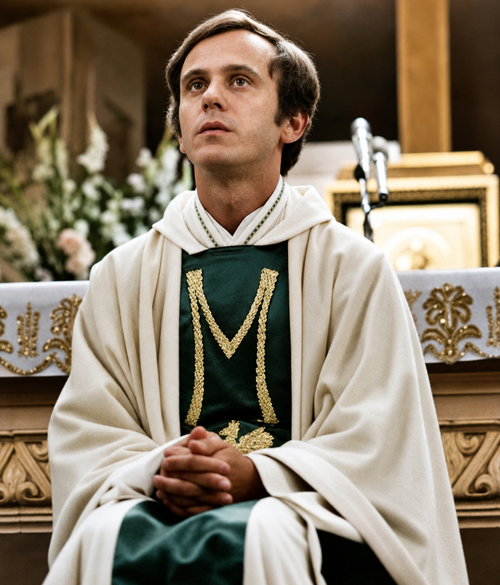
Jerzy Popiełuszko was beatified on June 6, 2010, in Warsaw, by Archbishop Angelo Amato on behalf of Pope Benedict XVI, formally recognized by the Church as a martyr who died in hatred of the faith. His feast day, October 19, marks the anniversary of his abduction rather than his death, and he is now venerated as a patron of Solidarity, of persecuted Christians generally, and of victims of totalitarianism everywhere. A miracle attributed to his intercession, the remaining requirement for formal canonization, continues to be investigated by Church authorities.
Part XII
Control Over a Body Is Not Control Over a Conscience
Popiełuszko's case, more than almost any other in this history, clarifies a distinction The War Within the Church returns to repeatedly: the difference between a government's control over a person's body and its control over that person's conscience. Communist authorities could make public fidelity costly enough that silence became understandable, even prudent, for most people most of the time. What they could never guarantee was that every single person would actually choose that silence. When a priest accepted the real, mortal risk and kept speaking anyway, the state was left with a stark choice: tolerate an alternative moral authority it could not control, or escalate its methods until that authority was physically eliminated. Popiełuszko's murder shows exactly how far that escalation was willing to go — and exactly how completely it failed to accomplish what it set out to do.
Part XIII
What's Inside The War Within the Church
Popiełuszko's story appears across two connected chapters of the book: Chapter 21, "Martial Law and the Priest Who Would Not Be Silent," which covers his life and murder in full narrative detail, and Chapter 34, "The Counter-Weapons," which uses his preaching on nonviolence and love of enemies as a central example of the spiritual strategies that helped the Church survive Communist persecution across the entire Eastern Bloc. The book's evidence appendices allow every date, name, and sentence cited in this article to be checked against its original source.
Frequently Asked Questions
Blessed Jerzy Popiełuszko — Q&A
They Killed Him to Silence Him. Instead, Hundreds of Thousands Walked Behind His Coffin, and His Killers Went to Prison for It.
Jerzy Popiełuszko preached that truth remains true even when a government insists otherwise, and a state that depended on controlling public speech decided that made him too dangerous to leave alive. What makes his story different from so many others in this history is that the world actually found out exactly who did it, exactly how, and exactly why — and saw them convicted for it in an open courtroom within four months.
Read the full documented case. Then carry his own prayer card, hang the icon that prays for those who walk toward danger anyway, and wear the shirt of a saint who also gave his whole body, not just his words, to his people.
Get The War Within the Church on Amazon →