Blessed Lazer Shantoja: Albanian Priest, Poet and Martyr of 1945
A priest of Shkoder who wrote poetry, translated European literature and was shot outside Tirana in March 1945.
At a Glance
- Born
- Shkoder; July 7, 1891 or September 2, 1892 (sources differ)
- Died
- March 5, 1945, executed near Tirana
- Titles
- Blessed, priest, poet, martyr
- Feast
- March 5 (individual memorial); November 5 (Albanian martyrs)
- Veneration
- Catholic Church; beatified November 5, 2016 at Shkoder
- Patronage
- No formal patronage established
- A Priest, a Poet and a Martyr
- Shkoder and the Shantoja Family
- A Vocation Within the Church
- Poetry, Translation and Journalism
- Exile, Politics and the Occupation
- Arrest, Torture and Death
- Remembered Without Legends
- What Scholars and Churches Say
- The Beatification at Shkoder
- Why He Matters to Eastern Christians
- Frequently Asked Questions
A Priest, a Poet and a Martyr
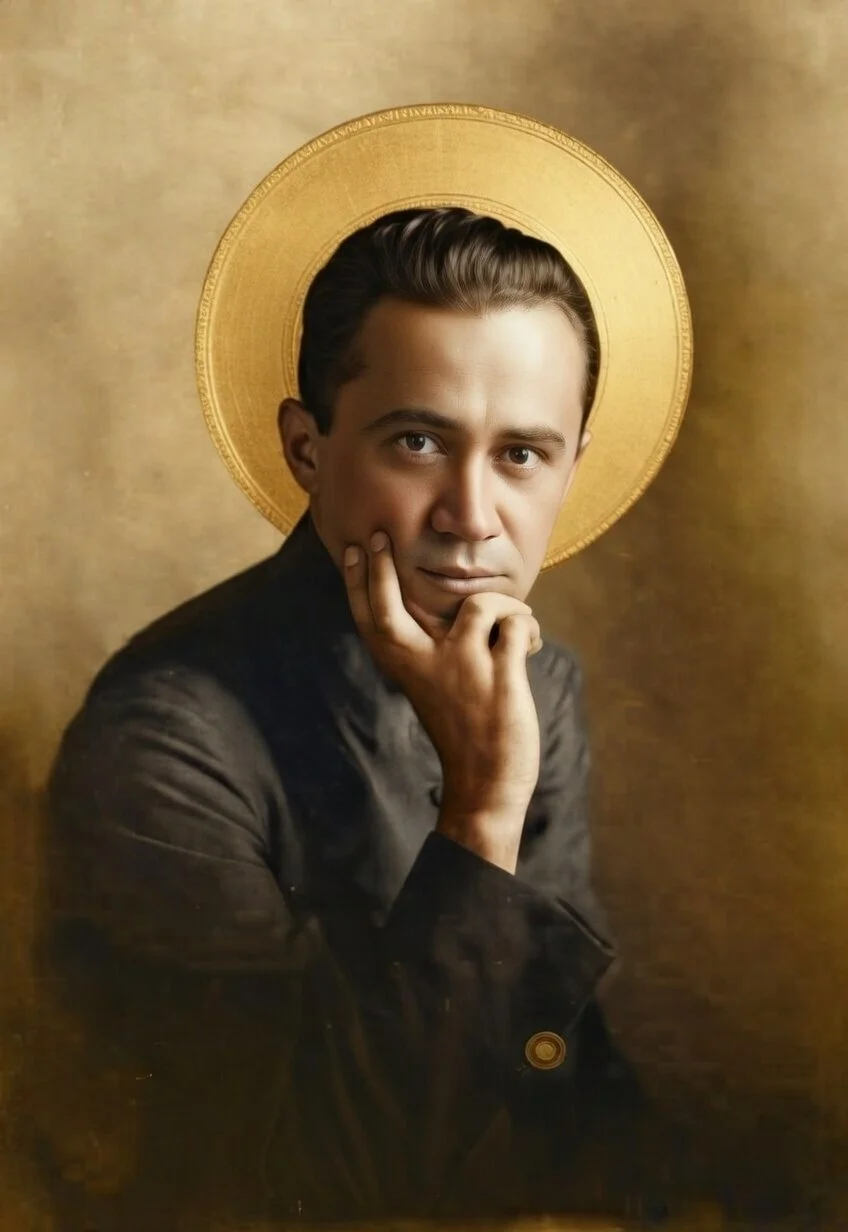
Blessed Lazer Shantoja is one of the thirty-eight Albanian martyrs beatified at Shkoder on November 5, 2016. He was a Roman Catholic priest, and the Vatican's account of the Albanian martyrs names him among the priests of the group. He was also a poet, a translator of German literature, a journalist and a collector of Albanian folk material, so his name is better known in Albanian letters than that of many saints.
His life does not fit a simple pattern. He opposed one Albanian ruler, spent years in exile, and later took public political positions during the Italian occupation that remain debated. Then, in the first months of the communist regime, he was arrested, tortured and shot. The Church honors him because of the way he died, as a priest killed in a persecution of the faith, and not because it approves every choice he made in politics.
This article follows the sources as they stand. Where they disagree, we say so, and where a story has been told and retold without firm documents, we label it as tradition. That includes the exact day of his birth, the date of his arrest and the place where his body lies, none of which can be stated with certainty.
Shkoder and the Shantoja Family
Lazer Shantoja was born in Shkoder, the great Catholic cultural center of northern Albania, then part of the Ottoman Empire. His father was Kel, also given as Mikel, Shantoja, and his mother was Luce Blinishti. The date of his birth is UNCERTAIN. Vatican Radio gives July 7, 1891 and notes that other biographies say September 2, 1892, and the Archdiocese of Vienna also recognizes the doubt between the two years.
He wrote a manuscript on the history of his family, usually called Shantojana, which names Vjerdha e Vjeter near Rragam in the Shkoder region as the family's ancestral home. The surviving manuscript's present location and completeness would need to be confirmed from archives. It is nonetheless a rare case in which a saint's own interest in his roots has reached us.
He was educated in Shkoder in schools linked to the Jesuits and to the Pontifical Seminary, where he studied languages, philosophy and theology. From 1912 to 1914 he continued his theological studies at Innsbruck in Austria, which gave him a strong command of German and opened Central European literature to him. His later translations grew from that education. He is also described as an early Albanian user of Esperanto, but the claim that he was the first Albanian Esperantist has not been confirmed from membership or publication records.
A Vocation Within the Church
Nothing in the sources suggests a conversion from another faith. Shantoja grew up in a Catholic family and moved naturally toward the priesthood. He was ordained on May 29, 1915, according to the Archdiocese of Vienna, soon after his studies in Austria. His vocation is best understood as the flowering of a Christian upbringing in a city where the Church had long been the home of learning.
From about 1917 biographical accounts place him in several parishes of the north, among them Pulaj, Beltoje, Velipoje, Rrjoll and Sheldi. In these places he combined ordinary pastoral work with teaching and cultural activity. A later account says he opened an Albanian-language school at Sheldi. The idea fits the work of many Catholic priests of that time, but the founding date and school records still need archival confirmation.
In 1922 he became secretary to Archbishop Lazer Mjeda of Shkoder, which brought him close to church leadership and to the political questions of the young Albanian state. That position, and the upheavals of 1924, drew him out of the parish and into public life. The path from village priest to political writer and exile was shorter in Albania then than it might seem now.
Poetry, Translation and Journalism
Shantoja's literary output was unusually wide for a priest of his generation. He wrote poems and satire, worked as a journalist and critic, translated from German and gathered traditional Albanian material. The Albanian linguist Kolec Topalli names him as a translator of Goethe, Schiller and Heine and points to his familiarity with Faust and William Tell.
Among his identifiable works is a collection associated with popular games, riddles and proverbs, usually cited as Per nate kazanash, and a sequence of five sonnets published under a pseudonym in 1934, which has been studied in modern Albanian scholarship. He also wrote for Catholic periodicals such as Ora e Maleve and, during his exile in Vienna, edited the political paper Ora e Shqipnise.
Some accounts credit him with a part in the founding of an Albanian institute of sciences in 1941. That is plausible given the circles in which he moved, but his exact role has not been verified, so he should not be called its founder. No collection of sermons, theological treatises or liturgical compositions by him has been identified, and his priestly work is known mainly through his parish service and his example.
Exile, Politics and the Occupation
In the crisis of 1924 Shantoja sided with the movement opposed to Ahmet Zog. When Zog returned to power he was imprisoned in January 1925, and after his release he went to Yugoslavia. By 1928 he was living in Vienna, where he published Ora e Shqipnise with the support of the anti-Zog leader Hasan Prishtina, and he later lived in Switzerland, where accounts describe pastoral service in the Biel area. A letter attributed to him, kept in the Albanian State Archives and published in transcription in 2025, concerns his need for papers to exercise his priesthood abroad. The original should be checked before it is quoted.
The most difficult part of his story begins with the Italian occupation of Albania in April 1939. After returning from exile he publicly supported arrangements connected with Italian influence and was close to circles sympathetic to the occupation government, including that of Mustafa Kruja. Sympathetic writers describe this as an attempt to keep Albania oriented toward Western Europe and away from Yugoslav or Soviet control. Other accounts speak of more direct collaboration. The exact extent of his political activity, beyond speeches and writing, is UNCERTAIN and needs study of the original records.
This chapter should not be hidden, and it should not be used to justify what happened to him. Beatification recognizes the martyrdom, which is the circumstances and religious meaning of his death, and does not endorse his full political record. The Dicastery for the Causes of Saints describes the Albanian martyrs as victims of a severe persecution carried out by an atheistic regime, and it names Shantoja and Father Ndre Zadeja among the first priests executed under the new dictatorship.
Arrest, Torture and Death
The communist movement under Enver Hoxha took control of Albania at the end of 1944, and Catholic institutions were especially exposed because of their foreign links, their schools and their loyalty to Rome. Shantoja was arrested in the Sheldi area, where he had sought refuge. The date of his arrest is UNCERTAIN, since accounts place it in December 1944, January 1945 or February 1945.
In prison he was tortured. Vatican Radio reports that his limbs were broken and that he was made to crawl, and Kolec Topalli describes severe mutilation. TRADITION: later retellings say that his mother saw his condition and begged the guards to put an end to his suffering. The report appears in several secondary sources, but its exact words have not been tied to a witness statement, so this article does not quote them.
He was shot outside Tirana on March 5, 1945, a date confirmed by Vatican Radio, Vatican News and the Archdiocese of Vienna. Some accounts name Sulce Bushati as another man executed with him. The details of the trial, including the judges and the charges as recorded, appear in later compilations and have not been compared here with court records. No secure record of his burial place or of authenticated relics was found, and no one should claim that his body rests in a particular church.
Remembered Without Legends
Unlike many ancient martyrs, Shantoja is not surrounded by miracle stories. No Church-approved healing has been attributed to his prayers in the sources examined, and none was needed for his beatification, since proof of martyrdom is enough to proceed in the case of one who died for the faith. The memory of him rests on endurance and on a death that was clearly a result of persecution.
TRADITION: some retellings present the scene of his mother and the guards as a symbol of the cruelty of the prison. They deserve respect as remembered suffering, but they should be read as later testimony and not as an exact record. No authenticated last words, final prayer or farewell letter from him has been found, and we do not invent one.
Devotion today is simple. He is named among the Albanian Catholic martyrs, and Catholic publications recall him on March 5. No pilgrimage centered on relics, no distinct icon type and no formally approved patronage have been established in the sources reviewed. The faithful who ask his help do so as part of the larger company of Albanian martyrs.
What Scholars and Churches Say
The official Catholic record is the beatification of Blessed Vincenc Prennushi and his thirty-seven companions, to whom Shantoja belongs. The Dicastery for the Causes of Saints records the cause, and Vatican News and Vatican Radio have published accounts of his life. The Archdiocese of Vienna has also published a biography that stresses his Austrian education and the doubt about his birth year.
Literary scholarship adds another layer. Alfred Capaliku has studied his sonnets in a study published by the Albanian Academy of Sciences, and Kolec Topalli has written on the persecution of Albanian scholars under communism. Journalists and historians have also pointed to archival leads, including his 1928 letter, that deserve further study before they are quoted in detail.
The best reading combines the official account of his martyrdom with independent study of his writing and his political choices. Neither alone is complete. A priest who wrote verse, translated Schiller and took controversial positions before dying in prison reminds us that holiness and martyrdom do not require a flawless record, only a death endured for the faith.
The Beatification at Shkoder
On November 5, 2016, Shantoja and thirty-seven companions were beatified at the Cathedral of Saint Stephen in Shkoder, during the pontificate of Pope Francis, with Cardinal Angelo Amato presiding on the pope's behalf. The celebration was a national moment for Albanian Catholics, who had lived for decades under a state that had declared itself atheist and closed the churches.
Two dates matter for his memory. March 5 is his individual memorial, attested by Vatican News, and November 5 is the collective observance of the Albanian martyrs. He has not been canonized, and no Orthodox feast for him has been identified.
A visitor to Shkoder can see the cathedral where the beatification took place and the city that formed him. The sites most closely tied to him are the northern parishes where he served, but there is no shrine of relics. Prayer for his intercession is therefore best made in the context of the whole group of martyrs.
undefined
undefined
Why He Matters to Eastern Christians
Shantoja was a Latin Catholic priest. There is no reliable evidence that he celebrated an Eastern liturgy, belonged to an Eastern monastery or has been glorified by an Orthodox Church, and this article does not claim any such link. The Church's recognition of him as blessed is specifically Catholic.
His story still concerns Eastern Christian readers as part of the history of Christians under communist rule in southeastern Europe. Catholics and Orthodox in Albania alike faced a regime that closed their churches and killed their clergy, and their sufferings invite common remembrance, though not a shared formal canonization.
For those who study the region, he offers a case of a priest whose faith, education and political choices were all caught up in a violent century. He is a reminder to pray for the Church in Albania and to look at the history of persecution honestly, including its complications.
Frequently Asked Questions
Ask His Prayers
Blessed Lazer Shantoja shows that a person with gifts, flaws and a complicated past can still give a true witness at the end. Ask him to pray for priests, for writers and for the Church in Albania.
View Prayer Card