Saint Astius of Durres: Bishop and Martyr of Dyrrachium, Known in Albania as Shen Asti
The early bishop of Dyrrachium, remembered as a martyr under Trajan and honored in Albania by Orthodox and Catholic Christians alike.
At a Glance
- Born
- Unknown
- Died
- About 100 by tradition, in the reign of Trajan (98 to 117); exact date unknown
- Titles
- Bishop, hieromartyr
- Feast
- June 4 (OCA and Greek calendars); July 6 (Albanian Orthodox); July 5 and 7 in Western listings
- Veneration
- Orthodox Church, Catholic Church, Albania; ancient cult, no canonization date
- Patronage
- Traditionally the protector of Durres
Who Was Saint Astius?
Saint Astius is one of the earliest Christian figures connected with the Albanian coast. He is remembered as a bishop of Dyrrachium, the ancient port that is now the city of Durres, and as a martyr who died for the faith in the days of the Roman emperor Trajan. His name appears in several forms. Greek sources call him Asteios, Latin and Italian sources write Asteius or Asteio, and Albanians know him as Shen Asti.
Almost everything we know about him comes from hagiography, the written lives and liturgical notices that churches preserved about their saints. No letters, sermons or other writings by Astius survive, and no contemporary record of his trial has been identified. For that reason this article separates what the Churches clearly attest, namely his cult, his feast days and the churches named after him, from the detailed story of his sufferings, which is marked as tradition wherever it cannot be confirmed.
Even with those limits, the memory of Astius is old and widely shared. Orthodox calendars commemorate him as a hieromartyr, which means a bishop or priest who died for Christ. Catholic hagiographical works and the Roman Martyrology also remember him in connection with the martyrs of Dyrrachium. A modern scholarly study by Anna Christidou examines how his cult grew and was received in the Byzantine Orthodox world, and it reminds readers that the archaeological evidence for him is slight.
Dyrrachium and the Birth of the Church There
Nothing reliable is known about the birth, family or upbringing of Astius. His parents, his education and the year he was born are all unknown, and any account that supplies them should be treated with caution. It is also uncertain whether he should be called Illyrian or Albanian in the modern sense. What can be said is that his life is tied to Dyrrachium, and that this city shaped the Christian community he served.
Dyrrachium was a major Roman port on the Adriatic, a place where ships, merchants and travelers from the Latin West and the Greek East met. It stood at the western end of the great Egnatian Road, which ran across the Balkans toward Thessalonica and Constantinople. A city with such traffic was a natural place for the new faith to take root, carried by sailors, traders and soldiers as well as by preachers.
Local Christian memory reaches even further back. The Orthodox Church of Albania recalls, as tradition, that the Apostle Paul preached in this region, and it names Saint Caesarius as another early bishop of the city. These memories express how deeply the Church of Durres wished to root itself in apostolic times. They do not prove that Astius knew an apostle, and they do not give a complete list of early bishops, but they show the setting in which his name was handed down.
A Bishop Before the Storm
No account of the conversion or baptism of Astius has come down to us. We do not know how he came to the faith, who ordained him, or when he was consecrated bishop. The traditional lives simply present him as a pastor already in charge of the Christians of Dyrrachium when persecution broke out. Honesty about this silence is part of respecting him, since inventing a vocation story would add nothing to his witness.
The Orthodox Church in America places him in the reign of Trajan, who ruled from 98 to 117. This setting is repeated in both Eastern and Western sources, though the year of his appointment remains unknown. Some sources suggest his death about the year 100. That figure is an estimate and is marked here as uncertain.
TRADITION: the life preserved by the Orthodox Church in America says that Astius received a dream that warned him of his coming suffering and death for Christ. In the story this dream prepares him for what follows and shows a shepherd who is ready to give his life. As a historical claim it cannot be checked, and it is best read as part of the received portrait of a bishop who accepted martyrdom with open eyes.
The Shepherd of Durres
The ministry of Astius cannot be described in detail. No list of churches he founded, clergy he ordained or journeys he made has been found in reliable sources. What the traditions say in general terms is that he cared for the Christians of Dyrrachium and encouraged the spread of the faith among the people of the city. This fits the duties of a bishop, but the extent of his work is not known.
The title hieromartyr tells us how the Church saw him. A hieromartyr is a bishop or priest who witnessed to Christ by his death, joining the service of the altar to the offering of his own life. In Eastern liturgical tradition such a saint is honored twice over, as a pastor who fed his flock and as a martyr who did not abandon it.
In the early centuries a bishop of a coastal city also had to guide a community that lived among pagan neighbors, temples and public festivals. Christians in a port like Dyrrachium had to decide how far they could share in civic life without taking part in idolatry. A bishop who held to the faith under such pressure became a point of reference for the whole community, and later generations kept his memory for that reason.
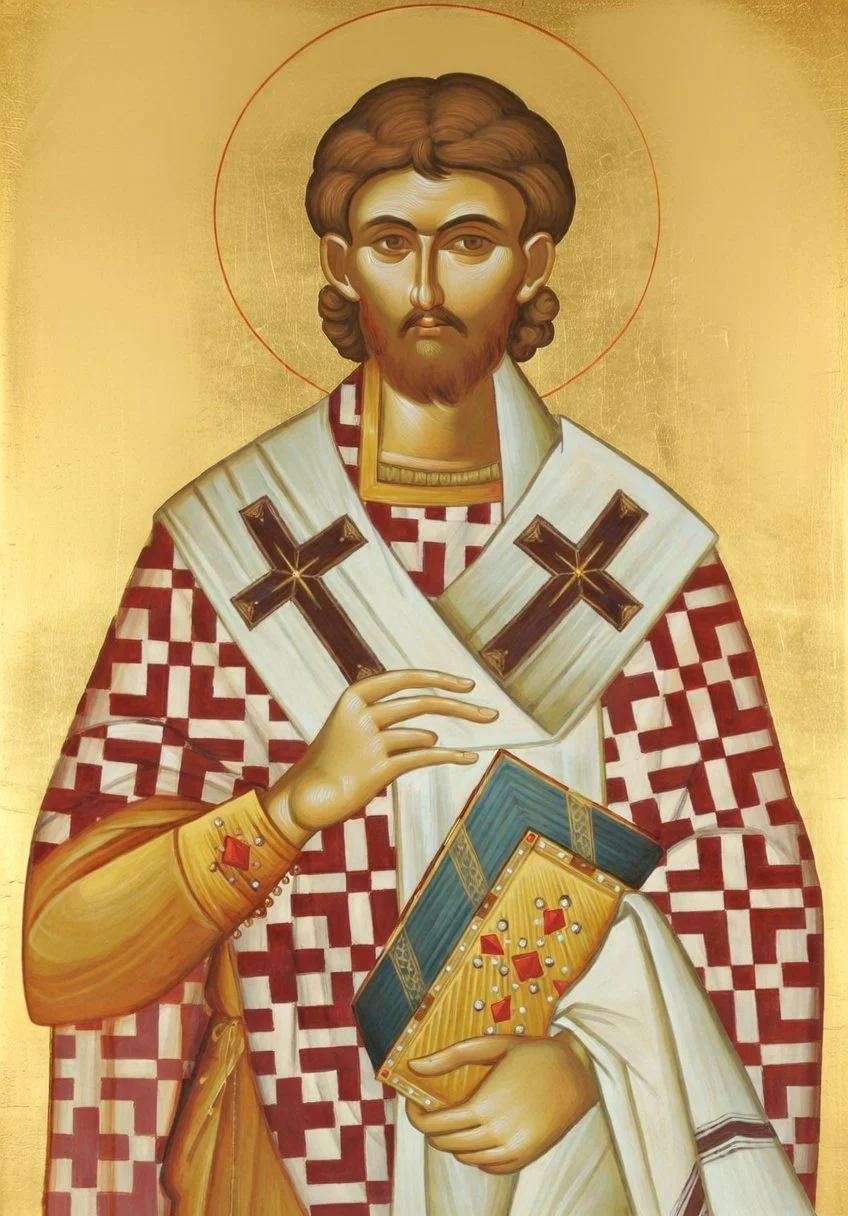
Arrest and Interrogation
According to the traditional accounts, a Roman official named Agricolaus or Agricolao was responsible for the proceedings against Astius. The Italian reference Santi e Beati, drawing on the Constantinopolitan Synaxarion, says the confrontation arose when the bishop refused to honor images of the god Dionysus. The name and rank of the official have not been verified from Roman records, and they are known only from the martyrdom tradition.
It would be wrong to picture the age of Trajan as one long empire-wide persecution. Roman policy toward Christians was uneven and often depended on local denunciations and the attitude of governors. The story of Astius describes a local confrontation, and no trial record survives to show the legal steps. What the sources agree on is the heart of the matter, that the bishop was asked to give up Christ and refused.
TRADITION: the Orthodox Church in America records that Astius was beaten with lead-weighted scourges and whips of oxhide while he held to his confession. Such details come from the passion narrative as it was told and retold, and they are not independently confirmed. The careful conclusion is that Astius was remembered as a bishop who suffered for the faith, while the particular tortures belong to the devotional account.
The Martyrdom
TRADITION: after the scourging, the accounts say that Astius was bound or fastened to a tree or cross, stripped of his clothing and smeared with honey. Insects gathered on his body in the heat and added to his suffering. He is said to have died without denying Christ. The sources do not agree on whether he was nailed or tied, and that point is UNCERTAIN.
The tradition adds that Christians recovered his body and buried it with reverence. The Vatican Radio account in Albanian also preserves the memory that a large church was later built over his grave. The exact burial place has not been securely identified in the sources consulted, and the present location of any authentic bodily relics could not be verified. Readers should be wary of any claim that his whole body now rests in a particular church unless it is backed by documents.
Astius was not canonized through a modern process. He belongs to the great company of saints whose holiness was recognized by early and continuous veneration, and no date of canonization or glorification is recorded. His place in the calendars of the Churches is the sign of that recognition, and it is the same sign by which many early martyrs are known.
Traditions and the Seven Companions
The Acta Sanctorum, in its treatment of July 7, preserves a Greek liturgical account that links Astius to seven other martyrs: Peregrinus, Lucian, Pompeius, Hesychius, Papias, Saturninus and Germanus. According to this TRADITION, they were Christians who fled persecution in Italy and came to Dyrrachium, where they saw Astius suffering for Christ. Strengthened by what they saw, they confessed the faith openly, were arrested and were drowned in the Adriatic Sea.
A later Albanian Orthodox account tells of a bishop who received a revelation and recovered the bodies of these seven martyrs. The versions differ about the bishop, the place and the time that passed, and one mentions seventy years. These details are UNCERTAIN, and the story concerns the companions and not the relics of Astius himself. It shows, however, that the martyrs of the coast were remembered as a group.
The cult also grew through art and worship. Vatican Radio discusses devotion to Astius at Rubik in northern Albania, and Christidou's study looks at his image in the Church of the Saviour there. An Albanian Orthodox account records that Metropolitan Jacob of Dyrrachium prepared a service for the saint in 1917, with approval from the Ecumenical Patriarchate said to have followed in 1918. These facts belong to the history of his veneration, not to his own lifetime, but they show a cult that was renewed on purpose.
What Scholars Say
The most important modern study found for this article is Anna Christidou's essay on St. Asteios of Dyrrachion, published in Byzantine and Modern Greek Studies in 2014. It treats him as one of the peripheral saints whose cults were taken into the wider Byzantine Orthodox tradition, and it asks why and how this happened. The study looks at hagiography, images and the institutions that promoted his memory, and it openly notes how little archaeological evidence there is.
Other sources include the Constantinopolitan Synaxarion and the Menologion of Basil II, both of which are cited for his commemoration, along with the Bollandist Acta Sanctorum for the companion martyrs. These are liturgical and hagiographical works of later centuries, and they should not be mistaken for eyewitness records. They are valuable as evidence of how the Church remembered him, not as proof of every detail.
The wise approach for a biography is therefore to distinguish two layers. The first is the documented history of veneration, which includes feast days, churches, hymns and scholarship. The second is the content of the martyrdom narrative, which is presented with respect but labeled as tradition when it cannot be corroborated. Keeping the two apart lets the reader honor the saint without claiming more certainty than the sources allow.
Churches and Feast Days
In Durres today the Church of the Apostle Paul and Saint Astius stands as the main modern place of devotion to him. The Orthodox Church of Albania dates the start of construction to November 1994, the main construction as complete in early 2002, and the consecration to May 3, 2009. The Albanian tourism agency gives a similar account of the church. Those dates mark the revival of the cult after the years of state atheism in Albania.
His feast days vary and should not be forced into one date. The Orthodox Church in America and Greek Orthodox calendars keep June 4. In Albanian Orthodox tradition and the Menologion of Basil II the date is July 6. Catholic hagiographical listings give July 5, and July 7 is tied to the martyrs associated with him in the Roman Martyrology. The differences reflect separate calendars and traditions and not simply the gap between old and new dating.
Visitors to Durres can see the ruins of the Roman amphitheater and other ancient remains that recall the city Astius knew. A pilgrim who walks there can ask the bishop to pray for the Church of the Albanian coast. Because the location of his relics is uncertain, devotion today centers on his memory, his feast day and the churches that bear his name.
undefined
undefined
Why He Matters to Eastern Christians
For Orthodox Christians the importance of Astius is clear. The Orthodox Church of Albania counts him among the early bishops of Durres, keeps his feast and honors him with a church dedication. The Orthodox Church in America publishes a troparion for him in the Fourth Tone, whose closing petition asks the hieromartyr to entreat Christ to save our souls. The full text can be found on the OCA website.
For Catholics and Eastern Catholics he is a shared saint from the time before the great divisions between Rome and Constantinople. Vatican Radio has published an account of his life and devotion, and Catholic sources record his martyrdom. No source examined sets a single feast for all the Eastern Catholic Churches or names an eparchy that has taken him as patron, so this article does not claim one.
Astius reminds both traditions that the Church of the Adriatic coast is very old. A bishop who stood firm in a Roman port, whether every detail of his story is preserved or not, belongs to the common memory of Christians in the East and the West. His witness invites us to ask for a shepherd's courage and for the unity of those who honor him in different calendars.
Frequently Asked Questions
Ask His Prayers
Saint Astius shows that a bishop's witness can outlast the details of his biography. Ask him to pray for the Church in Albania, for pastors who serve under pressure, and for Christians of every tradition who honor him.
View Prayer Card