Saint Donatus of Euroea: Bishop and Wonderworker of Epirus, Known in Albania as Shen Donati
The fourth-century bishop of Euroea in Epirus, remembered by the historian Sozomen for his holiness and wonders.
At a Glance
- Born
- Unknown
- Died
- About 387 by tradition; exact date unknown
- Titles
- Bishop, confessor, wonderworker
- Feast
- April 30 (Orthodox and Roman Martyrology)
- Veneration
- Orthodox Church, Catholic Church, Albania; ancient cult, no canonization date
- Patronage
- Traditionally linked with Epirus and Paramythia
Who Was Saint Donatus of Euroea?
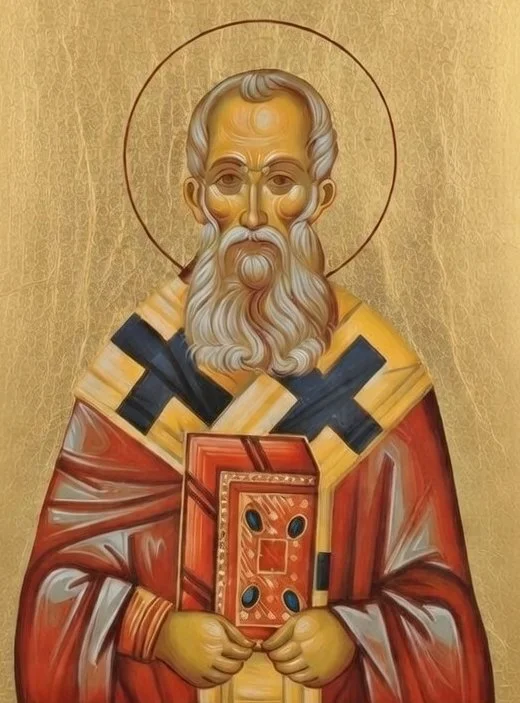
Saint Donatus was a bishop of Euroea, a city in ancient Epirus, in the later part of the fourth century. The historian Sozomen, writing in the fifth century, remembered him as a man of holy life whom God used to work wonders. The Orthodox Church and the Catholic Church both keep his memory on April 30, and Albanian Christians honor him as Shen Donati.
His case is unusual in one good way. He is not only a name in a calendar. A historian wrote about him not long after his time, a shrine and a tomb are described, and a pope wrote letters about the care of his remains. That is more early evidence than many saints have.
There is still a gap between the evidence and the full biography. We know that he was a bishop and that he was revered. We do not know his dates, his birthplace or his family, and many of the stories told about him come from later writers. This article keeps the two apart.
What Is Not Known
Almost nothing reliable survives about his childhood. No source names his parents, his school or his birthplace. Some later summaries say Euroea was his home town, but Sozomen only shows that he was its bishop, which does not make him a native.
His name, Donatos in Greek and Donatus in Latin, says little. It does not fix his ancestry or his language. He belonged to the Roman world of Epirus, whose boundaries do not match modern borders, so it would be wrong to call him simply Greek or Albanian.
That caution matters because the Orthodox Church in America describes Euroea as being in Albania, while the ancient city is usually placed in the Epirus region of present-day northwestern Greece. His Albanian veneration is real. It does not prove that he was born in Albania.
A Bishop Under Theodosius
There is no account of his baptism, his ordination or the day he became bishop. Sozomen includes him among the notable bishops of the time. The setting is the reign of the emperor Theodosius I, from 379 to 395, though the exact years of his service are not known.
This was an age in which Christianity gained imperial favor and bishops took on more public roles. Donatus belongs to that generation. There is no evidence that he took part in the great councils or the doctrinal debates of the day.
Later Eastern lives say that he went to the imperial court and healed a daughter of Theodosius who was troubled by an evil spirit. This is tradition. It is not in Sozomen, and neither the girl nor the date can be named. A further tradition that he took part in the baptism of the emperor is called an error by the Italian scholar Pietro Bertocchi, and it is not repeated here.
Shepherd of Euroea
His real work was that of a bishop of Euroea. Sozomen gives no list of churches he built or letters he wrote. What he preserves is a memory of holiness attached to the local people, and a description of a church named for Donatus near his tomb, with a spring beside it that the people believed came through his prayers.
Sozomen names the village of Isoria, in the territory of Euroea, as the source of this memory. The church and its link to Donatus are good evidence. The belief that the spring came by miracle is part of the devotional account and is marked here as tradition.
In the sixth century, Procopius writes about the building works of the emperor Justinian in Epirus and notes that people of Euroea were moved to a safer place. His list of fortified sites includes two with the name of Saint Donatus, in the areas of Justinianopolis and Photice. This shows the saint's name was still strong in the region. No writings by Donatus survive, and none should be quoted as his. Later collections sometimes confused him with Donatus of Arezzo.
No Martyrdom, but a Dispute Over His Body
There is no reliable record that Donatus was jailed, tortured, exiled or killed for his faith. His titles are bishop, confessor and wonderworker, and not martyr. As a bishop of the age he would have led his people in worship, teaching and charity, but no particular conflict can be given to him without evidence.
The most valuable early document about his afterlife is a letter of Pope Gregory the Great, written around 603 or 604, to Bishop Alcyson of Corcyra, the island of Corfu. Clergy of Euroea had fled to Kassiopi on Corfu and brought the body of Donatus with them. They wanted to place it in a local church there.
The problem was jurisdiction. Gregory upheld the authority of the bishop of Corcyra and asked that the displaced clergy be treated with charity. He allowed an honorable burial of the remains in the local church, as long as the visitors did not claim authority over it, and left open the chance that they might one day return home with it. This dispute happened long after Donatus died and does not involve him personally.
Death and the Journey of the Relics
The date usually given for his death is about 387, as in the Orthodox Church in America's life of him, and the same date appears in later Western summaries. It is an approximate tradition and not a documented date. The OCA says he died peacefully. No inscription or record fixes the year.
The relic story has four steps. Sozomen describes his tomb in a church of his name in Epirus. Gregory's letters show his body in the care of Euroea's clergy on Corfu around 603 to 604. Later tradition says relics were taken to the church of Santa Maria e San Donato on Murano near Venice, traditionally in 1125. An Orthodox account says part of the relics was returned to Paramythia on September 29, 2000, though that comes from a later church report.
The first two steps rest on strong early sources. The Murano and Paramythia steps rest on later church and local tradition, and the unbroken history of the relics is uncertain. He has no canonization date, since his cult is older than the formal system. His place in the Roman Martyrology and the Orthodox calendar shows that both Churches count him a saint.
Wonders Told of Him
Sozomen's best-known story is of a great serpent near Chamaegephyrae that attacked cattle and travelers. Donatus is said to have faced it unarmed, made the sign of the cross and spat toward it, and it died. Eight pairs of oxen were needed to drag the body away to be burned. This is early tradition, told by a historian, but it is not verified natural history. It may preserve a memory, a symbol of Christ's victory over evil, or a legend that grew.
Sozomen also tells of a dry journey on which Donatus prayed, touched the ground, and water came up as a spring that kept serving the community. Unlike the serpent story, it is tied to a landmark and a shrine. The Orthodox life tells a related tale of a bitter spring near Soreia that he made safe to drink. It may be a form of the same stories.
Later Eastern lives add a prayer that brought rain in a drought, the healing of the emperor's daughter and the raising of a dead debtor to testify that a debt was paid. The last story is told of other saints too, including Donatus of Arezzo, so it is hard to assign to Donatus of Euroea. All of these are devotional tradition, and the theme in all of them is a bishop who protects travelers, gives water and defends the poor.
What the Sources Say
The key early source is Sozomen's Ecclesiastical History, book 7, chapter 26. Gregory the Great's letter to Alcyson of Corcyra supplies the relic dispute, and Procopius's On Buildings gives the later regional evidence. The Roman Martyrology confirms the Western April 30 commemoration.
The Orthodox Church in America provides a life, with the troparion and kontakion, and the Prologue from Ohrid adds devotional traditions. Pietro Bertocchi's entry on Santi e Beati discusses the mix-up with Donatus of Arezzo and the duplicate October 29 commemoration, which he traces to an error by Cardinal Baronius. A modern article on the transfer of relics from Venice to Paramythia reports the return of relics.
What is firm is that he was a fourth-century bishop of Euroea, was revered by the early fifth century, had a shrine and tomb, and that his body was the subject of papal correspondence. What is open is the year of death, the court stories, the details of the later relic journeys, and the exact history of his cult in Albania. A critical edition of the Greek acts and local Albanian sources could help.
Places to Remember Him
Paramythia in Epirus is the place most tied to his memory today, and it is where part of his relics is reported to have been returned. The site of ancient Euroea and the village of Isoria, named by Sozomen, belong to the same landscape.
Corfu holds the memory of Kassiopi, where the refugee clergy of Euroea brought his body. On Murano, near Venice, the church of Santa Maria e San Donato keeps his name and a relic tradition that dates, by tradition, to 1125.
Those who cannot travel can keep April 30 by reading Sozomen's account and praying for bishops and for travelers. A fitting prayer is for the water we depend on and for those who suffer from drought.
undefined
undefined
Donatus in East and West
He is a shared saint of the undivided Church. He lived long before the split between East and West, and both Churches keep his feast on April 30. The Orthodox Church in America publishes a troparion for him in tone 4. It is a standard hymn for holy bishops and is not quoted here.
His relics sit in the Latin West at Murano and, by report, in the Orthodox East at Paramythia, a living picture of a saint who belongs to both. Pope Gregory's letters show a Roman bishop caring for the remains of an Eastern one.
How each Eastern Catholic Church keeps his feast was not checked, so it should not be assumed. His value for Albanian Christians is real, since Epirus has long been a shared land, but the details of his cult in Albania as distinct from Epirus need local documents.
Frequently Asked Questions
Ask His Prayers
Saint Donatus shows that a bishop's holiness can be remembered for centuries by the people he served. We ask his prayers for bishops and priests, for travelers, and for the people of Epirus and Albania. May his humility and care for the poor teach us to serve those around us.
View Prayer Card