Saint Abd el-Masih al-Manahry: Coptic Monk, Priest and Fool for Christ of Egypt
A twentieth-century Coptic monk and priest who lived in poverty at El-Manahra and died on Easter Sunday, 1963.
At a Glance
- Born
- About 1892, Abu Shehata, Minya, Egypt; exact date uncertain
- Died
- April 14, 1963 (Easter Sunday), 6 Parmoute 1679 AM
- Titles
- Father, priest-monk, ascetic, fool for Christ
- Feast
- 6 Parmoute (April 14); local celebrations are sometimes held after Easter
- Veneration
- Coptic Orthodox Church; no formal glorification date found
- Patronage
- No formal patronage established
- A Modern Coptic Ascetic
- Simon of Abu Shehata
- Servant of Christ at Saint Macarius
- A Cell of Mud Brick and a Life of Prayer
- Foolishness for Christ in a Changing Egypt
- Easter Sunday, 1963
- Prophecy, Healing and Remembered Wonders
- Sources and Cautions
- El-Manahra and His Feast
- Why He Matters to Eastern Christians
- Frequently Asked Questions
A Modern Coptic Ascetic
Saint Abd el-Masih al-Manahry was a monk and priest of the Coptic Orthodox Church who lived in Egypt in the twentieth century and died on Easter Sunday, April 14, 1963. His name appears in several forms, among them Abdel-Messih El-Makari, after the Monastery of Saint Macarius where he became a monk, and El-Manahry, after the village of El-Manahra where he spent his later years. The name Abd el-Masih means servant of Christ.
He is honored for his poverty, his long prayer, his generosity to the poor and his chosen foolishness for Christ. He wrote no known book and founded no institution. What Copts remember is a life that echoed the old desert fathers of Egypt, lived in a village in the age of cars and newspapers.
The main sources are Coptic biographies, parish publications and local reports, with a biography by Bishop Mina of Girga cited as an important early work that we could not examine. Because most of the evidence is devotional, we mark miracle stories as tradition and keep the facts that are widely agreed apart from those that are not.
Simon of Abu Shehata
He was born Simon, also written Samaan, around 1892 in Abu Shehata near Matai in the Minya Governorate of Upper Egypt. His parents are named as Henein and Esther. A birth date of November 11, 1892 appears in some secondary references, but the stronger biographies do not establish it, so the exact day is UNCERTAIN.
The biographies describe his father as a prosperous farmer with livestock, who relied on Simon's work. The boy worked in agriculture and had no formal schooling, and a Coptic biography says that he taught himself to read and write. Another devotional account credits him with a wide knowledge of Scripture and the memorizing of passages.
His family resisted his wish to be a monk. Simon is said to have gone to the Monastery of Saint Samuel the Confessor in the Qalamun region, only to be brought home by his father more than once. TRADITION: later biographies say that animals died after these attempts, as a sign from God, and that he asked his father to let him go if another son was born, after which a boy named Hanna came. The family records have not been checked, but the stories show that his vocation was shaped by patience and the eventual consent of his family.
Servant of Christ at Saint Macarius
There was no conversion from another faith. Simon was raised a Christian, and the turning point of his life was entry into monastic life. In 1914, according to the main Coptic biographies, he entered the Monastery of Saint Macarius the Great in Scetis, in what is now Wadi El Natrun, and was given the monastic name Abd el-Masih.
He was guided there by Father Abd el-Masih al-Masoudi al-Baramusi and by that monk's brother Father Jacob. The training emphasized prayer, obedience and humility, as it has since the days of the early desert monks.
TRADITION: the biographies tell that the Coptic patriarch of the time considered making him a bishop and that Abd el-Masih acted strangely in the patriarch's presence until he was sent away. After this, his spiritual father is said to have directed him to leave the monastery and live a hidden life in the world. He settled in El-Manahra, which gave him the name al-Manahry. The details of these events are UNCERTAIN because they come from devotional biography and not from church records.
A Cell of Mud Brick and a Life of Prayer
Abd el-Masih was not known as a theologian, preacher or administrator. His gift was an example of prayer and simplicity. His home in El-Manahra is described as a small cell of unplastered mud brick. He had almost no possessions, ate little and gave to those in need.
Coptic accounts speak of memorized hymns and doxologies, long hours of prayer and nights spent in vigil. One story says that he tied a rope from the ceiling to his waist to keep from sleeping. He is said to have eaten once a day and to have owned very little clothing. Such descriptions recall older Egyptian lives of monks, where bodily discipline served repentance and attention to God. The exact fasting rule and the number of vigils are UNCERTAIN, since they rest on hagiography and not on diaries.
His life shows that a monk could keep his rule while living among villagers. He is not known to have founded a monastery, school or hospital, and no letters or writings of his have been authenticated. What lasted was the memory of how he lived and the devotion of those who knew him.
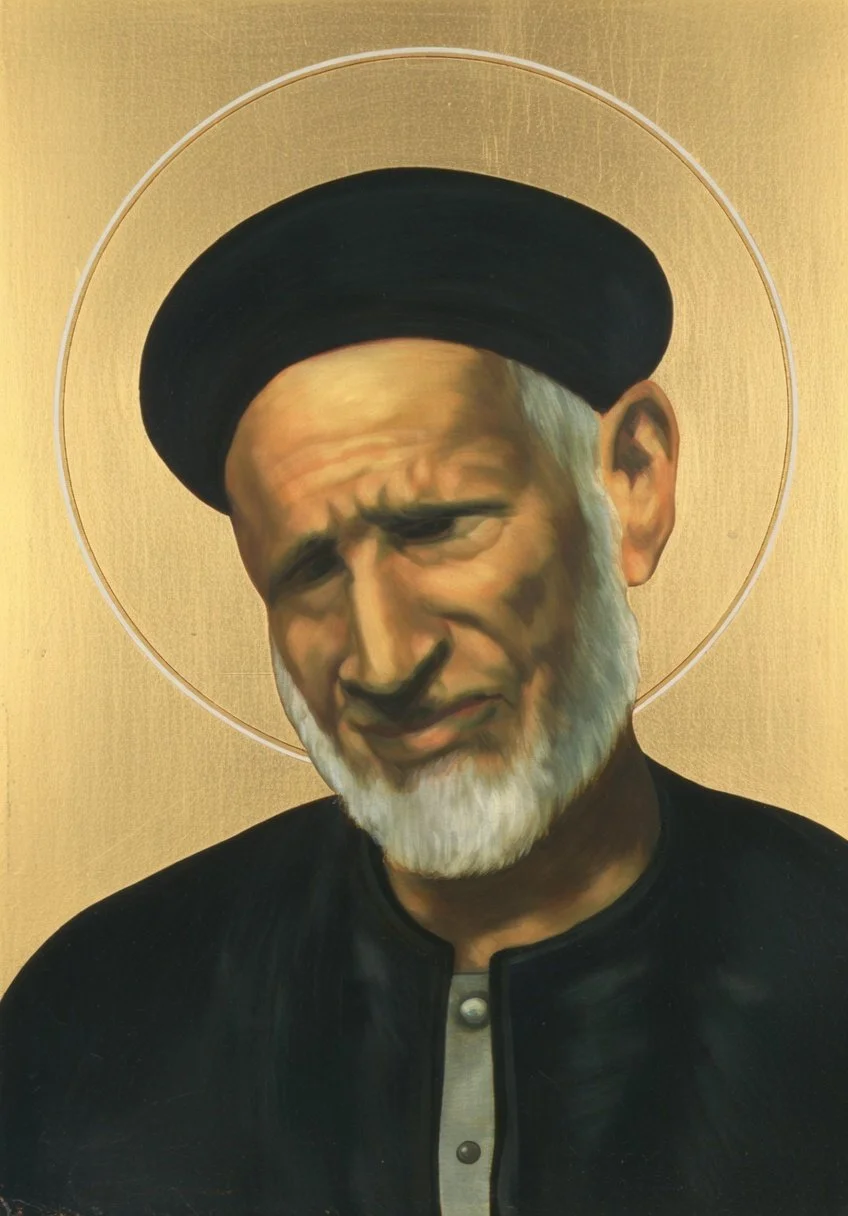
Foolishness for Christ in a Changing Egypt
He lived in a time of great change in Egypt, from British occupation through the independence movement and the monarchy to the republic. His spiritual world was the revival of Coptic monasticism, which drew on the ancient heritage of the desert. Unlike many modern saints, his life does not center on prison, martyrdom or public controversy.
His struggles were mostly inward. He had to balance family duty with his call to be a monk, to flee the honor of high church office and to bear the severe discipline he placed on himself. His foolish behavior could also be misunderstood. TRADITION: some accounts say he often spoke of wanting to marry as a way to hide his holiness, while others took the remarks as signs of eccentricity.
A historical question concerns his living outside the monastery. Coptic monastic life values obedience and stability, and the tradition says that he left at the direction of his spiritual elder and did not abandon his vows. The formal authorization for his living at El-Manahra has not been found in documents, so it is UNCERTAIN. No reliable evidence shows that he was excommunicated, condemned or deprived of priestly standing.
Easter Sunday, 1963
Abd el-Masih died on April 14, 1963, which was Easter Sunday in the Coptic Church that year, and the date corresponds to 6 Parmoute, 1679 in the Coptic calendar. The date is repeated by parish accounts, biographical collections and reports of his yearly commemoration, so it is well established.
TRADITION: devotional writers say that from Palm Sunday he told people that he would be crowned and would rejoice at the coming feast. His followers understood this afterward as a reference to his meeting with Christ the Bridegroom. The wording varies between accounts and should be treated as a remembered saying and not as a documented quotation.
His main place of veneration is the Church of the Virgin Mary and Father Abd el-Masih at El-Manahra in the Minya Governorate. A local report from 2016 describes an annual commemoration at which his body was brought out, carried in procession, anointed with perfume and returned. The present state and authentication of his relics are UNCERTAIN without a recent shrine record. We found no formal decree or date of glorification, and he is called a saint by Coptic Orthodox congregations in the devotion of the Church.
Prophecy, Healing and Remembered Wonders
Coptic sources present him as a wonderworker credited with healing, spiritual insight and knowledge of the future. These accounts are important evidence of his veneration, but they do not by themselves prove that the events took place as told. The short English biographies we consulted do not give medical records that would let anyone judge a particular cure.
TRADITION: a well-known story ties him to the future Pope Cyril VI of Alexandria. A longer devotional account says that Abd el-Masih pointed to Father Mina the Solitary as the future patriarch before the election. Father Mina became Pope Cyril VI in 1959 and served until 1971, which is independently documented, but the prophecy itself comes from later testimony and is UNCERTAIN. Other stories speak of his appearing in different places, but no specific incident has been corroborated.
More solid evidence of devotion lies in the church dedicated to him, the annual commemorations, the care of relics and his place in Coptic parish teaching. A scholarly study that cites Otto Meinardus notes monastic garments linked to him at the church in Manahra and says that Copts and Muslims in the Minya and Maghagha region honor him. His commemoration on 6 Parmoute is sometimes moved until after Easter because of the liturgical weight of Holy Week.
Sources and Cautions
The key biography is by Bishop Mina of Girga, titled in English Biography of a Contemporary Saint: Father Abd el-Masih al-Maqari. We confirmed it only through references in Coptic sources and did not examine a full edition, so details such as his birth date, his ordination, his link with Pope Cyril VI and the origin of the miracle stories remain qualified.
Other sources include a detailed entry on the St-Takla website, parish biographies from Coptic churches in North America and local news reports from Egypt. Many of these repeat the same material, so agreement between them should not be counted as independent confirmation. Otto Meinardus's studies of Coptic saints and pilgrimages give background on relic veneration and popular devotion.
The evidence supports a careful article about a modern Coptic ascetic whose holiness has been honored in continuing devotion. It does not allow every miracle to be presented as proven history, nor does it allow a formal canonization date to be given where none has been found.
El-Manahra and His Feast
The center of his memory is the church at El-Manahra in Minya, where his cell is also remembered. People come on the anniversary of his death, and a church was consecrated there during a celebration in 2016, according to a local report.
His feast is 6 Parmoute, which corresponds to April 14 in the twentieth and twenty-first centuries. Reports from 2016 and 2019 show that local celebrations are sometimes delayed until after Easter. A Coptic parish in Calgary also lists a relic attributed to him, though the type of relic and its history are not described in the public list.
A reader who wishes to honor him can learn about the desert fathers, pray for humility and ask his prayers on his feast. Because the details of the relics are uncertain, devotion today centers on the church at El-Manahra, the memory of his cell and the testimony of those who knew him.
undefined
undefined
Why He Matters to Eastern Christians
Abd el-Masih belongs to the Coptic Orthodox Church, which is an Oriental Orthodox Church and not part of the Byzantine Eastern Orthodox communion. For Coptic Christians he is part of their own inheritance, and his commemoration is documented in parish life. His Orthodox veneration does not by itself mean that the Catholic Church has canonized him, and we found no such recognition.
For Coptic Catholics and other Eastern Christians, his story connects to the Alexandrian tradition of monks and desert fathers, which is a shared inheritance of faith. We could not verify that the Coptic Catholic, Melkite, Maronite or Byzantine Orthodox Churches have formally adopted him in their calendars.
For Byzantine readers, he offers a familiar comparison with holy fools, who hide their virtue and refuse public honor. The Gospel's teaching on prayer in secret and the Apostle Paul's words about being fools for Christ are natural companions to his story, though these are our connections and not statements he made.
Frequently Asked Questions
Ask His Prayers
Saint Abd el-Masih shows that a monk's holiness can be hidden in a village. Ask him to pray for the Coptic Church, for the poor and for those who struggle with pride.
View Prayer Card