Saint John of Ustiug: Fool for Christ and Wonderworker of Veliky Ustyug
A young holy fool of northern Russia who lived barefoot and in prayer near the Dormition Cathedral and died in 1494.
At a Glance
- Born
- About 1476 by tradition, at Pukhovo near Ustyug; exact date unknown
- Died
- May 29, 1494, at Ustyug, traditionally at about eighteen
- Titles
- Blessed, fool for Christ, wonderworker
- Feast
- May 29 (Julian), June 11 (Gregorian); also with the Vologda saints on the Third Sunday after Pentecost
- Veneration
- Russian Orthodox Church; recognized in the sixteenth century
- Patronage
- Traditionally Veliky Ustyug, with Saint Procopius
- A Holy Fool of the Russian North
- Pukhovo, Orlets and a Mother in the Monastery
- From Fasting to Foolishness
- A Life of Prayer and Poverty
- Northern Russia and the Cost of Foolishness
- Death, Burial and Recognition
- Fire, Healing and Intercession
- Sources and Scholars
- Veliky Ustyug and His Feast
- Why He Matters to Eastern Christians
- Frequently Asked Questions
A Holy Fool of the Russian North
Saint John of Ustiug, also spelled Ustyug, is one of the holy fools of the Russian Church, men and women who took on poverty, shame and apparent madness for the sake of Christ. He lived and died in the late fifteenth century in Veliky Ustyug, a trading city in northern Russia. Tradition says he was only eighteen when he died in 1494.
His life was not that of a priest or abbot. He founded no monastery, wrote no book and held no office. What was remembered about him is that he fasted, prayed through the night in a small hut, and walked the streets by day barefoot and in rags, enduring ridicule and cold. The local people came to see in him a hidden holiness, and after his death a cult grew at his grave.
The main sources are Russian hagiography, above all a Life compiled in 1554 about sixty years after his death, and the calendars and hymns of the Russian Orthodox Church. This article keeps the safer facts apart from the miracle stories, which are marked as tradition.
Pukhovo, Orlets and a Mother in the Monastery
John was born into a Christian family in the village of Pukhovo near Ustyug. The traditional biographies name his parents as Savva and Maria. The year of his birth is UNCERTAIN, and the date of about 1476 comes only from the report that he died at eighteen. The Life of 1554 is the earliest source, and the Orthodox Church in America notes that it drew on the memories of people who had known him.
His family later moved to Orlets, a settlement on the Yug River, though sources give different distances from Ustyug, thirty or forty versts. In childhood he is said to have fasted strictly, taking no food on Wednesdays and Fridays and only bread and water on other days. A Russian collection of saints' lives preserves a conversation in which his mother questions his fasting, but the words are UNCERTAIN and should not be taken as a record.
After his father died, his mother entered the Holy Trinity Monastery at Orlets and took the name Natalia. Some later accounts call her an abbess, but the Orthodox Church in America confirms only her tonsure, so her office is uncertain. John grew up in the shadow of the monastery before he took up his own unusual path.
From Fasting to Foolishness
John did not convert from another religion. He grew up in an Orthodox household, and his turning point was the choice of a particular calling. The tradition describes a path from fasting and silence to prayer and then to the hard discipline the Russians call yurodstvo, foolishness for Christ.
The idea behind it comes from the Apostle Paul's words in the First Letter to the Corinthians, where he says that the apostles are fools for the sake of Christ. Holy fools in the Eastern Church took that saying seriously. They gave up honor, comfort and respectability and sometimes acted in ways that seemed senseless in order to hide their prayer and to break the pride of the world. It was never a duty for ordinary Christians, and it does not mean that every eccentric person is a saint.
According to his Life, John left Orlets and went to Ustyug, where he settled near the Cathedral of the Dormition of the Mother of God. This was the neighborhood of another holy fool, Saint Procopius of Ustyug, who died in 1303 by tradition. John entered a local tradition already in place, and the move from private fasting to public humiliation became the center of his story.
A Life of Prayer and Poverty
John did not preach from an office or govern a house. His ministry, as the sources describe it, was prayer joined to poverty and humiliation. A small hut was built for him in Ustyug, and he spent his nights there in prayer while his days passed in the streets. He is said to have gone barefoot in every season in torn clothing, and to have rested on rubbish heaps.
Such behavior drew mockery and sometimes rough treatment. The Life presents his conduct as a chosen form of self-denial and not as a lack of purpose, joined to private prayer. His message, if one can call it that, was humility, freedom from possessions and rejection of praise.
The sources do not show that he was ordained or took monastic vows, and they name no church, hospital or charity that he founded. No letter, sermon or prayer by him is known. The literary works about him, namely the Life of 1554, a service from the sixteenth century and later praises, were written by others and tell us how he was honored.
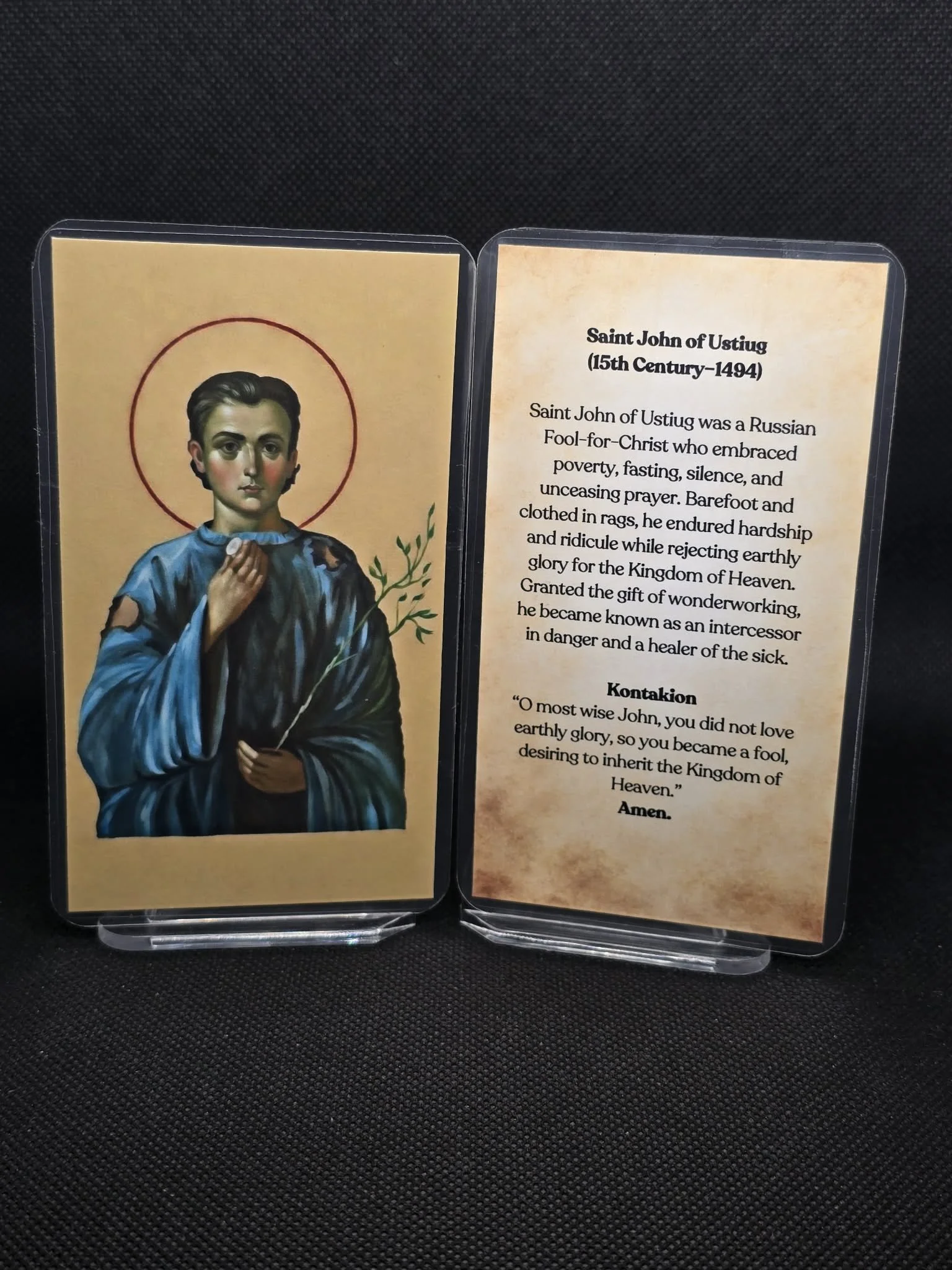
Northern Russia and the Cost of Foolishness
John lived in the late fifteenth century, when the northern Russian lands were being drawn into the growing Muscovite state. It was a world of monasteries, local saints and pilgrimage, in which the memory of holy men and women formed part of a community's identity. The Russian Museum places him in the long line of holy fools whose holiness took the form of apparent marginality.
His trials were hunger, cold, exposure and mistreatment by others. His Life stresses that he bore mockery without giving up prayer. There is no sign that he was imprisoned, tried for heresy, excommunicated or killed for his faith. The particular acts of violence against him cannot be reconstructed from any document of his own time and are UNCERTAIN.
A further point of care concerns the sources. The earliest Life was written after the events and rests on remembered testimony. It is valuable evidence of early devotion, but it does not prove every incident. John and Procopius were remembered together as holy fools and heavenly protectors of Ustyug, and their pairing shows in the city's sacred art.
Death, Burial and Recognition
According to tradition John died peacefully on May 29, 1494. A Russian diocesan biography gives his age as eighteen, which fits the traditional chronology but is not confirmed by birth records. He was buried near the Dormition Cathedral in Ustyug, close to where he had lived his calling.
A church was afterwards built over his grave. Regional summaries speak of a wooden church followed by a stone church built between 1656 and 1663, though the building sequence should be checked against architectural records. The present condition and location of his relics are UNCERTAIN without a recent authoritative inventory.
His recognition is commonly dated to the councils held under Metropolitan Macarius of Moscow in 1547. A published text of the council's decrees names the holy fools Procopius and John of Ustyug and directs their commemoration at Ustyug. The careful wording is that his local recognition is linked with the Macarian council, and the full extent of his first recognition should not be overstated. His Life was compiled in 1554, and a service in his honor was written in the sixteenth century.
Fire, Healing and Intercession
TRADITION: a well-known story says that John put his hands into a stove with burning coals and then lay on them without harm. It appears in Russian church biographies, including a diocesan account, and it expresses divine protection of a man who accepted bodily hardship. No document from his lifetime corroborates it.
TRADITION: another story concerns Maria, the wife of the Ustyug governor Prince Feodor Krasny, who was seriously ill. A servant was sent to ask for John's prayers, and before he could speak, John answered as if the prince and his wife were present. When the servant returned, she had recovered. The date, the illness and the identity of those involved have not been established from other records. Later accounts also credit his intercession with protection against enemies, including a Russian victory near Dmitrov in 1610, which belongs to the religious interpretation of that event.
Devotion is shown in material objects as well as stories. The State Historical Museum in Moscow holds an icon of Saints Procopius and John of Ustyug dated 1677, with a decorated cover dated 1679, commissioned by a local man named Peter Kuchukov. Such objects show a cult that lasted long after John's time, though they do not prove the miracles told about him. Reports of healings after his death are devotional claims and no verified list of cases exists.
Sources and Scholars
The first source is the Life compiled in 1554. A scholarly discussion cited in our research says its compiler was Paul, later linked with the Boris and Gleb Monastery at Solvychegodsk, who used the memories of his father and aunt, who knew John. That attribution needs to be checked against the manuscripts before it is treated as settled.
Later works rework the story, among them the Life in the collection of Saint Dimitry of Rostov and the book of Russian saints by the nun Taisia. These are not eyewitness records and should not be mixed up with the original Life. The Orthodox Church in America's biography summarizes the main points, and Russian diocesan calendars repeat the miracle stories.
The Russian Museum and the State Historical Museum provide commentary and objects that show the importance of John and Procopius to Ustyug. The most defensible summary is that John was a late medieval ascetic whose reputation grew into a regional cult with a Life written soon after his death, formal recognition in the sixteenth century and a long history of images and hymns.
Veliky Ustyug and His Feast
Veliky Ustyug in northern Russia is the center of John's memory. The church built over his burial place near the Dormition Cathedral was the focus of devotion for centuries. He and Saint Procopius are remembered together as heavenly guardians of the city.
His feast is May 29 on the Julian calendar, which falls on June 11 on the Gregorian calendar in this century. He is also remembered with the Saints of Vologda on the Third Sunday after Pentecost. The Orthodox Church in America includes him in its calendar and publishes hymns for his day, which we do not quote here.
A traveler or reader who wishes to honor him can do so by learning the story of the holy fools and by asking his prayers on his feast. Because the present state of his relics is unclear, the best centers of devotion are the city of Ustyug, its churches and the images of John and Procopius.
undefined
undefined
Why He Matters to Eastern Christians
John's importance is clearest in the Russian Orthodox tradition. His life shows the Eastern Christian calling of foolishness for Christ, with its radical humility, voluntary poverty and constant prayer. He also belongs to the story of lay asceticism, since the sources do not make him a priest or the founder of a monastery.
The themes his story carries are wide. They include the gap between outward appearance and inner holiness, the rejection of status, the need for prayer and the link between discipline and humility. These ideas are familiar from Eastern spiritual writing and from the Gospel's teaching on doing good in secret.
For Eastern Catholics, his life gives a view into the spiritual culture of the Russian Byzantine world. We did not find that he appears in an official Eastern Catholic calendar or that the Catholic Church has issued a decree about his cult, so this article describes him mainly as a saint of the Russian Orthodox Church.
Frequently Asked Questions
Ask His Prayers
Saint John of Ustiug shows that holiness can be hidden in poverty and shame. Ask him to pray for the poor, for the despised and for those who seek humility.
View Prayer Card