Saint Agatha of Sicily: Virgin, Martyr and Patroness of Catania
A young Sicilian Christian woman martyred under the Emperor Decius, remembered in both the Roman Canon of the Mass and Byzantine hymns, whose memory is far better attested than the details of her life.
At a Glance
- Born
- Uncertain; traditionally about 231 or 235 AD, in Catania or Palermo, Sicily
- Died
- Traditionally February 5, 251 AD, Catania, Sicily, during the persecution of Decius (year and details uncertain)
- Feast day
- February 5 (Roman Catholic, Byzantine Orthodox and Maronite calendars); August 17 marks the return of her relics to Catania in 1126
- Canonization
- Ancient martyr; honored before formal papal canonization existed
- Patron of
- Catania, nurses, breast cancer patients and nursing mothers, bell founders and bakers; invoked against fire and volcanic eruptions
- Relics
- Cathedral of Saint Agatha, Catania, according to local tradition
- Best known for
- Her martyrdom, the Passion that tells of it, and the veil said to have halted the lava of Etna
- An Ancient Martyr of Sicily
- Birthplace, Family and Tradition
- Consecrated to Christ
- Quintianus and the Decian Persecution
- The Passion: Torture and Saint Peter
- What the Early Sources Actually Show
- Death and the Spread of Her Cult
- Relics: Constantinople and Home Again
- Etna, the Veil and Devotion
- Why She Matters to Eastern Christians
- Frequently Asked Questions
An Ancient Martyr of Sicily
Saint Agatha is one of the oldest and most widely honored women martyrs of the Church. Her martyrdom in Sicily and the early veneration of her memory are well established in Christian tradition. Almost everything else about her life is less certain. The earliest detailed accounts of her death were written centuries after the events and cannot be treated as eyewitness testimony.
This article therefore separates three things: the secure fact that she was venerated as a martyr from early times, the later written Passion that tells her story, and the traditions that grew up around her relics and her city. Where a detail comes from the Passion or from local devotion, it is marked as tradition. Readers who want the solid core should look at sections 6 and 7, which deal with the early evidence.
Birthplace, Family and Tradition
Agatha lived in Roman Sicily, a Mediterranean island with a strong Greek culture and Roman rule. Christianity had reached Sicily before her time, but the surviving documents do not allow a detailed picture of her local church. The traditional birth year is about 231 or 235 AD. Both Catania and Palermo claim her as a native, and neither claim can be settled by contemporary evidence. Her name is also often given as Agatha of Catania or Agatha of Palermo.
TRADITION: The later Passion describes her as a girl of wealthy and respected Christian parents, of unusual beauty and good education. These details may preserve real memories, but nothing outside the Passion confirms them. UNCERTAIN: The names of her parents and the circumstances of her upbringing cannot be established. Because the tradition says her parents were Christians, there is no reliable evidence of a dramatic conversion from paganism. The earliest picture we can recover is of a Christian woman whose faith was public enough to bring persecution.
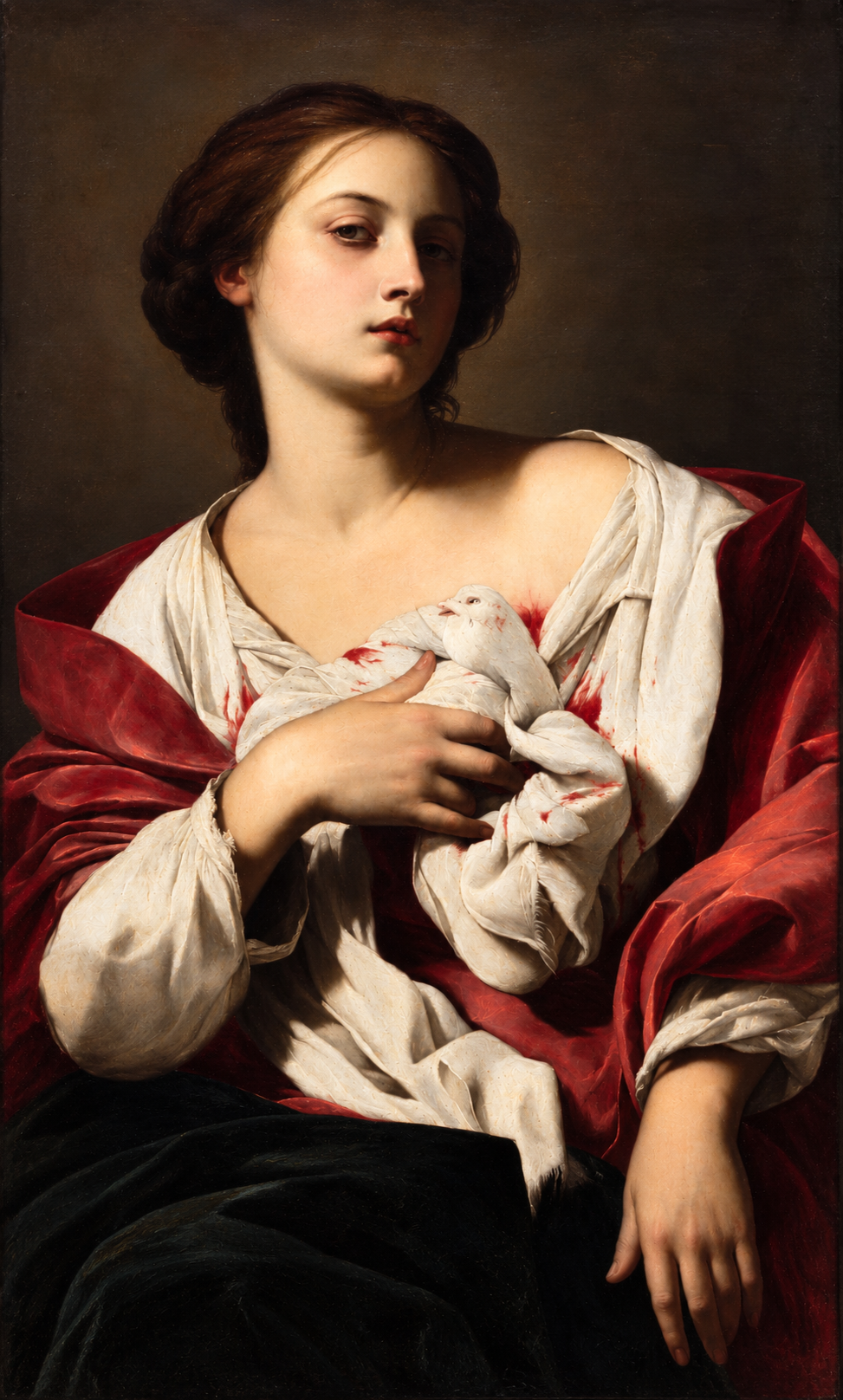
Many portraits show her as a teenager, and the Orthodox Church in America gives her age as fifteen. No contemporary document fixes her age, so a precise number should not be treated as historical fact.
Consecrated to Christ
The central feature of Agatha's traditional vocation is a lifelong commitment to virginity for Christ. According to the Passion, she chose Christian chastity over marriage. Vatican News preserves a tradition that she was consecrated by her bishop and received a veil, and that she is sometimes described as a deaconess.
UNCERTAIN: Neither a formal consecration nor service as a deaconess can be shown from contemporary records, and they should not be stated as verified church appointments. The same applies to devotional claims that she worked among the poor or held a regular church office. Unlike founders of monasteries or hospitals, Agatha has no known institutional work. She is remembered as a martyr.
Quintianus and the Decian Persecution
The Emperor Decius ruled from 249 to 251 AD, and his reign included an empire-wide demand that people take part in public sacrifices. For Christians who refused, this was a severe crisis. Agatha's traditional martyrdom fits this period, and the Catholic Encyclopedia judges the Decian dating plausible, though not certain beyond doubt.
TRADITION: In the Passion, a Roman official named Quintianus was attracted to Agatha because of her beauty and wealth. When she refused him, he used the persecution against Christians as his opportunity and had her arrested. The story treats her loyalty to Christ and her resistance to the abuse of power by a provincial governor as one act. Modern readers should separate the plausible fact of persecution from the specific conversations and motives given to Quintianus, which come from much later literary texts and not from surviving Roman court records.
The Passion: Torture and Saint Peter
TRADITION: According to the Passion, Quintianus put Agatha in the custody of a woman named Aphrodisia, hoping to weaken her resolve and her chastity. When this failed, Agatha was brought before the court and tortured. The most famous episode is the mutilation of her breasts, ordered by Quintianus after she kept refusing him. This episode is central to her later iconography, in which she often holds her breasts on a plate.
TRADITION: While in prison, Agatha is said to have been visited by the Apostle Peter, who healed her wounds. She was questioned and tortured again, including with burning coals and broken pottery, and returned to her cell. These accounts speak of Christian endurance and inner freedom, but none of the individual episodes can be verified.
What the Early Sources Actually Show
The strongest historical evidence for Agatha is the early cult. The Martyrologium Hieronymianum records her commemoration on February 5, and she appears in the ancient Carthaginian martyrology, whose surviving form belongs to the fifth or sixth century. The sixth-century poet Venantius Fortunatus lists her among distinguished women martyrs in De Virginitate, which shows that her fame had spread beyond Sicily. Her name also stands in the Roman Canon of the Mass, now Eucharistic Prayer I.
The martyrdom account survives in Latin and Greek versions. The Catholic Encyclopedia holds that neither can be accepted as a reliable record of the detailed events. Matthieu Pignot's catalogue entry on the Martyrdom of Agatha (BHL 133) places the Latin Passion, probably written in Catania, somewhere between the fifth and late seventh centuries, and the exact date is still debated. The point to keep in mind is that her early cult is firmly attested, while the detailed Passion is a later stage in the growth of her memory.
Scholars have also tested the idea that her festival simply continues ancient worship of Isis or Demeter. A 2025 study by Cristina Soraci finds no established direct continuity, and resemblances in processions or clothing do not by themselves prove borrowing. That theory is best treated as a disputed interpretation and not as settled fact.
Death and the Spread of Her Cult
Agatha is traditionally said to have died in prison on February 5, 251 AD. UNCERTAIN: No trial record, eyewitness account or contemporary report survives, so her final words and the exact circumstances of her death cannot be verified. What is clear is that her connection with Catania is ancient and that the city became the main center of her veneration.
The cult reached Rome by late antiquity. The Catholic Encyclopedia records a letter of Pope Gelasius I, who reigned from 492 to 496, that mentions a basilica dedicated to her, and Pope Gregory I later restored to Catholic use a Roman church of Saint Agatha that had been held by Arian Christians. The Vatican City State publishes an article that credits Pope Gregory IX with a canonization in 1228, but this could not be confirmed from a papal decree, and as an ancient martyr her recognition is in any case far older than formal canonization.
Relics: Constantinople and Home Again
The Cathedral of Saint Agatha in Catania keeps relics traditionally identified as hers. Local historical accounts say that Byzantine forces carried her relics to Constantinople in 1040 and that they came back to Catania on August 17, 1126. The return is linked to two men named Gisliberto and Goselmo, whose names appear in different forms in the sources. Catania still marks the return of the relics on August 17.
TRADITION: The two men are said to have been told in dreams by Agatha to recover her remains, and to have hidden the relics while bringing them out of Constantinople. The details of the removal and return are hard to verify independently. The cathedral's silver bust and reliquary casket belong to the medieval growth of her devotion. They are works of art, and the authenticity of each relic inside them is a separate question. The historian Paul Oldfield has shown that the revival of her cult in twelfth-century Sicily was tied to Norman political networks and the island's return to the Latin Christian world, which gives a useful setting for these relic traditions.
Etna, the Veil and Devotion
TRADITION: About a year after her death, in 252 AD, Mount Etna is said to have erupted and threatened Catania. Christians carried her veil toward the lava while praying for her help, and the flow stopped. This story is central to her role as patroness of Catania and as protector against volcanoes and fire. UNCERTAIN: The date of the eruption, the course of events and the miraculous cause cannot be established from contemporary evidence.
TRADITION: After her burial, a mysterious young man, taken to be an angel, is said to have left a tablet with a Latin inscription praising her holiness and promising protection for her homeland. It is usually shown as the letters M.S.S.H.D.E.P.L. It should not be described as a securely dated object from her lifetime. Another story from the Passion of Saint Lucy says that Lucy of Syracuse visited Agatha's tomb with her sick mother Eutychia, and that the mother was healed. It is a hagiographical tradition and not a documented medical event.
Her patronage of breast cancer patients, nurses and nursing mothers comes from the traditional account of her torture, and her patronage against fire and volcanic eruptions from the Etna stories. Some of these patronages are regional or devotional and are not universal liturgical titles. Devotion is especially strong in Sicily and Malta. Catania holds a major festival each year from about February 3 to 5, with services, processions, candle offerings and veneration of the relics.
Saint Agatha, virgin and martyr, you stayed faithful to Christ through great suffering. Pray for those who are sick or afraid, for women who suffer in body or spirit, and for those who face danger. Give us courage to remain faithful in small trials and great ones. Amen.
This is a short devotional prayer written for this page, and it is not an official text of the Church. The Orthodox Church in America publishes a troparion in Tone 4 for her feast on February 5, which readers can find in its liturgical texts.
Why She Matters to Eastern Christians
Agatha is not only a Latin saint. Her cult belongs to the early Christian inheritance shared by East and West. The Orthodox Church in America commemorates her on February 5, gives an account of her martyrdom as Martyr Agatha of Palermo in Sicily, and publishes a troparion and kontakion in her honor. The Greek Orthodox Archdiocese of Canada also lists her on February 5, and the Maronite calendar likewise remembers her on that day.
Her place in Byzantine devotion is supported by more than modern calendars. Carmelo Crimi has studied an encomium of Patriarch Methodios I of Constantinople that shows Agatha was celebrated in Constantinople in the ninth century, and it includes an account of miraculous oil linked to her annual feast. Elena Nonveiller's study of her cult between Catania and Constantinople also discusses an unusual women's festival mentioned in a text attributed to Michael Psellos. For Eastern Christians she stands for ancient martyrdom and for a concrete link between Greek-speaking Sicily and Constantinople. One limit should be stated: her commemoration is documented in Byzantine Orthodox and Maronite calendars, but this is not enough to call her a distinctive patron of every Eastern Catholic or Oriental Orthodox tradition.
Frequently Asked Questions
A Witness Across East and West
Agatha left no writings and very little reliable biography, yet Christians in Sicily, Rome and Constantinople kept her memory for centuries. Her story belongs to anyone who needs courage. Her prayer card is a small reminder of that witness.
View Prayer Card