Saint Longinus the Centurion: Soldier, Witness of the Cross and Martyr
The Roman officer remembered in the Gospels as the centurion who confessed Christ at the Crucifixion, and in tradition as a convert, missionary and martyr in Cappadocia.
At a Glance
- Born
- Unknown; Eastern tradition names Cappadocia as his homeland
- Died
- Unknown; tradition places his martyrdom in Cappadocia some time after the Crucifixion
- Feast day
- October 16 (Orthodox and Byzantine calendars); March 15 in older editions of the Roman Martyrology
- Canonization
- Ancient saint; no formal date of canonization or glorification is documented
- Patron of
- Soldiers, and people with eye troubles (by devotion; no formal patronage declaration verified)
- Best known for
- Being the centurion who confessed Jesus as the Son of God at the Cross
- A Soldier Named by Tradition
- What Is Known of His Origins
- The Centurion at the Cross
- The Guards at the Tomb
- Cappadocia: Preaching and Witness
- The Problem of Identity
- Martyrdom
- Relics: The Head, the Blood and the Lance
- Legends of the Eyes and the Widow
- Art, Hymns and Devotion
- Why He Matters to Eastern Christians
- Frequently Asked Questions
A Soldier Named by Tradition
Saint Longinus is one of the best-known figures of the Passion, and one of the hardest to pin down in history. The Gospels describe an unnamed centurion at the Crucifixion and an unnamed soldier who pierced the side of Jesus. They do not give either man the name Longinus, and they do not say that the two were the same person. That gap between Scripture and tradition is the first thing to understand about him.
The Christian East has long honored Longinus as the centurion who confessed Christ at the Cross and later died as a martyr. In the West, the name came to be attached to the soldier with the lance as well. This article follows the lines separately. Where a detail comes from the Gospels it is stated as such, and where it comes from hagiography or later legend it is marked as tradition or uncertain.
What Is Known of His Origins
Nothing reliable survives about the early life of Longinus. No Roman military record, inscription, letter or early biography gives his parents, childhood, education or family. UNCERTAIN: His birth date and birthplace are unknown. TRADITION: Eastern Orthodox accounts, including those of the Orthodox Church in America and the Greek Orthodox Archdiocese, say that he came from Cappadocia in Asia Minor, in modern Turkey, and that he returned there after leaving the army.
A centurion was a Roman officer, and the Catholic Encyclopedia notes that the size of the unit a centurion commanded and his seniority varied. The title shows that he had military responsibility, but it does not tell us his exact rank or career. Some later stories call him Greek or name particular places in Cappadocia where he lived. Those details come from hagiography and are not independent biography.
Even the name is debated. In a 2024 study, Boris Uspensky examines how Eastern and Western traditions assigned different identities to Longinus. The name appears in the apocryphal Gospel of Nicodemus, and it is often said to come from the Greek word for a spear, but that derivation is not secure, and Longinus was also an ordinary Roman name. The safest conclusion is that tradition remembers a Roman officer connected with the Passion of Christ, whose life before it is unknown.
The Centurion at the Cross
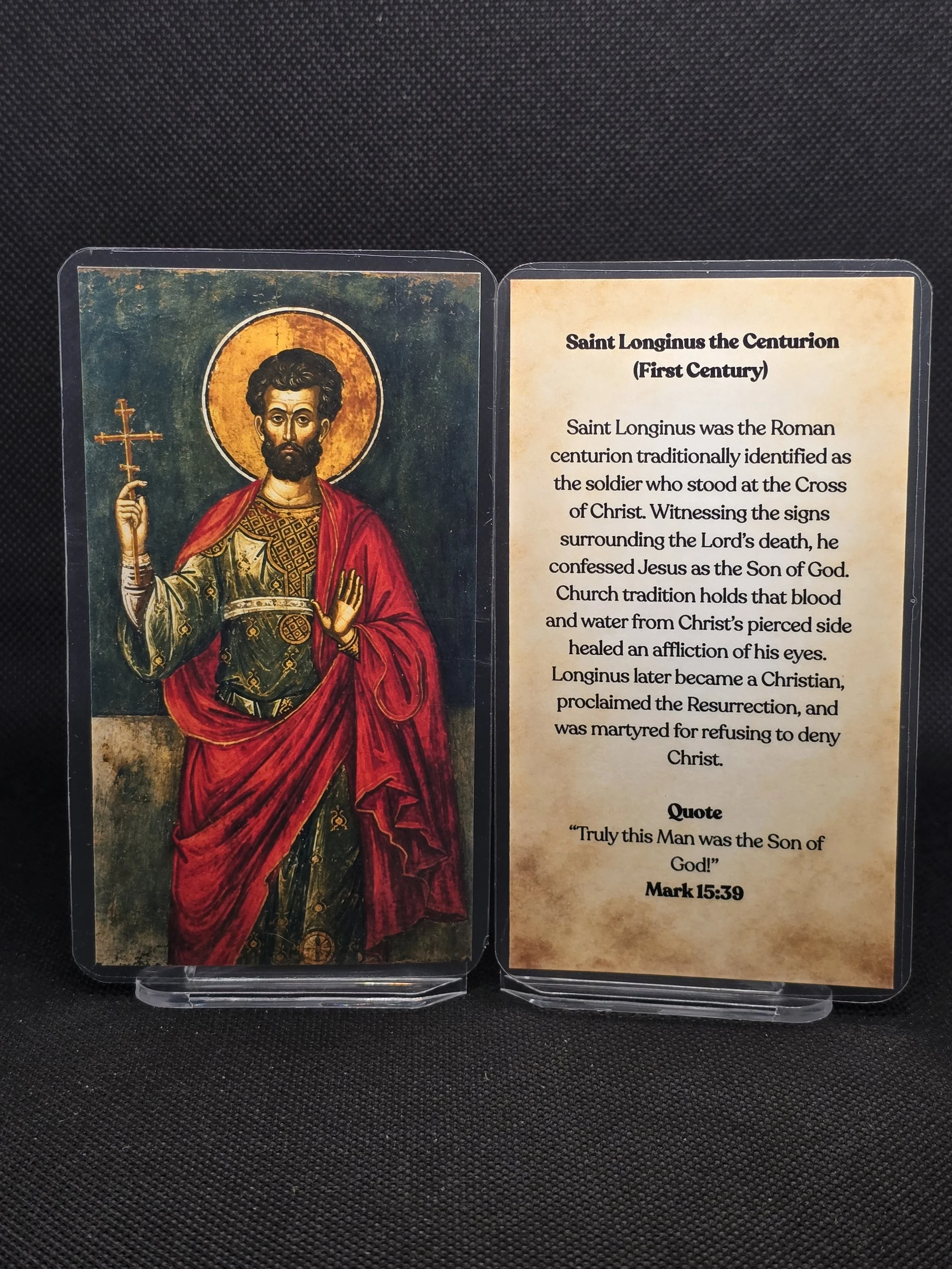
The earliest evidence tied to him comes from the Gospels. In Matthew 27:54 the centurion and those guarding Jesus are terrified by the earthquake and the other events surrounding his death, and they say that he was truly the Son of God. In Mark 15:39 a centurion standing opposite Jesus acknowledges him as the Son of God after seeing how he died. Mark 15:44 and 45 add that Pilate asked a centurion to confirm that Jesus was dead before releasing the body to Joseph of Arimathea. In Luke 23:47 the centurion glorifies God and says that Jesus was innocent.
John's Gospel tells of a soldier who pierced the side of the dead Jesus with a lance, so that blood and water flowed out. John does not name the soldier and does not say he was the confessing centurion. TRADITION: Eastern Christianity names the confessing centurion Longinus. Over time some traditions also gave the same name to the soldier with the lance. Modern scholars warn against treating the two identities as one established fact.
The Guards at the Tomb
TRADITION: According to the account of the Orthodox Church in America, Longinus and his soldiers afterward kept watch at the tomb of Christ. After the Resurrection they refused money offered to spread the story that the disciples had stolen the body. The account goes on to say that Longinus and two fellow soldiers were baptized, left military service and went to Cappadocia to preach.
Matthew 28:11 to 15 supplies the biblical background for the story of the bribed guards. However, Matthew does not name Longinus among them, and the passage does not say that any guard refused the payment. UNCERTAIN: The details of his baptism, the person who baptized him and the circumstances of leaving the army cannot be established.
Cappadocia: Preaching and Witness
TRADITION: Longinus is remembered as a missionary in Cappadocia. According to the Greek Orthodox Archdiocese, after leaving the army he preached Christ in his homeland, won converts and drew the attention of the authorities. The Orthodox Church in America likewise presents him and his companions as eyewitnesses whose testimony about the Crucifixion and Resurrection brought others to the faith.
Some Latin accounts describe a long period of monastic living and preaching. A Latin Passion of Longinus, summarized by the North American Society for the Study of Christian Apocryphal Literature, describes such a life, but the length and nature of it are uncertain, and the different accounts cannot be merged into one chronology. There is no reliable evidence that he founded a monastery, a church or any community. Claims of that kind are tradition and not documented fact.
No writing by Longinus is known. There are no letters, sermons, prayers or autobiographical texts that can be securely credited to him. The works that bear his name are later biographies, martyrdom accounts, homilies and hymns, and they are sources about him and not by him.
The Problem of Identity
The main historical difficulty is how the figure of Longinus developed. In his chapter on the Gospel of Nicodemus and the cult of Saint Longinus, published in 2024, Boris Uspensky separates Longinus the Soldier, linked with the lance, from Longinus the Centurion, linked with the confession at the Cross. He finds that the Greek East and Latin West developed differently, with the Latin tradition more ready to join the two figures.
The Gospel of Nicodemus, also known in part as the Acts of Pilate, was influential in shaping the legend. Its textual history is complicated. J. K. Elliott notes scholarly disagreement about its origins, with large parts commonly dated to the fifth or sixth century, even though some studies describe the tradition as developing in the fourth century. UNCERTAIN: These texts cannot tell us whether the historical centurion and the soldier with the lance were one man.
Martyrdom
TRADITION: In the main Byzantine account, summarized by the Orthodox Church in America, Longinus's preaching in Cappadocia stirred hostility. Pilate was persuaded to seek his death, and soldiers were sent to find him. Longinus met them without telling them who he was, welcomed them into his home and gave them hospitality. When they explained their mission, he told them he was the man they sought. The soldiers hesitated to kill their host, but Longinus would not run away, and he and his companions were beheaded.
A Martyrdom of Longinus attributed to Pseudo-Hesychius of Jerusalem preserves a fuller version. A Latin Passion names a provincial official called Octavius, who demanded that Longinus sacrifice to the gods. He refused and was tortured. These versions name different officials and arrange events in different ways, so they cannot be taken as one verified history. UNCERTAIN: The place and year of his death are unknown.
A caution is needed. Some later narratives blame Jewish religious opponents for turning Roman officials against Longinus. These are claims of hagiographical texts and not established history, and they must never be turned into an accusation against Jewish communities in general.
Relics: The Head, the Blood and the Lance
TRADITION: In the Eastern account, the severed head of Longinus was carried to Jerusalem, shown to Pilate and thrown outside the city. A blind woman later found it and brought it back to Cappadocia for burial. This story is preserved in Orthodox hagiography and gives no archaeological history of a relic.
The West developed other traditions. Mantua in Italy holds a relic traditionally believed to contain earth soaked with the blood of Christ, said to have been gathered by the soldier who pierced his side. According to the Diocese of Mantua, the relic is associated with discoveries in 804 and 1048, which describe the history of its veneration and say nothing certain about the life of Longinus. Saint Peter's Basilica in Rome keeps a relic traditionally identified as the Holy Lance, and its connection with Longinus is presented as traditional. UNCERTAIN: The authenticity of any surviving lance attributed to him has not been proved, and the Catholic Encyclopedia notes competing relic traditions with uncertain origins.
Legends of the Eyes and the Widow
TRADITION: A widely told legend says that Longinus had poor eyesight, and that when he pierced the side of Christ, some of the blood reached his eyes and restored his sight, leading to his conversion. The story appears in medieval Western writing, including the Golden Legend of Jacobus de Voragine. UNCERTAIN: John's Gospel says nothing about the soldier's eyes or a healing, and the story cannot be verified.
TRADITION: A second tale concerns a blind widow of Cappadocia who traveled to Jerusalem seeking a cure. Her son died, and in her grief she dreamed that Longinus showed her where his head had been thrown. When she found it, her sight returned, and a vision showed her son in glory. She went home and buried her son together with the saint's remains. The Latin Passion also tells of Longinus destroying idols and casting out demons, so that witnesses believed. These accounts belong to hagiographical tradition and not to verified eyewitness history.
Art, Hymns and Devotion
Longinus became a recognizable figure in pictures of the Crucifixion. The Rabbula Gospels, a Syriac manuscript dated to 586 AD, show the soldier piercing the side of Christ. The Catholic Encyclopedia notes that the name Longinus appears in connection with the illustration while admitting uncertainty over whether the inscription is original. In Saint Peter's Basilica a monumental statue of Longinus stands among the figures around the great dome.
Eastern devotion stresses his confession of Christ and his martyrdom, while Western art often stresses his lance and its link with the Blood of Christ. By devotion he is invoked by soldiers and by people with eye troubles, but no formal, universal patronage has been verified. His veneration belongs to the ancient liturgical tradition, and no papal decree or documented date of glorification has been found. His place in the Roman Martyrology and in Eastern synaxaria shows his place in liturgical memory but does not prove the accuracy of every story told about him.
Saint Longinus, soldier at the Cross, you saw the Lord die and confessed that he was the Son of God. Pray for soldiers and for all who carry out hard duties. Pray for those who have done wrong, that they may find repentance and mercy. Open our eyes to see Christ and give us courage to confess him. Amen.
This is a short devotional prayer written for this page, and it is not an official text of the Church. The Orthodox Church in America publishes hymns for his feast on October 16.
Why He Matters to Eastern Christians
Longinus has a clear place in Eastern Christian worship. The Orthodox Church in America commemorates him on October 16, gives his life and publishes hymns for his feast, and the Greek Orthodox Archdiocese also remembers him on that day. He is honored in the Byzantine tradition as the centurion who stood at the Cross.
Two themes stand out for Eastern readers. The first is the confession of Christ by a Gentile soldier, whose recognition of the Son of God at the moment of his death is recorded in the Gospels. The second is repentance. In the hagiography, a man associated with an execution becomes a witness, a missionary and a martyr, which fits the Eastern emphasis on conversion of heart. Because so much of his story is tradition, the Eastern account is best read as devotion that grew around a Gospel figure and not as a documented biography.
Frequently Asked Questions
The Soldier Who Saw
Longinus stands at the foot of the Cross as a witness. Little about his life can be proved, and the Gospel moment that made him known can be read by anyone. His prayer card is a small reminder to carry in your pocket.
View Prayer Card