Saint George the Great Martyr: Soldier, Victory-Bearer and Mor Girgis
The soldier martyr honored from England to Egypt and Syria: what the early evidence shows, what the Passions add, and why the dragon belongs to a later story.
At a Glance
- Born
- Uncertain; Cappadocia and Palestine are both named in the sources
- Died
- Traditionally April 23, 303, though the year and place are uncertain
- Feast day
- April 23 (Roman Catholic, Byzantine, Maronite and Syriac calendars; May 6 on the Julian calendar); 23 Baramouda in the Coptic calendar; November 3 for the church and relics at Lydda
- Canonization
- Ancient saint; no formal date of canonization or glorification is documented
- Patron of
- Soldiers, knights and archers; England and Portugal; protector against evil, in Eastern devotion
- Titles
- Great Martyr, Victory-Bearer, Trophy-Bearer, Wonderworker; Mor Girgis in the Syriac tradition
- A Famous Saint with an Uncertain Life
- Birth, Family and the Question of Cappadocia
- The Soldier of the Passions
- The Great Persecution and the Torn Edict
- The Passion of Saint George
- Martyrdom, Lydda and the Relics
- The Dragon and Other Legends
- Devotion in East and West
- Mor Girgis in the Syriac and Coptic Traditions
- Why He Matters to Eastern Christians
- Frequently Asked Questions
A Famous Saint with an Uncertain Life
Few saints are as widely known as Saint George, and few have a life that is harder to reconstruct. His name appears on the flags, churches and calendars of many nations, and his image on horseback is familiar even to people who know nothing else about Christianity. Yet the historical record about the man himself is thin.
What can be said with reasonable confidence is this. George was venerated as a martyr very early, and his cult was centered on the town of Lydda in Roman Palestine, today the city of Lod in Israel. Pilgrims who visited his tomb there wrote about it as early as the sixth century. Behind that cult, most scholars think, stands a real Christian who was put to death for the faith, probably in the time of the Great Persecution under Diocletian.
Almost everything else, including his parents, his rank, the details of his trial and the dragon, comes from later writing. This article tries to keep the two apart. Passages marked TRADITION come from the Passions and later devotion, and passages marked UNCERTAIN are points on which the sources disagree. The result is a more modest portrait than the legends suggest, but it is also an honest one, and it makes the lasting devotion to George easier to understand.
Birth, Family and the Question of Cappadocia
UNCERTAIN: The sources do not agree on where George was born. Vatican News gives about 280 and Cappadocia in Asia Minor. A study published by the Vatican Apostolic Library names Palestine. Both claims appear in the Church's own literature, and neither can be checked against a contemporary record.
TRADITION: The Orthodox Church in America relates that George came from a wealthy Christian family, that his father, an army officer, was martyred while George was still young, and that his mother then took him to Palestine, where she had property. The Greek Orthodox Archdiocese gives a similar picture of a prosperous Cappadocian family with ties to Palestine.
TRADITION: The names of his parents differ from source to source. Some Syriac and Coptic accounts call his father Anastasius and his mother Theobaste, while another Greek account names his mother Polychronia. These names should not be treated as established history.
The scholar Hippolyte Delehaye, whose conclusions are summarized in the Catholic Encyclopedia, regarded the connection with Lydda as far better founded than the family stories. For that reason this article treats George's childhood as a pious tradition rather than as biography. What the tradition does show is what later Christians wanted to say about him: that he came from a Christian home and that faith came before wealth and position.
The Soldier of the Passions
TRADITION: The Passions describe George as a young man who entered the Roman army and rose quickly because of his courage and discipline. The Greek Orthodox Archdiocese calls him a military tribune, a commander of troops, and the Orthodox Church in America places him in the imperial guard. None of these ranks is confirmed by a surviving military record, so his exact office remains UNCERTAIN.
This military setting is nevertheless central to his image. In the Christian East he is the soldier whose first loyalty was to Christ, which is why he became the model for Christians who served in the army and for rulers who sought a heavenly protector. A soldier's oath and a martyr's confession are set side by side in his story, and the story asks which of the two comes first.
The title Great Martyr, used in Byzantine worship, expresses the honor given to his witness. The additional titles Victory-Bearer and Trophy-Bearer refer to the crown of victory the martyr receives, and Wonderworker reflects the many healings and rescues credited to his intercession.
The Great Persecution and the Torn Edict
In 303 the emperor Diocletian and his colleagues began what is known as the Great Persecution. Churches were to be destroyed, sacred books handed over, and Christians who held official positions lost them. Later measures were harsher, and many Christians were imprisoned or put to death. Eusebius of Caesarea, in Book 8 of his Ecclesiastical History, describes these events as a contemporary witness.
TRADITION: According to the Passions, George answered the persecution by giving his wealth to the poor, freeing his slaves and declaring himself a Christian before the authorities. He is said to have refused every offer to keep his place if he would sacrifice to the Roman gods.
A well-known later story says that George tore down the imperial edict in public. Eusebius does tell of a prominent Christian in Nicomedia who tore down a posted decree and was put to death for it, but he does not give the man's name. The Catholic Encyclopedia, following Delehaye, cautions against identifying that man with George. UNCERTAIN: The link is a later guess, and there is not enough evidence to confirm it.
What survives in every version is the central moment: a Roman officer who is asked to put the emperor's order above his faith, and who refuses. That refusal, rather than any particular detail, is what Christians have remembered.
The Passion of Saint George
The oldest narrative of George's sufferings is a Passion, or Acts, which exists in Greek, Syriac, Coptic and other languages. A Greek account was in circulation by about the fifth century, and a Syriac manuscript from about the year 600 preserves an important early form. George Anton Kiraz published a scholarly edition of the Syriac and Garshuni versions in 1991 under the title The Acts of Saint George and the Story of His Father.
TRADITION: These texts describe a long series of tortures that George survives by divine help. He is said to have been bound to a wheel with blades, poisoned, imprisoned and killed more than once, and each time he is restored to life. He destroys idols, and many who watch are converted. The Coptic Synaxarium adds the conversion of a magician named Athanasius and of an empress named Alexandra, and it credits George with healing the sick and raising the dead.
The extravagant character of these stories is exactly why scholars treat the Passion as unreliable history. The Decretum Gelasianum, a list of approved and rejected writings traditionally attributed to Pope Gelasius I, places the Acts of George among the apocryphal books. Modern scholars doubt that Gelasius wrote the list and suggest an anonymous compiler of the early sixth century.
This is not a rejection of the saint. It shows that Christians could honor a martyr while declining to accept every story told about him, and that distinction has been part of Church practice for a very long time.
Martyrdom, Lydda and the Relics
TRADITION: The Passions end with George's beheading for refusing to renounce Christ. The usual date is April 23, 303, in the reign of Diocletian. Other traditions give other years, and the place of death is also disputed, so the date and the setting are both UNCERTAIN.
The link with Lydda is much better attested. The Vatican Apostolic Library points to pilgrims who describe his tomb there: Theodosius, writing about 530, Antoninus of Piacenza, about 570, and Arculf, whose journey of about 670 was recorded by Adomnan. Vatican News also reports a Greek inscription dated to 368 that names martyrs called George and companions, which shows that devotion to a martyr of that name was already established, although it cannot by itself give his biography.
TRADITION: A servant is said to have carried his body to Lydda, and later accounts connect the first church there with the reign of Constantine and the work of Saint Helena. The surviving evidence does not fix a date for the building.
The Orthodox Church in America notes that the present church at Lydda was restored in 1872 and that November 3 commemorates its dedication and the relics of the saint. The Patriarchate of Jerusalem continues to celebrate the day at the shrine. These facts show continuous devotion at the site. They do not scientifically prove that the tomb holds the martyr's remains, and the Church does not ask anyone to believe more than that.
The Dragon and Other Legends
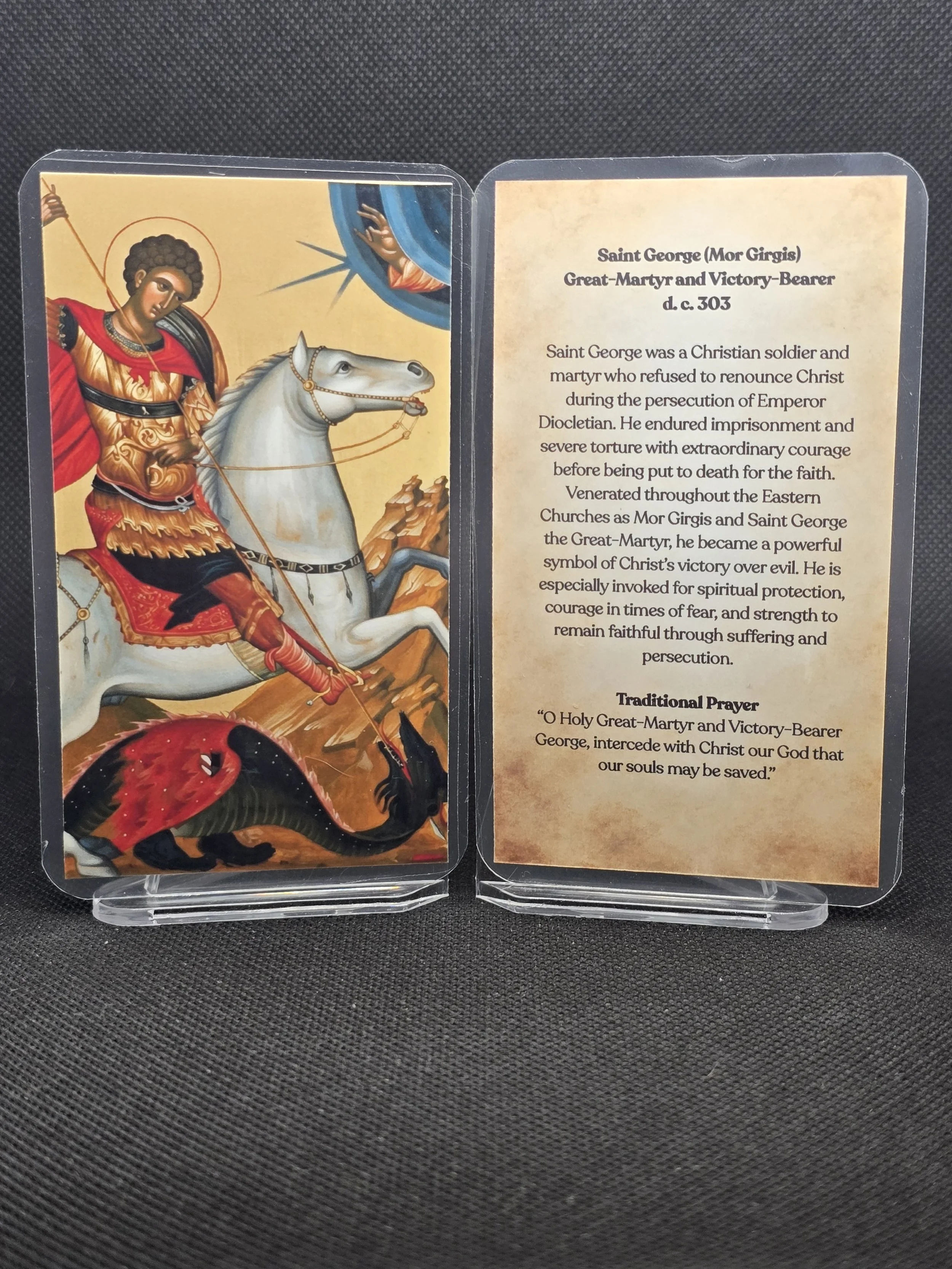
TRADITION: The best-known story about George is that he rescued a king's daughter from a dragon. In the story a town has been feeding the creature, first with animals and then with its own children, until the lot falls on the princess. George rides in, wounds the dragon, leads it into the town on the princess's girdle and, when the people agree to be baptized, kills it.
This legend is not in the earliest Passions. Scholars trace its first clear appearance to an eleventh-century Georgian text, and it reached the Latin West in the Golden Legend of Jacobus de Voragine in the thirteenth century. From there it shaped English knighthood, the Order of the Garter and countless paintings.
The dragon is best read the way Christian art reads it, as a picture of evil defeated by faith. The Book of Revelation already calls Satan the dragon, and an image of a soldier of Christ trampling that dragon was natural to the Christian imagination. Treating the episode as literal history would miss that meaning and would also place the legend ahead of the martyr.
The other miracles credited to George, such as the healing of a disabled child, the survival of poison and the raising of the dead in the Coptic account, belong to the same devotional literature. They are part of how his communities prayed, and they are labeled here as tradition because none can be supported by an independent source.
Devotion in East and West
George's cult spread across the Christian world with unusual speed. Churches were dedicated to him around the eastern Mediterranean, and Greek, Syriac, Coptic, Armenian and Latin Christians all kept his memory. In the Byzantine world he became one of the best-known military martyrs, often pictured with Demetrius and Theodore. Christopher Walter's study The Warrior Saints in Byzantine Art and Tradition and Monica White's Military Saints in Byzantium and Rus follow this development.
In the West his feast is April 23, an optional memorial in the modern Roman calendar. Medieval England took him as a patron, and Portugal did likewise. Jonathan Good's The Cult of St George in Medieval England shows how the English devotion grew, and also how little can be proved about the historical man.
The calendars differ in ways that can confuse a reader. Churches that follow the Julian calendar keep April 23 on what the civil calendar calls May 6, and in Greek Orthodox practice the feast is moved to Bright Monday if it falls during Holy Week or on Pascha. The Coptic Church keeps 23 Baramouda, which generally falls on May 1. Byzantine Christians also keep November 3 for the church and relics at Lydda.
Patronages follow the image of the soldier. He is invoked by soldiers, knights and archers, and in many places as a protector of the vulnerable. His patronage is closely tied to courage and to steadfastness in the faith.
Mor Girgis in the Syriac and Coptic Traditions
In Syriac Christianity George is Mor Gewargis, and the form Mor Girgis is its Arabic-influenced counterpart used in the Middle East. The Syriac Orthodox tradition calls him Mor Gewargis Sahdo, meaning George the Martyr. Syriac Christians did not receive him only from the West. They preserved one of the oldest complete forms of his Passion, and the Syriac manuscript of about the year 600 is one of the main witnesses to the early text.
This matters for the history of the legend. It shows that devotion to George was already strong in the Christian East centuries before the dragon story took shape in medieval Europe. The Syriac sources are also the reason that a Catholic and Eastern Christian biography has to speak of the saint in more than one language.
In the Coptic Church George is honored as the Prince of Martyrs, and the Synaxarium for 23 Baramouda gives a long account of his sufferings and wonders. The Maronite calendar of the Eparchy of Saint Maron lists him on April 23, and the Chaldean Catholic Patriarchate has published reflections on his feast and his icon. His memory is therefore shared by Catholic, Orthodox and Oriental Orthodox Christians who are not otherwise in communion.
You are the deliverer of captives and the defender of the poor, the healer of the sick and the protector of rulers. O George, great martyr and bearer of victory, intercede with Christ our God for the salvation of our souls.
This is a plain English rendering of the sense of the Byzantine apolytikion of Saint George in the fourth tone, which appears in Greek Orthodox collections of hymns for his feast. It is not a quotation from any published translation, and it should not be taken as an official liturgical text. Readers who want the authorized wording should consult the service book of their own Church.
Why He Matters to Eastern Christians
For Eastern Catholics and Orthodox Christians George is above all a liturgical presence. His feast is kept with proper hymns and readings, and his icon, whether as a standing soldier or a rider spearing the dragon, is found in homes and churches. Research on early Byzantine art shows that military portraits of George appeared well before the mature dragon story, so the icon of the soldier is the older image.
He also stands for a kind of shared inheritance. Because Catholic, Orthodox, Syriac and Coptic Christians all honor the same martyr on nearly the same day, his feast is one of the places where the divided Churches still pray in recognizable harmony.
The sources do not show that he was uniquely important to any one Eastern Church, and this article does not claim it. What the sources do support is a broad, long-standing and genuine devotion, and that is enough to make him a natural companion for Eastern Christians who face fear, temptation or a divided loyalty.
A theme that recurs in his troparion is rescue. He is called a deliverer of captives and a defender of the poor, and prayers to him often ask for protection of the weak and of those in authority. That emphasis is closer to the earliest meaning of his cult than the later image of a lone knight.
Frequently Asked Questions
The Soldier Who Would Not Bow
George asks to be remembered as a martyr rather than as a legend. His life is mostly hidden, but the faith behind his name is plain: a Christian who would not trade loyalty to Christ for safety. If you would like to keep a prayer card of Saint George, you can find one below, and a short prayer to keep in mind is simply: Saint George, pray for us.
View Prayer Card