Blessed Fulton J. Sheen: Bishop, Broadcaster and Apostle of the Holy Hour
The American bishop who taught millions by radio and television, kept a daily Holy Hour for decades, and was beatified in 2026: his life, his work, and his ties to Eastern Catholics.
At a Glance
- Born
- May 8, 1895, El Paso, Illinois, United States
- Died
- December 9, 1979, New York City
- Feast day
- December 9, authorized in the beatification decree; the extent of liturgical use depends on local approval
- Beatification
- September 24, 2026, St. Louis, Missouri; not yet canonized
- Venerable
- 2012, after a decree of heroic virtue under Benedict XVI
- Known as
- Bishop, theologian, author and broadcaster; patronage is not officially assigned
- A Priest Who Taught a Nation
- Boyhood in Illinois
- Priesthood and Study at Louvain
- Radio, Television and the Written Word
- Missions, Rochester and the Permanent Diaconate
- Controversies and Hard Questions
- Death and the Dispute over His Burial
- The Road to Beatification
- Sheen and the Eastern Catholic Churches
- Why He Matters Today
- Frequently Asked Questions
A Priest Who Taught a Nation
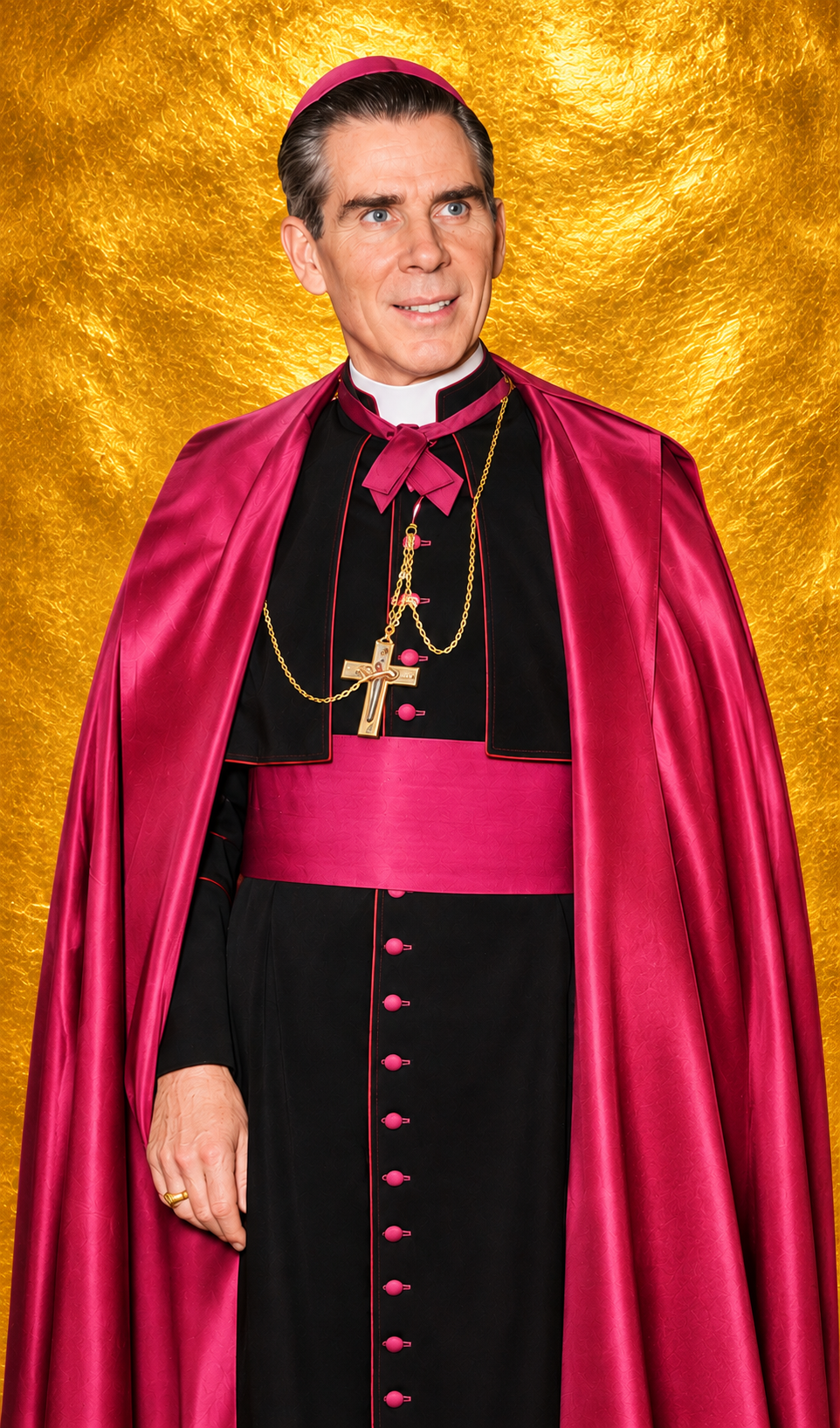
Few Catholic clergymen of the twentieth century were as widely heard as Fulton J. Sheen. Through radio, and then television, he brought sermons, philosophy and plain talk about Christ into ordinary living rooms in the United States. His audience reached far beyond Catholics, and his books sold in the millions.
Behind the public figure stood a quieter habit that he credited for everything else: a daily hour of prayer before the Blessed Sacrament, which he kept throughout his priesthood. He urged other priests to do the same, and this Holy Hour became the center of his spiritual legacy.
On September 24, 2026, Sheen was beatified in St. Louis, Missouri, and he is now called Blessed. Vatican News had announced the date in March of that year, and Catholic news services reported the ceremony. This article follows the life as it is described by the Catholic University of America, the Archbishop Fulton J. Sheen Foundation, diocesan sources and the historian Thomas C. Reeves. Where accounts rest on later recollection they are marked TRADITION, and where the record is incomplete they are marked UNCERTAIN.
Boyhood in Illinois
Fulton John Sheen was born on May 8, 1895, in El Paso, Illinois, the eldest of four sons of Newton and Delia Sheen, a farming family of Irish descent. He was baptized Peter John, but he took his mother's maiden name, Fulton, as a boy and used it for the rest of his life.
The Sheen Foundation records that his mother dedicated him to the Blessed Virgin Mary after his baptism, and Marian devotion marked his later preaching and writing. In 1900 the family moved to Peoria, where he attended the cathedral school and then Spalding Institute, a Catholic high school. He went on to St. Viator College in Bourbonnais, Illinois, and later to St. Paul Seminary in Minnesota.
TRADITION: A well-known story says that, while serving Mass for Bishop John Lancaster Spalding, the boy dropped a cruet of wine. The bishop is said to have calmed him and predicted that he would study at Louvain and become a bishop. Both things happened, but the story comes from later recollection and is not documented by a record made at the time, so it is better told as a memory than as a prophecy.
Sheen was not a convert. He was baptized and raised Catholic, and his priestly vocation grew within the Church from childhood.
Priesthood and Study at Louvain
Sheen was ordained a priest for the Diocese of Peoria on September 20, 1919, at St. Mary's Cathedral. He then pursued advanced studies at the Catholic University of America and at the University of Louvain in Belgium, where he earned a doctorate in philosophy in 1923 and received the Cardinal Mercier Prize for International Philosophy.
The thinking of Saint Thomas Aquinas shaped his approach. He held that faith and reason are not enemies, and that Christian teaching has something to say to modern problems, from the family to politics. This conviction ran through his classroom teaching and later through his broadcasts.
In 1926 he began teaching at the Catholic University of America in Washington, where he remained until 1950, first in theology and then in philosophy. His early radio sermons began the same year, and in 1930 he started speaking on The Catholic Hour, the national radio program that made him widely known.
He also kept the daily Holy Hour. According to the Sheen Foundation and to witnesses gathered by the university, he never gave it up. For him prayer before the Eucharist was not a decoration on his work but the source of it.
Radio, Television and the Written Word
On The Catholic Hour, beginning in 1930, Sheen spoke about marriage, suffering, moral responsibility, politics and the person of Jesus Christ. His audience on the radio was far larger than any lecture hall could hold.
His best-known television series, Life Is Worth Living, began on February 12, 1952, on the DuMont network and later moved to ABC, where it ran until 1957. Sheen stood before a blackboard in a bishop's cape and gave an extended talk with almost no production tricks. The audience at its height is estimated at about thirty million viewers a week, though this is a historical estimate and not an audited figure. In 1953 he received an Emmy Award for most outstanding television personality.
He was also a prolific author. Among his best-known books are God and Intelligence (1925), Religion Without God (1928), Calvary and the Mass (1936), Communism and the Conscience of the West (1948), Peace of Soul (1949), Three to Get Married (1951), The World's First Love (1952), Life of Christ (1958) and The Priest Is Not His Own (1963). His autobiography, Treasure in Clay, was published after his death, in 1980. The Catholic University of America counts dozens of books in all, but a single agreed number does not exist.
The themes return again and again: the Incarnation and the Cross, Eucharistic devotion, the need for repentance, and the Christian answer to modern ideologies.
Missions, Rochester and the Permanent Diaconate
In 1950 Sheen became the national director in the United States of the Society for the Propagation of the Faith, and in 1951 he was consecrated a bishop and named an auxiliary bishop of New York. He held the missions post for about sixteen years. The Sheen Foundation says he raised millions of dollars for missionary work, though a single audited total was not found.
In December 1966 he became Bishop of Rochester, New York, after taking part in the Second Vatican Council. He encouraged a larger role for the laity, worked with other Christians, and tried to help poor communities. In 1968 he helped to found a housing foundation for low-income families. On June 1, 1969, he ordained Michael Cole as a permanent deacon, who diocesan sources identify as the first permanent deacon ordained in the United States after the modern restoration of that ministry.
His time in Rochester was also difficult. In 1968 he proposed turning over St. Bridget Church and its property for low-income housing. Local opposition was strong, in part because the people affected had not been properly consulted, and the plan was dropped. Diocesan retrospectives praise his concern for the poor while acknowledging the weakness of his administrative approach.
He resigned as bishop in 1969 and was named titular Archbishop of Newport.
Controversies and Hard Questions
A serious biography has to include the disputes. In the 1950s Sheen's relationship with Cardinal Francis Spellman of New York broke down. Historian Thomas C. Reeves, in America's Bishop: The Life and Times of Fulton J. Sheen (2001), describes the quarrel as centered on control of money raised for the missions. Sheen held that mission funds should be used for missions.
UNCERTAIN: The full private correspondence between the two men has not been made public. For that reason claims that Spellman himself caused every later setback, including the end of the television series or the move to Rochester, go beyond what can be firmly shown.
His beatification was first set for December 21, 2019, and was then postponed. In a statement of December 5, 2019, the Diocese of Rochester explained that questions had been raised about how priests were assigned during his years as bishop. The same statement said that no complaint had accused Sheen himself of improper conduct. The issue was one of oversight, not of personal wrongdoing.
The Sheen Foundation has said that legal and historical reviews found he handled the cases appropriately, and in 2023 its executive director reported the findings of an independent legal review commissioned by the foundation. Those findings are the foundation's own and should be read as such. In February 2026 Bishop Louis Tylka of Rochester announced that the Holy See had authorized the cause to proceed again. UNCERTAIN: The confidential reasoning behind that decision was not found in public records, so only the outcome is established.
Death and the Dispute over His Burial
In his last years Sheen kept preaching and writing despite poor health. He died on December 9, 1979, in the chapel of his residence in New York. Accounts preserved by the Catholic University of America say that he was found near the Blessed Sacrament, a detail often repeated in devotional biographies.
His funeral was held at St. Patrick's Cathedral in New York on December 13, 1979, and he was buried in the cathedral crypt.
Years later his niece, Joan Sheen Cunningham, asked to have his body moved to Peoria, where he had grown up and been ordained. The Archdiocese of New York and the cathedral's trustees opposed it, and the dispute went to court. A New York appeals court upheld the transfer in March 2019. His remains were moved on June 27, 2019, to the Cathedral of St. Mary of the Immaculate Conception in Peoria, and his tomb there is a place of public prayer.
The Road to Beatification
The cause was opened in 2002 under the Diocese of Peoria. On June 28, 2012, Pope Benedict XVI recognized his heroic virtue, and he was called Venerable. In July 2019 Pope Francis approved a miracle attributed to his intercession, which cleared the way for beatification.
The miracle concerns a baby boy, James Fulton Engstrom, born in Illinois in 2010 without any detectable heartbeat after complications with the umbilical cord. According to the family and the Sheen Foundation, the baby's parents and others prayed for Sheen's help while doctors worked to revive him. The heart is reported to have started after about an hour, and the child recovered without the serious damage that had been feared. The Church examined the case medically and theologically before approving it.
It is worth being clear about what such a declaration means. The Church recognizes the case as a miracle attributed to Sheen. It does not claim that science has demonstrated a supernatural cause.
After the delay of 2019 and the renewed authorization of 2026, Sheen was beatified on September 24, 2026, in St. Louis, with Cardinal Luis Antonio Tagle presiding on behalf of Pope Leo XIV. The decree allows him to be honored on December 9. A beatification does not by itself create a universal feast, and local liturgical use needs the proper approval. He has not been canonized, and other reports of favors received through his prayers are not Church-approved miracles unless they complete the same process.
Sheen and the Eastern Catholic Churches
Sheen belonged to the Latin Church, but he had a documented connection to the Christian East. OSV News reports that, with permission from Pope Pius XII, he celebrated the Byzantine Divine Liturgy for the first time on September 3, 1955, during a Marian pilgrimage at Uniontown, Pennsylvania. The liturgy was arranged to be recorded and sent behind the Iron Curtain by Radio Free Europe, as a sign of solidarity with Christians suffering under communist rule. Reports describe it as an early use of English in a Byzantine liturgy in the United States.
A Catholic press report published in 2026 adds that he celebrated a Melkite Divine Liturgy in Birmingham, Alabama, in 1960, and recalled his hope that the Byzantine tradition could help in reconciliation between Catholics and Russian Orthodox Christians.
After the beatification, Bishop Robert Pipta of the Ruthenian Catholic Eparchy of Parma celebrated a Byzantine Divine Liturgy of thanksgiving at the cathedral in Peoria on September 26, 2026. An icon of Blessed Fulton Sheen, combining Latin and Byzantine episcopal symbols, was shown at the liturgy, according to OSV News.
These events give Eastern Catholics a real reason to treat him as one of their own friends. His Catholic beatification, however, is not a recognition by the Orthodox Churches. No Orthodox glorification of Sheen is known, and no general Eastern Catholic feast for him has been established.
Lord Jesus Christ, you are present in the Eucharist. Through the prayers of Blessed Fulton Sheen, who spent an hour each day before you, teach us to pray, to speak of you with courage and kindness, and to love those who do not yet know you. Blessed Fulton Sheen, pray for us.
This is a short devotional prayer written for this page, and it is not an official text of the Church. The Archbishop Fulton J. Sheen Foundation publishes an approved prayer for his canonization, which readers may prefer. There is no ancient prayer or Byzantine troparion for Sheen, since he was beatified only recently.
Why He Matters Today
Sheen's lasting influence lies in how he joined strong thought to simple speech. He believed that a priest could explain Christian teaching in a way ordinary people can follow without watering it down. Many who now speak about the faith online or on air still cite him as a model.
His second legacy is the Holy Hour. He did not treat Eucharistic prayer as a private extra but as the center of a priest's work, and the practice of daily adoration has spread among priests and laypeople who have read him.
For Eastern Christians a third point stands out: his concern for persecuted Christians behind the Iron Curtain and his willingness to pray the Byzantine liturgy with them. In an age of sharp division between East and West, a Latin bishop who prayed in the Eastern rite is a small but real sign of unity.
Finally, his life is a reminder that holiness and imperfection can exist side by side. He was a gifted but sometimes difficult man, caught up in disputes that are still discussed, and the Church has presented him for imitation not for perfection but for the virtue he lived.
Frequently Asked Questions
The Man Before the Tabernacle
Sheen is remembered for his microphone and his books, but he would have pointed to his hour of prayer. If you would like to keep a prayer card of Blessed Fulton Sheen, you can find one below, and a short invocation to keep in mind is simply: Blessed Fulton Sheen, pray for us.
View Prayer Card