Saint Macarius of Optina: Monk, Spiritual Elder and Editor of the Fathers
The nineteenth-century Russian monk who became a spiritual father to monks, nobles and ordinary families, and who helped bring the writings of the Eastern Fathers to Russian readers.
At a Glance
- Born
- November 20, 1788 (Old Style); the exact birthplace is uncertain
- Died
- September 7, 1860 (Old Style), at Optina Hermitage near Kozelsk, Russia
- Feast day
- September 7 on the church calendar (September 20 on the civil calendar for churches that follow the Julian calendar); October 11 for the Synaxis of the Optina Elders
- Glorification
- Russian Orthodox Church Outside Russia, May 13, 1990; Moscow Patriarchate, local veneration 1996 and general veneration 2000
- Titles
- Venerable, Elder (Starets) of Optina, hieroschemamonk
- Catholic status
- No Catholic canonization or universal Catholic feast is established
- A Spiritual Father for Ordinary People
- Childhood and Early Career
- The Call to the Monastery
- Leonid and the Move to Optina
- The Work of Spiritual Direction
- Editing the Fathers
- Difficulties and Context
- Death and Burial
- Glorification and Relics
- Tradition and Devotion
- Why He Matters to Eastern Catholics and Orthodox Readers
- Frequently Asked Questions
A Spiritual Father for Ordinary People
Saint Macarius of Optina belongs to a long line of Russian monks called startsy, or elders: men who were not necessarily bishops or scholars but who had gained such experience in prayer that others sought their advice. At the Optina Hermitage, near the town of Kozelsk, he became one of the most trusted of these guides in the nineteenth century.
What makes him unusual is who came to him. Monks and priests did, but so did nuns, landowners, officials, writers and mothers of families. His letters, which survive in large numbers, deal with ordinary matters such as pride, anxiety, marriage, grief, work and the struggle to pray.
He also did something less visible. With the help of lay friends, he oversaw the publication of Russian editions of the Eastern Fathers, so that writings once found only in a few monastery manuscripts could be read by many people. This article follows the biography of the Orthodox Church in America, the detailed account published by Optina Monastery and academic studies. Passages marked TRADITION come from devotional accounts, and passages marked UNCERTAIN are points on which the sources disagree.
Childhood and Early Career
He was born Mikhail Nikolayevich Ivanov on November 20, 1788, according to the Old Style calendar then used in Russia, into a family of the provincial nobility. His father, Nikolai, was a landowner and government official, and his mother was Elizabeth, born Emelyanova. He was baptized Michael.
UNCERTAIN: The place of his birth is not settled. The biography published by Optina Monastery names Zhelezniki, near Kaluga, while other accounts connect him to the family estate in the Dmitrov district of Orel Province. The safest statement is that he came from a noble family of the Orel and Kaluga regions.
According to the Optina biography, his great-grandfather had become a monk and his grandmother was remembered for feeding prisoners, so the boy grew up near monasteries and knew Orthodox worship from the start. His mother fell ill with tuberculosis, the family moved to Moscow in 1794, and she died on January 21, 1797. He then lived with relatives, among them his sister Daria and her husband, and studied at a parish school before continuing with his aunt.
In 1802 he and his brother Alexis became assistant bookkeepers in the treasury at Lgov, and by 1805 he held a post in the financial office at Kursk. He was known as careful and intelligent, and he liked reading and playing the violin. His father died in 1806. These details matter because Macarius was no stranger to the working world. He had handled money, paperwork and family duties, and later he spoke to laypeople from experience.
The Call to the Monastery
He was not a convert, since he was baptized and raised Orthodox. His change of life was a gradual turn from civil service to the monastery.
In October 1810 he visited the Ploschansk Hermitage of the Mother of God. The Orthodox Church in America records that even his relatives were unsure whether he had planned to stay or decided only after seeing the life there. He told his brothers that he would remain, gave them the care of the family property, and asked for a contribution toward a church at his father's grave. On December 24, 1810, he was clothed as a rassophore monk with the name Melchizedek.
On March 7, 1815, he received full monastic tonsure with the name Macarius. Bishop Dositheus of Orel and Sevsk ordained him a hierodeacon on March 12, 1815, and a hieromonk on May 27, 1817.
In these years he felt the need of an experienced teacher. He found one in Schemamonk Athanasius Zakharov, a disciple of Saint Paisius Velichkovsky, whose cell held manuscript translations of the Greek ascetical Fathers. Macarius lived with him, cared for him and studied the manuscripts. Athanasius died on October 17, 1825. Through him Macarius received a direct link to the Paisian revival of prayer, obedience and patristic study.
Leonid and the Move to Optina
In 1828 Elder Leonid Nagolkin, later known as Saint Leo of Optina, came to Ploschansk. Macarius recognized in him the spiritual father he had been looking for and asked to become his disciple. When Leonid moved to Optina in 1829, Macarius kept in touch by letter. After a period of administrative work, which included an assignment in Saint Petersburg, he received permission to move to Optina himself, and he arrived on February 5, 1834.
His responsibilities grew. In October 1836 he became a confessor of the monastery, and on December 1, 1839, he became superior of the Skete of Saint John the Baptist, the smaller hermitage attached to Optina. Even then he continued to seek Leonid's counsel and to obey him.
Leonid died on October 11, 1841, and from then on Macarius was one of the principal elders of Optina. The pattern of his life is plain in these dates: he spent many years as a disciple before he was a teacher, and he accepted authority long after he had earned the right to exercise it.
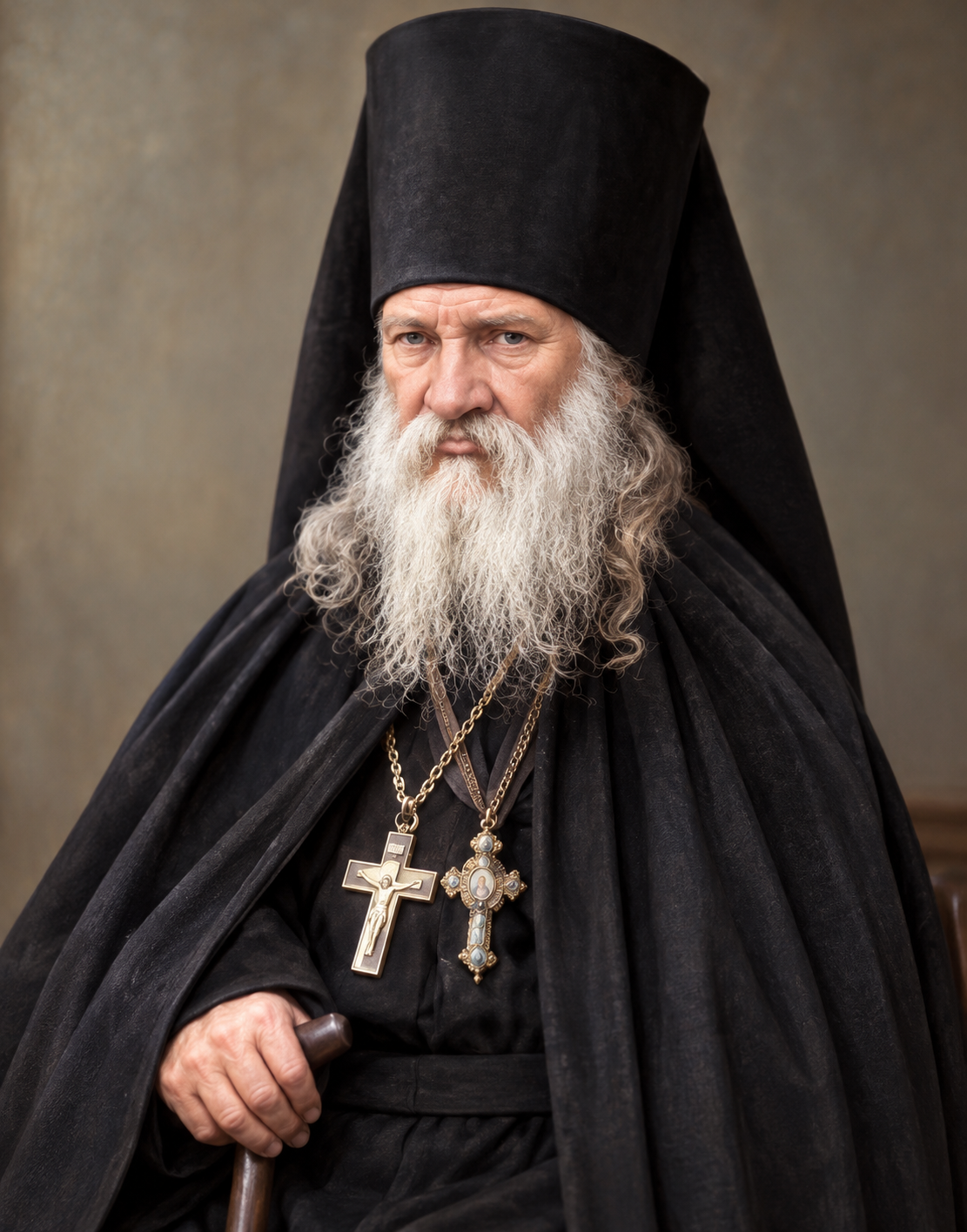
The Work of Spiritual Direction
In the monastic tradition a starets is a spiritual father whose experience and discernment help others find the way. Macarius guided monks, clergy, nuns, laypeople, aristocrats and educated men and women. His letters deal with repentance, prayer, pride, marriage, suffering, family relationships, obedience and temptation.
He also trained novices and prepared monks for tonsure. His direction was not limited to those within the monastery walls, and this opening of monastic counsel to people in the world became a mark of Optina's influence.
Macarius did not found Optina or its skete. Both existed before him, and the revival of Optina had begun under other leaders, including the brothers Moses and Anthony Putilov and Elder Leonid. His distinctive contribution was to strengthen the spiritual and intellectual work already there and to make it available to the wider Church.
His own written legacy is mostly letters rather than treatises. An English selection, Russian Letters of Spiritual Direction, 1834 to 1860, was translated by Iulia de Beausobre and first published by Dacre Press in 1944, later by St. Vladimir's Seminary Press. It draws on an earlier Russian collection of letters to laypeople printed in Moscow in 1880.
Editing the Fathers
Macarius inherited many manuscripts connected with Paisius Velichkovsky and his disciples. Working with the philosopher Ivan Kireyevsky, Natalia Kireyevskaya, monastic helpers and with the support of Metropolitan Philaret of Moscow, he helped to set up an organized effort to publish the writings of the Fathers in Russian.
A life of Paisius appeared in the journal The Muscovite in 1845, and the first substantial book of the Optina publishing effort, which included a life of Paisius and selections from his writings, came out in January 1847. The difference between the magazine article and the later book explains why some accounts give different dates.
According to the Orthodox Church in America, sixteen books of patristic literature were published under his supervision. The authors included Isaac the Syrian, Barsanuphius and John, Mark the Ascetic, Maximus the Confessor, Symeon the New Theologian and Nilus of Sora.
The scholar Jan Zozulak argues that Macarius and his collaborators helped to hand on the hesychast tradition through readable editions, joining Byzantine spirituality with Russian intellectual and religious life. The books underwent review at the Moscow Theological Academy with the attention of Metropolitan Philaret, so the work took place inside the official Church and not outside it.
Difficulties and Context
Macarius lived in an empire where the Church worked under heavy state supervision. Religious publishing needed approval and could be censored, and the revival of eldership was not free of suspicion. Some church officials worried that the elders had too much influence over monks and visitors, and Leonid in particular was accused of unauthorized practices and had limits placed on his contact with pilgrims.
Macarius inherited that atmosphere. The concern about eldership did not vanish at once, although his publishing had powerful support. There was also a question about how Orthodox spirituality related to Russian intellectual life. Kireyevsky was linked with the Slavophile movement, which wanted to recover the place of Orthodoxy in culture, but scholars warn against reducing it to simple hostility toward the West. His interest in the Greek Fathers was also a search for a fuller idea of reason, faith and human experience.
UNCERTAIN: When Natalia Kireyevskaya became his spiritual daughter is disputed. Some biographies give 1838, but Optina's own research notes that her earlier confessor was still living and that the early letters do not clearly show a full relationship at that date.
The principal sources show no evidence that Macarius was ever condemned for heresy, left Orthodox teaching or founded a separate movement.
Death and Burial
In 1853 Macarius resigned as head of the Skete of Saint John the Baptist, though he kept receiving spiritual children and writing letters. In his last illness in 1860 he suffered from a serious urinary disorder that his Orthodox biography calls ischuria. He received Holy Unction and Holy Communion, and on September 2 he was given an icon of the Vladimir Mother of God sent by Metropolitan Philaret and a cross containing a relic of the True Cross.
He asked for the prayers for the dying, and on September 7, 1860, at about seven in the morning, he died while the ninth ode of the Canon for the Departure of the Soul was being read. He had received the Great Schema in secret about two years before. He was buried on September 10 beside Elder Leonid at Optina.
Glorification and Relics
Veneration of Macarius grew among monks and laypeople long before any formal act. The Russian Orthodox Church Outside Russia glorified him together with the other Optina Elders on May 13, 1990, at Saint Nicholas Cathedral in Montreal, according to the study The Order of Glorifying Saints in ROCOR.
The Moscow Patriarchate authorized local veneration on June 13, 1996, and, according to the sources reviewed, the relics of Macarius and several other elders were uncovered in July 1998. General veneration of the Optina Elders was approved on August 7, 2000. The Orthodox Church in America places the relics in the Church of the Vladimir Icon of the Mother of God at Optina.
One date should be handled with care. The year 1988 is connected with the glorification of Saint Ambrose of Optina by the Moscow Patriarchate, and it should not be given as the glorification of Macarius. The glorification of each elder was a separate act.
The feast of Saint Macarius is September 7 on the church calendar, which is September 20 on the civil calendar for churches that keep the Julian calendar. The Synaxis of the Optina Elders is kept on October 11.
Tradition and Devotion
Orthodox biographies speak of Macarius's discernment, prophecy and healing. The historical evidence for his life is much stronger than the independent evidence for particular miracles, so the stories below are presented as tradition and not as verified fact.
TRADITION: The Optina elders' biographers describe him helping people who were ill or thought to be troubled by evil spirits, and they credit healings to his prayer. None of the cases is supported by independent medical documentation.
TRADITION: The Orthodox Church in America records that in 1859 Macarius prayed for a gravely ill spiritual daughter named Maria, who wished to live long enough to see her son. He is said to have predicted that she would recover for a time and that their deaths would come close together. Maria died on August 23, 1860, and Macarius died on September 7. The dates are recorded, but the prediction remains a devotional account.
TRADITION: Optina's own writings preserve a memory, attributed to a later elder, that Macarius became restless just before the writer Nikolai Gogol arrived, as though he sensed an important visitor. The monastery presents it as tradition. The link between Gogol and Optina is a documented part of the monastery's literary history.
What is documented is continuing devotion: Macarius appears in the Orthodox calendar and in the Synaxis of the Optina Elders, and he is honored in icons, hymns, pilgrimages and the veneration of his relics.
O our holy father Macarius, pray to Christ our God to save our souls!
This is the closing line of the troparion for Saint Macarius in Tone 8 as published by the Orthodox Church in America. The full text is not reproduced here, and readers who want the complete hymn should consult that source or the service book of their own Church.
Why He Matters to Eastern Catholics and Orthodox Readers
For Orthodox Christians Macarius is a clear example of the ancient monastic idea of spiritual fatherhood. His teaching was shaped by the Desert Fathers, the Byzantine writers on prayer and the hesychast tradition handed on by Paisius Velichkovsky. His special importance lies in bringing that heritage to laypeople, professionals, families and people in distress.
Eastern Catholic readers have their own reason to study him. In the apostolic letter Orientale Lumen, of May 2, 1995, Pope John Paul II described Eastern monasticism as part of the shared spiritual heritage of Christians, and in sections 9 and 13 he wrote about monastic life and the value of spiritual fathers who help believers discern their state. These themes fit the ministry of Macarius well.
It is important to be exact. Orientale Lumen does not name Macarius, and it is not a Catholic declaration of his holiness. No source reviewed shows a Catholic canonization, a place in the universal Roman calendar, or a feast kept by the Eastern Catholic Churches in general. His place for Eastern Catholics rests on a shared patristic and ascetic tradition, not on any official Catholic recognition.
That is still a good deal. A reader from any tradition can find in his letters what the Fathers taught about humility, patience and prayer, put in plain words for people who had jobs, children and worries.
Frequently Asked Questions
A Father for Those in the World
Macarius spent his life guiding people toward humility, prayer and patience, whether they lived in a cell or a country house. If you would like to keep a prayer card of Saint Macarius, you can find one below, and a short invocation to keep in mind is simply: Holy Father Macarius, pray to God for us.
View Prayer Card