Saint Ashkhen: Armenian Queen, Royal Convert and Supporter of the Church in the Time of Saint Gregory the Illuminator
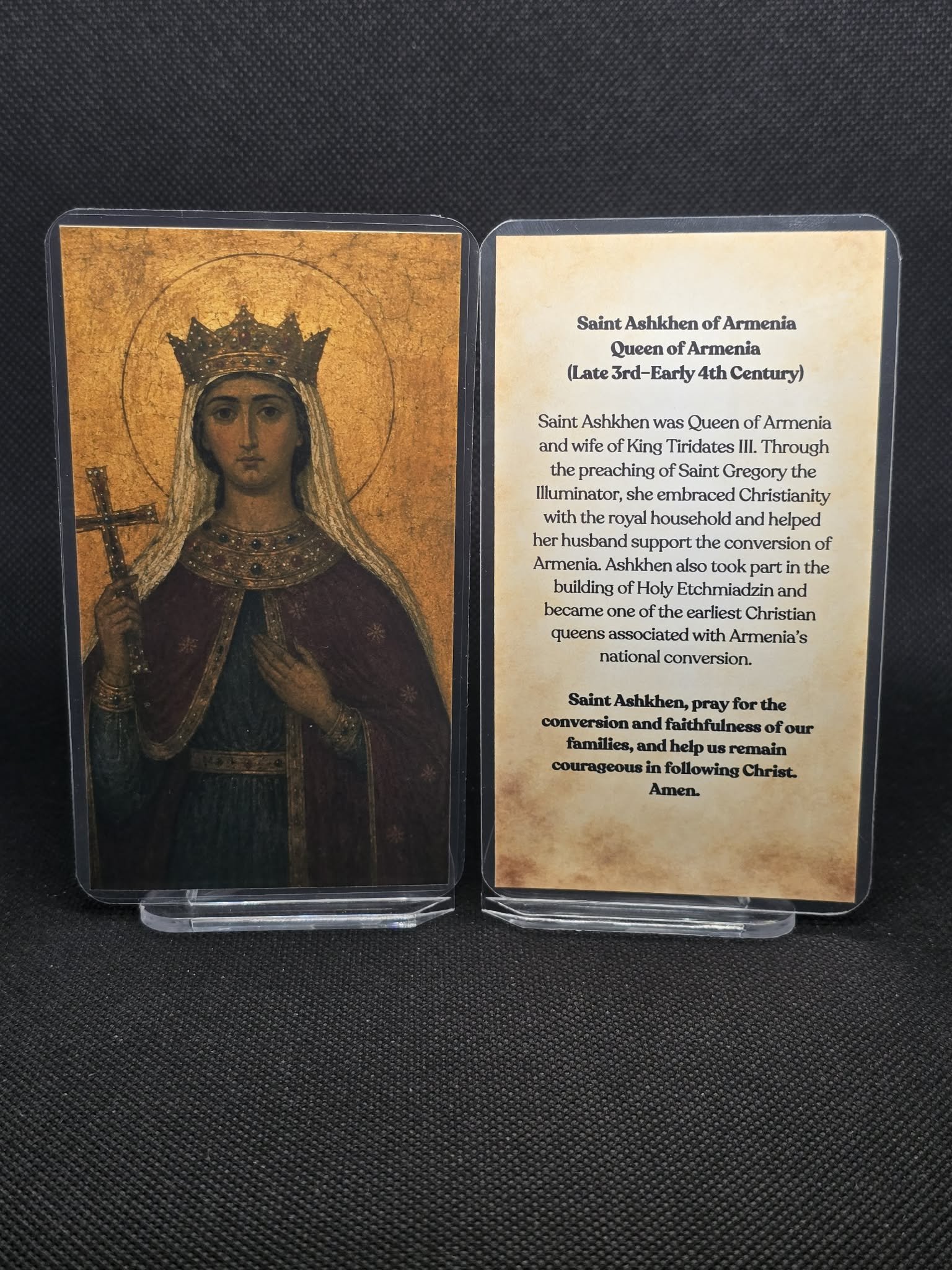
The queen of Armenia who, with her husband King Tiridates III and his sister Khosrovidukht, was baptized by Saint Gregory the Illuminator.
At a Glance
- Born
- Uncertain, probably the later third century; traditionally a princess of Alania
- Died
- Uncertain, traditionally in the fourth century; a group entry gives about 330
- Titles
- Queen of Armenia, royal convert, saint of the Armenian Church
- Feast
- With Tiridates and Khosrovidukht, the fourth Saturday after Pentecost (movable)
- Veneration
- Armenian Apostolic Church; no separate Roman or Byzantine feast verified
- Patronage
- None formally designated; remembered for Christian conversion and family faith
- Who Was Saint Ashkhen?
- Alan Princess and Royal Bride
- Baptism in the Conversion of Armenia
- Queen of a Newly Christian Kingdom
- Persecution, Politics and Uncertainty
- Last Years, Death and Memory
- Traditions and Devotion
- What Scholars Say
- Places to Remember Her
- Ashkhen and the Eastern Churches
- Frequently Asked Questions
Who Was Saint Ashkhen?
Saint Ashkhen is remembered as the queen of Armenia in the age of its conversion to Christianity. She was the wife of King Tiridates III, also called Trdat, and she is commemorated with him and with his sister, Saint Khosrovidukht, in the calendar of the Armenian Apostolic Church. Together the three stand for the moment when the royal house of Armenia received baptism from Saint Gregory the Illuminator.
Her place in history is real but modest in detail. Armenian tradition names her clearly, yet the sources say much more about Gregory and Tiridates than about the queen herself. No writings by Ashkhen survive, and no early biography of her was written. What the Church keeps is her name, her baptism, her place beside the king, and her share in the memory of the Church's foundation.
This article therefore sets out what is held by the Armenian Church and what scholars can support, and it marks clearly where a detail rests only on later tradition. That approach is the most respectful one for a saint whose witness is communal. Ashkhen is honored not for a long list of deeds but for being one of the first Christian queens of a nation that made Christianity its public faith.
Alan Princess and Royal Bride
Armenian Church educational tradition identifies Ashkhen as a princess of Alania, the land of the Alans in the northern Caucasus, and names her father as a ruler called Ashkhatar. A publication of the Armenian Church Western Diocese gives her marriage to Tiridates at Vagharshapat in the year 291, while other accounts give 297. The difference is not resolved, and no contemporary record settles it.
An Alan marriage is plausible, because the kingdoms and peoples of the Caucasus were tied together by dynastic alliances and by shared frontiers with Rome and Persia. Still, her genealogy cannot be reconstructed with certainty. Her birth date, her mother, and her early religion are unknown, and any story of her childhood should be treated as unsupported.
By marriage she entered the Arsacid, or Arshakuni, royal house of Armenia. Later Armenian sources name a son, Khosrov, who is remembered as Khosrov III, and some reconstructions add daughters. The names and details of the children are less secure than the figure of the queen herself. It is also important not to confuse Ashkhen, the wife, with Khosrovidukht, the king's sister, who appears beside her in the conversion story.
Baptism in the Conversion of Armenia
The main narrative of the conversion is the History attributed to Agathangelos. It tells that Tiridates persecuted Christians, that Gregory was imprisoned in a deep pit, and that the king later suffered a grievous affliction. Khosrovidukht is said to have received a revelation that only Gregory could heal him. Gregory was released, and the king and his household turned to the faith.
According to the account preserved by the Mother See of Holy Etchmiadzin, Gregory returned after his consecration, and the king, the queen and the princess prepared by fasting. Gregory then baptized Tiridates, Ashkhen and Khosrovidukht, and many nobles and soldiers followed. The Armenian Church traditionally dates the adoption of Christianity to the year 301, though modern scholars treat the date and sequence with caution.
Ashkhen enters this story as a convert beside the king, not as a separate hero of resistance. Later devotional writing sometimes pictures her as a secret Christian who protected the faithful during the persecution. The stronger evidence does not support that picture, and it would be wrong to present it as fact. Her witness is that she accepted baptism and stood with her family in the new faith.
Queen of a Newly Christian Kingdom
The Armenian Church links Ashkhen, Tiridates and Khosrovidukht with the building of the Cathedral of Holy Etchmiadzin at Vagharshapat. Church accounts tell that the royal family took part in the work and carried stones from the slopes of Mount Ararat. This is a cherished tradition, and it cannot be checked against building records of the time.
Church educational literature also says that Ashkhen encouraged the building of churches in memory of the holy women martyrs Saint Hripsime and Saint Gayane. It is safest to say that she belonged to the royal circle that supported these foundations, rather than to claim that she personally commissioned each church later credited to the royal family.
There is no sound evidence that Ashkhen preached, founded a school, led a religious community, or held any office in the Church. She left no letters, sermons or prayers. Her ministry was that of a Christian queen who lent her name, her household and her support to a decisive change in the life of her people.
Persecution, Politics and Uncertainty
Ashkhen lived at the meeting point of two great powers. Armenia lay between the Roman Empire and Sasanian Persia, and its kings had to steer among military pressure, shifting alliances and rival claims. The adoption of Christianity was a religious turning point and also a political choice with consequences for the whole kingdom.
Christianity was not new to the Armenians when the royal house was baptized. Believers were already present, and some had suffered for the faith. The events around Gregory and Tiridates are best understood as the establishment of the Church under royal protection, with the destruction of old shrines and the founding of new ones as part of that change.
Scholars such as Robert W. Thomson have shown that the Agathangelos History reached its surviving form in the fifth century and blends memory, biblical patterns and later explanation. For that reason the personal trials of the queen, including her feelings during the persecution, remain unknown. We should not invent a drama for her that the sources do not give.
Last Years, Death and Memory
The date and place of Ashkhen's death are uncertain. A parish publication of the Armenian Church lists Tiridates, Ashkhen and Khosrovidukht together with an approximate death date of about 330, but this is a group approximation and cannot fix her own year. Tradition says that Ashkhen and Khosrovidukht spent their later years at the fortress of Garni, while Tiridates withdrew to a mountain retreat linked with Gregory.
No authenticated tomb, relic shrine or translation of her remains is known from the sources reviewed. Any claim that she lies in a particular fortress or royal burial place should be treated as uncertain unless supported by clear historical or archaeological evidence.
Her sainthood rests on the living liturgical practice of the Armenian Church, not on a documented canonization decree. The Mother See of Holy Etchmiadzin recorded a celebration of her joint feast with Divine Liturgy at the open altar of King Tiridates III in July 2003. That public worship is direct evidence that she is honored as a saint today.
Traditions and Devotion
Most stories about Ashkhen belong to the wider conversion narrative, not to a separate set of miracles. Tradition tells of the healing of Tiridates through Gregory, of Khosrovidukht's revelation, of the royal baptism, and of the building of Etchmiadzin. In none of these is Ashkhen the one who works the wonder, and the stories should be marked as tradition.
No healing, apparition or miracle at her tomb has been authenticated, and no incorrupt body or famous icon is tied to her. Her devotion is quiet. It centers on the shared feast, where the Church gives thanks for the king, the queen and the princess as the first fruits of a Christian nation.
The Armenian lectionary assigns readings to this commemoration, including passages from the Book of Wisdom, the prophet Isaiah, the First Letter to Timothy, and the Gospel of Luke. The reading from Timothy calls for prayer for kings and all in authority, which suits a feast of rulers who turned to Christ. No special hymn to Ashkhen alone was verified, so none is quoted here.
What Scholars Say
The chief source is the History attributed to Agathangelos, which presents itself as an eyewitness account but belongs, in its surviving Armenian form, to the fifth century. Robert W. Thomson edited and translated it, and his work in Encyclopaedia Iranica is a standard guide to its composition and limits. Ashkhen appears in it only in passing, as part of the royal household.
Armenian Church publications, such as the educational booklet Heroines and Saints, preserve the fuller traditional portrait of Ashkhen as an Alan princess and supporter of church building. These are valuable records of what the community believes, but they are not independent ancient evidence, and they differ on some dates.
The honest summary is that the queen is firmly attached to the tradition of the conversion, while her personal biography is thin. Scholars caution against reading each episode as plain political history. A responsible biography keeps the confirmed core, which is baptism, royal rank and liturgical memory, and labels everything else as tradition or uncertain.
Places to Remember Her
Vagharshapat, today the town of Etchmiadzin, is the natural place to remember Ashkhen. The Mother See of Holy Etchmiadzin stands there, and the cathedral is tied in tradition to the royal family and to Gregory. Nearby are the churches that honor Saint Hripsime and Saint Gayane, whose martyrdom opens the conversion story.
Khor Virap, near Mount Ararat, is the traditional site of Gregory's imprisonment, and it is a major place of pilgrimage for Armenians. Although Ashkhen is not described as being there, visitors often recall the whole royal conversion at this site. Garni, with its ancient fortress and temple ruins, is linked by tradition with the later years of the queen and her sister-in-law.
Those who cannot travel can keep her feast in prayer on the fourth Saturday after Pentecost, together with Tiridates and Khosrovidukht. It is a movable observance, so the calendar date changes each year, and readers should check the Armenian Church calendar for the current date. A note that some online lists give December 23 is not supported by the official calendars consulted.
undefined
undefined
Ashkhen and the Eastern Churches
Ashkhen is honored explicitly in the Armenian Apostolic Church, which belongs to the family of Oriental Orthodox Churches and is distinct from the Byzantine Orthodox Churches. Her sainthood in that Church is documented by its calendar and by public liturgical celebration.
Armenian Catholics share the same early history of the conversion, and the queen belongs to their common heritage. However, a specific entry commemorating Ashkhen in the current Armenian Catholic calendar was not independently confirmed, and no separate Byzantine Orthodox or Roman Catholic feast was found. It would be inaccurate to claim a confirmed feast in all communions.
For Eastern Christian readers she is a reminder that the conversion of a nation was the work of many people, including women of the royal house. She stands with Gregory, Tiridates, Khosrovidukht, Hripsime and Gayane as part of the foundation story. Her quiet witness invites prayer for rulers, for families, and for the faith of nations.
Frequently Asked Questions
Ask Her Prayers
Saint Ashkhen reminds us that faith can enter a nation through a household, and that those who hold earthly power can bow before Christ. We ask her prayers for rulers, for families, and for the Armenian people, and for all who seek to hand on the faith to the next generation. May her quiet example help us to stand beside the saints who built the Church.
View Prayer Card