Saint Sandukht: Armenian Virgin Martyr, Royal Daughter and Convert of Saint Thaddeus the Apostle
The princess remembered by the Armenian Church as its first woman martyr, who chose Christ over her father the king.
At a Glance
- Born
- Uncertain; traditionally a princess of Armenia in the first century
- Died
- Uncertain; traditionally in the apostolic age, with December 8 given in a martyrdom text
- Titles
- Virgin, martyr, traditionally the first Christian martyr of Armenia
- Feast
- With Saint Thaddeus, on a movable Saturday in July in the Armenian Apostolic Church
- Veneration
- Armenian Apostolic Church; Armenian Catholic and Roman status not verified
- Patronage
- None formally designated
- Who Was Saint Sandukht?
- A Princess in the Royal House
- Hearing the Gospel and Receiving Baptism
- A Witness Among the First Believers
- Persecution and the Historical Problems
- Martyrdom, Burial and Relics
- Traditions and Devotion
- What Scholars Say
- Places Linked to Her Memory
- Sandukht and the Eastern Churches
- Frequently Asked Questions
Who Was Saint Sandukht?
Saint Sandukht, also written Sandoukht or Sanduxt, is remembered in the Armenian Church as a virgin martyr of the earliest age of Christianity in Armenia. Tradition calls her the daughter of King Sanatruk and says that she heard the Gospel from Saint Thaddeus the Apostle, received baptism, and was put to death because she would not give up her faith.
The Armenian Church honors her together with Thaddeus and speaks of her as its first martyr. That title belongs to sacred tradition. It is not a ranking that historians can prove, because the stories about her were written down long after the events they describe, and they were shaped by the literary habits of ancient martyr accounts.
This article sets out what the Church remembers about Sandukht and marks clearly where the evidence is thin. The honest conclusion is that her place in Armenian worship is firmly documented, while the details of her life, family, death and burial rest on tradition. She is a witness whose memory is communal and whose meaning is plain even where the facts are uncertain.
A Princess in the Royal House
According to Armenian tradition, Sandukht was a daughter of King Sanatruk, whose name appears in the Armenian histories as a ruler of the time of the apostles. She is said to have been raised in a royal household in which the old religion of Armenia formed part of public and political life.
The historian Movses Khorenatsi, in his History of the Armenians, tells of Sanatruk and links the martyrdom of his daughter with the mission of Thaddeus. Scholars note, however, that a king named Sanatruk is usually placed later than the date given for Thaddeus, near the turn of the first and second centuries. The accounts cannot simply be joined into one dated history.
Her mother, her birth date, her age, her brothers and sisters, and her education are all unknown. For that reason she should be introduced as a princess according to Armenian Christian tradition, and not as a woman whose family tree has been confirmed. The silence of the sources about her childhood is a reason for care, not an invitation to invent a story.
Hearing the Gospel and Receiving Baptism
Armenian tradition says that Saint Thaddeus, one of the early apostles, came from Edessa to Armenia and preached in the province of Artaz. The Church traditionally places this journey in the year 44. Sandukht is said to have met him, listened to his teaching, and received baptism.
An Armenian apocryphal text, the Martyrdom of Thaddaeus, tells the story in greater detail. In it Sandukht goes to Thaddeus secretly, hears him, and is baptized amid signs of heavenly light and angelic voices. These scenes belong to the genre of martyr literature and should be read as tradition, not as eyewitness report.
Her turning point is her refusal to renounce Christ. The tradition says that her conversion became known to her father, who tried to make her return to the old worship, and that she would not. Khorenatsi reports that the king himself had first been favorable to the faith but turned away under pressure from the nobles. No words of Sandukht can be quoted as her authentic testimony.
A Witness Among the First Believers
Sandukht is not remembered as a builder of churches, a founder of monasteries, or an author. Her importance lies in how the tradition pictures her: as an early convert who encouraged others to believe and who shared the life of the small community gathered by Thaddeus.
The longer martyrdom text adds a tender detail. After fellow believers were killed, Sandukht is said to have obtained cloth, wrapped their bodies, and arranged their burial in secret. Whether this happened cannot be known, but it shows how the Armenian Church wished to remember a woman who cared for the dead at risk to herself.
No writings, foundations, schools or charities can be credited to her with any certainty. A modern study by the scholar Valentina Calzolari has shown that the portrait of Sandukht echoes the earlier Acts of Paul and Thecla, with its themes of a woman who preaches, remains a virgin, and dies for the faith. This does not prove that she was invented, but it explains why her story reads as it does.
Persecution and the Historical Problems
Sandukht belongs to the Armenian Church's memory of its apostolic beginnings, the belief that the Gospel first came to Armenia through Thaddeus and Bartholomew, long before the royal conversion under Saint Gregory the Illuminator. The time between those first preachers and Gregory was, in the tradition, a time of persecution and of small, hidden communities.
Three problems face anyone who writes her life. The first is chronology, because the king and the apostle are hard to place in the same decade. The second is literary shaping, because the martyrdom accounts were retold and expanded over centuries. The third is the historical status of Sandukht herself, which scholars such as Anna Sofyan treat as a question to be studied and not as a settled fact.
The tradition tells that she was threatened, held prisoner, and urged again and again to deny Christ, and that her steadiness only hardened the king against the believers. These episodes are marked as tradition. They fit the pattern of ancient martyr stories, and they should be held with respect and without false precision.
Martyrdom, Burial and Relics
The shorter account of the Armenian Church says that Sandukht and Thaddeus suffered martyrdom at Shavarshan, in Artaz, by order of King Sanatruk. Khorenatsi tells the story a little differently, and the fuller apocryphal text describes her dying after a blow from a crowd, accompanied by heavenly signs. The manner of her death is therefore uncertain.
The Martyrdom of Thaddaeus gives December 8 as the day of her death and December 13 for Thaddeus, without any year. These are dates within the literary tradition. They are not records, and they should not be confused with the movable summer feast that the Church keeps today.
Khorenatsi also speaks of the discovery and moving of the relics of Sandukht and Thaddeus, and a related text tells of a man named Kiriakos who saw her in a vision and found her body. A chapel dedicated to Saint Sandukht stands on a hill near the Monastery of Saint Thaddeus in northwestern Iran. The chapel proves a long cult at that place, but it does not prove that her body lies there, and no authenticated chain of custody is known.
Traditions and Devotion
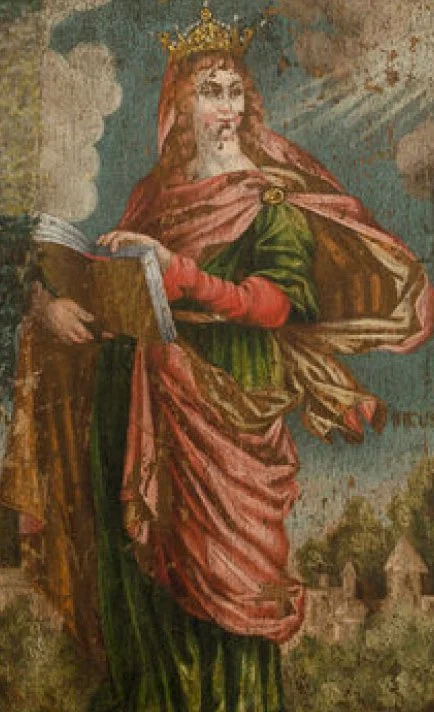
Most of the wonders told of Sandukht come from the Armenian apocryphal martyrdom cycle. The texts speak of light and angelic voices at her baptism, of heavenly strengthening in prison, and of a dream in which Christ clothes her in a bright garment and a crown. Thaddeus is said to have read the dream as a sign of her coming martyrdom. All of this is tradition.
At her death the same texts describe an earthquake, a pillar of fire, voices from heaven and a sweet fragrance. Such signs are common in ancient martyr literature and should not be repeated as confirmed events. The tradition of healings at her relics likewise has no documented medical case behind it.
Devotion to Sandukht is quiet but continuous. The Armenian Church keeps her commemoration with Thaddeus on a Saturday in July, with the Divine Liturgy, and pilgrims continue to visit the monastery of Saint Thaddeus where her memory is kept. The feast is movable, so readers should check the Armenian Church calendar for the current date.
What Scholars Say
The earliest witness to Sandukht in the Armenian histories is Movses Khorenatsi, who wrote in the fifth century or later. The longer Martyrdom of Thaddaeus is an anonymous work that survives in manuscripts and has been described and catalogued by modern scholars of Christian apocrypha. Neither is a contemporary record.
Calzolari studied how the Armenian text borrows from the Acts of Thecla and the role it gives to women. Sofyan examined Sandukht together with Saint Sukias and Saint Hripsime, and she observed that Sandukht is little known outside the Armenian Church. Encyclopaedia Iranica explains the difficulty of fitting the historical Sanatruk into the apostolic story.
The balanced reading is that Sandukht is a real figure of Armenian sacred memory, and that her biography cannot be rebuilt as first-century history. A responsible account keeps what the Church celebrates, which is faithfulness to Christ against family and power, and labels the rest as tradition or as uncertain.
Places Linked to Her Memory
The Monastery of Saint Thaddeus in Artaz, in northwestern Iran, is the chief place tied to the memory of the apostle and to Sandukht. It is a destination for Armenian pilgrims, and the Chapel of Saint Sandukht stands on a hill to the south of the main monastery.
At Holy Etchmiadzin, the mother church of the Armenian Church in Armenia, the feast of Thaddeus and Sandukht is marked with the Divine Liturgy in the chapel of Saint Thaddeus. Those who cannot travel can keep the day in prayer wherever they live.
Her story also invites a visit to the wider story of Armenian beginnings, including the royal conversion told in the lives of Saint Gregory the Illuminator, Saint Hripsime and Saint Gayane. The apostolic witness of Thaddeus and Sandukht stands as the first chapter of that history, remembered before the kingdom itself became Christian.
undefined
undefined
Sandukht and the Eastern Churches
Sandukht is honored explicitly in the Armenian Apostolic Church, which belongs to the family of Oriental Orthodox Churches and is distinct from the Byzantine Orthodox Churches. Her commemoration appears in its official calendar and in public liturgy.
Armenian Catholics share the same ancient heritage, but a specific entry for her in the current Armenian Catholic calendar was not independently confirmed. No Roman Catholic canonization, no place in the General Roman Calendar, and no commemoration in the Byzantine Orthodox calendars was found. It would be wrong to present her as universally celebrated.
For Eastern Christian readers she stands as a reminder that the faith reached Armenia through apostles and through women who would not deny Christ. Her witness speaks to anyone who has had to choose between loyalty to the Lord and the pressure of family or power, and it asks the prayers of all who share the Armenian Christian inheritance.
Frequently Asked Questions
Ask Her Prayers
Saint Sandukht reminds us that the faith in Armenia began with a few believers who paid dearly for it. We ask her prayers for the persecuted, for young people who must stand alone for Christ, and for the Armenian people. May her witness teach us to put the love of the Lord before comfort, rank and fear.
View Prayer Card