Saint Vartan Mamikonian: Armenian Commander and Martyr of Avarayr, Defender of the Christian Faith
The Armenian commander who led the resistance to Persian religious coercion and fell at the Battle of Avarayr in 451.
At a Glance
- Born
- Uncertain, perhaps about 387 or 388
- Died
- 451, at the Battle of Avarayr; May 26 or June 2 is disputed
- Titles
- Commander (sparapet) of Armenia, holy martyr, Vartan the Captain
- Feast
- Thursday before Armenian Great Lent (Vartanants), movable
- Veneration
- Armenian Apostolic Church; honored by Pope John Paul II in 2001
- Patronage
- No formal patronage; remembered for courage and defense of the faith
Who Was Saint Vartan Mamikonian?
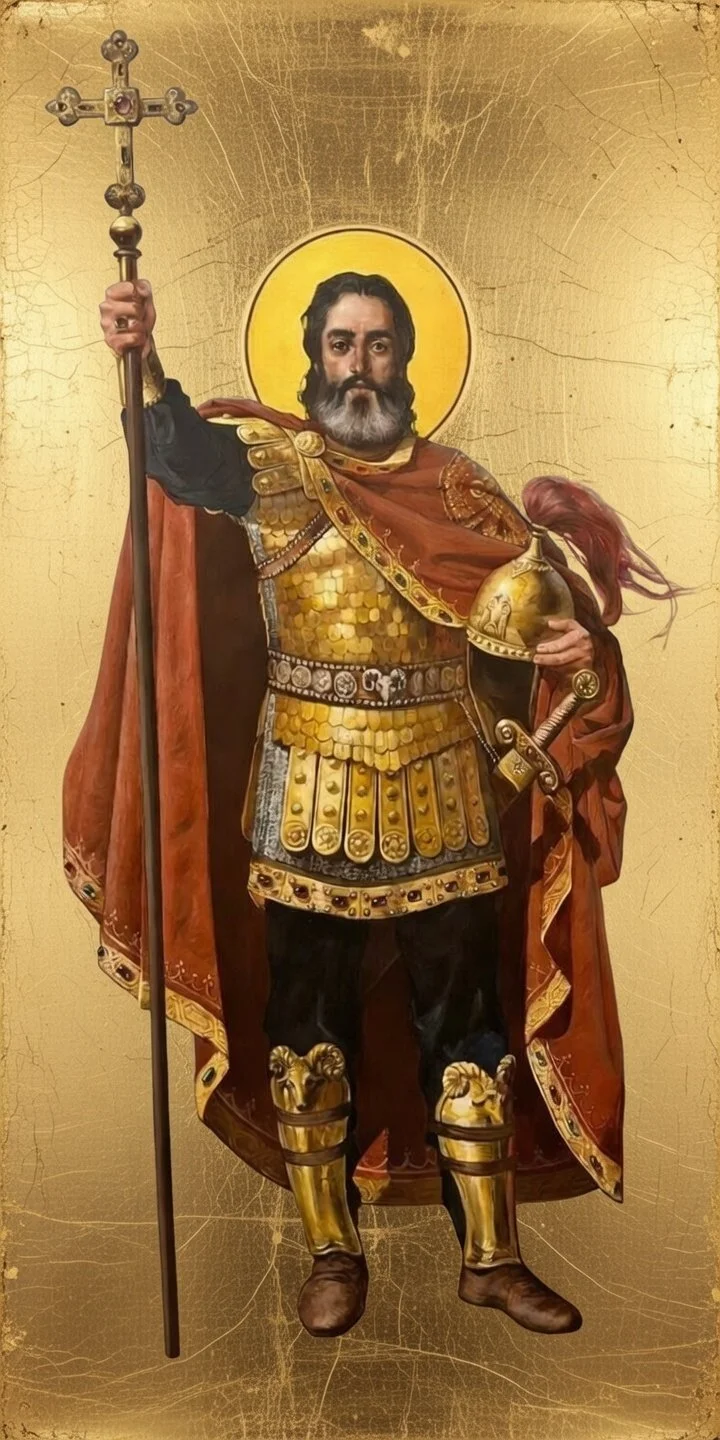
Saint Vartan Mamikonian, also written Vardan, was the commander of the Armenian forces in the fifth century and the leader of the Armenian resistance to Persian pressure to give up Christianity. He died at the Battle of Avarayr in the year 451, and the Armenian Church honors him together with his companions as holy martyrs.
The Church keeps his memory each year on the feast of Vartanants, the Thursday before Armenian Great Lent. It is one of the best loved days in the Armenian calendar, and it is marked by the Divine Liturgy, hymns and public gatherings. For Armenians the day speaks of faith that cannot be bought or frightened away.
The battle itself was a military defeat. What the Church celebrates is the steadfastness of those who fell, and the survival of the faith that they defended. This article keeps those two things apart, because history and devotion each say something true, and it marks clearly where the sources are disputed.
The Mamikonian House
Vartan belonged to the Mamikonian family, one of the great noble houses of ancient Armenia. The family held the hereditary office of sparapet, the commander of the Armenian army. His birth is uncertain, with about 387 or 388 sometimes given, and his birthplace is not known.
According to the Armenian tradition of the martyrdom of Saint Shushanik, his father was Hamazasp Mamikonian and his mother, Sahakanush, was a daughter of Saint Sahak the Parthian, the Catholicos who worked with Saint Mesrob Mashtots on the Armenian Scriptures. Through his mother, Vartan was a grandson of one of the great churchmen of his people.
Some Armenian accounts say he studied at the school founded by Sahak and Mesrob, and the dates make this plausible, though it cannot be confirmed. He married and had children. His best known daughter was Saint Shushanik, whose passion is a famous early work of Georgian Christian literature. Their family ties show how closely noble service and the life of the Church were joined in his world.
The Crisis of 449
There is no evidence that Vartan became a Christian late in life. He was raised in a Christian family, and his calling was military and political, not monastic or priestly. His turning point came when the Persian king Yazdegerd II tried to bring the Armenians back to Zoroastrian worship.
In about 449 the Armenian nobles were called to the Persian court. The historian Ghazar Parpetsi tells that some of them outwardly accepted the Persian religion, and that Vartan was among those who gave way for a time. He is then said to have explained to his family that the submission was only a show, and the nobles who wished to resist turned to him as their leader.
This story is told by a writer who was friendly to the Mamikonians, and it should be read with that in mind. It shows that the pressure on the Armenian leaders was heavy and that their choices were not simple. By 450 the resistance had become an armed revolt, with Vartan as its chief commander.
Leading the Resistance
Vartan did not found a monastery, write a theology or hold holy orders. His work was to gather the noble houses, organize the army, and try to protect the churches and the worship of the Armenian people from forced change. The uprising seized key places and resisted the setting up of Persian fire temples.
The struggle reached beyond Armenia. Persia also pressed on the neighboring lands of Georgia and Caucasian Albania. Vartan sought help from the Byzantine Empire, but the aid he needed did not come, and the Armenians had to face the Persian army largely alone.
No writings of Vartan are known. The speeches given to him and to his soldiers come mainly from Yeghishe, whose History of Vardan and the Armenian War is a work of faith as well as history. Scholars such as Robert Thomson stress that its speeches are literary, so they should be read as words preserved by Yeghishe and not as quotations from Vartan himself.
Division, Politics and the Armies
The Armenians were not united. The powerful prince of Syunik, Vasak, sided with the Persians, and the Armenian histories call him a traitor. Because those histories were written by his opponents, a fair reader will also remember that the nobles disagreed about how best to save their people, even if the sources condemn Vasak.
The armies were uneven. Ghazar writes that the Armenians numbered about 66,000, and later tradition speaks of 60,000 against a Persian force of 200,000, with elephants and heavy cavalry. These numbers are the figures of the old narratives and cannot be treated as counts. It is safe to say only that the Persian army was much stronger.
The conflict was both religious and political. The Armenian writers see it as a defense of Christian worship, and so did the soldiers who fought. Modern historians add that it was also a struggle over the power of the nobles and the rule of an empire. Both sides of the story belong to an honest account.
Avarayr and Its Aftermath
The decisive battle was fought on the plain of Avarayr in the province of Artaz, in what is now northwestern Iran. The Persian army was led by a commander the sources call Mushkan Niusalavurt. The Persians won, Vartan was killed, and several of the leading Armenian commanders fell with him.
The year, 451, is secure. The day is not. Some sources give May 26 and others June 2, and the Armenian Church does not mark the day of the battle but keeps a movable feast before Lent. Ghazar records 1,036 Armenian dead, and the Church remembers Vartan with 1,036 companions. As a battle statistic this number is uncertain, but as a liturgical number it is firmly fixed.
The burial place of Vartan is not known, and the sources reviewed do not establish an authenticated tomb or relics. The defeat did not end the faith. A later revolt under his nephew Vahan Mamikonian led to the peace of Nvarsak in 484, which gave the Armenians freedom to practice Christianity. Avarayr is remembered as the price that opened that road.
Traditions and Devotion
Vartan's cult rests on his martyrdom, not on a collection of miracles. No miracle of his lifetime and no healing at his grave has been documented in the sources reviewed, and none should be invented. Armenian devotion reads the defeat at Avarayr as a spiritual victory, which is a theological judgment and not a claim to have won the battle.
Tradition tells that before the battle the priest Ghevond, called Leontius, ministered to the soldiers. The Divine Liturgy was celebrated, Holy Communion was given, and men were baptized. These scenes express how the Church understood the struggle, and not every detail can be independently confirmed.
The feast of Vartanants is marked with hymns, sermons and gatherings in Armenian parishes around the world. A hymn to Vartan and his companions exists in the Armenian service books, but its date and author are unknown, so it is not quoted here. Because the feast is movable, readers should check the Armenian Church calendar for the current date.
What Scholars Say
Two early histories tell the story: Yeghishe, History of Vardan and the Armenian War, and Ghazar Parpetsi, History of Armenia. Both were written within a generation or two of the events, but both have a purpose. Yeghishe is theological and rich in speeches, and Ghazar is more careful but is friendly to the Mamikonians.
Robert Hewsen wrote the entry on Avarayr in Encyclopaedia Iranica, and Thomson and Gohar Muradyan have written on the two historians. They agree on the main facts, which are the family, the rebellion, the battle and the defeat in 451. They also warn about the numbers, the speeches and the exact chronology.
The balanced reading is that Vartan is firmly historical, and that the spiritual meaning of his death was formed quickly and has been kept ever since. A careful account tells what is well established, which is his rank, his leadership and his death at Avarayr, and labels the figures, the dates of birth and death, the burial and the later glorification as uncertain.
Places to Remember Him
The plain of Avarayr, in northwestern Iran, is the site of the battle. It lies near the monastery of Saint Thaddeus, and Armenian pilgrims who visit that region often remember Vartan and his companions there.
In Armenia, Vartanants is celebrated in churches and in public squares, and the Mother See of Holy Etchmiadzin keeps the feast with the Divine Liturgy. Many Armenian parishes in other lands are named for Saint Vartan, including cathedrals that hold their own processions each year.
Those who cannot travel can keep the day in prayer, with the Armenian people and with Saint Ghevond and the other companions. The memory of Avarayr belongs to every Christian who has had to choose between loyalty to Christ and the pressure of a powerful ruler.
undefined
undefined
Vartan and the Eastern Churches
Vartan is honored by the Armenian Apostolic Church, which belongs to the Oriental Orthodox family and is distinct from the Byzantine Orthodox Churches. His feast is documented in its official calendar, and it is one of the major feasts of the year.
Pope John Paul II honored Vartan and his companions in an apostolic letter of 2001 on the seventeen hundredth anniversary of the baptism of Armenia, presenting their sacrifice as a witness to fidelity to Christ. That is a significant Catholic recognition, but it is not a separate Roman Rite feast. The current Armenian Catholic calendar entry was not independently confirmed, and no universal Byzantine Orthodox commemoration was found.
For Eastern Christian readers Vartan stands as a man who lived in the shadow of two empires and still would not hand over the faith. His memory reminds us that conscience cannot be commanded by a throne, and that a people can be sustained by the courage of those who die for the truth.
Frequently Asked Questions
Ask His Prayers
Saint Vartan reminds us that faith is worth more than safety, and that courage is often found in hard choices made in company. We ask his prayers for the Armenian people, for Christians under pressure, and for all who must stand for the truth when the cost is great. May his memory strengthen us to be faithful in small things and in great ones.
View Prayer Card