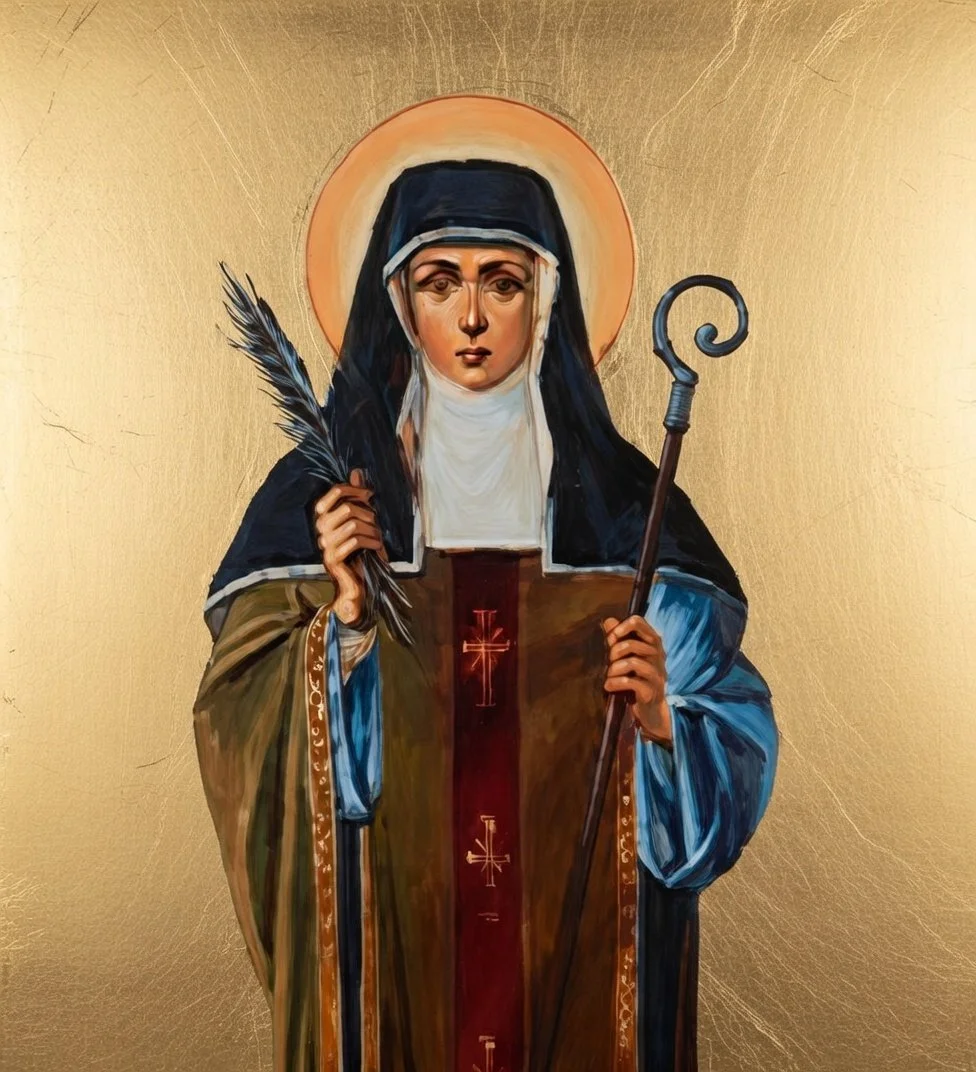
Saint Gayane: Armenian Virgin, Abbess and Martyr of Vagharshapat, Companion of Saint Hripsime
The abbess of the holy virgins who, with Saint Hripsime, is remembered as a martyr at the dawn of Armenian Christianity.
At a Glance
- Born
- Uncertain; tradition links her community with Rome
- Died
- Traditionally 301 at Vagharshapat; other sources give other years
- Titles
- Virgin, abbess, martyr, leader of the holy virgins
- Feast
- Armenian Apostolic: a movable Tuesday after Pentecost; Byzantine: September 30 with Hripsime
- Veneration
- Armenian Apostolic and Byzantine Orthodox; Catholic calendar entry not verified
- Patronage
- None formally designated
Who Was Saint Gayane?
Saint Gayane, also written Gaiane, is remembered in the Armenian Church as the superior of a community of Christian virgins and as one of the martyrs of Vagharshapat, the ancient royal city of Armenia. She is honored with Saint Hripsime and their companions, whose deaths stand at the beginning of the story of how Armenia became a Christian kingdom.
Almost everything told of her comes from tradition. The Armenian histories say she led the women, protected their vows, and died at the hands of King Tiridates III. A church bearing her name still stands in Etchmiadzin, and the Armenian Church still keeps her feast with the Divine Liturgy and with a procession of her relics.
This article tells her story as the Church tells it, and it marks clearly what is tradition and what is uncertain. Her witness is not that of a writer or a founder. It is the witness of a spiritual mother who would not betray the vows of those in her care.
A Community of Consecrated Women
Nothing can be established about Gayane's birth, parents, childhood or education. The Armenian Church's account says that she was the abbess of a community of virgins linked with the Monastery of Saint Paul in Rome, and that Saint Hripsime lived under her care. This is tradition. It does not prove that Gayane was born in Rome.
The word abbess needs care. The Armenian Church uses it, and Orthodox accounts speak of a superior or elder. It is safest to describe her as the traditional head of a group of consecrated women, and not to picture a monastery with the rules of the later Middle Ages.
Some retellings give the women noble Roman families or other backgrounds, but none of these claims is supported by early evidence. The Orthodox hagiography says Gayane raised Hripsime from childhood, which cannot be confirmed. Their bond is remembered as spiritual rather than as a blood relation, a bond of teacher and pupil and of shared faith.
Flight from Rome to Armenia
Gayane's own conversion is not recorded. The earliest narrative shows her already as a Christian leader. The turning point of her story is the persecution of Christians under the emperor Diocletian, which tradition dates to his reign from 284 to 305.
According to the Armenian Church, Gayane and her companions fled Rome to keep their vows, traveled east, passed through Edessa, and came at last to Vagharshapat, where they found shelter in wine presses. The details of the route and the dates cannot be confirmed from other sources and belong to hagiography.
The crisis came when King Tiridates III desired Hripsime and tried to take her as his wife. She refused out of her consecration to Christ. The tradition says that Gayane was brought before the king and told to persuade Hripsime to yield, and that she encouraged her to stay faithful instead. That moment is the heart of Gayane's image as a protector of another woman's conscience.
A Spiritual Mother
Gayane is remembered for the quiet work of guiding a community. The tradition says that she kept the discipline of the sisters, strengthened them in the flight and the persecution, and held them to their promise of chastity and prayer. Her authority was spiritual and was exercised in the face of danger.
No sermons, letters, prayers, rule of life or theological writings of Gayane survive. No institution in Armenia can be shown to have been founded by her. The Church of Saint Gayane at Etchmiadzin is a later memorial built in her honor, not a monastery that she is known to have established.
Her lasting influence is therefore a matter of memory. The Armenian Church counts her and her companions among the first witnesses whose sacrifice opened the way for the faith to be received by the king and the people. She is a figure of faithfulness rather than of achievement.
The Royal Persecution and the Sources
Gayane's story belongs to the narrative of the conversion of Armenia under Tiridates III and Saint Gregory the Illuminator. The traditional date of that conversion is 301. Pope John Paul II recalled that date in his apostolic letter of 2001 for the seventeen hundredth anniversary of the baptism of Armenia, and he spoke openly of the legendary features of the old account.
The main source is the History attributed to Agathangelos. Robert Thomson has shown that the Armenian text we have was composed in the later fifth century and gathers older traditions. It cannot be read as a plain report from the time. The flight from Rome, the words said to the king, and the torments should be treated as tradition and not as established facts.
The dating is also unsettled. The Armenian Church gives 301 for the martyrdoms, while the Orthodox Church in America gives 292 for the story of Hripsime and Gayane. Historians also note that the usual dates for Gregory's imprisonment, the reign of Tiridates and the conversion do not all agree with modern reconstructions. For that reason the safest wording is that she was martyred near the beginning of the fourth century.
Martyrdom, Tomb and Relics
According to the tradition, Gayane was put to death at Vagharshapat with two companions, while Hripsime and the larger group of women were killed in other places in the city. The Armenian Church places her death on the southern side of the town. The Orthodox account tells of severe tortures before the sisters were beheaded, but these details are late hagiography and cannot be verified.
The tradition says that after he was released and the king was restored, Saint Gregory gathered the remains of the martyrs and set up small chapels over their graves. The present Church of Saint Gayane was built in 630, in the time of the catholicos Ezr, and is a fine early domed basilica. UNESCO describes a vaulted burial chamber under the main apse, traditionally the place of her rest.
The building proves a long cult but does not prove the identity of the remains. The Mother See of Holy Etchmiadzin keeps a reliquary in the form of a right hand that is said to hold her relics and uses it in processions on her feast. No formal canonization date is known. Her sainthood rests on ancient recognition and continuous worship.
Traditions and Devotion
The martyrdom of Gayane and Hripsime is tied in tradition to the story of King Tiridates. After their deaths he is said to have been struck by an affliction, which the old account pictures as a change into a wild beast, until Gregory was freed from the pit and healed him through prayer. This is a legend, and Saint John Paul II himself noted its legendary character while stressing its meaning.
The tradition also says that Gregory was guided in a vision to the places where the martyrs lay, and that this led to the chapels over their graves. The historical value of the vision is uncertain. It belongs to the sacred geography of Vagharshapat, where the churches of the women are set around the mother church.
Documented devotion is more solid than the legends. The Armenian Church keeps her feast with the Divine Liturgy at her church, with a procession of the reliquary and a blessing of the people. The date is movable, falling on a Tuesday after Pentecost, so readers should check the Armenian Church calendar for the current year. No verified modern healing at her relics could be found.
What Scholars Say
The key source is Agathangelos, in the English translation of Robert Thomson, which presents the story of the holy virgins as part of the conversion of the king. Thomson's article in Encyclopaedia Iranica explains how the text was put together and why it cannot be read as an eyewitness account.
The Armenian Church's own account in the history of Saint Hripsime and her companions gives the Roman origin of the community and the journey east. The Orthodox Church in America gives a parallel life with the details of the tortures and the community, and those details should be weighed as hagiography.
A fair summary is that Gayane is an ancient and firmly venerated figure whose biography cannot be rebuilt from independent records. A careful account keeps what the Church celebrates, namely her leadership of the women, her faithfulness and her death at Vagharshapat, and treats the details of dates, the Roman background and the sufferings as tradition or as uncertain.
Places to Remember Her
The Church of Saint Gayane at Etchmiadzin is the heart of her memory. Built in 630 and restored in the seventeenth century, it is part of the group of churches and the cathedral that together are a World Heritage site. Beneath its apse lies the vaulted tomb that tradition names as her resting place.
Nearby stands the Church of Saint Hripsime, and the cathedral of Holy Etchmiadzin lies between the two. Pilgrims often visit all three, which together tell the story of the virgins, the king and the bishop. The feast of Saint Gayane is marked at her church with a procession around the grounds.
Those who cannot travel can remember her in prayer on her feast, with Hripsime and the other companions. The movable dates differ between the Armenian and the Byzantine calendars, which keep her on September 30 with Hripsime, so a reader should check the calendar of his own Church.
undefined
undefined
Gayane and the Eastern Churches
Gayane is honored in the Armenian Apostolic Church, which belongs to the Oriental Orthodox family and is not the same as the Byzantine Orthodox Churches. Her memory is also kept in the Byzantine calendar on September 30, where she is named with Hripsime and those with them, according to the Orthodox Church in America.
Armenian Catholics share the heritage of the conversion, and Pope John Paul II treated Hripsime and her companions as witnesses whose martyrdom belongs to the foundation of Armenian Christianity. A current Armenian Catholic calendar entry for Gayane by name was not independently confirmed, and no feast in the General Roman Calendar was found.
For readers in every tradition she stands as a model of spiritual motherhood. She did not bend to a king who wished her sisters to yield, and she strengthened another woman in the freedom of her conscience. Her example speaks to anyone who is asked to give way to power against the truth.
Frequently Asked Questions
Ask Her Prayers
Saint Gayane reminds us that holiness is often hidden in the care of others. We ask her prayers for those who lead and teach the young, for consecrated sisters and brothers, and for the Armenian people. May she help us to protect the conscience of the weak and to stay faithful when power asks us to give way.
View Prayer Card