Saint Hripsime: Armenian Virgin and Martyr of Vagharshapat, Witness of Conscience Before a King
The consecrated virgin whose refusal of King Tiridates III stands at the start of the story of Armenia as a Christian nation.
At a Glance
- Born
- Uncertain; tradition says a Roman noblewoman
- Died
- Traditionally 301 at Vagharshapat; the Orthodox Church in America gives 292
- Titles
- Virgin and martyr, one of the Hripsimian virgins
- Feast
- Armenian Apostolic: a movable Monday in early summer; Byzantine: September 30; historical Roman Martyrology: September 29
- Veneration
- Armenian Apostolic, Byzantine Orthodox, and the Latin martyrological tradition
- Patronage
- None formally proclaimed; honored for chastity and freedom of conscience
- Who Was Saint Hripsime?
- A Roman Maiden and a Community of Virgins
- The Refusal That Began a Journey
- A Witness, Not a Founder
- The King, the Sources and the Dates
- Martyrdom, Shrine and Relics
- Traditions and Devotion
- What Scholars Say
- Places to Remember Her
- Hripsime and the Eastern Churches
- Frequently Asked Questions
Who Was Saint Hripsime?
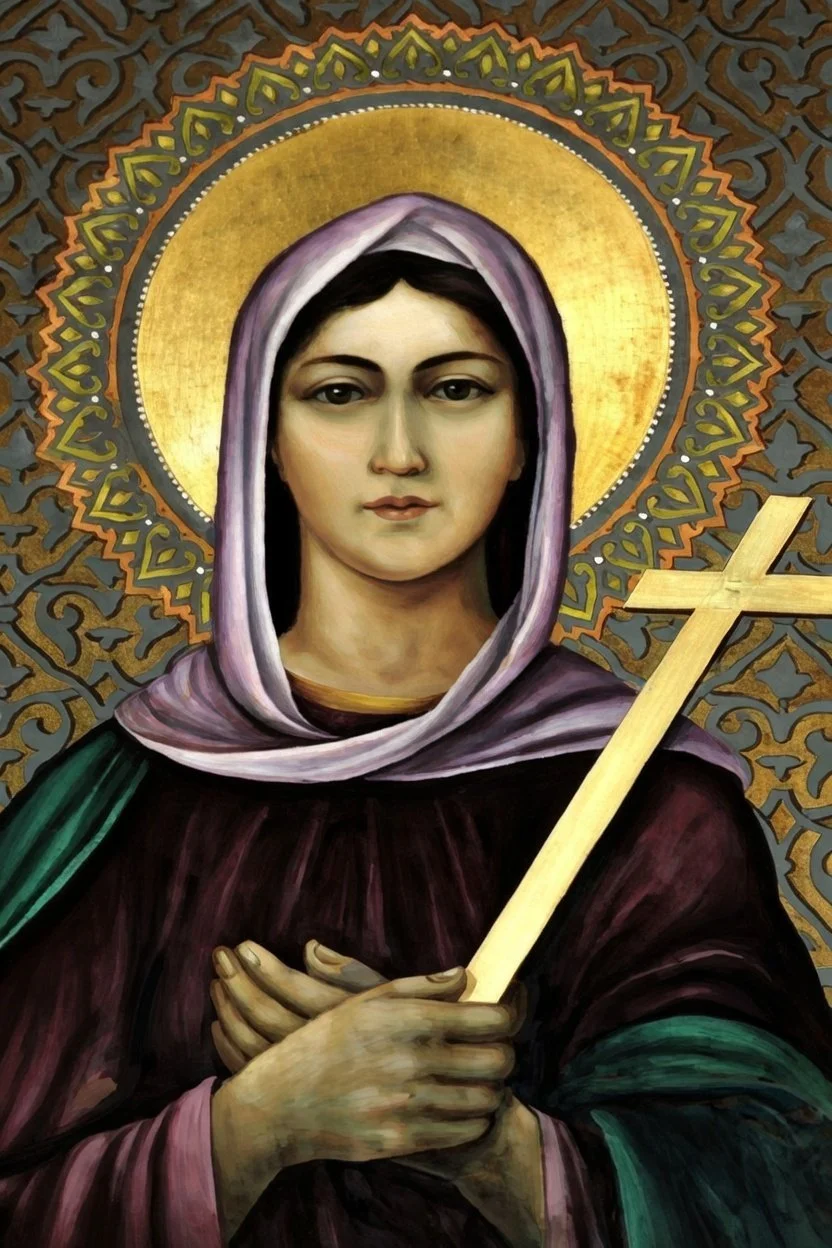
Saint Hripsime, also written Rhipsime, is remembered as a Christian virgin who died as a martyr at Vagharshapat, the royal city of ancient Armenia. She is honored together with Saint Gayane and the other women of her company, and their deaths stand at the beginning of the story of how Armenia became a Christian kingdom under Saint Gregory the Illuminator.
Her cult is ancient and wide. The Armenian Church keeps her feast with the Divine Liturgy and a procession of her relics. The Byzantine calendar names her on September 30, and the old Latin martyrology lists her on September 29. A great church bearing her name stands at Etchmiadzin and is part of a World Heritage site.
The details of her life are less certain than the strength of her memory. This article tells her story as the Church tells it, and it marks what is tradition and what is uncertain. What remains secure is that for seventeen centuries Christians have seen in her a young woman who would not let a king command her conscience.
A Roman Maiden and a Community of Virgins
Nothing certain is known about Hripsime's parents, birthplace or childhood. Armenian tradition says she came from a noble Roman family, and some tellings give her imperial or royal ancestry. No Roman record supports this, and a careful writer calls her a Roman princess only as a tradition.
The tradition says she lived in a community of Christian women linked with the monastery of Saint Paul in Rome, under the direction of Saint Gayane. The Armenian Church calls the women nuns, but the exact form of their life and rule cannot be checked. Her baptism and the story of her first vow are unrecorded.
It is also wise to be careful about family ties. Gayane is called her superior and protector, and one Orthodox life says she raised Hripsime from childhood, but this cannot be proved. Others who retell the story have called Gayane her mother or nurse. The sources do not establish a blood relation, and the bond is best described as that of spiritual teacher and pupil.
The Refusal That Began a Journey
The turning point of Hripsime's story is not her entry into religious life, about which almost nothing is told. It is her refusal to give up her vow when a ruler wanted her for himself. In the tradition, the emperor Diocletian heard of her beauty and sought to make her his wife, and she fled with Gayane and other women rather than abandon her promise to Christ.
The Armenian Church tells that they traveled east, through places linked with the life of Christ and through Edessa, and some accounts add Alexandria. A tradition in the Armenian Church of Georgia says the Mother of God guided them to Armenia. Arriving at last near Vagharshapat, the women took shelter in wine presses outside the city.
These episodes belong to hagiography. The flight from Rome, the emperor's message to King Tiridates III and the details of the route are not found in independent records. They are kept here as tradition, because they explain how a group of Christian women came to be in Armenia, and because they show the Church's own memory of what Hripsime stood for.
A Witness, Not a Founder
Hripsime left no writings. No letters, sermons, prayers or rule of life can be credited to her. The oldest tradition does not even make her the head of the community. That place belongs to Gayane, while Hripsime is remembered as the most prominent of the martyrs among the women.
The tradition says the sisters lived in chastity, prayer and common discipline. Their arrival in a land that was still largely pagan is sometimes pictured as a quiet Christian witness. There is no evidence that Hripsime founded a monastery in Armenia, preached in public, or converted any particular group of people.
Her role is therefore of another kind. In the narrative of Agathangelos, her martyrdom is the event that links the persecution of Christians under Tiridates with the release of Gregory the Illuminator and the conversion of the royal house. Pope John Paul II recalled this role in his apostolic letter of 2001 for the anniversary of the baptism of Armenia, speaking of her martyrdom together with the sufferings of Gregory.
The King, the Sources and the Dates
Hripsime's story belongs to the reign of Tiridates III, in the age of Diocletian. The Armenian Church traditionally dates the conversion of the kingdom to 301, though historians continue to discuss the exact chronology. In the tradition, the king was at first hostile to Christians and imprisoned Gregory, and he desired Hripsime and demanded that she become his wife.
The tradition says that when she refused, he grew angry, and that Gayane was pressed to persuade her to give way but encouraged her to stay true instead. The women were then tortured and killed. The Orthodox Church in America dates the story to 292 and the Armenian Church to 301, which shows how the dating differs from one tradition to another.
The main source is the History attributed to Agathangelos. Robert Thomson has shown that the Armenian text was composed in the later fifth century and contains legendary and biblical elements. The scholar Anna Sofyan has also noted parallels between Hripsime and the stories of other holy virgins such as Agnes and Irene. The wise conclusion is that she may preserve the memory of a real martyr of the conversion age, while the detailed story of the flight and the sufferings cannot be independently verified.
Martyrdom, Shrine and Relics
The Armenian Church tells that Hripsime and thirty-two companions died on the northeastern side of Vagharshapat, while Gayane and two companions were killed elsewhere in the city. A woman named Mariamne is also named in the same persecution. Other sources give different totals, and the numbers should not be forced into a single count.
The tradition says that after he was freed, Saint Gregory gathered the bodies, buried them with honor, and set up small chapels at their graves. The present Church of Saint Hripsime was completed in 618 under the catholicos Komitas I, according to UNESCO, and is among the finest early Armenian buildings, with a central dome and a distinctive plan of apses and niches. Excavations in the 1970s found earlier Christian and pagan burials at the site.
The Armenian Church reports that in 1979 sealed graves with headless remains were found near the shrine, and the catholicos Vasken I judged it highly probable that they were the companions of Hripsime. This is an ecclesiastical judgment and not a scientific proof. The Church also keeps a reliquary of her right hand, carried in procession on her feast. No date of formal canonization is known, because her cult comes from the age of local recognition.
Traditions and Devotion
The best known tradition tells of what happened after the martyrdom. Agathangelos says that Tiridates and his court were struck down and that the king took on the nature of a wild boar, until Gregory was released from the pit and healed him through prayer. Pope John Paul II repeated the story in 2001 while noting that it is a traditional and legendary account. It is not a medical or historical fact.
Another tradition links Hripsime with the Cross of Varag. The Armenian Church of Georgia says that she carried a relic of the True Cross and buried it near Mount Varag, and that it was found again by a miracle in the seventh century, which is the origin of the Armenian feast of the Holy Cross of Varag. The provenance of the relic and her part in it cannot be verified.
Devotion today is simple and public. Armenians keep her feast with the Divine Liturgy, pilgrimages and hymns, and they venerate her relics. Her feast is movable, falling on a Monday in early summer just before that of Gayane, so readers should check the Armenian Church calendar for the current year. No individual healing at her shrine has been documented well enough to be called verified, and none is claimed here.
What Scholars Say
The chief source remains Agathangelos, read in Robert Thomson's English translation and discussed in his article in Encyclopaedia Iranica. Davit Sahakyan has more recently shown that the different layers of the History call for careful critical reading, especially in its prayers and its story of the conversion.
The Armenian Church's own accounts, those of the Mother See of Holy Etchmiadzin and of the Eastern Diocese in America, give the fuller traditional picture, including the numbers of the companions and the discovery of the graves in 1979. The Orthodox Church in America provides a parallel life with its own details, including the date 292.
A fair summary is that Hripsime is a deeply rooted figure of Christian memory whose shrine, building and continuous worship are better documented than her biography. The existence of an ancient cult should not be dismissed because the story is legendary, and it should not be used as proof that every detail occurred. This article keeps to that middle path.
Places to Remember Her
The Church of Saint Hripsime at Etchmiadzin, completed in 618, is the center of her memory. Its vaulted interior and cross-shaped plan have made it a model of Armenian church architecture, and pilgrims come to pray at the tomb where her remains are said to lie.
Not far away stands the Church of Saint Gayane, and between them is the cathedral of Holy Etchmiadzin. Together these three places tell the story of the king, the virgins and the bishop. On her feast the reliquary of her hand is carried in procession from the cathedral to her church.
Those who cannot travel can remember her on her feast with Gayane and the companions, or on September 30 in the Byzantine calendar. The Armenian dates move each year, so check the calendar of your own Church. Wherever she is invoked, she is asked for help by those who need courage to keep a promise.
undefined
undefined
Hripsime and the Eastern Churches
In the Armenian Apostolic Church, which belongs to the Oriental Orthodox family, Hripsime is inseparable from the story of the conversion of the nation. In the Byzantine tradition, the Orthodox Church in America names Rhipsime, Gaiane and their companions on September 30, and the Greek Orthodox synaxarion names them as well.
Catholics know her through the historical Roman Martyrology, which lists her on September 29, and through the apostolic letter of Pope John Paul II in 2001, which recalled her martyrdom as part of the story of Armenia's baptism and noted its legendary character. A single Armenian Catholic calendar date was not confirmed, so Armenian Catholic readers should check their own eparchial calendar.
She is thus one of the rare saints whose memory crosses the boundaries of several Churches. Across them she stands for three things: the witness of martyrs, the dignity of a life freely given to Christ, and the conviction that faith cannot be commanded by a throne. That shared memory is a small sign of the unity that Christians still hold in common.
Frequently Asked Questions
Ask Her Prayers
Saint Hripsime reminds us that conscience cannot be bought or ordered, and that a quiet refusal can change the course of a nation. We ask her prayers for young people who must stay true to a promise, for those who suffer for the faith, and for the Armenian people. May her courage help us to keep faith with Christ in small choices and in great ones.
View Prayer Card