Catholic Saints • New York • 1774 to 1821
Saint Elizabeth Ann Seton and Eliza Hamilton: Two New York Widows and the Children They Served
Two women in early New York lost their husbands within months of each other, one in 1803 and one in 1804. Each turned her grief toward poor widows and children. One became a saint. The other became the founder of an orphanage that still exists in some form.
Elizabeth Seton at a Glance
- Born
- August 28, 1774, New York City
- Married
- January 25, 1794, to William Magee Seton
- Widowed
- December 27, 1803, in Tuscany
- Received into the Church
- March 14, 1805, St. Peter’s Church, New York
- Founded
- Sisters of Charity of St. Joseph’s, Emmitsburg, Maryland (1809)
- Died
- January 4, 1821, Emmitsburg, aged 46
- Canonized
- September 14, 1975, by Pope Paul VI
A New York Girl Before the Revolution Ended
Elizabeth Ann Bayley was born in New York City on August 28, 1774, the second child of Dr. Richard Bayley and Catherine Charlton Bayley. Her father was a physician who later became the first health officer of the port of New York, and her mother belonged to a family of Episcopalian clergy. When Elizabeth was about three, her mother died. The loss marked her. In later life she wrote about being aware as a child of the presence of God in nature and of the brevity of life.
She grew up in a prosperous and religious Episcopalian milieu in a city that was still recovering from British occupation. On January 25, 1794, at the age of nineteen, she married William Magee Seton, a young merchant of twenty-five from a leading New York shipping family. They were married by Samuel Provoost, the Episcopal bishop of New York. Over the next several years they had five children: Anna Maria, William, Richard, Catherine and Rebecca.
Her adult life began with comfort, society and a growing family. It would end in poverty, exile and a new church, and the turning points came faster than anyone would have predicted.
Part II
The Society for the Relief of Poor Widows
In 1797 a group of New York women, led by the Scottish-born educator Isabella Graham, founded the Society for the Relief of Poor Widows with Small Children. It was one of the first private charities of its kind in the country. Elizabeth Seton, who was twenty-two, is named in the sources I consulted as one of the founding members.
The society’s work was practical. Subscribers made regular donations, and volunteers delivered food, coal and moral encouragement. Staff members assessed each recipient’s needs, looked for drinking problems, and tried to find helpful relatives. They matched women with jobs, ran a sewing program that provided regular income, and distributed spinning wheels and cloth. The society also operated schools for fatherless children, and it hired some mothers to teach across the city. The goal, in the language of the time, was to keep families out of the almshouse.
The scale is worth noting. In its first year the society helped ninety-eight widows and two hundred twenty-three children. By 1800 the number had grown to 152 widows and 420 children. These are not abstract numbers. They represent the first sustained effort by New York women to look at poverty in their own streets and organize a response.
For Elizabeth Seton, the work was an education. She saw what happened to a woman and her children when the husband died or failed. A few years later she would learn this for herself.
Part III
Italy, Loss and a New Church
William Seton’s family firm began to fail. His father died in 1798, and William, who had never been strong, took over the business as the economic situation worsened and his health declined. He had tuberculosis. In late 1803, in the hope that a warm climate might help, he and Elizabeth sailed with their eldest daughter, Anna Maria, to Tuscany, where they had business friends, the Filicchi family.
The voyage ended in disaster. On arrival, the family was held in quarantine in a lazaretto at Livorno. William died on December 27, 1803, and was buried in the Old English Cemetery in Livorno. The sources differ on whether he died at Livorno or in nearby Pisa, so I name only the Tuscan coast. Elizabeth was twenty-nine, a widow in a foreign country with a small child and four more at home.
The Filicchi family took her in. During the weeks she spent with them, she attended Catholic Mass and was deeply affected by what she saw: the Blessed Sacrament, the devotion to Mary, the sense of a continuous tradition. When she returned to New York in June 1804, she took with her a serious interest in the Catholic faith. She opened a school for girls to support the family, and she spent about eight months in correspondence and reflection before making her decision.
On March 14, 1805, she was received into the Catholic Church by Father Matthew O’Brien at St. Peter’s Church in Manhattan. She was confirmed the following year by Bishop John Carroll. The decision cost her dearly. Her Episcopalian relatives were hurt, some friends dropped away, and the pupils at her school declined. She had chosen a minority faith in a city that was hostile to it.
Part IV
Eliza Hamilton and the Orphans
Seton was not the only New York widow to turn her loss into charity. On July 12, 1804, Alexander Hamilton died of the wound he had received in his duel with Aaron Burr the day before. His wife, Elizabeth Schuyler Hamilton, whom everyone called Eliza, was forty-seven, with seven living children and a pile of debts. She would live to ninety-seven.
Eliza Hamilton had known Isabella Graham, the leader of the widows’ charity. In 1806 she joined Graham and Joanna Bethune in founding the Orphan Asylum Society of New York, which cared for children who had lost both parents. Eliza served as its leader for years, and the institution continues today under the name Graham Windham. The date of the founding and her role are well documented in the institution’s own history, and the story of her later life, built on the work of preserving her husband’s papers and caring for orphans, is a widely known one.
The connection between Seton and Hamilton in this article is the common world they occupied and the common problem they faced. Both women were widowed within months of each other, both lived in New York, and both were connected to the circle around Isabella Graham. I found no documentation of a close personal friendship between them in the sources I consulted, so I do not claim one. The link is thematic rather than biographical, and that is how I offer it: two women of the same city and the same years, who answered the same loss in similar ways.
Part V
From a Bowery Boarding House to Emmitsburg
Seton’s money troubles grew after her conversion. In 1807 she opened a boarding house in the Bowery. The Embargo Act of that year, which disrupted American trade, contributed to the financial collapse of the family’s remaining resources, and they moved to Staten Island. The sources I consulted do not give an exact date for the move.
By most accounts, in 1808 she went to Baltimore at the invitation of Bishop Carroll and opened a school for girls. In early 1809 she moved with her children and several followers to Emmitsburg, Maryland. On July 31, 1809, she established the Sisters of Charity of St. Joseph’s, the first community of religious sisters founded in the United States. She opened St. Joseph’s Academy and Free School in the same year.
In 1811 the sisters adopted a rule modeled on that of the Daughters of Charity, the community founded by Vincent de Paul and Louise de Marillac. In 1813 Seton and several colleagues took vows of poverty, chastity, obedience and service to the poor. By 1815 she was sending three sisters to manage the St. John’s Orphan Asylum in Philadelphia, and in 1817 she established a mission in New York City. She had returned in a sense to the city of her birth, now in a habit, running a school for poor children.
The sisters taught the children of the poor and of the well-to-do side by side, and they trained teachers. This was the start of what became the American Catholic parochial school system.
Part VI
Death, Canonization and a Long Reach
Elizabeth Seton died in Emmitsburg on January 4, 1821, at the age of forty-six. She had suffered from tuberculosis for years, and she had lost two daughters, Anna Maria and Rebecca, to illness. Her sons had grown up and gone out into the world. In the years since, the community she founded spread across the country, and in 1850 the Emmitsburg community merged with the Daughters of Charity of St. Vincent de Paul.
The Church recognized her with remarkable speed by the standards of the time. She was beatified by Pope John XXIII on March 17, 1963, and canonized by Pope Paul VI on September 14, 1975. She was the first person born in the United States to be canonized, and her feast day is observed on January 4.
There is something right about telling her story alongside Eliza Hamilton’s. They shared a city and a loss, and each of them looked at the children whom the city had overlooked. Elizabeth Seton did it as a religious founder. Eliza Hamilton did it as a trustee and benefactor. The Church remembers only one of them as a saint, but the city remembers both.
Part VII
Timeline
- 1774: Elizabeth Bayley born August 28 in New York City
- 1794: Marries William Magee Seton on January 25
- 1797: The Society for the Relief of Poor Widows with Small Children is founded
- 1803: Sails to Tuscany; William dies December 27
- 1804: Returns to New York in June; Alexander Hamilton dies July 12
- 1805: Received into the Catholic Church March 14
- 1806: Eliza Hamilton helps found the Orphan Asylum Society
- 1809: Founds the Sisters of Charity of St. Joseph’s at Emmitsburg on July 31
- 1821: Dies January 4
- 1963: Beatified March 17
- 1975: Canonized September 14
What Two Widows Did with Their Grief
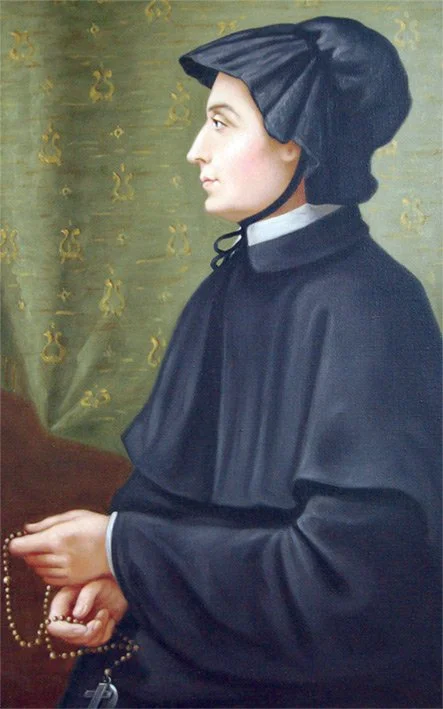
Neither woman asked for the loss that changed her life. Each turned it toward children who needed someone. The prayer card of Saint Elizabeth Ann Seton is a good companion for anyone who is grieving, teaching or serving children.
View the Saint Elizabeth Ann Seton Prayer Card →Frequently Asked Questions
