Saint Elizabeth the New Martyr: Grand Duchess of Russia, Founder of the Martha and Mary Convent and Martyr of Alapaevsk
A German princess who became a Russian Orthodox sister of mercy and died a martyr
At a Glance
- Born
- November 1, 1864, Darmstadt
- Died
- July 18, 1918, near Alapaevsk, Russia
- Feast
- July 18 (July 5 on the Old Calendar)
- Glorified
- 1981 (ROCOR), 1992 (Moscow Patriarchate)
- Title
- New Martyr, Grand Duchess
- Relics
- Church of Saint Mary Magdalene, Jerusalem
- Who Was Saint Elizabeth the New Martyr?
- Early Life and Family
- Her Entry into the Orthodox Church
- The Martha and Mary Convent of Mercy
- Her Letters and Her Character
- Revolution, Arrest and Imprisonment
- Martyrdom at Alapaevsk
- Glorification and Relics
- Devotion and Tradition
- Why She Matters to the Eastern Churches
- Frequently Asked Questions
Who Was Saint Elizabeth the New Martyr?
Saint Elizabeth the New Martyr was born a German princess and became a Russian grand duchess, a convert to Orthodoxy, the founder of a community of mercy in Moscow, and a martyr. She is one of the best documented saints of the twentieth century, since her letters, the records of her convent and the church records of her glorification survive.
Her story links court and slum, prayer and nursing, forgiveness and violence. It is also a story of the Russian Revolution, in which her family and her faith were both targets of the new regime.
Most of the main facts of her life are well documented. The details of her last hours in the mine are disputed, and this article marks those as TRADITION or UNCERTAIN.
Early Life and Family
Elizabeth was born on November 1, 1864, at Darmstadt in the Grand Duchy of Hesse, in what is now Germany. Her father was Louis IV, Grand Duke of Hesse, and her mother was Princess Alice, a daughter of Queen Victoria. Her family called her Ella.
She grew up in a household that joined royal rank with religious teaching and practical charity. Her mother stressed care for the sick and the poor. When Elizabeth was a child, her mother died in an outbreak of diphtheria, and the children came more under the influence of Queen Victoria. Elizabeth was raised Lutheran, and she also met Anglican worship during her time in Britain. She was named after Saint Elizabeth of Hungary, a saint of her ancestral family. This does not mean that she was ever a Roman Catholic.
In 1884 she married Grand Duke Sergei Alexandrovich, a son of Emperor Alexander II and an uncle of the future Emperor Nicholas II. Her younger sister Alix later married Nicholas and became the Empress Alexandra. Elizabeth and Sergei had no children of their own, but they cared for the children of Sergei's brother Grand Duke Paul.
Her Entry into the Orthodox Church
Elizabeth was not required to give up her Lutheran faith when she married. Her conversion came slowly, after years of life in Russia, study of Orthodoxy and observation of her husband's practice. Letters to her father in January 1891 show how seriously she took the decision, and how much tension it caused. She wrote that it came from her own conscience and that her husband had not pressed her. She was received into the Orthodox Church in 1891.
The second turning point was the murder of her husband. In February 1905, Sergei was killed near the Kremlin by a bomb thrown by the revolutionary Ivan Kalyayev. The date is February 4 on the Julian calendar. Elizabeth went to the scene herself. She later visited Kalyayev in prison and urged him to repent. This visit is firmly remembered in Orthodox biographies, but the exact words of their talk should not be quoted without a traceable source.
After her widowhood she withdrew gradually from court life, sold valuable belongings, and gave her resources to the founding of a community that joined prayer with active mercy.
The Martha and Mary Convent of Mercy
Her main work was the Martha and Mary Convent of Mercy in Moscow, on the Bolshaya Ordynka street. The name recalls the sisters of Bethany, who stand for service and for listening to Christ. Work at the convent is dated to February 1909, and Westminster Abbey records a dedication of Elizabeth and seventeen women in April 1909.
Its sisters took commitments of obedience, chastity and non-possession, but the community was not at first the same as a fully enclosed monastery. Nursing, social help and religious teaching were basic to its calling. A historical study reports that the community had eighteen sisters in 1910 and grew substantially by 1913. These numbers show growth and are not a fixed membership.
The convent gave medical care to people who could not pay, fed the poor, helped needy children, offered religious teaching and visited the suffering. A description printed in Moscow in 1914 is strong evidence of the actual work, since it comes from her lifetime. Elizabeth held that charity had to rest on prayer, self-denial and the life of the Church.
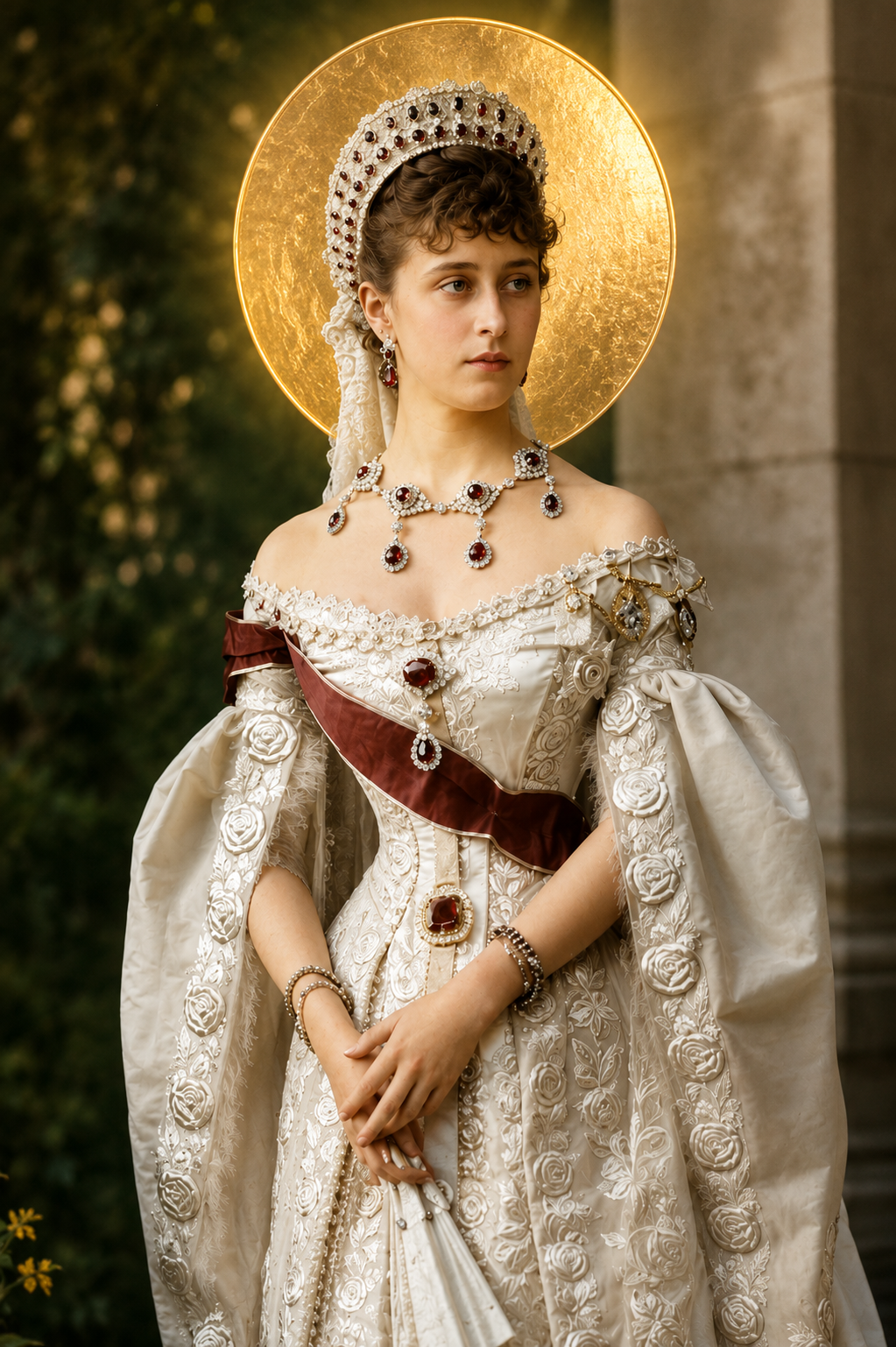
Her Letters and Her Character
Elizabeth wrote no systematic theology. Her written legacy is chiefly her letters, her instructions for the convent's work and her personal reflections. A collection of her correspondence was published in Moscow in 2011, and extracts appear in publications of the convent.
These letters are important because they give her own words from before her martyrdom, and are less open to later pious additions. Readers should trust them over unsourced quotations that circulate online.
Her gifts also included a practical sense. She raised funds, bought property, organized staff and supported medical work. This experience came from her earlier charitable projects among the nobility, and it helped her to build a lasting institution and not only a gesture of goodwill.
Revolution, Arrest and Imprisonment
Elizabeth's life crossed with the collapse of imperial Russia. Revolutionary groups attacked the autocracy, and political violence, social unrest and war weakened the state. The murder of her husband was part of that violence. Her visit to his killer is remembered as an act of Christian forgiveness, and it does not mean that she approved the revolutionary cause.
After the revolution of 1917 the Romanovs became a target. Her German birth did not protect her. The convent at first continued its work, but she was arrested in May 1918 and taken from Moscow. Westminster Abbey and the convent's own account give May 7 for her arrest. She was moved through places of detention and came at last to Alapaevsk in the Urals. She was joined in captivity by Sister Barbara Yakovleva, who was also killed.
Her arrest and death had political and religious sides. She was both a Romanov and the head of an Orthodox sisterhood, and an honest account does not reduce the reason to one motive. There is no evidence that she was offered release in return for denying Christ, so no formal trial or profession of faith should be invented.
Martyrdom at Alapaevsk
On the night of July 17 to 18, 1918, Elizabeth, Barbara and other prisoners, including other Romanov relatives, were taken to an abandoned mine near Alapaevsk and murdered. Several were thrown into the shaft, and explosives were used. This came shortly after the killing of Nicholas II and his family at Ekaterinburg.
TRADITION: Orthodox biographies say that Elizabeth survived the fall for some hours, that hymns were heard from the mine, and that she bound the wounds of Prince John Konstantinovich with part of her clothing. UNCERTAIN: the order of the deaths, how long she lived, what she said and what she was able to do are disputed. The historian Lyudmila Kulikova has questioned several traditional details using material from the original investigation, so these accounts should not be written as settled fact.
After anti-Bolshevik forces took the region, her body was recovered and identified. Her coffin and Barbara's travelled east, eventually through China, and were laid in the Church of Saint Mary Magdalene in Gethsemane, Jerusalem, around 1920 to 1921. Elizabeth had visited the Holy Land earlier in life.
Glorification and Relics
The Russian Orthodox Church Outside Russia glorified Elizabeth and Barbara with the New Martyrs and Confessors of Russia in services that began on October 31, 1981, and culminated on November 1. Westminster Abbey gives 1984 for this earlier recognition, but the Church's own history supports 1981. The Moscow Patriarchate glorified them in 1992, at a council of bishops that met from March 31 to April 5.
Before the 1981 ceremonies their relics were examined in Jerusalem, and parts were taken to New York for veneration, including Elizabeth's right hand. The main relics rest in the Church of Saint Mary Magdalene in Jerusalem, and not at the convent in Moscow. Church accounts describe parts of the remains as incorrupt. This should not be taken to mean that her whole body was preserved without decay.
The convent complex in Moscow was returned to the Church in 1992 and its sisterhood was restored. Relics visited Russia in 2004 and 2005, and the Moscow Patriarchate reported large crowds. These reports show the scale of devotion and do not by themselves prove any cure. Her statue was unveiled at Westminster Abbey in 1998, among the twentieth century martyrs.
Devotion and Tradition
Believers ask Elizabeth for help in sickness, poverty, suffering and persecution, and nurses and charity workers look to her. UNCERTAIN: no formal decree names her patron of a particular profession, and no medically investigated healing has been verified as a miracle of her intercession. A careful account should not invent miracles or counts of miracles.
TRADITION: biographies say that she wished to be buried near the Church of Saint Mary Magdalene in Jerusalem and that this wish was fulfilled. Her burial there is historical. Whether she or the later storytellers understood the wish as a prophecy cannot be known.
The strongest devotion rests on what can be documented: a woman who left a palace to serve the poor, forgave the man who murdered her husband, and kept her faith under arrest.
Lord Jesus Christ, You humbled Yourself to serve. Through the prayers of Saint Elizabeth, give us hearts that forgive our enemies, hands that serve the poor and the sick, and faith that remains steady in every trial. Amen.
This is a short original prayer written for this article. It is not an official liturgical text. The Orthodox Church in America publishes the official troparion for her feast.
Why She Matters to the Eastern Churches
For Orthodox Christians she is a glorified martyr whose life unites conversion, prayer, organized charity and endurance in persecution. Her convent shows that Martha and Mary can work together: prayer is the root of service, and service to the suffering is a sign of true prayer. Her feast is July 18, or July 5 on the Old Calendar.
For Eastern Catholics, her life is an example of Eastern Christian spirituality and mercy. She was glorified by Orthodox authorities, and no reliable Vatican document has been found that makes her a canonized Catholic saint. No universal Eastern Catholic feast for her has been verified, so her Orthodox feast should not be called a Catholic observance.
Catholics may still study and admire her witness. She stands among the Christian martyrs of the twentieth century honored at Westminster Abbey, and her example speaks to believers of every tradition.
Frequently Asked Questions
Ask Her Prayers
Saint Elizabeth is asked for help by nurses, by those who serve the poor and by those who have been wronged and wish to forgive. You may wish to keep a prayer card of Saint Elizabeth near you as a reminder to pray for the suffering and for those who persecute.
View Prayer Card