Saint Euphrasia Eluvathingal: Life, Miracles & The Praying Mother of Kerala
Syro-Malabar Catholic Church • Congregation of the Mother of Carmel • Ollur, Kerala • 1877–1952
Saint Euphrasia Eluvathingal
The Praying Mother and Mobile Tabernacle — a Syro-Malabar Carmelite nun who spent nearly half a century in a small convent in Kerala, carrying within her a divine presence so visible to those around her that they named her after the vessel that houses God. Canonized by Pope Francis in 2014, she is the third saint of the ancient St. Thomas Christian community.
At a Glance
- Born
- October 17, 1877 — Kattoor, Thrissur district, Kerala, India (baptized Rosa Eluvathingal)
- Died
- August 29, 1952 — St. Mary's Convent, Ollur, Kerala (age 74)
- Religious Name
- Sister / Mother Euphrasia of the Sacred Heart of Jesus, CMC
- Order
- Congregation of the Mother of Carmel (CMC) — founded by St. Kuriakose Elias Chavara
- Church
- Syro-Malabar Catholic Church (East Syriac rite)
- Feast Day
- August 29 (Syro-Malabar); August 30 (universal Church)
- Beatified
- December 3, 2006 — St. Anthony's Forane Church, Ollur (Cardinal Varkey Vithayathil, on behalf of Pope Benedict XVI)
- Canonized
- November 23, 2014 by Pope Francis — St. Peter's Square, Rome
- Primary Shrine
- St. Mary's Convent, Congregation of the Mother of Carmel, Ollur, Thrissur, Kerala
- Titles
- "Praying Mother," "Mobile Tabernacle," "Spouse to the Divine and Mother to All Humans"
- Patron
- Those who suffer; the sick; those seeking deeper prayer
In the Carmelite tradition, holiness is primarily hidden. Its greatest figures have typically not been preachers who addressed multitudes or founders who built institutions across continents. They have been people who found God in the interior castle — in the silence of the chapel, in the discipline of the cloister, in the unceasing conversation of the soul with its Creator. Their holiness shows not in what they accomplished but in what they became: vessels so transparent to the divine light that those around them could see God through them.
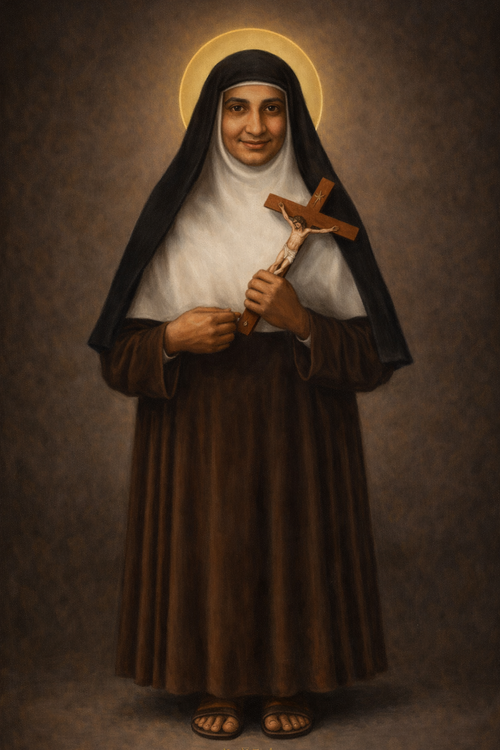
Saint Euphrasia Eluvathingal was such a person. For nearly forty-eight years she lived within the walls of St. Mary's Convent at Ollur in Kerala's Thrissur district, a member of the Congregation of the Mother of Carmel — the first indigenous women's religious congregation of the Syro-Malabar Church, founded by Saint Kuriakose Elias Chavara. She was novice mistress, briefly mother superior, and then simply a member of the community — praying, serving, suffering, and radiating. The people of Ollur called her the "Praying Mother." Her fellow sisters called her the "Mobile Tabernacle," because wherever she walked, the divine presence she carried within her seemed to fill the air around her.
When Pope Francis canonized her on November 23, 2014 — in the same ceremony that canonized her congregation's founder, Saint Kuriakose Elias Chavara — the Syro-Malabar Church gained its third saint. She was the fourth Indian to be formally canonized by the Catholic Church, and the third saint to emerge from the ancient St. Thomas Christian community of Kerala. This is the complete story of her life.
The CMC and the Syro-Malabar Carmelite Tradition
To understand Euphrasia Eluvathingal, one must first understand the congregation she entered and the community that shaped her from childhood.
The Syro-Malabar Church: Ancient Roots
The Syro-Malabar Catholic Church traces its origins to the apostolic mission of St. Thomas the Apostle, who tradition holds arrived in Kerala in 52 AD. The St. Thomas Christians — called Nasrani — maintained an unbroken Christian presence for nearly two millennia, using the East Syriac liturgy of the ancient Church of Edessa. Their liturgical language draws on Classical Syriac, a form of Aramaic; their theology was shaped by the great Syriac Fathers; their identity was summarized in the phrase: "Indian in culture, Christian in faith, Syriac in liturgy." Euphrasia was born into this ancient community, and its liturgical world — the Holy Qurbana, the Rosary, the East Syriac devotional heritage — was the air she breathed from birth.
The Congregation of the Mother of Carmel
The Congregation of the Mother of Carmel (CMC) is the first indigenous women's religious congregation of the Syro-Malabar Church. Its origins lie in the vision of Saint Kuriakose Elias Chavara, who understood that the Church's renewal required women in consecrated religious life as much as it required men. He supported the establishment of the first Carmelite convent for women at Koonammavu in 1866, under the Carmelite rule of the Third Order of Discalced Carmelites. The congregation grew rapidly, establishing new convents across the Thrissur diocese and beyond.
The CMC spirituality is Carmelite at its core — shaped by the tradition of Teresa of Ávila, John of the Cross, and Thérèse of Lisieux — but expressed within the distinctive liturgical and cultural heritage of the Syro-Malabar Church. It combines contemplative depth with active apostolate: prayer and service, silence and mission, the interior castle and the schoolroom. Euphrasia entered this congregation as a teenager and lived entirely within its charism for the rest of her long life.
Part II
Early Life: Rosa of Kattoor (1877–1887)
Rosa Eluvathingal was born on October 17, 1877, in the village of Kattoor in the parish of Edathuruthy, in the Diocese of Thrissur, Kerala. She was the eldest child of Cherpukaran Anthony Eluvathingal and his wife Kunjethy Chalissery — a wealthy, devout Syro-Malabar Catholic family with deep roots in the ancient Nasrani community. She was baptized on October 25, the eighth day after her birth, in the Mother of Carmel Church at Edathuruthy, and named Rosa after St. Rose of Lima — whose story of radical penance, hidden holiness, and mystical suffering her mother would often tell her.
The family was wealthy and prominent. Her father Anthony was known as a man of determination and firm will — qualities Rosa would inherit, along with his quick temper, which she spent her entire religious life disciplining. Her mother Kunjethy was simple, unassuming, and deeply devout: it was she who taught Rosa to pray the rosary daily and to participate regularly in the Holy Qurbana. From her mother Rosa received the habit of Marian prayer; from her father she received the force of character that would sustain her through decades of illness, criticism, and interior darkness.
Rosa had three brothers and a younger sister. The sister died in early childhood — a loss that would deepen young Rosa's understanding of suffering and the fragility of life, and that helped soften her father's resistance to her religious vocation years later. She heard her mother tell the stories of St. Rose of Lima's virtues and penances; she read about the hidden lives of the saints; and from these she formed, even in early childhood, a single desire: to be holy, and to be so in a quiet, hidden manner that no one would notice.
The Apparition of the Blessed Mother (age 9)
At the age of nine, Rosa experienced what devotees of her memory describe as an apparition of the Blessed Virgin Mary. The details have been transmitted primarily through family tradition, but the effect was decisive: from that moment, Rosa made a private vow of virginity and dedicated her life entirely to God. The world with all its wealth and marriage arrangements ceased to be a live option for her. Her whole interior being was oriented in a single direction, and nothing her father could arrange would change it.
At around age ten, Rosa was enrolled in the boarding school attached to the CMC community — the very Carmelite congregation she would later join. This decision, seemingly practical, would prove providential: it placed her directly in the spiritual environment of the community whose charism she already intuitively shared, and gave her years of formation before she formally entered religious life.
Part III
A Vocation Defended: Against Family, Against Illness
As Rosa grew into young womanhood, the path toward religious life encountered two substantial obstacles. The first was her father's opposition; the second, more formidable in some ways, was her own body.
Her Father's Resistance
Anthony Eluvathingal had plans for his eldest daughter. She was beautiful, intelligent, and from one of the most prosperous families in the region. He wanted to arrange a marriage with the son of another wealthy family. Rosa refused, quietly but absolutely. She had made her vow at nine; she had no intention of breaking it at seventeen or twenty. The standoff between them lasted years.
It was Rosa's own prayer life — and the sudden death of her younger sister — that eventually softened her father's resolve. Watching his daughter's unwavering devotion and facing the grief of a child's death, Anthony Eluvathingal finally relented. Not merely relented: in a gesture that speaks to the depth of the transformation, he personally accompanied Rosa to the Carmelite convent — escorting her himself to the door of the life she had chosen.
The Obstacle of Illness — and a Vision of the Holy Family
The second obstacle was more immediately threatening to her vocation. From the earliest months in the convent, Rosa was plagued by persistent, serious illness. The community's superiors grew concerned: a sister too ill to participate fully in the life of the congregation was a burden the young community could barely afford. There came a moment when the decision was made — she would be sent home, permanently.
At precisely that moment, in the midst of what would have been her final illness in the convent, Rosa experienced what she and the sisters who witnessed her account described as an apparition of the Holy Family. The illness — whatever its nature — ceased. She recovered completely. Sister Agnes, the then-mother superior, wrote a detailed account of both the vision and the healing and sent it to Bishop John Menacherry, the first native Malayalee Bishop of Thrissur. His response was immediate and fateful: he ordered Euphrasia to report to him regularly on every aspect of her spiritual life, and he kept every letter she wrote him. His successor Bishop George Alappatt would eventually pass these letters to the Congregation of the Carmelites of Thrissur with the prophetic words: "You will need them." They were used in the canonization process.
From her earliest years in religious life, Bishop Menacherry ordered Euphrasia to write to him about her inner life. The result was a collection of letters — from July 28, 1900 to August 1919, approximately 79 preserved letters in her own hand — that constitute one of the most remarkable personal spiritual documents in the history of the Indian church. They reveal a soul of extraordinary depth, transparency before God, and complete surrender to suffering. These letters were the primary documentation used in her canonization process.

Entering the Carmelite Life: Vows and Formation (1897–1904)
In 1897, Bishop John Menacherry — the first native Malayalee Bishop of Thrissur — established a new Carmelite convent for women at Ambazhakad, transferring sisters and aspirants from the Koonammavu convent who belonged to his diocese. Rosa was among them. On May 10, 1897, she became a postulant in the Carmelite Congregation, adopting the name Sister Euphrasia of the Sacred Heart of Jesus. On January 10, 1898, she received the holy habit of Carmel from Bishop Menacherry himself.
The making of her perpetual vows on May 24, 1900 — the feast of Our Lady Help of Christians — was by her own account an occasion of "unspeakable joy." She belonged forever to her Heavenly Spouse. What followed in the first years of her solemn profession was a period of deepening interior life alongside the ordinary duties of convent life: assisting the novice mistress, caring for the sick, serving at meals, managing the practical rhythms of a growing religious community that was often in financial difficulty.
The poverty of those early years at Ollur was real and sometimes acute. There were periods when the sisters did not have a full meal each day. Euphrasia's response to scarcity was characteristic: when food was scarce she spoke of it to God; when generous benefactors provided extra, she expressed joy on behalf of her sisters and quietly ensured that neighboring convents in similar need also received a share. Tireless sisters from Chiyyaram, Kanimangalam, and Ollur Fatima would walk to the Ollur mother house hungry and weary. Euphrasia would go immediately to the kitchen, feed them, and prepare packets of food to send back to their convents.
Part V
Novice Mistress: Forming Future Saints (1904–1913)
In May 1904, Sister Euphrasia was appointed Novice Mistress of the Congregation — the sister responsible for the formation of all new members entering religious life. She held this position for nine years, shaping the spiritual character of an entire generation of CMC sisters. It was, arguably, the most consequential nine years of her active ministry.
She was known as a demanding novice mistress. She required meticulous observance of the Carmelite rule and exacted from her novices the same standard of interior and exterior discipline she maintained for herself. Some resented her corrections; some found her strict. She was unmoved by the criticism — writing to Bishop Menacherry: "I derive immense benefit when I hear anyone speak ill of me. My soul has learnt how to turn every incident into good." The novices who persevered recognized in her not severity but love — a love that refused to settle for anything less than the fullness of what God was asking of them.
The Encounter with Mariam Thresia
During her years as novice mistress, one of the most remarkable encounters in modern Catholic hagiography took place. In late 1912, Bishop Menacherry sent Mariam Thresia of Puthenchira — herself a future saint, canonized by Pope Francis in 2019 — to the Ollur convent for a period of discernment. From November 26, 1912 to January 27, 1913, Mariam Thresia was placed under Euphrasia's care as novice mistress.
What followed was described by those who knew both women as the meeting of two souls already deeply shaped by the same Holy Spirit. Both Euphrasia and Mariam Thresia had experienced heavenly visions, diabolical attacks, spiritual ecstasies, and the graces of extraordinary mystical life. Both were carrying interior lives of exceptional depth within relatively ordinary exterior forms. For Mariam Thresia, it was the first time she had encountered anyone who could fully recognize and understand what she was experiencing. Eyewitnesses called it "the coming together of two holy saintly souls guided by the Holy Spirit." Their brief time together was one of mutual confirmation: each saw in the other what holiness looks like from the inside.
Euphrasia Eluvathingal — then serving as Novice Mistress, known for her extraordinary union with the Eucharist, her bilocation, and her reading of consciences — was canonized by Pope Francis on November 23, 2014.
Mariam Thresia Chiramel Mankidiyan — sent to Ollur for discernment, experiencing mystical ecstasies and diabolical encounters that her own community did not yet understand — was canonized by Pope Francis on October 13, 2019.
The convent at Ollur in the winter of 1912–1913 held, simultaneously, two women the Catholic Church would eventually formally declare saints. This encounter is one of the most extraordinary moments in the history of Kerala's extraordinary tradition of sanctity.
Part VI
Mother Superior and the Hidden Life (1913–1952)
In 1913, Sister Euphrasia was appointed Mother Superior of St. Mary's Convent, Ollur — the mother house of the CMC congregation. She found the appointment deeply unwelcome. Her entire desire was for a hidden life, not a position of authority. She was not temperamentally suited to the role, by her own assessment; she felt inadequate to its responsibilities.
Her solution was characteristically Carmelite. She acquired a statue of the Sacred Heart of Jesus, placed it at the center of the convent, and formally entrusted the office of Mother Superior to the Sacred Heart. "I am not equal to this," she said in effect. "Let Him be the superior. I will serve." She held the post from 1913 to 1916, and those under her authority knew that the convent's daily direction came from a woman who was not managing a community so much as surrendering one to God.
After her term as Mother Superior, Euphrasia was transferred briefly to Manalur in April 1916, and then returned to Ollur, where she would remain — in various positions of service, eventually as a simple sister — for the rest of her life. For nearly forty-eight years, St. Mary's Convent at Ollur was her entire world. She did not travel. She did not preach. She did not found schools or hospitals. She prayed, served, suffered, and radiated.
This is the life that earned her the two names that have followed her into eternity. The people of Ollur called her the "Praying Mother" because she was always at prayer, and because she interceded tirelessly for everyone who sought her help. Her fellow sisters called her the "Mobile Tabernacle" because the divine presence she kept within her through constant Eucharistic devotion and interior union with God seemed to radiate from her wherever she went — in the chapel, in the kitchen, in the garden, in her cell. Her room was described as feeling like a chapel. Novices who encountered her in the recreation yard felt they had entered sacred space.
The Spirituality of the Mobile Tabernacle
Euphrasia's sanctity was not complex to describe, though it was extraordinarily difficult to live. It rested on three pillars that the Carmelite tradition and the Syro-Malabar liturgical heritage combined to give her: unceasing prayer, total abandonment to God's will, and Eucharistic union so complete that it transformed her visible presence into a kind of living monstrance.
The Eucharist as Center
The Holy Qurbana — the Eucharistic liturgy of the Syro-Malabar Church, whose East Syriac tradition understands the Eucharist as the central act of the Church's life, the sacrifice that makes present the offering of Christ — was the axis of Euphrasia's day. She spent the majority of her waking hours in the convent chapel, often simply present before the Blessed Sacrament in a state of prolonged contemplative prayer that those who observed her could not fully classify as ordinary human activity. The title "Mobile Tabernacle" was not a metaphor to her sisters — it was an observation. The presence they found in the chapel when the tabernacle was opened was the presence they found when Euphrasia walked into a room.
She wrote her own prayer of adoration, addressed to the Trinity and the Eucharistic Christ: "O most Holy Trinity! Father, Son and Holy Spirit, I adore you profoundly. I offer you the precious body, blood, soul and divinity of Jesus Christ, present in all the tabernacles of the world..." This prayer — its movement from adoration to offering, from Trinity to Eucharistic presence, from personal devotion to the universal Church scattered across the world — captures the breadth of her interior life.
The Rosary and Marian Consecration
Alongside her Eucharistic devotion, Euphrasia maintained an intense Marian consecration rooted in daily rosary prayer — the habit her mother had given her in childhood. Her Carmelite spirituality was deeply Marian, following the tradition of the CMC congregation and the broader Syro-Malabar devotional heritage, in which Mary as Theotokos (God-bearer) and perpetual intercessor is central. Her apparition of the Blessed Mother at age nine had oriented her entire religious life; her devotion to Mary never diminished but deepened through decades of prayer.
Suffering as Prayer
Throughout her life, Euphrasia suffered from persistent physical illness. Rather than seeking relief from this suffering, she embraced it with a logic identical to that of Saint Alphonsa — suffering united to Christ becomes prayer, becomes offering, becomes participation in the redemption of the world. She wrote to Bishop Menacherry: "When I think of the sufferings of the Lord who shed his blood and died on the cross, I feel that a day without any suffering is empty; please pray to God and obtain for me some suffering."
This is not masochism. It is a theology of the cross fully inhabited: the recognition that the Christian life is ordered toward participation in the Paschal Mystery, and that suffering freely received and freely offered to God becomes not a loss but a contribution to the world's redemption. It is the spirituality that shaped Saint Alphonsa, that shaped the desert fathers and mothers, that runs through the Syriac mystical tradition Euphrasia received through her liturgical heritage — and that she lived with a consistency rare even among those who profess it.
Total Abandonment to God's Will
Perhaps the most defining characteristic of Euphrasia's spirituality was what the Carmelite tradition calls abandonment — the complete surrender of the self's preferences, plans, and resistances to the will of God. When she was appointed novice mistress, she did not want the role; she accepted it. When she was appointed mother superior, she did not want it; she entrusted it to the Sacred Heart and served. When illness came, she welcomed it. When criticism came, she found benefit in it. When poverty came, she distributed what little there was. The entire arc of her interior life was a movement toward having no will of her own that was separate from God's.
Part VIII
Mystical Gifts and Extraordinary Graces
The Catholic hagiographic tradition distinguishes carefully between the ordinary holiness of a saint — virtue practiced heroically over a lifetime — and the extraordinary mystical gifts that God sometimes grants alongside that holiness. Euphrasia received both. The extraordinary gifts attributed to her are documented by multiple witnesses and were examined carefully during her canonization process.
- Bilocation: Multiple witnesses during her lifetime reported encountering Euphrasia in two places simultaneously — a phenomenon attributed in Catholic mystical theology to the soul's advanced union with God enabling a kind of extension of presence. Specific accounts cite her being seen in the convent chapel while simultaneously being seen elsewhere in the compound. These reports were examined by the diocesan tribunal and the Congregation for the Causes of Saints.
- Reading of Consciences: Numerous people who sought Euphrasia's counsel reported that she knew their interior state — their sins, struggles, and spiritual condition — without being told. This charismatic gift, known in the mystical tradition as the "reading of consciences" or cardiognosis, is attested across the Catholic mystical tradition from the desert fathers through Padre Pio. In Euphrasia's case it was consistently associated with her Eucharistic prayer: as if her prolonged immersion in the Eucharistic presence had refined her perception of souls.
- The Vision of the Holy Family: The healing vision she received during the illness that threatened to expel her from the convent was the first formally documented supernatural event of her religious life. The then-mother superior Sister Agnes attested to both the vision and the healing in the letter she sent to Bishop Menacherry, which became the first document in what would eventually be a canonization file spanning decades.
- Mystical States During Prayer: Witnesses described observing Euphrasia in states of prolonged prayer that transcended ordinary consciousness — what mystical theology classifies as contemplative union or ecstasy. These states occurred frequently in the convent chapel and were observed by other sisters over many years. The consistency and duration of these states, and the character of the person who experienced them, were factors in the canonization process's assessment of her heroic virtue.
- Intercessions for Souls in Purgatory: Euphrasia was known throughout the community for her special concern for the souls in purgatory, for whom she offered specific prayers and penances. Multiple accounts from the period describe her expressing knowledge of the needs of particular deceased persons in a manner her community found unexplainable by natural means.
These gifts were not what made Euphrasia a saint. They were signs pointing to what made her a saint: a lifetime of heroic virtue, practiced in hiddenness, sustained by prayer, and oriented entirely toward God. As the Church has always taught, extraordinary charisms are given not to benefit their recipient but for the building up of the body of Christ. Euphrasia's gifts served her community and the wider world she interceded for; they were not signs of her own exaltation but of the depth to which she had made herself a vessel for God's use.
Part IX
Final Years and Holy Death (1950–1952)
By 1950, the Golden Jubilee year of St. Mary's Convent at Ollur, Mother Euphrasia was in her seventies — aged by illness and decades of physical mortification, but still present in the community, still praying, still extending her blessing to the newest postulants who came to her in the recreation hall. One postulant from that jubilee year left a vivid account: "There she was, an old nun with a toothless smile waiting for us. She blessed us and told us to become very fervent brides of Christ and love Jesus without measure with an eager heart, and to be wise virgins." In that image — the old woman, the toothless smile, the blessing, the charge to love without measure — the entire arc of her life is present.
She spent her final months in increasing physical weakness, living what she had spent fifty-five years preparing for: total surrender, total trust, total love. On August 29, 1952, at St. Mary's Convent, Ollur, Mother Euphrasia of the Sacred Heart of Jesus died peacefully, at the age of seventy-four.
At the moment of her death, eyewitnesses reported that the church bell at Cheralayam parish — some distance from the convent — began to ring without stop, though no one was pulling it. Kerala's Christian communities have long traditions of signs at the death of the holy. This was understood by those who heard it as a sign of God's acknowledgment of the passing of one of His most faithful servants.
Almost immediately, those who had sought her help during her lifetime came to her tomb. The reports of miraculous favors began within days.
Part X
Miracles: Before and After Death
The Vatican-approved miracles for Euphrasia's beatification and canonization are among the most thoroughly documented in recent Indian hagiographic history. Each involves an instantaneous, medically inexplicable healing of a condition experts had declared incurable or treatable only by surgery — and each involves a desperate visit to Euphrasia's tomb by someone with nothing left to rely on but prayer.
The Beatification Miracle: Thomas Tharakan and Bone Cancer (1997)
Thomas Tharakan was a fifty-five-year-old carpenter and furniture polisher from Anchery in Ollur — a daily wage laborer for whom the cost of surgery was simply impossible. On December 4, 1997, he was diagnosed with bone cancer at Jubilee Mission Hospital in Thrissur, following severe pain in his leg and hip. Doctors told him that immediate surgery was necessary. He could not afford it.
That same day, accompanied by his sister, Thomas Tharakan went directly to the tomb of Sister Euphrasia at St. Mary's Convent, a short distance from his home, and prayed. He had heard stories. He had nothing else. He prayed with everything he had.
He experienced complete remission. Dr. Rao, his treating physician, examined him and found no trace of the cancer. The doctor later testified before a Vatican commission, confirming the healing as medically inexplicable. Thomas Tharakan's response was equally remarkable: since 1997, he has cycled five kilometers to the convent chapel every morning to pray in gratitude. The Medical Board of the Congregation for the Causes of Saints in Rome unanimously recognized the cure as miraculous on February 3, 2005. The Theological Consultants confirmed it on September 20, 2005. The Ordinary Session of Cardinals and Bishops approved it on June 6, 2006. Pope Benedict XVI promulgated the decree on June 26, 2006, deeming the healing inexplicable by current medical science.
The Canonization Miracle: Young Jewel's Tumor Disappears
The miracle approved for canonization involved a seven-year-old boy named Jewel from Aloor in Thrissur district. Jewel had a tumor in his neck of a kind that made swallowing any food nearly impossible. Doctors at Dhanya Hospital in Potta, Thrissur, examined him and declared the disease incurable. The family was poor; the prognosis was hopeless.
Jewel's grandmother began praying to Euphrasia with great intensity, asking for the child's healing. The family prayed together. Doctors who examined Jewel subsequently noticed that the tumor had begun to shrink. Dr. Sasikumar of Dhanya Hospital examined him again — and found the tumor had disappeared entirely. Multiple other doctors examined the boy and confirmed: there was no medical basis for this event. The Vatican approved this cure as the canonization miracle on April 3, 2014.
- Healing of a Child Born Blind: Among the miracles attributed to Euphrasia's intercession after her death, accounts include a child born blind who gained sight after the parents' prayers to her. This case, like many others, was documented by the CMC community and diocesan authorities but was not among the cases formally submitted to Rome.
- Ongoing Intercessions: The tomb of St. Euphrasia at Ollur has been a pilgrimage site since almost the moment of her death in 1952. People of all backgrounds — not only Catholics — visit seeking her intercession. Reports of healings, resolutions of family crises, and spiritual conversions have been documented continuously in the decades since. The tomb and room of St. Euphrasia at St. Mary's Convent are open to the public, and visitors consistently describe the shrine as having an atmosphere of unusual peace and divine presence.
Part XI
The Path to Canonization (1987–2014)
The canonization ceremony of November 23, 2014 carried a particular beauty for the Syro-Malabar community: the founder of the CMC congregation and one of its most luminous daughters were canonized together on the same day, by the same Pope, before the same crowd of tens of thousands. The congregation that Kuriakose Elias Chavara had worked to establish — the first indigenous women's religious congregation of the Syro-Malabar Church — was now represented by its own saint, standing beside him at the altar of the universal Church.
Where to Venerate Saint Euphrasia: Relics and Pilgrimage Sites
The heart of devotion to Saint Euphrasia is the place she spent almost half a century: St. Mary's Convent at Ollur, near Thrissur, Kerala. Her mortal remains are there; her room is preserved there; her shrine draws pilgrims from across India and the world.
The Primary Shrine: St. Mary's Convent, Ollur, Kerala
St. Mary's Convent of the Congregation of the Mother of Carmel in Ollur is an active religious community — not a museum, but a living house of prayer — to which pilgrims come seeking Euphrasia's intercession before her tomb inside the convent chapel. Her mortal remains were moved here in January 1990 when her original burial place was opened and a new tomb was prepared inside the chapel. Her room and other personal spaces within the convent are also accessible to visitors. A St. Euphrasia Museum and Art Gallery on the compound further documents her life and legacy.
The shrine telephone for visiting enquiries is +91 487 235 1241. Her feast is celebrated on August 29 (Syro-Malabar liturgical calendar) or August 30 (universal Church, as August 29 is the feast of the Beheading of St. John the Baptist).
| Location | Details | Website / Contact |
|---|---|---|
| St. Mary's Convent (CMC), Ollur, Thrissur, Kerala, India | Primary shrine. Mortal remains in convent chapel. Her room preserved on site. St. Euphrasia Museum and Art Gallery. Pilgrimage site with daily visitors. Tel: +91 487 235 1241. | Contact CMC Congregation, Ollur |
| CMC Convents Worldwide | The Congregation of the Mother of Carmel — the order Euphrasia belonged to — operates dozens of convents across India and internationally. Relics may be held at CMC communities. Contact the CMC Generalate for information on relic locations. | Contact CMC Provincialate, Thrissur |
| St. Thomas Syro-Malabar Catholic Eparchy of Chicago (USA) | The governing body for all Syro-Malabar Catholics in the United States. Contact for information on authenticated relics of St. Euphrasia in North America and parish veneration opportunities. | stthomasdiocese.org |
| Syro-Malabar Catholic Eparchy of Mississauga (Canada) | Cathedral at St. Alphonsa Syro-Malabar Catholic Cathedral, 6630 Turner Valley Road, Mississauga, ON. Contact for relic information in Canada. | syromalabarcanada.com |
| St. Euphrasia Parish (euphrasia parish) | One of several parishes dedicated to St. Euphrasia. Check euphrasia parish-named churches in the Thrissur diocese for local veneration. | euphrasiaparish.org |
Note on first-class relics in North America: For current information on authenticated first-class relics of Saint Euphrasia in the United States, contact the St. Thomas Syro-Malabar Catholic Eparchy of Chicago. CMC-run institutions in North America may also hold relics; contact the CMC provincialate for details.
Eastern Christian Prayer Cards for Parishes & Families
Handcrafted prayer cards featuring the saints of the Syro-Malabar and Eastern Christian tradition — for icon corners, feast day celebrations, parish gifts, and bulk church orders. Honor the saints who shaped the world's oldest Christian community.
Browse Prayer Cards →The Scriptures of the Eastern Christian World
The Complete Ethiopian Bible (81 books) — includes the full Eastern canon with Enoch, Jubilees, and more.
View on Amazon →
Bible with Enoch & Jubilees — ancient Jewish-Christian texts that shaped the theology of the earliest Eastern churches.
View on Amazon →
Book of Enoch (standalone) — the ancient text quoted in the New Testament, central to early Christian mysticism across all Eastern traditions.
View on Amazon →Saint Euphrasia gave her life in a covenant of total love — her marriage to Christ, lived in the Carmelite cloister. The same total love is the calling of every married couple. For those seeking to live the radical self-giving of the Christian vocation in marriage, explore our free collection of Christian marriage books — offered in the spirit of the same Syro-Malabar tradition that formed Euphrasia.
Questions About Saint Euphrasia Eluvathingal
Saint Euphrasia's entire life was a spousal love — given without reserve, lived in hiddenness, sustained entirely by prayer. That same radical love is the calling of the Christian marriage. If you are looking to go deeper in your marriage through Eastern Christian spirituality, our free marriage resources are offered in the same spirit.
Hidden, but Never Far
Saint Euphrasia Eluvathingal never left Ollur. She never gave a great speech, never published a book, never led a movement. She prayed, served her community, suffered patiently, and loved — for forty-eight years in the same small convent, before the same tabernacle, in the same chapel where the Holy Qurbana was offered day after day. And in doing so she became one of the most extraordinary intercessors the Syro-Malabar Church has ever produced.
A carpenter with bone cancer came to her tomb with nothing. A grandmother prayed over a child with a tumor that doctors could not cure. Both were healed. The Mobile Tabernacle, who spent her life carrying God through the corridors of a small convent in Kerala, is still carrying that presence — now from heaven, and still to anyone who comes with the same total need that Thomas Tharakan and Jewel's grandmother brought to her tomb.
Get the Saint Euphrasia Prayer Card →As an Amazon Associate, The Eastern Church earns from qualifying purchases.