Saint Feofil of Kiev: Life, Miracles & Traditional Prayers
Free Orthodox Marriage Resources
The Eastern Church offers free resources on Christian marriage — grounded in the wisdom and tradition of the Eastern Church. Download them today and enrich your spiritual journey together.
Access Free Marriage Resources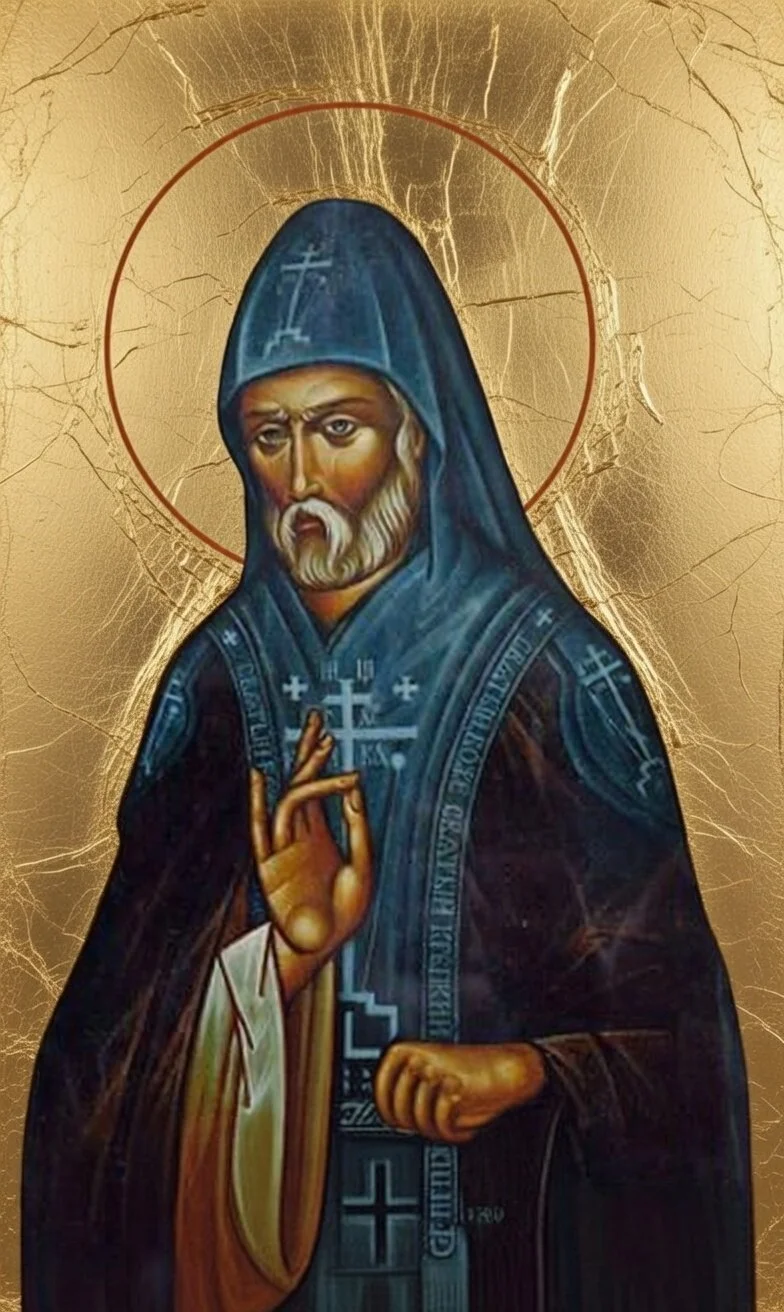
Among the holy ascetics who have illumined the Orthodox Church, few shine with more paradoxical brilliance than the Blessed Hieroschemamonk Feofil of Kiev — the ragged monk who rode a bull backward through the streets of Kyiv, dined with tsars and rebuked them with prophecy, multiplied food for the hungry, and concealed within a life of apparent madness an interior of blazing sanctity.
Saint Feofil (Theophilus) of Kiev, formally known as Hieroschemamonk Feofil (Gorenkovsky), was a 19th-century Orthodox monastic and yurodivyi (юродивий) — a "fool for Christ" — who lived at the Kiev-Pecherskaya Lavra and the Kitayevskaya Hermitage near Kyiv, Ukraine. His feast day is celebrated on October 28 / November 10 (Old and New Calendar respectively), and on July 14 as the day of his glorification. Canonized by the Ukrainian Orthodox Church in 1993 — 140 years after his repose — his memory had never ceased among the people of Kyiv, passed with reverence from generation to generation.
Quick Reference: At a Glance
| Full Birth Name | Foma Andreevich Gorenkovsky |
| Minor Schema Name | Feodorit (Theodoret) |
| Great Schema Name | Feofil (Theophilus) |
| Born | October 1788, Makhnovo, Kyiv Province |
| Reposed | October 28, 1853, Kitayevskaya Hermitage, near Kyiv |
| Feast Day (Old Calendar) | October 28 |
| Feast Day (New Calendar) | November 10 |
| Glorification Feast | July 14 (canonization day, 1993) |
| Type of Saint | Venerable (Prepodobny); Holy Fool for Christ (Yurodivyi) |
| Rank / Title | Hieroschemamonk |
| Primary Monastery | Kiev-Pecherskaya Lavra; Kitayevskaya Hermitage |
| Canonized | July 27, 1993, Ukrainian Orthodox Church |
| Relics Location | Church of the Twelve Apostles, Kitaevskaya Hermitage, Kyiv (since 2009) |
| Prayer Card | Available at The Eastern Church → |
The Ancient Tradition of the Holy Fool for Christ
To understand Saint Feofil, one must first understand the radical tradition he embodied.
The yurodstvo (юродство) — foolishness for Christ's sake — is one of the most demanding and paradoxical forms of Christian asceticism. Rooted in St. Paul's declaration that "We are fools for Christ's sake" (1 Corinthians 4:10), the holy fool deliberately embraces the appearance of madness, social shame, and humiliation in order to mortify the ego, conceal spiritual gifts, and rebuke the pride of those around them. In return, God frequently grants them extraordinary gifts of prophecy, healing, and discernment.
This form of life flourished especially in Eastern Christianity, producing luminaries such as St. Basil the Blessed of Moscow, St. Andrew the Fool for Christ of Constantinople, and — in Ukraine — the Blessed Feofil of Kyiv. The yurodivyi walks a razor's edge: appearing foolish enough to be credibly dismissed, yet spiritually potent enough that God works miracles through them. It is a life of voluntary crucifixion to the world.
Feofil understood this tradition profoundly. He had memorized the entire Psalter, never missed a liturgical service in his youth, and received Holy Communion regularly — all while appearing to the outside world as an eccentric, even scandalous, figure. His superiors filed formal complaints. The Metropolitan himself heard reports of his misbehavior. Yet people crowded at the monastery gates seeking his blessing, his word, his intercession.
Early Life: Miraculous Preservation from Birth
The story of Feofil begins not with monasticism but with survival — a series of divine interventions that foreshadowed his extraordinary life.
In October 1788, twin boys were born to Andrei and Evfrosiniya Gorenkovsky in the town of Makhnovo, near Kyiv Province. The older was named Foma and the younger Kalliniky. From infancy, Foma displayed unusual characteristics. He would regularly refuse his mother's milk and seemed distant from normal maternal interaction. Evfrosiniya, interpreting this as demonic possession, hardened her heart against her own son.
Three Miraculous Survivals
First Survival — Cast into the River (Twice)
Evfrosiniya secretly commanded her servant to take the infant Foma to the river before dawn and throw him in. The servant obeyed — and watched in astonishment as the child floated peacefully to the opposite bank and was cast onto dry land. Compelled a second time, she threw him in again. The waves carried him to a small island, depositing him unharmed. Terrified, the servant refused to continue and returned the child to his father.
Second Survival — The Mill Wheel
Evfrosiniya herself took the infant to a mill near their home and threw him beneath the turning mill wheel. As she walked away satisfied, the millstone stopped. The pressure of the water caused a tremendous roar; the horrified miller found the baby floating in the whirlpool. The moment he removed the child, the wheels began to turn again. The miller returned Foma to his father Andrei.
Third Survival — The Axe Wound
Years later, when a priest-caretaker attempted to return Foma to his mother, Evfrosiniya — still hardened — threw an axe at her own son, driving the blade into his right shoulder. The elder seized the bleeding child and carried him to safety. Throughout his life, Feofil wore an iron belt bearing an icon of the Epiphany against his skin — in perpetual memory of his triple miraculous salvation from drowning.
Orphaned, Wandering, and Educated
Foma grew up a foster child, moved between households after his father's death. From his earliest years, rather than playing with other children, he would sit alone as if in deep meditation, praying and fasting, never willingly missing a single church service. People noticed he was extraordinary. By around age seven, under Church care, he was enrolled in the primary classes of the Kiev-Mohyla Academy. His uncle, a widowed priest and starets at the Bratsky Monastery, eventually became his guardian. In 1810 he was sent as a deacon to Chigirin, then transferred for insufficient vocal ability as a sexton to Obukhov. Two years later he returned to Kyiv.
Reconciliation with His Mother
Learning his mother was terminally ill, Foma went to her in pity. His prayers were answered: her heart had softened, and weeping bitterly she begged his forgiveness. She pressed him against her breast, made the sign of the cross upon him, and gave her spirit to the Lord. Foma closed her eyes with his own hands and arranged her burial — a deathbed reconciliation, the fruit of patient prayer, that reveals the depth of mercy defining his entire ministry.
Monastic Formation: From Novice to Hieromonk
The Great Schema and the Life of Foolishness for Christ
The tonsure into the Great Schema on December 9, 1834 was the defining formal moment of Feofil's outward life — the highest and most demanding degree of Orthodox monasticism, its vestments emblazoned with the instruments of the Passion. For Feofil, already drawn toward radical asceticism, it was not an endpoint but a seal upon a path of utter self-abandonment.
His new name, Feofil (Greek: Θεόφιλος, "lover of God" / "beloved of God"), captured the essence of his spiritual life. All that he did — including what appeared as absurdity — was rooted in an all-consuming love for God.
His yurodstvo was not performance but combat. By courting shame, mockery, and misunderstanding, he waged war against the passions of pride, vanity, and self-regard. Every insult absorbed in silence was a blow against his own ego. Every act of apparent scandal cut through the surface of social religion to reveal deeper spiritual reality.
"The more slovenly he was dressed, the more his spirit struggled, the more strengthened and ardent were his prayers and the more thoughtful his forehead became." — From the Life of Hieroschemamonk Feofil
Appearance, Habits, and Daily Ascetic Life
The outward appearance of Saint Feofil was deliberately and provocatively unkempt — a living rebuke to vanity. His clothing was shabby, patched, and consistently stained with dough and oil from cooking. His monastic robe was never buttoned. He wore a tattered boot on one foot and a felt boot or bast shoe on the other. A dirty towel was habitually tied around his head. He sewed pieces of old rags around his cowl and wore them until his death. On one occasion he was seen wearing a large artificial stomach beneath his clothing — an object that caused young onlookers to burst into uncontrollable laughter, which was precisely his point.
His iron belt, worn constantly against the skin, bore an icon of the Epiphany — commemorating his triple miraculous salvation from water as an infant.
His cell was a chaos of apparent disorder: filled with pots, crocks, and provisions — groats, tea, flour, sugar, bread, honey, and roe — all destined for visitors, pilgrims, and the poor. He placed an old coffin in his cell but filled it with provisions to give away rather than lying in it. He slept on a log placed against the stove, or on a narrow bench, so that if he dozed off he would fall, wake up, and return immediately to prayer.
His prayer life was unceasing. He had memorized the entire Psalter, never missed a single liturgical service from his youth, made countless prostrations before his icons each day, and would kneel for hours on a large tree stump in the open air, "constantly bewailing the corruption of the times and praying for the forgiveness of the sinful world."
When served food from the monastic refectory, he would mix everything together — sweet with bitter — and when questioned about it, he explained: "After all, in life, sweet is mixed with bitter."
Formal complaints about him reached the Metropolitan. Among the documented accusations: "Feofil breaks the rule and order… No one knows where he might read his prayers… He barely participates in the liturgy… He stands before the altar-table as if dumbfounded… he bends down and wipes his nose with the garments of the altar table." Yet despite these reports, people crowded the monastery gates for his blessing.
The Monasteries and Hermitages of His Life
Kiev Bratsky Monastery
Feofil's entry point into monastic life in 1812. He spent nearly two decades here — from novice through hierodeacon to hieromonk and the beginning of his holy foolishness. When appointed steward in 1827, he immediately resigned the honor, preferring spiritual obscurity.
Kiev-Pecherskaya (Kiev Caves) Lavra
One of the oldest and most revered monastic sites in all of Eastern Christianity, founded in the 11th century. Feofil asked repeatedly to be moved to its caves for prayer and fasting. Though denied, the Lavra remained a constant reference point in his life and pilgrims from there witnessed his miracles.
Goloseyevskaya Hermitage
Feofil was transferred here in 1844, aged 55. The tension between his visible "dysfunction" and interior holiness became most acute here, with conflicting official reports and Metropolitan restrictions following in quick succession.
Novopasyechny Orchard
An agricultural dependency of the Lavra where Feofil lived for more than half a year before his final transfer.
Kitayevskaya Hermitage — His Final and Beloved Home
Transferred here by decree of Metropolitan Filaret on April 29, 1849. Surrounded by high hills and thick woods, the hermitage allowed Feofil the solitude he craved. In the woods he poured out his soul in prayer — and here his most famous miracles occurred, Tsar Nicholas I sought him out, and he predicted his own death and burial place with calm precision. His incorrupt relics rest here to this day.
Documented Miracles of Saint Feofil
The miraculous ministry of Blessed Feofil encompassed: healing of spiritual passions, physical healing, multiplication of food, discernment of hidden sins, and prophecy.
Miracle I — The Taming of the Wild Bull
A butcher named Ivan Katkov confessed to Feofil that he had acquired a bull so violent several people had been crippled by it. Feofil told him: "Give it to me." Feofil instructed Katkov to say to the bull: "Little bull! From now on you are no longer mine, but Father Feofil's." Katkov did — and the snorting, pawing animal became meek as a lamb, licking his hands. It was brought to Feofil at the Kitayevskaya Hermitage that evening. Feofil built a small cart with a sailcloth hood and rode through Kyiv always seated in the rear with his back to the bull, reading his Psalter on a small analoy. The bullock had neither harness nor reins — only a yoke — yet went precisely where the starets wished, navigating around stones, ruts, and ditches so as not to jog the Blessed One from his reading.
Miracle II — Healing of Lascivious Passions
One of the Metropolitan's singers, Nikolai, suffered from overwhelming passions of the flesh that tormented him day and night. Meeting Feofil in the woods, he tried to avoid him. The Blessed One called out and, astonishingly, said: "Come here. We will delight in lascivious thoughts together." Stricken with shame, the young man wept. Feofil consoled him: "The Lord is merciful. Let's go and pray." He knelt and prayed for half an hour, then rose with a tender face: "Go. Lascivious thoughts will no longer disturb you." The young man was immediately and completely healed.
Miracle III — Multiplication of Food for Pilgrims
Walking along the Dnieper with his cellmate Panteleimon, Feofil encountered exhausted, starving pilgrims who had lost their way. He asked his cellmate to give them porridge from their small pot. The cellmate protested there was barely enough for themselves. Feofil insisted. No matter how much porridge was ladled out to the crowd, the amount in the pot did not diminish. Every pilgrim ate their fill — and the pot remained full. Panteleimon kept this miracle secret until after the starets' repose.
Miracle IV — Prophecy Against the Cruel Husband
A wealthy Kyiv cattle dealer "A. D—ov" was coarse and contemptuous of Feofil, while his pious wife was devotedly attached to the saint. One day in the husband's absence, Feofil arrived with pieces of coal and drew elaborate ciphers — figures in the tens and hundreds of thousands — all over their expensive wallpaper. When the husband returned and raged, Feofil left in silence. Soon the family was overtaken by catastrophe: their business collapsed, debts appeared, their property was auctioned, and D—ov ended his days in a wretched hovel provided by the Kyiv city administration. The ciphers were understood in retrospect as a prophetic accounting of the man's spiritual and material debt.
Miracle V — Foreknowledge of a Monk's Death
During a service, Feofil left his Psalter and went outside to pray. A monk hid the Psalter in his pocket as a prank. When Feofil returned, he walked directly to the monk and said: "Oh elder, elder. You must die tomorrow and you play evil tricks today. Woe unto you." The next morning, the elderly monk died. This spread through the Lavra as incontestable evidence of the starets' gift of discernment.
Miracle VI — The Roof Opens at His Repose
At the moment of Feofil's holy repose on October 28, 1853, his cellmate Dimitry witnessed the roof of the cell rise up and the blue sky reach down, as if to receive the holy soul of the dying righteous one. The moment he yielded his spirit to the Lord, the room returned to normal — a vision echoing the earliest hagiographic accounts of saints' departures.
Miracles After Repose — Continuing to This Day
Pilgrims to Feofil's grave reported healings, consolations, and answered prayers for 140 years before formal canonization in 1993. After canonization, his relics were found incorrupt. The Life records: "the number of miracles performed by God through blessed Feofil is so great that one could probably write a book just on them." Healings continue to be reported at the Church of the Twelve Apostles, Kitayevskaya Hermitage, to this day.
Prophecies and the Gift of Discernment
Saint Feofil's gift of forevision — clairvoyance about future events and hidden realities — was one of the most extensively documented aspects of his ministry. For more than thirty years he served, in the words of his Life, "as a bright lamp of Evangelical truth for all Orthodox Christians." His discernment operated in multiple modes: perceiving the hidden sins of those who came to him; foreseeing events of the visible world including deaths, the fates of families, and the movements of empires; and predicting the founding of religious communities not yet in existence.
Famous institutional prophecies of Saint Feofil:
The founding of the Intercession (Pokrovsky) Convent in Kyiv — fulfilled exactly as he described.
The founding of the Transfiguration (Preobrazhenskaya) Hermitage of the Kiev Pechersk Lavra — prophesied while walking with Panteleimon past an empty hill at the precise spot where the hermitage later arose.
The founding of the Holy Trinity Monastery of Jonah in Kyiv — predicted years before its establishment.
The Encounter with Tsar Nicholas I and the Crimean Prophecy
Among the most extraordinary episodes in Feofil's life is his encounter with Emperor Nicholas I (Nikolai Pavlovich) of Russia — a meeting of imperial power and holy poverty that left the Tsar shaken and the saint's words ringing through history.
As the Tsar's carriage drove through the Perchersk district of Kyiv, about to turn a corner, it encountered Feofil plodding along on his bullock cart. The moment the Tsar's horses drew level with Feofil's cart, they stopped as if frozen to the ground. All efforts of the coachman were futile. The sovereign, his attention caught by the ragged monk sitting backward in his cart reading a Psalter, asked who this person was. The court brought Feofil before him. "What kind of person are you?" asked Nikolai Pavlovich sternly. Feofil replied with childlike simplicity: "I am a man of God."
When the suite explained that this was the monk Feofil, a fool-for-Christ of the Kievo-Pecherskaya Lavra, the Tsar said with genuine amazement: "A God's fool-monk? Strange." He then said: "Well, go with God and wish me a happy journey." Feofil replied immediately: "No, Your Majesty. You have to go through thorns." At that moment the horses broke free and the carriage sped ahead. The Tsar looked back intently at the strange monk.
This encounter occurred in 1852 — shortly before the Crimean War (1853–1856), which proved catastrophic for Russia and ended with the death of Tsar Nicholas I before its conclusion. The words "you have to go through thorns" were understood by those who heard them, in retrospect, as a precise prophetic announcement. One witness wrote: "The prophecy of the Starets is as clear as God's day."
The Holy Repose of Saint Feofil
In autumn 1853, Feofil called his cellmate Panteleimon to the window and pointed at a spot outside: "At the cross above the grave. Do you see it?" Panteleimon saw nothing unusual. He departed on pilgrimage, and when he returned, a grave and cross were in exactly the location the saint had indicated — the saint had foreseen the precise spot of his own burial.
On the morning of October 28, 1853, the holy fool received the Holy Mysteries in his cell. Partway through the day, he calmly sent a cellmate to the superior with a request: to toll the bell for his repose. The igumen hurried to Feofil's cell — but the Blessed One had already departed before he arrived. What the igumen found was an emaciated, broken body — and filling the cell, a marvelous, indefinable fragrance, one of the classical signs of sanctity in Orthodox tradition. The cellmate Dimitry simultaneously witnessed the roof rise and the blue sky open above, as if to receive the departing soul.
When news of his repose spread, crowds poured to the Kitayevskaya Hermitage. His coffin was covered on all sides with candles by his countless followers.
Canonization, Relics, and Formal Veneration
The memory of Saint Feofil never faded among the people of Kyiv. For 140 years after his repose, accounts of his miraculous intercessions circulated, passed "from one generation to another" among the descendants of those who had known him.
On July 27, 1993, the Holy Synod of the Ukrainian Orthodox Church formally canonized Feofil of Kyiv. Feast days were established as October 28 (Old Calendar) / November 10 (New Calendar), and July 14 as the celebration of his glorification. He is also commemorated in the Cathedrals of Vinnytsia Saints and Kyiv Saints.
At the time of his glorification in 1993, his honorable relics were discovered and translated to the Holy Trinity Cathedral of the Kitayevskaya Hermitage. On February 24, 2009, the relics were transferred to the Church of the Twelve Apostles at the same hermitage, where they remain available for veneration to this day.
Troparion, Kontakion, and Prayers to Saint Feofil
Troparion — Tone I
Having heard the voice of Thine Apostle Paul,
saying: "We are foolish for Christ's sake,"
Thy servant Theophilus, O Christ God,
did love the life of the foolish for Thy sake on earth.
Wherefore in venerating his memory
we entreat Thee, O Lord, to save our souls.
Troparion — Tone VIII
O blessed Divinely-wise Theophilus,
Thy pure soul shining with an Orthodox understanding,
and resplendent with the radiance of virtues,
illumines the hearts of the faithful,
driving away the darkness of the demons;
wherefore as a participant in heavenly glory
intercede for us, O man of God,
wonderful Theophilus!
Prayers to Saint Feofil center on intercession for those struggling with spiritual warfare, especially temptations of the flesh; healing of passions; protection of travellers; those mocked or marginalized; and those seeking discernment. As a hieroschemamonk, he intercedes especially for monastics, priests, and those discerning a religious vocation. A prayer card bearing his image is available from The Eastern Church — suitable for an icon corner or as a personal reminder of his protection.
How to Venerate Saint Feofil Today
Liturgical commemoration. His feast days — October 28 (Old Calendar) / November 10 (New Calendar) and July 14 — are occasions for special prayer, Divine Liturgy, and commemoration in parishes with Ukrainian or Russian Orthodox heritage.
Pilgrimage to the Kitayevskaya Hermitage. Located in the Holosiivskyi district of Kyiv, Ukraine, the hermitage's Church of the Twelve Apostles houses the saint's incorrupt relics, available for veneration by pilgrims.
Icon and prayer card. Placing an icon or prayer card of Saint Feofil in the home icon corner and reading the Troparion on his feast or in times of need is a traditional and accessible form of personal devotion.
Fasting and almsgiving on his feast. In keeping with Feofil's own example of radical generosity — giving his income to the poor, filling his coffin with provisions for visitors — marking his feast with an act of charity is particularly fitting.
Reading his Life. The full Life of Hieroschemamonk Feofil, compiled by Vladimir Znosko and published by Holy Trinity Publications (Jordanville, NY), is the primary English-language source and may be read as an act of prayerful veneration.
Spiritual Legacy and Continuing Significance
Saint Feofil of Kyiv stands at the intersection of several profound spiritual traditions: the yurodstvo (holy foolishness), the starchestvo (eldership and spiritual direction), and the specifically Ukrainian stream of monastic sanctity flowing through the Kiev Caves. He represents the paradox at the heart of the Gospel: that the foolish things of this world confound the wise, that the last shall be first, and that the way of apparent weakness conceals the greatest power.
His life speaks with particular urgency to those who feel misunderstood, dismissed, or marginalized — proof that God sees what the world does not see, and honors what the world mocks. He is the patron of those who endure social rejection for the sake of spiritual integrity.
His example of radical poverty and generosity — giving away every kopek of his income, filling his coffin with provisions for the poor, multiplying food for hungry pilgrims — is a rebuke to acquisitiveness in any era. His gift of prophecy and discernment continues to be invoked by those facing uncertain futures.
Feofil is a saint of Kyiv — the mother city of Eastern Slavic Christianity. In a land that has faced repeated trials throughout its history, the witness of the Blessed Feofil — who knelt for days on his tree stump praying for "the forgiveness of the sinful world" — remains a living intercession. His people believe his prayers still rise before the throne of God on behalf of the land and the city he loved.
"May the light of the Blessed Starets Feofil appear as a beacon and may he illumine the world with his deeds which in his lifetime the world did not understand, seeing in the man of God nothing but foolishness." — Preface to the Life of Hieroschemamonk Feofil
Saint Feofil (Theophilus) of Kiev · Holy Fool for Christ · Hieroschemamonk
Holy Blessed Feofil, intercede for us before the Lord!
Sources: Hieroschemamonk Feofil, Fool-for-Christ's-Sake, Ascetic and Visionary of the Kiev-Caves Lavra (Vladimir Znosko, Holy Trinity Publications) · OrthoChristian.com · Death to the World · Icon and Light · Joy of All Who Sorrow Orthodox Church · NYC Deanery of the UOC · Orthodox Church in America
Free Marriage Resources from The Eastern Church
Inspired by the saints of the Eastern Church, these free resources on Christian marriage are grounded in millennia of Orthodox and Eastern Catholic wisdom. Whether you are preparing for marriage or deepening your union, these resources are a gift for your journey.
Download Free Marriage Resources