Saint Gabriel Urgebadze: The Complete Life, Miracles, Relics, and Legacy of Georgia’s Beloved Fool for Christ
Complete Biography • Life, Relics & Miracles • Georgian Orthodox Church • 1929–1995
Saint Gabriel Urgebadze: The Complete Life, Miracles, Relics, and Legacy of Georgia’s Beloved Fool for Christ
A Soviet-era monk who burned a portrait of Lenin in public, was confined to a psychiatric hospital for it, and spent his final decades living in a converted chicken coop at a Georgian convent — and who is now venerated across the Orthodox world as one of the most beloved saints of the twentieth century. This is his full story: the life, the imprisonment, the relics, and the miracles, documented as completely as they are available.
Saint Gabriel Urgebadze — At a Glance
- Birth Name
- Goderdzi Urgebadze
- Born
- August 26, 1929, Tbilisi, Georgian SSR
- Died
- November 2, 1995 (aged 66), Mtskheta, Georgia
- Monastic Name
- Gabriel, in honor of the Archangel Gabriel
- Titles
- Archimandrite • Confessor • Fool for Christ (Salos)
- Canonized
- December 20, 2012, by the Holy Synod of the Georgian Orthodox Church
- Feast Day
- November 2 (Gregorian) • October 20 (Julian, used liturgically by the Georgian Church)
- Buried
- Samtavro Convent, Mtskheta, Georgia (1995)
- Relics
- Uncovered February 22, 2014 • enshrined at Samtavro’s Transfiguration Cathedral since April 1, 2014
- Known For
- Burning a public Lenin portrait (1965) • decades of ascetic life • hundreds of recorded healing miracles
- Patronage
- Georgia • invoked broadly for healing, deliverance, and protection
- Also Called
- Gabriel of Georgia • Elder Gabriel • Mama Gabrieli (“Father Gabriel”)
Who Was Saint Gabriel Urgebadze?
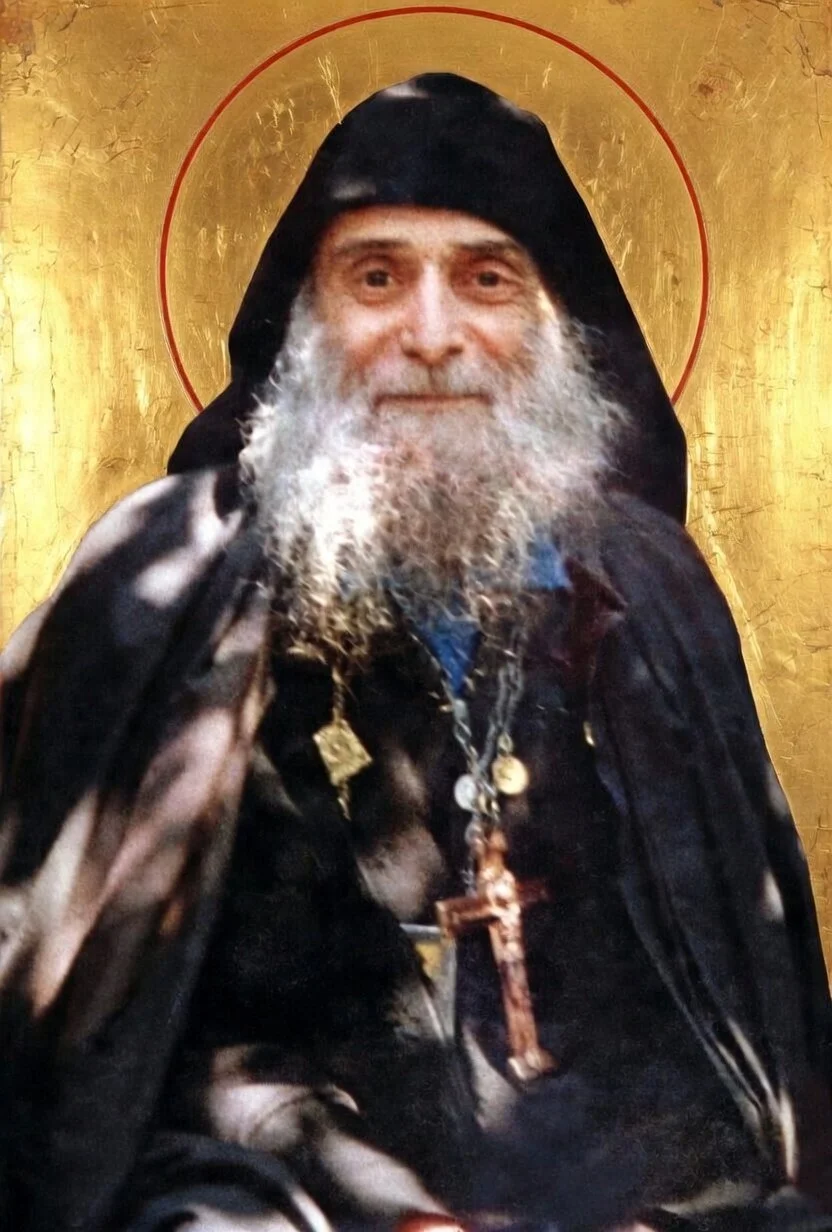
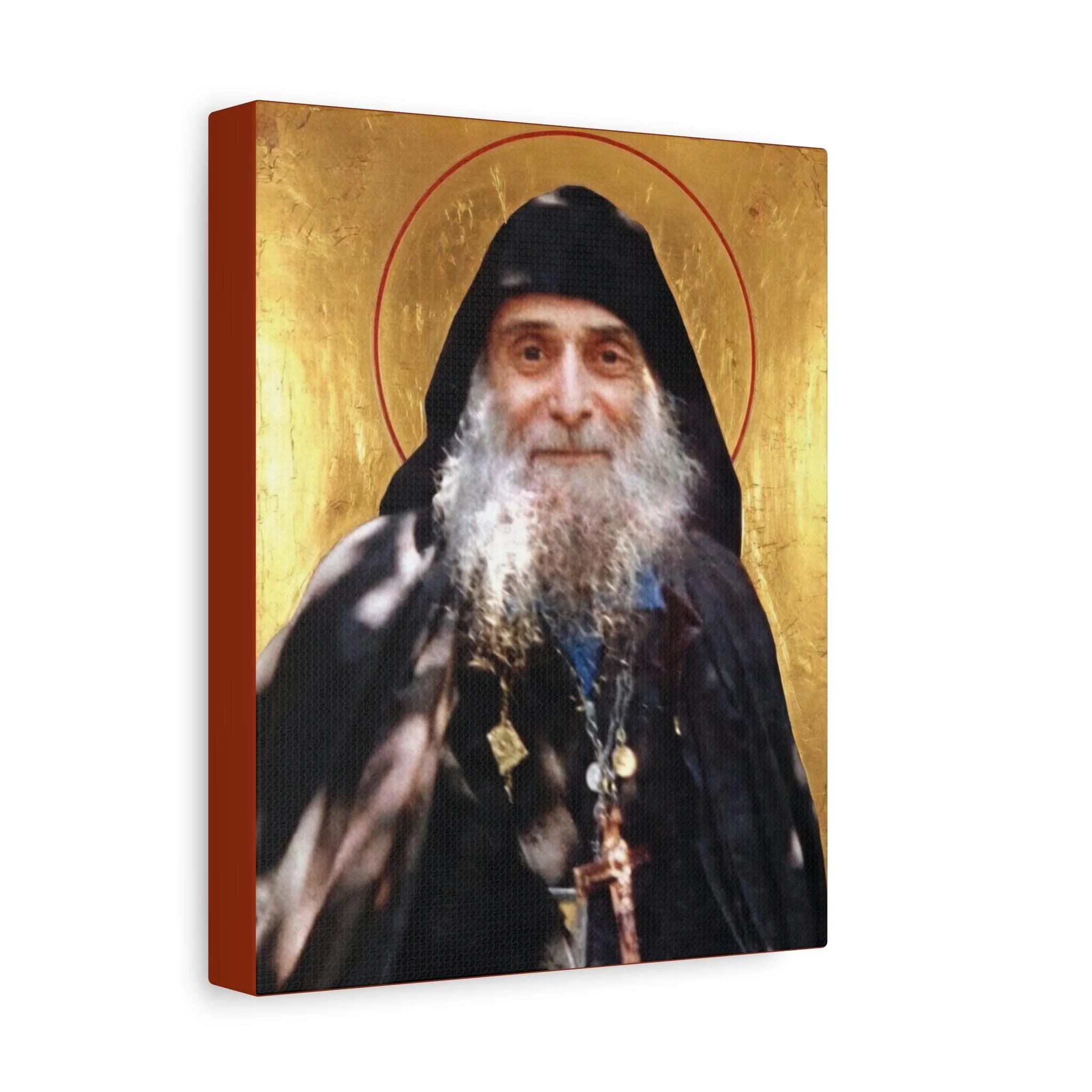
Walk into almost any Georgian Orthodox church, and you will see his face. It hangs beside icons of the Theotokos and the Archangel Michael: an elderly monk with a long white beard, a cane, and eyes that somehow manage to look both fierce and gentle in the same portrait. He is in taxis. He is on dashboards. He is stitched into the fabric of ordinary Georgian life in a way that very few saints canonized in the last hundred years have managed to achieve. His name is Saint Gabriel Urgebadze, and outside the Orthodox world, almost nobody has heard of him.
He was born in 1929, in the middle of the Soviet Union’s most militantly atheist decades, and he died in 1995, four years after Georgia regained its independence. In between, he lived a life that reads less like a modern biography and more like something out of the fourth-century Egyptian desert: public confrontation with state power, imprisonment, a diagnosis of insanity used as a weapon against his faith, decades of self-imposed poverty and asceticism, and a stream of miracles that Orthodox Christians across the world continue to report to this day. He is formally titled Confessor and Fool for Christ — two of the oldest and most demanding categories of sanctity the Church recognizes, and he earned both.
This article gathers everything documented about his life: his childhood, his confrontation with Soviet power, his decades at Samtavro Convent, his canonization, the location and history of his relics, the churches that bear his name, and the miracles attributed to him both before and after his death. Where a detail comes from an official Church source, this article says so. Where it comes from personal testimony or pious tradition rather than documented history, this article says that too.
Part II
Childhood in Soviet Georgia
Goderdzi Urgebadze was born on August 26, 1929, in Tbilisi, then part of the Georgian Soviet Socialist Republic. He was baptized as an infant at the Church of the Great Martyr Barbara in the Navtlugi district of the city. His father, Vasili Urgebadze, worked as an official connected to the Communist Party and died under circumstances that remain unclear when Goderdzi was only two years old. In his father’s memory, the family began calling the boy “Vasiko.”
He grew up, in other words, inside the very apparatus the Soviet state used to enforce atheism — and found his way to Christ almost entirely on his own. Church attendance was dangerous, religious instruction was effectively illegal, and an entire generation of Georgian children was raised to believe that faith in God was a relic of a superstitious past. Goderdzi’s early and intense devotion to Christ, in a household and a country actively working against it, is one of the details his biographers return to again and again: nobody taught him this. He found it himself, as a child, in a country doing everything it could to make sure children did not find it.
Part III
Military Service and a Hidden Faith
In 1949, Goderdzi was called up for compulsory Soviet military service. Surrounded by soldiers trained in state atheism, he did not hide his faith so much as practice it quietly — slipping away to visit churches near his deployment whenever the opportunity presented itself. Eventually his superiors discovered his religious devotion. In the logic of the Soviet military, a grown man who genuinely believed in God, angels, and demons could only be explained as mentally unwell, and he was labeled accordingly upon his discharge.
Back home, Goderdzi began building a small chapel in the yard of his own house, scavenging discarded icons from local landfills — sacred images thrown away by families under pressure from Communist authorities to purge their homes of religious material. He wanted, from a young age, to enter monastic life formally. The Soviet state made that extraordinarily difficult for any young man, let alone one already flagged as ideologically unreliable.
Part IV
The Burning of the Lenin Portrait, 1965
The single event most associated with Gabriel Urgebadze’s life took place on May 1, 1965, during an official Soviet parade in Tbilisi. A massive public portrait of Vladimir Lenin had been erected as part of the celebration — the kind of state-sanctioned iconography that stood, quite literally, in place of the icons the regime had spent decades trying to erase from Georgian public life. In front of a crowd of thousands, Gabriel poured kerosene over the portrait and set it on fire.
It was not an act of vandalism in his own understanding of it, and it is not remembered that way by the Church that later canonized him. It was a public confession of faith, staged in the most confrontational terms available to a man with no other platform: a direct declaration, in the middle of a state celebration of atheism, that Christ — not the Soviet state and not its founding ideologue — held ultimate authority. He was beaten severely by the crowd and by police on the spot, and by some accounts came close to being killed before authorities took him into custody.
Part V
Arrest, Torture, and the Psychiatric Ward
Rather than face a conventional trial for his public act of protest, Gabriel was subjected to interrogation, beatings, and ultimately confinement in a Soviet psychiatric facility — a common tactic used against religious and political dissidents throughout the USSR, where genuine, uncompromising faith in God was itself treated as a symptom of mental illness. According to accounts preserved by those who documented his life, his official medical diagnosis chart from this period bore the number 666, the number the Book of Revelation assigns to the Antichrist — a detail Orthodox writers have long taken as a strange, almost providential irony rather than a coincidence worth dismissing.
He was eventually released from the psychiatric hospital, but not without further cost. Even after his release, and after his ordination to the priesthood, ecclesiastical authorities under continued state pressure suspended him from active priestly ministry. He continued attending services regardless, receiving Communion humbly in the line with the laity rather than functioning as clergy, for a period that lasted years. It was not until 1971 that the Patriarch of Georgia lifted the suspension, restored his priestly faculties, and appointed him priest of the convent that would become his home for the rest of his life: Samtavro.
Part VI
Monastic Tonsure and the Name Gabriel
Even before the events of 1965, Gabriel had been working toward formal monastic life for years under enormous state obstruction. In 1954, on the recommendation of Patriarch Melchizedek III of Georgia, Goderdzi was finally accepted into the monastery at Motsameta, where he was tonsured a monk. He was given the monastic name Gabriel, in honor of the Archangel Gabriel — the messenger who announced the Incarnation to the Virgin Mary. Some sources place his diaconal ordination in 1952 and his priestly ordination and monastic tonsure in 1955, in the early years of a religious vocation that the Soviet state had spent nearly a decade trying to prevent.
Part VII
What “Fool for Christ” Actually Means
Understanding Saint Gabriel requires understanding a category of Orthodox sanctity that has no real Western equivalent: the Fool for Christ, called salos in Greek and yurodivy in Russian and Slavic tradition. A Fool for Christ deliberately adopts behavior that appears eccentric, socially unacceptable, or even insane, as a form of radical humility — a rejection of worldly respectability so total that the saint willingly accepts being mocked, misunderstood, and dismissed by the society around him. It is one of the oldest and most demanding forms of sanctity the Church recognizes, going back to the earliest centuries of Christian monasticism.
Gabriel fits this pattern precisely, and the Georgian Orthodox Church formally recognized it in his title: Confessor and Fool for Christ. His public burning of the Lenin portrait, his decision to live in an abandoned chicken coop rather than any more dignified dwelling, and numerous recorded incidents of behavior that struck observers as strange or even shocking were, in the theological reading of his life, not eccentricity for its own sake. They were a sustained, deliberate refusal to let worldly dignity — even religious respectability — stand between himself and total honesty before God.
Part VIII
Life at Samtavro: The Tower and the Chicken Coop
From 1971 onward, Samtavro Convent in Mtskheta — Georgia’s ancient capital, and one of the country’s most sacred sites — became Gabriel’s permanent home. He lived for years in a cell in the convent’s old tower. In 1987, he moved to a small wooden hut on the grounds that had formerly served as a chicken coop, and lived there through harsh winters without heating, as a deliberate ascetic discipline in the tradition of the desert fathers. He briefly sought even greater solitude at Shio-Mgvime Monastery in 1990, but according to accounts of his life, a vision instructed him to return to Samtavro, where he remained in his tower cell until his death.
He became, over these decades, spiritual father to an enormous number of people — offering guidance, comfort, and, according to the accumulating testimony of those who sought him out, both healing and prophecy. Pilgrims of every kind found their way to him: the desperate, the sick, the doubting, and eventually people from across the Orthodox world who had heard of the strange, humble monk at Samtavro.
Part IX
The Vision of the Angel and the Relic of the True Cross
Among the most remarkable episodes recorded from his years at Samtavro concerns one of Georgia’s greatest sacred treasures. According to accounts preserved by the monastery, Gabriel experienced a vision of an angel of God, who revealed to him the precise hidden location of a fragment of the True Cross — a relic connected to Svetitskhoveli Cathedral, the “Living Pillar” cathedral in Mtskheta that is itself one of the holiest sites in the Georgian Orthodox Church, believed to house Christ’s Tunic. Gabriel, together with the nuns of Samtavro, recovered the relic from where it had been concealed. It remains kept at Samtavro Monastery to this day.
A note on sourcing: this account comes from Orthodox hagiographic tradition connected to Samtavro Convent rather than from independent archaeological documentation. It is presented here, as it is presented within the Georgian Orthodox tradition, as an account of sacred tradition rather than a claim independently verifiable outside that tradition.
Part X
Sayings and Teachings of Saint Gabriel
Gabriel left no formal theological writings, but a substantial body of his sayings has been preserved by those who knew him, and they are still widely quoted and printed on icons and in devotional literature throughout Georgia and the wider Orthodox world.
His final recorded words, spoken as he approached death, are remembered as: “I have been following You from the age of twelve, Lord, and now I am ready. Take me to Yourself.”
Part XI
Miracles During His Lifetime
Even before his death, Gabriel had a reputation among those who sought him out at Samtavro for spiritual discernment that went beyond ordinary pastoral insight — visitors reported that he seemed to know the nature of their troubles before they spoke, and offered guidance that addressed concerns they had not yet voiced aloud. The recovery of the True Cross relic, described above, is itself counted among the signs of grace attributed to him during his lifetime. As his reputation grew through the final Soviet years and into Georgian independence, increasing numbers of pilgrims made their way to his cell at Samtavro seeking prayer, counsel, and healing.
Part XII
Death and Burial, November 2, 1995
Gabriel Urgebadze died on November 2, 1995, at Samtavro Convent in Mtskheta, at the age of 66. He was buried on the grounds of the convent that had been his home for nearly a quarter century. Almost immediately, his grave began drawing pilgrims — a steady, then growing, then eventually overwhelming stream of the faithful coming to pray at the site, many reporting a distinctive sense of peace and grace at the grave itself, and many bringing testimonies of healings and resolved crises they attributed to his intercession even before the Church had formally recognized him as a saint.
Part XIII
Canonization, December 20, 2012
Seventeen years after his death, on December 20, 2012, the Holy Synod of Bishops of the Georgian Orthodox Church, under Catholicos-Patriarch Ilia II, formally glorified Gabriel Urgebadze as a saint, with the title Holy Father Gabriel, Confessor and Fool for Christ. It is worth being precise about this date, because it is sometimes reported incorrectly, including on devotional content circulating online: the canonization took place in December 2012, not February 2012. In the years since, he has become, by any reasonable measure, one of the most widely venerated saints canonized anywhere in the Orthodox world in the last several decades — his image found, as noted at the outset of this article, in churches, homes, cars, and public spaces across Georgia and increasingly beyond it.
Part XIV
The Uncovering and Translation of the Relics, 2014
On February 22, 2014, in a solemn ceremony at Samtavro Convent, the relics of Saint Gabriel were formally uncovered. In a cross procession accompanied by soldiers and a great multitude of the faithful, the relics were first translated to Svetitskhoveli Cathedral in Mtskheta — the cathedral that houses the Tunic of Christ, and is regarded as the spiritual heart of the Georgian Church. The following day, the relics were translated to the Holy Trinity Cathedral (Sameba) in Tbilisi, where they were originally scheduled to remain for public veneration for one week.
The response from the faithful was so overwhelming that the Georgian Patriarchate extended the veneration period at Sameba Cathedral by several additional weeks to accommodate the crowds. On April 1, 2014, the relics were finally translated back to Samtavro Convent, where Catholicos-Patriarch Ilia II announced their permanent placement. They remain enshrined today in the Transfiguration Cathedral of Samtavro Convent, and the convent has become one of the most visited pilgrimage sites in the country. Small particles of the relics have since been shared, with the blessing of Samtavro’s abbess, with convents and parishes elsewhere in the Orthodox world, including in Bulgaria, Russia, and Belarus.
Part XV
Miracles After Death: Documented Testimonies
The volume of testimony attributed to Saint Gabriel’s intercession since his death is, by the account of those who collect it, so large that it has been described as “inexhaustible.” Entire collections of these accounts have been compiled and published, particularly by the Orthodox news outlet OrthoChristian.com, which has run recurring series under titles like “The New Miracles of Elder Gabriel” documenting fresh testimonies as they arrive from Georgia, Russia, Belarus, and Bulgaria.
Among the most widely circulated is the account of a mother whose son collapsed at school in Tbilisi in February 2010 and was hospitalized in grave condition. At the hospital, she reported seeing a priest in black vestments assisting the nurses, who told her, “I am waiting for you at Samtavro.” Not recognizing the words’ significance at the time, she later learned that Samtavro was the location of Elder Gabriel’s grave, brought her son there, and prayed at the tomb — a story she has since recounted publicly as a turning point in her son’s recovery.
Other documented testimonies include a woman reporting the disappearance of a cyst after venerating Gabriel’s relics at Samtavro; a account from a Kemerovo convent in Russia describing relief from what the account calls an incurable illness after a reliquary containing a particle of Gabriel’s relics was placed on the sufferer; and reports collected by television journalists and clergy of healings connected to oil taken from the lamp that burns continually near his relics. A myrrh-streaming icon of Saint Gabriel — an icon reported to exude a fragrant, oil-like substance, a phenomenon the Orthodox Church associates with particular grace — has also been reported and venerated in Georgia.
A note on sourcing: these accounts are personal testimonies collected and published by Orthodox faithful, clergy, and outlets such as OrthoChristian.com. They are presented here as devotional testimony, in the same spirit the Orthodox Church itself presents them — not as clinically verified medical claims, but as the lived witness of a community that has continued, in large and growing numbers, to seek Saint Gabriel’s intercession.
Part XVI
Churches, Icons, and Veneration Around the World
Georgia. A church in an eastern suburb of Tbilisi is dedicated specifically to Gabriel Urgebadze and contains an interior fresco depicting the 1965 burning of the Lenin portrait — a striking and unusual choice of iconography that has itself drawn journalistic attention, since it places a recognizable Soviet leader, depicted in flames, inside consecrated church art. In Mtskheta, following a petition signed by Gabriel’s sister and roughly 3,000 parishioners of local Georgian churches, the city authorities and Georgian Patriarchate renamed Cholokashvili Avenue, the street where Gabriel had lived and built his first home chapel, to St. Gabriel Avenue. A new church was planned for construction near the site of that original chapel with the blessing of Catholicos-Patriarch Ilia II.
Bulgaria. Devotion to Saint Gabriel has taken particularly strong root in Bulgaria. The Church of the Assumption of the Most Holy Mother of God in Sofia now houses an icon of Saint Gabriel containing a relic, brought from Samtavro Convent, and the church has become a pilgrimage site in its own right. Bulgarian Orthodox faithful have had his biography translated into Bulgarian, and holy oil and printed icons connected to Samtavro are reported to be commonly available in Bulgarian church shops.
Russia and Belarus. Testimonies of miracles attributed to Saint Gabriel have been documented from as far as Kemerovo in Siberia, where a convent dependency received a relic particle from Samtavro’s abbess, and from Belarus, where devotional literature has referred to Gabriel’s spiritual reach as extending over “Georgia and half of Orthodox Rus’.” His veneration continues to spread through the broader Orthodox world primarily through these channels: relic particles shared from Samtavro, translated biographies, and pilgrim testimony rather than through formal ecclesiastical decree.
Part XVII
Saint Gabriel in the United States
Saint Gabriel Urgebadze is increasingly known among American Orthodox Christians, and devotional articles about him have been published by American jurisdictions, including the American Carpatho-Russian Orthodox Diocese (ACROD). His icon and prayer cards are available through Orthodox and Eastern Catholic devotional retailers in the United States, and his story circulates widely in English-language Orthodox media.
That said, this article is committed to accuracy over enthusiasm on one specific point: at the time of writing, no parish or chapel in the United States has been confirmed to be formally dedicated to Saint Gabriel Urgebadze specifically. Readers should also be careful not to confuse devotion to him with the numerous American churches named “St. Gabriel’s,” almost all of which — in New York, Connecticut, Pennsylvania, Louisiana, and elsewhere — are dedicated to the Archangel Gabriel, a different figure entirely, and most of which predate Gabriel Urgebadze’s canonization by decades. As his cult continues to grow, it would not be surprising to see a mission, chapel, or side-altar formally dedicated to him in North America in the coming years; as of this writing, that has not been documented.
Complete Timeline
The Life of Saint Gabriel Urgebadze at a Glance
- August 26, 1929 — Born Goderdzi Urgebadze in Tbilisi, Georgian SSR. Baptized at the Church of the Great Martyr Barbara.
- 1931 — His father, Vasili Urgebadze, dies under unclear circumstances. The child is called “Vasiko” in his memory thereafter.
- 1949 — Called up for compulsory Soviet military service; his faith is discovered and he is discharged and labeled mentally unfit.
- 1952–1955 — Ordained deacon (1952); on the recommendation of Patriarch Melchizedek III, enters Motsameta Monastery and is tonsured a monk, taking the name Gabriel.
- May 1, 1965 — Burns a public portrait of Lenin in Tbilisi during an official parade; is beaten, arrested, and confined to a psychiatric hospital.
- 1965–1971 — Suspended from active priestly ministry under continued state pressure; attends services and receives Communion as a layman.
- 1971 — The Patriarch of Georgia lifts his suspension and appoints him priest of Samtavro Convent, Mtskheta.
- 1987 — Moves from his tower cell to a converted chicken coop on the convent grounds, living there through the winters without heat.
- 1990 — Briefly seeks solitude at Shio-Mgvime Monastery, then returns to Samtavro following a vision.
- November 2, 1995 — Dies at Samtavro Convent, aged 66. Buried on the convent grounds; his grave immediately becomes a site of pilgrimage.
- December 20, 2012 — Canonized by the Holy Synod of the Georgian Orthodox Church under Catholicos-Patriarch Ilia II.
- February 22, 2014 — His relics are formally uncovered at Samtavro Convent.
- February 23 – April 1, 2014 — Relics translated to Svetitskhoveli Cathedral, then Holy Trinity Cathedral in Tbilisi for extended public veneration.
- April 1, 2014 — Relics returned permanently to Samtavro Convent, enshrined in the Transfiguration Cathedral.
- Today — Venerated across Georgia, Bulgaria, Russia, and Belarus, with continuing testimonies of healing reported at his relics and through icons bearing them.
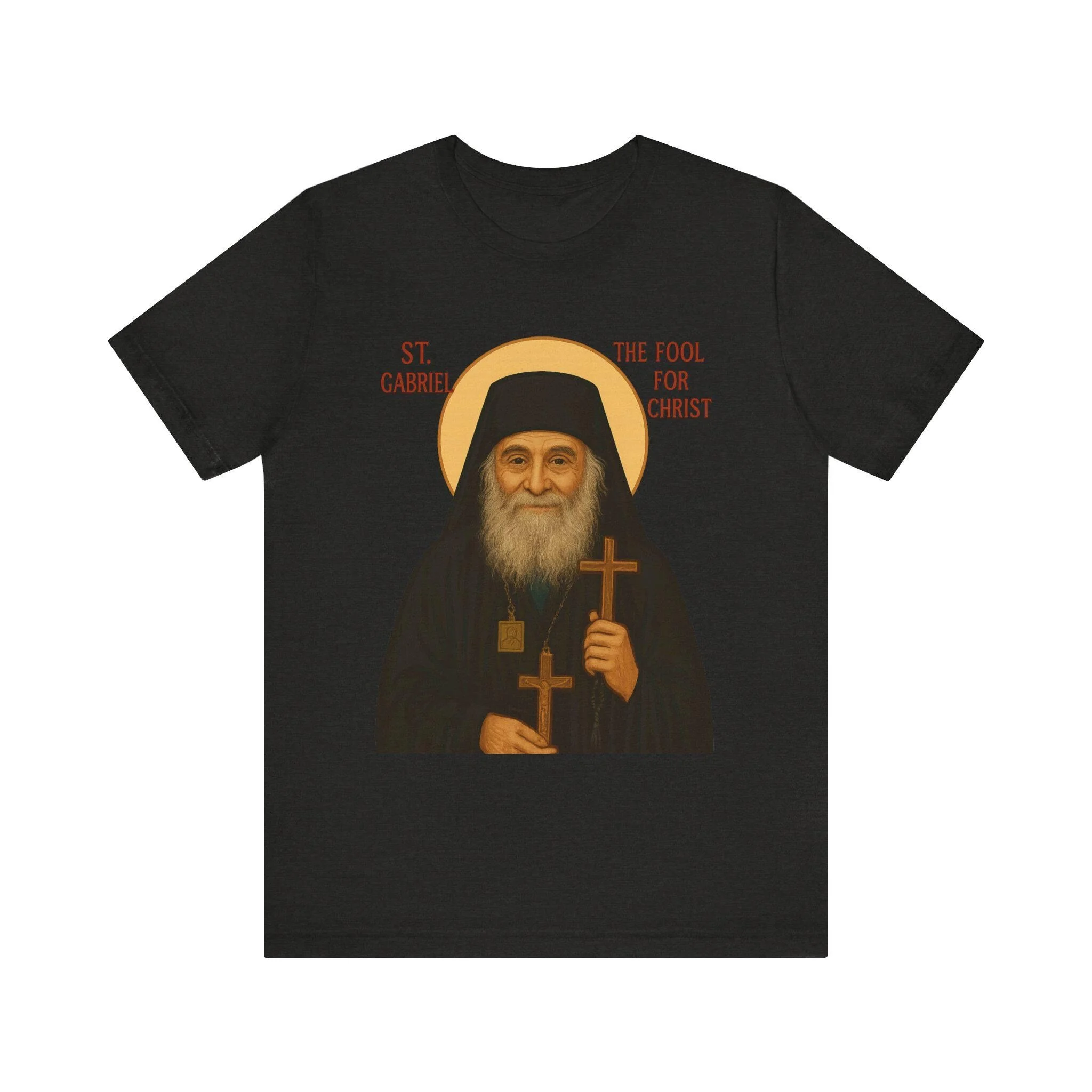
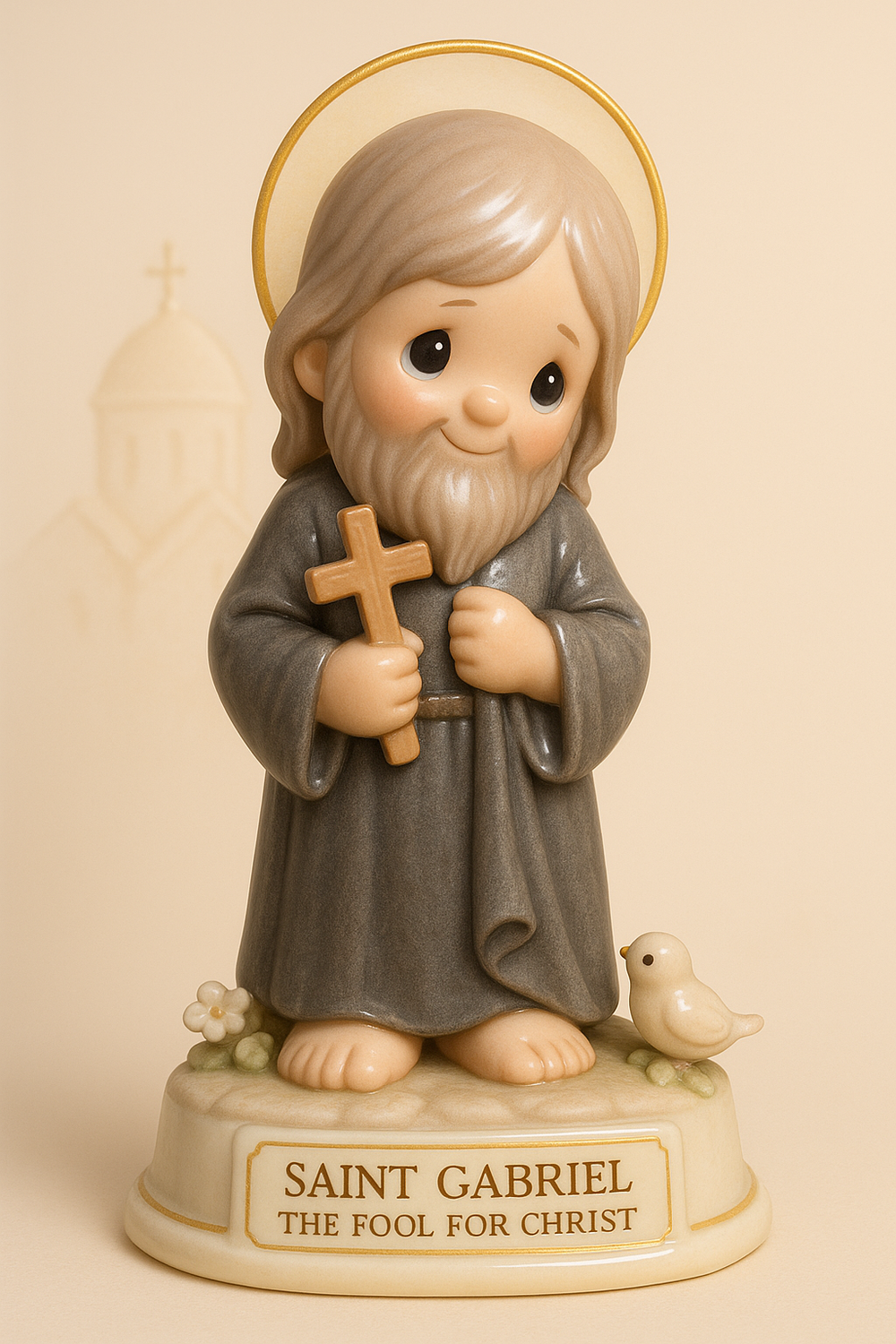
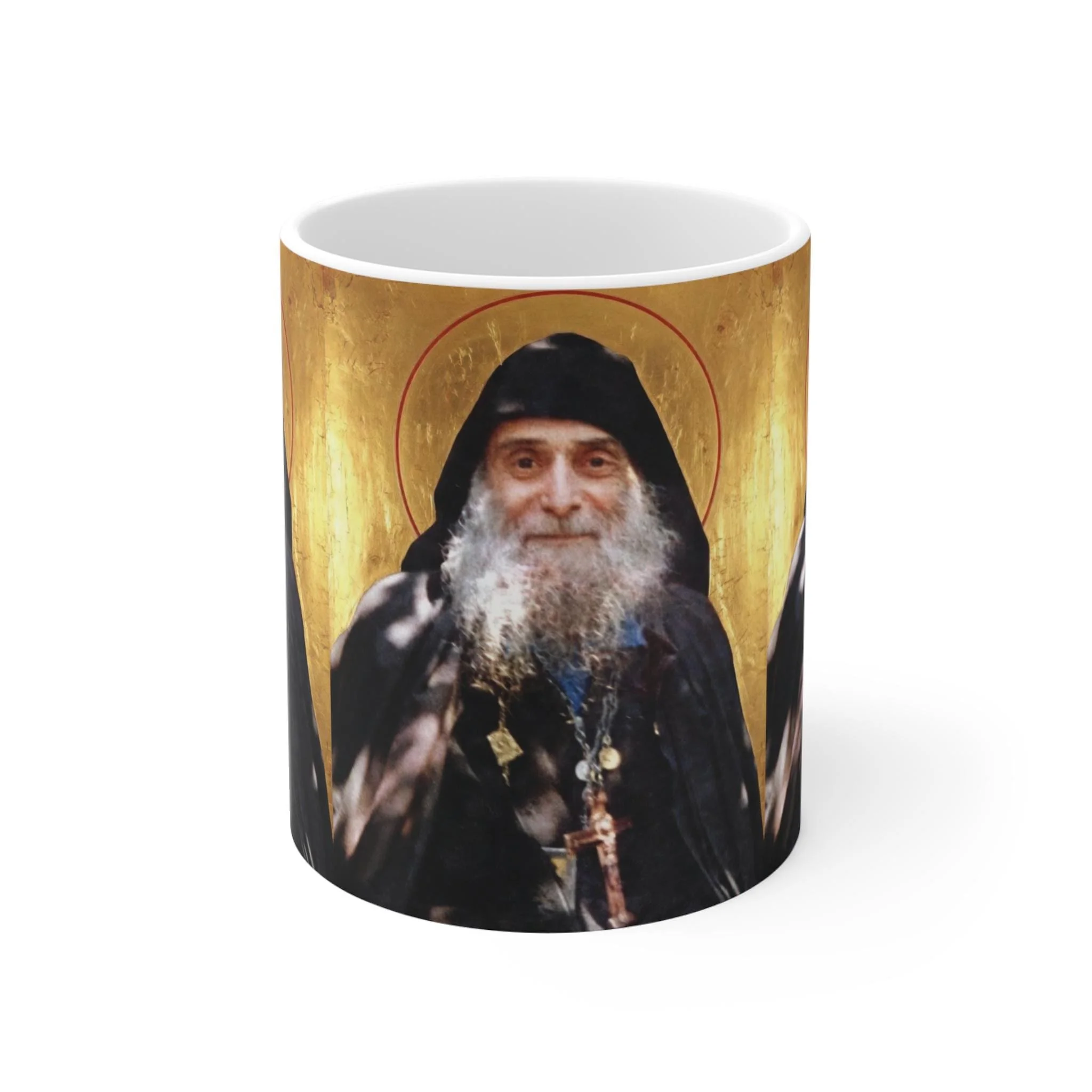
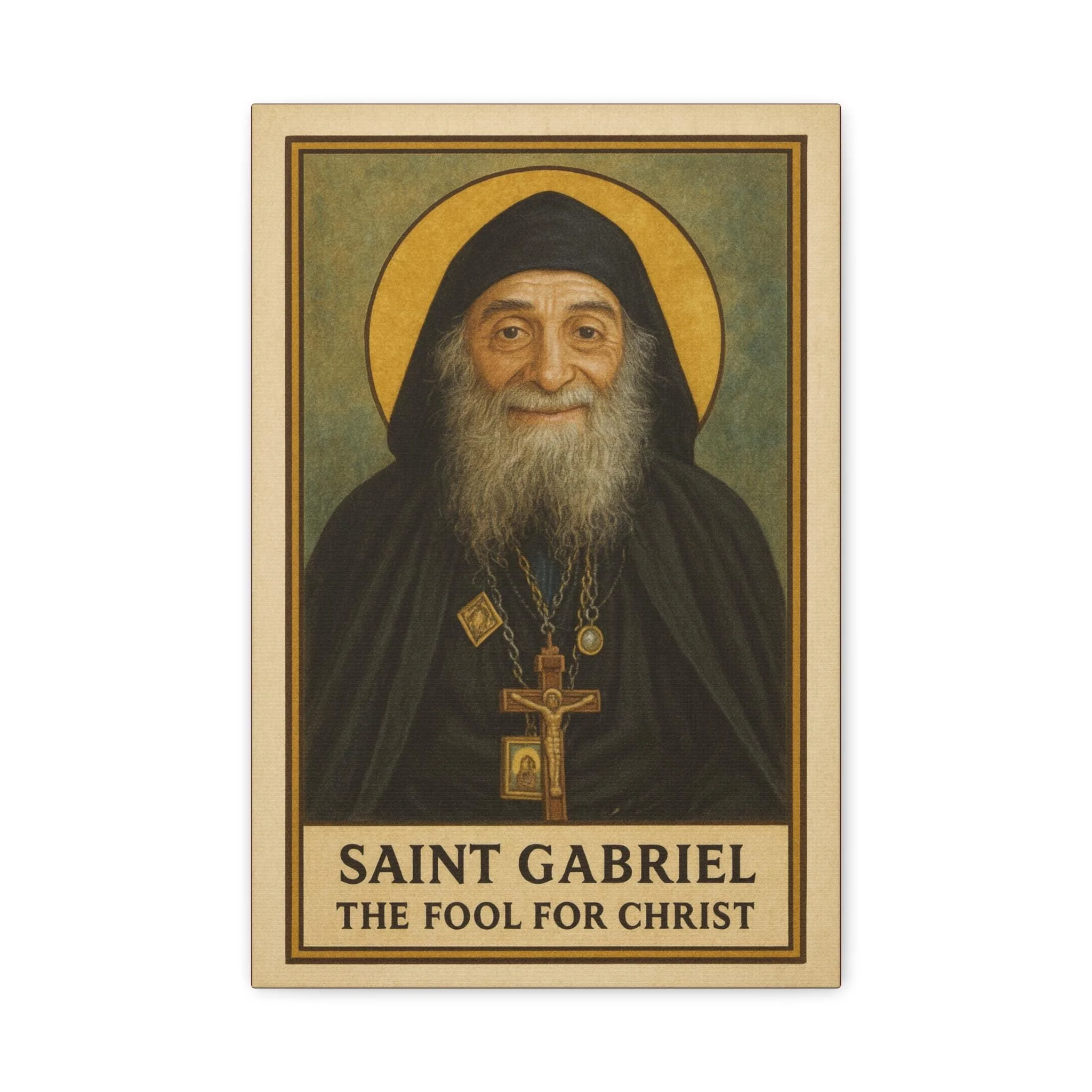
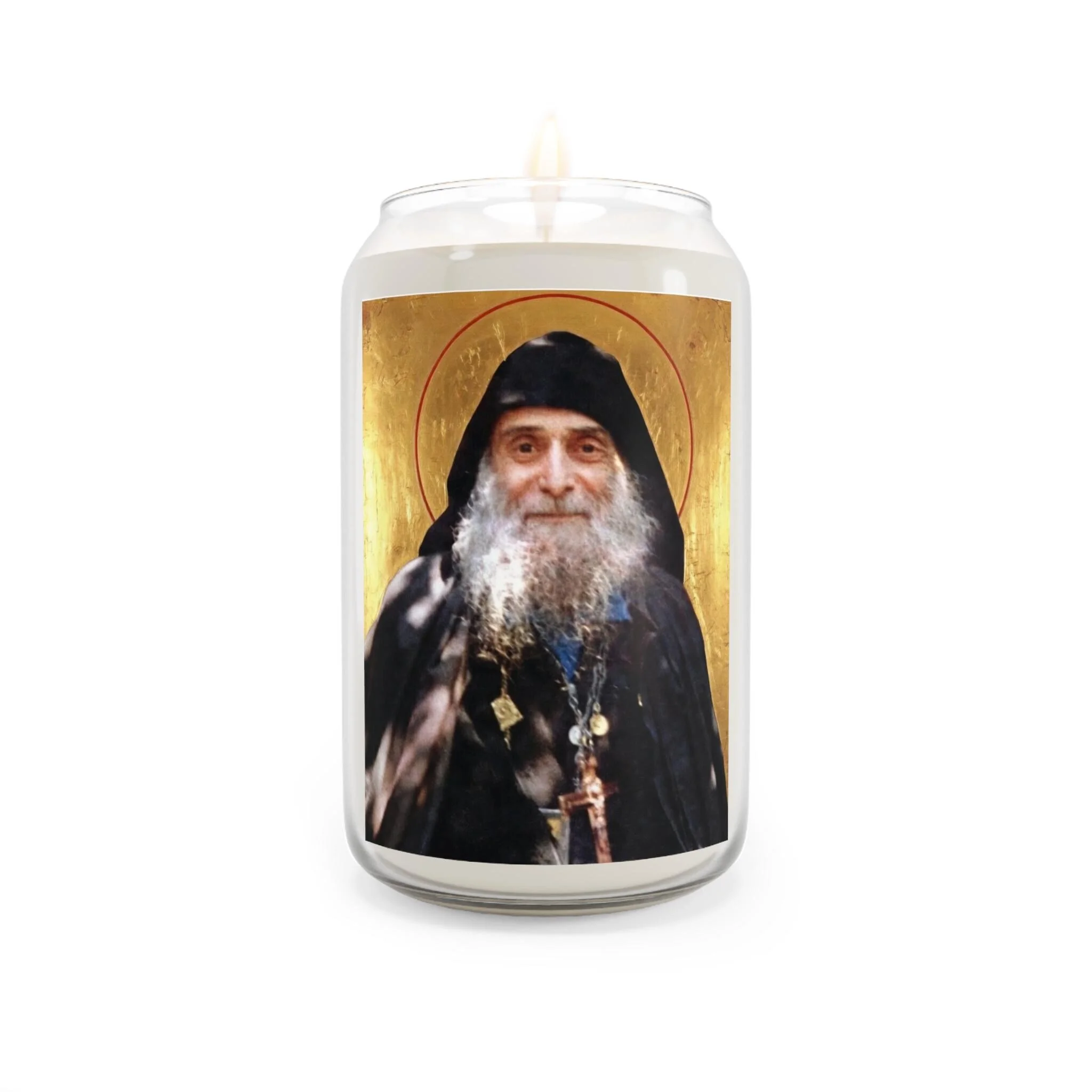
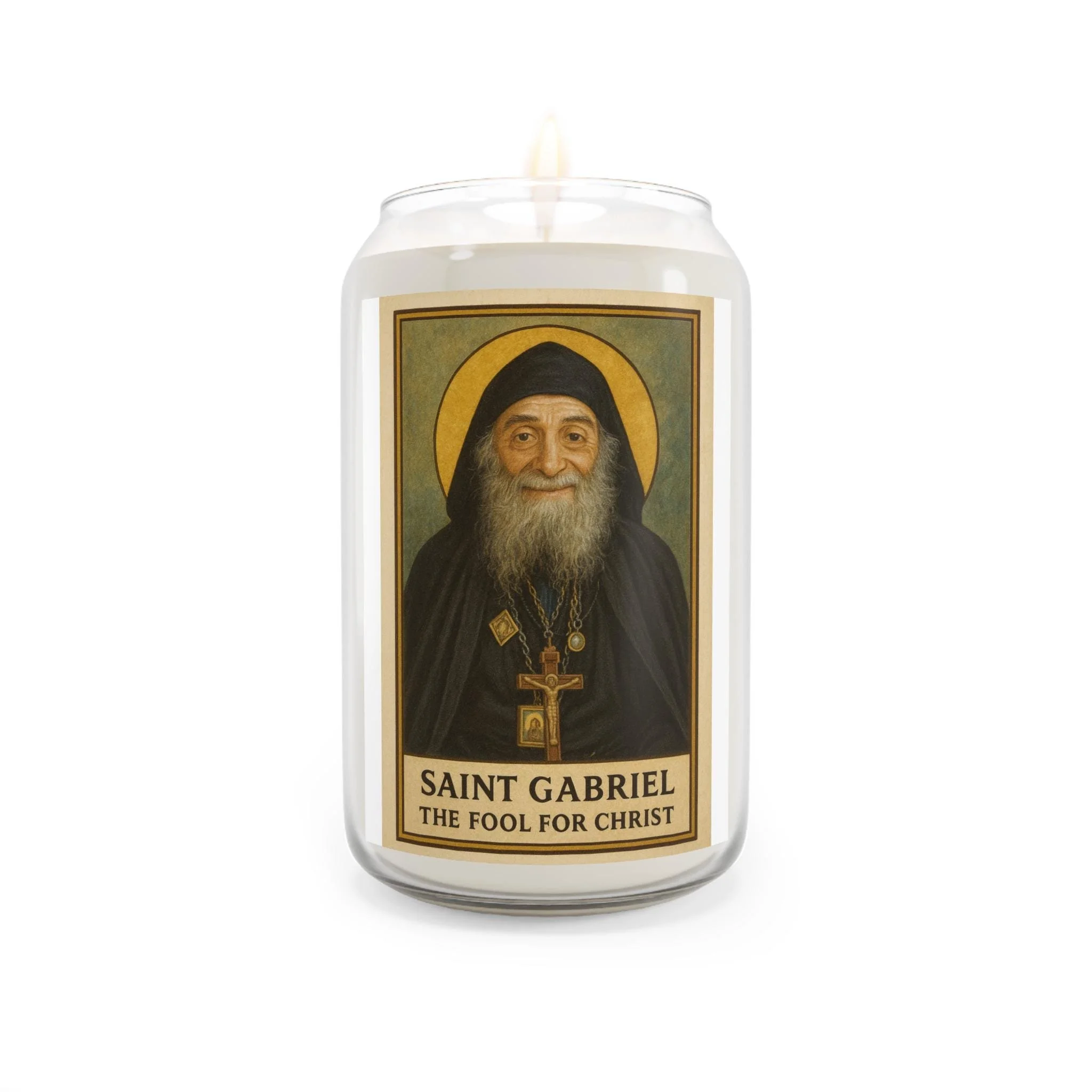
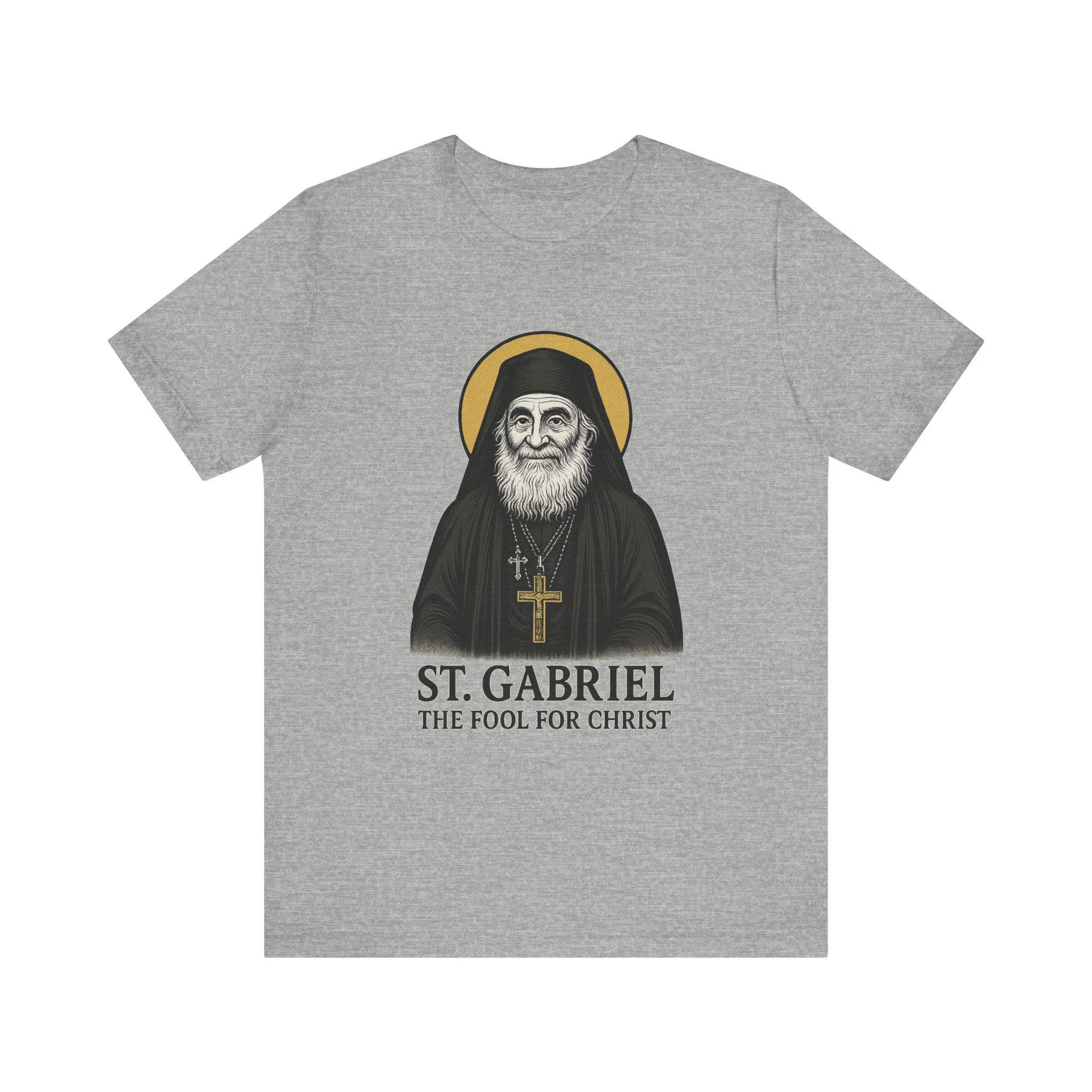
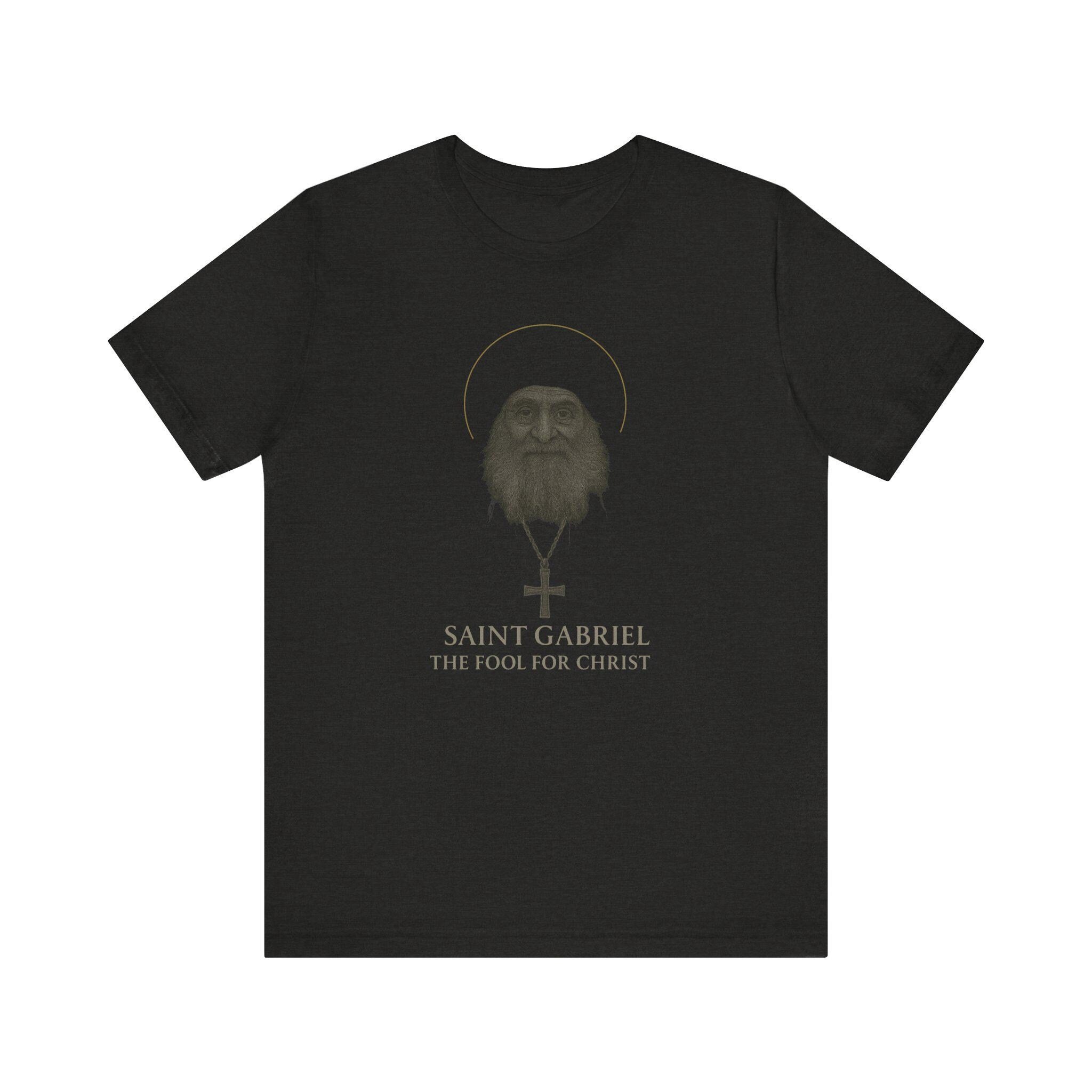
Every way we make Saint Gabriel’s witness available: prayer cards for adults and children, apparel, a canvas icon for the wall, and a devotional candle for your prayer corner.

Part XVIII
Prayers to Saint Gabriel Urgebadze
Holy Father Gabriel, you who stood alone before a crowd and a regime that had spent decades trying to erase the very idea of Christ from your homeland, and who paid for that stand with beatings, imprisonment, and years of suspicion — I come to you today asking for a fraction of the courage you carried.
You were called foolish by the world for the sake of Christ, and you accepted that title without bitterness, choosing a chicken coop over comfort and humility over vindication. Teach me to care less for how I appear and more for what is true. Teach me that holiness does not require the world’s approval, and that a single act of honest confession can outlast an empire.
Intercede for me in the trial I am facing now, whatever form it takes — a fear I cannot name, an illness that will not lift, a truth I am afraid to speak. You who saw grace return the Holy Cross to its rightful place through your prayers, ask the Lord to make crooked things straight in my life as well.
Holy Father Gabriel, Fool for Christ, pray to God for us. Amen.
Lord Jesus Christ, physician of souls and bodies, who worked healing through your servant Gabriel during his life at Samtavro and who has continued to answer the prayers of the faithful who seek his intercession since his repose — hear the prayer I bring you now.
I ask, through the prayers of Saint Gabriel, for healing for [name the person or need]. I do not presume to know your will in this matter, but I trust that you who healed through the oil of his lamp and the touch of his relics have not stopped hearing the prayers of those who come to you in his name.
Holy Father Gabriel, pray to God for the healing we ask. Lord, have mercy. Amen.
Appendix
Frequently Asked Questions
A Chicken Coop, a Burned Portrait, and a Saint the Whole Orthodox World Now Turns To
Saint Gabriel Urgebadze had every reason to disappear into the machinery of Soviet erasure: a dead father, a state built to stamp out exactly the kind of faith he carried, a diagnosis meant to silence him, and decades spent in a converted chicken coop that nobody outside Samtavro’s walls had any reason to notice. Instead, seventeen years after his death, the Church recognized what the pilgrims at his grave already knew — and today his face hangs in homes and churches across Georgia, Bulgaria, Russia, and Belarus, carried by people who never met him and never will, asking for his prayers anyway.
This work exists to bring saints like Gabriel Urgebadze — the little-known, the recently canonized, the ones whose stories have not yet made it into English-language devotional life — into the light, so their holiness can stand as an example the way his stood in front of that crowd in Tbilisi in 1965. Every prayer card purchased through this site helps fund the research and documentation behind articles like this one. If you are not able to buy one, we ask you instead simply to pray — for us, for the work, and for whoever else comes across this page in need of a saint who understood what it costs to tell the truth in public.
Get the Saint Gabriel Urgebadze Prayer Card →Lord Jesus Christ, Son of God, please have mercy on me, a horrible sinner.