Saint Irene Chrysovalantou: The Complete Life, Miracles, and Legacy of the Abbess Who Received Apples from Paradise
Complete Biography • Life, Miracles & Legacy • Byzantine Church • 9th Century
Saint Irene Chrysovalantou: The Complete Life, Miracles, and Legacy of the Abbess Who Received Apples from Paradise
Brought to Constantinople to become an empress, she became a nun instead — and lived to receive fruit carried across the sea by the hand of the Apostle John. This is her complete story: the royal wedding she never had, the convent she came to lead, the miracles recorded during her life and after it, and the monastery in Queens, New York that keeps her memory alive today.
Saint Irene Chrysovalantou — At a Glance
- Born
- 9th century, Cappadocia, Byzantine Empire
- Died
- 9th century, Constantinople, at over 100 years of age
- Title
- Venerable (Osia) • Abbess of the Convent of Chrysovalantou
- Feast Day
- July 28
- Known For
- The apples of Paradise sent by Saint John the Theologian • gift of clairvoyance • extreme asceticism
- Life Rediscovered
- Manuscript of her Life found c. 1917, Monastery of Saint Dionysiou, Mount Athos
- Liturgical Service Composed
- 1958, by the Athonite hymnographer Gerasimos Mikragiannanitis
- Patronage
- Infertility • impossible or seemingly hopeless situations • women seeking to conceive
- Major Shrine (USA)
- Sacred Patriarchal and Stavropegial Monastery of St. Irene Chrysovalantou, Astoria, New York (founded 1972)
- Major Shrine (Greece)
- Wonderworking icon venerated at Lykovrisi, Attica
- Historical Context
- Connected to the court of Emperor Michael III (r. 842–867) and Empress Theodora
Who Was Saint Irene Chrysovalantou?
She was raised for a throne she never sat on, and became instead one of the most beloved wonderworking saints of the Byzantine Church — a woman whose story very nearly disappeared entirely, saved only by a manuscript rediscovered on Mount Athos centuries after her death. Saint Irene Chrysovalantou (in Greek, Agia Eirini Chrysovalantou) lived in ninth-century Constantinople, was brought to the imperial court as a candidate to marry the Emperor, and instead became abbess of the Convent of Chrysovalantou, where she lived for decades in a manner so ascetic and so marked by visions and wonders that her contemporaries struggled to describe her in ordinary terms.
She is known above all for one extraordinary episode: the delivery, by a ship’s crew stopped in open water by a figure who identified himself as the Apostle John the Theologian, of apples said to come directly from Paradise. That story alone would be enough to secure her a place in Orthodox memory. But her full life — the royal wedding she avoided, the gift of foresight she was given, the miracles recorded at her tomb, and the centuries during which her story was nearly lost after the fall of Constantinople — is far richer than the apples alone suggest. This article gathers all of it, tiered honestly by source: documented Byzantine history where it exists, and sacred hagiographic tradition where that is what the record actually offers.
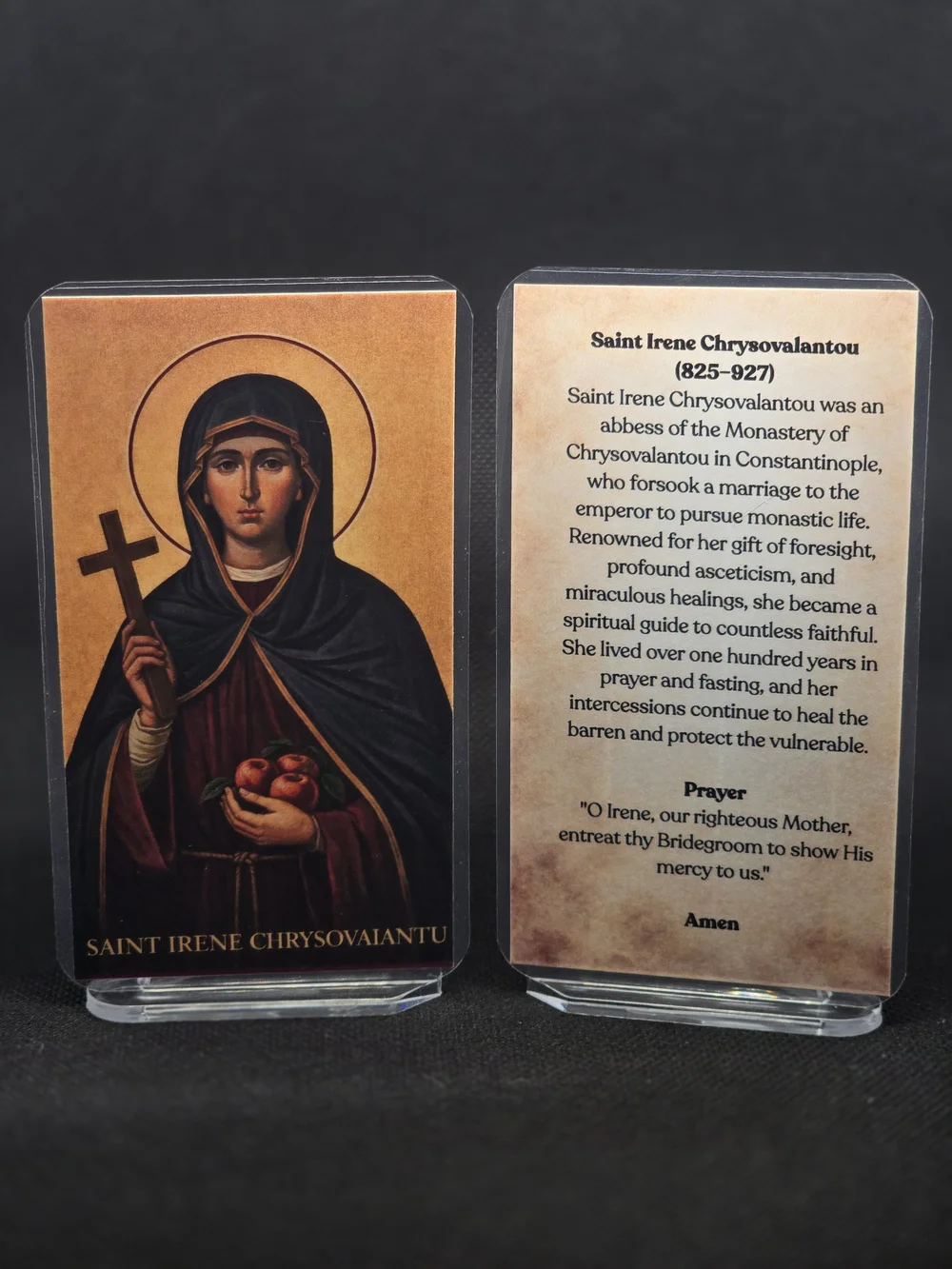
Part II
Birth in Cappadocia
Irene was born in Cappadocia, in central Asia Minor, to a wealthy and aristocratic family. The exact year of her birth is not recorded, but her death at over one hundred years of age, combined with the historically documented reign of Emperor Michael III (842–867), places her birth in the early ninth century. Cappadocia at the time was already a deeply Christian region, marked by monastic communities carved into its volcanic landscape, and it was into this world — wealthy by birth, devout by culture — that Irene was raised.
Her family’s standing connected her to the imperial court in a very direct way: her sister married Vardas (Bardas), the brother of the Empress Theodora, who is remembered in Orthodox history for restoring the veneration of icons after the Iconoclast controversy. It was this family connection, and Irene’s own reputation for beauty and virtue, that would soon draw her into the greatest turning point of her life.
Part III
The Bride Show for Emperor Michael III
When the young Emperor Michael III came of marriageable age, Empress Theodora, acting as regent, initiated what Byzantine sources call a “bride show” — an empire-wide search for the most beautiful, virtuous, and refined young woman to become the emperor’s wife. It was a recognized institution of the Byzantine court, and messengers were sent throughout the empire to identify candidates. Irene, celebrated for both her beauty and her character, was selected as one of these candidates and summoned to Constantinople.
It is worth pausing on how significant this moment was. A summons to the imperial bride show was, for a family like Irene’s, the opportunity of several lifetimes — the possibility of a daughter becoming Empress of the Romans. By every worldly measure, Irene was being handed the highest position a woman of the ninth-century Byzantine world could hope to attain. What happened next is the reason she is remembered as a saint rather than as an empress.
Part IV
Saint Joannikios and the Word That Changed Her Path
As the imperial escort brought Irene toward Constantinople, their route passed near Mount Olympus in Asia Minor, where a renowned ascetic named Saint Joannikios the Great lived in extreme seclusion, appearing, by tradition, only to those he judged worthy. Irene had heard of his holiness and asked the escort to take her to him so that she might receive his blessing before continuing on to the palace. The escort agreed, and Joannikios received her.
Irene was reportedly astonished that the hermit knew her by name and could speak with such certainty about her future, and she fell at his feet in reverence. She continued on to Constantinople as instructed, but by the time she and the other candidates arrived, tradition holds that the emperor had already been matched with another bride. Whatever the precise sequence of events, Irene did not become empress. She went, as Joannikios had told her she would, to the Convent of Chrysovalantou.
Part V
Entering the Convent of Chrysovalantou
At the Convent of Chrysovalantou, located on high ground north of the Church of the Holy Apostles in Constantinople, Irene entered monastic life with an intensity that immediately set her apart. She was noted by her community for her obedience, her humility, and her enthusiasm for the ascetic life — qualities so pronounced that her fellow nuns reportedly said she bore “the spirit of a freed slave,” a striking Byzantine expression of total, willing self-surrender.
Within her first year as a novice, Irene had already begun reading the lives of the saints in her cell, and she was especially drawn to the example of Saint Arsenius the Great, the fourth-century desert father famous for praying through the entire night with his arms stretched toward Heaven. She asked her abbess for a blessing to take up this same discipline, and — recognizing the depth of the young nun’s humility — the abbess granted it before Irene had even completed her first year in the convent.
She shone forth, according to her Life, “in great ascetical labors,” and endured what her hagiographers describe as sustained demonic attack in return — a common motif in the lives of the desert and monastic saints, understood as the spiritual opposition that meets any soul pursuing holiness with real seriousness.
Part VI
Becoming Abbess
Irene rose to become abbess of Chrysovalantou remarkably early in her monastic life. As leader of the convent, she is remembered as having increased her own spiritual struggles rather than easing them — continuing her personal asceticism even as she took on responsibility for guiding an entire community, and trusting, in the words used to describe her leadership, in God’s guidance for the community she now shepherded.
It was during her years as abbess that the events for which she is best remembered took place: the extraordinary gifts of grace that marked her as, in the fullest Orthodox sense, a living saint.
Part VII
The Apples of Paradise
The central episode of Saint Irene’s life, and the one for which she is most widely known, concerns a ship’s crew sailing near the island of Patmos — the same island where the Apostle John the Theologian is traditionally held to have received the Book of Revelation. According to her hagiography, an old man appeared on the shore and called for the ship to stop. Despite favorable wind, the vessel came to a sudden, inexplicable halt. The old man then walked across the surface of the water, boarded the ship, and produced six apples, saying they were sent from Paradise: three for the Patriarch Methodios, and three for Abbess Irene of Chrysovalantou, with the message that whoever ate them would have their soul’s deepest desire granted, “for this gift comes from John in Paradise.”
Irene received her three apples and, according to the account, fasted for a week in thanksgiving before eating them. For forty days, she consumed only small pieces of the first apple, taking no other food or water. She later shared pieces of a second apple with the nuns of her community on Holy Thursday after they received Holy Communion, and the nuns reported an unusual, almost otherworldly sweetness, as if their very souls were being nourished by it.
An angel is said to have later informed Irene that she would be called to the Lord the day after the feast of Saint Panteleimon. In preparation, she fasted for a week beforehand, sustaining herself only on water and small pieces of the third and final apple. The whole monastery, according to the account, was filled with a heavenly fragrance during this final fast, and any discord among the community is said to have disappeared entirely.
Part VIII
Clairvoyance, Visions, and the Unjustly Accused
Beyond the apples, Irene’s Life records a range of extraordinary gifts attributed to her during these years as abbess. She was granted the gift of clairvoyance, said to know the thoughts of everyone who came to her for counsel before they spoke them aloud. She reportedly foretold, through a private message to a relative’s eunuch messenger, the coming death of Caesar Bardas and, later, of Emperor Michael III himself — both of whom, as documented Byzantine history confirms independently of her hagiography, met violent ends: Bardas was killed in 866 on the orders of Basil the Macedonian, and Michael III was assassinated the following year, in 867, clearing Basil’s path to the throne.
She is also recorded as having appeared in a vision to the emperor himself, rebuking him for the unjust imprisonment of a nobleman who had been falsely accused, and securing the man’s release. Her nightly prayer discipline, continued in the courtyard of the monastery in imitation of Saint Arsenius, is described in later accounts as having caused her to rise from the ground in prayer and the cypress trees of the courtyard to bend toward her — imagery that Orthodox hagiography uses to describe a soul whose communion with God had become, quite literally, larger than the ordinary boundaries of the physical world.
A note on sourcing: the specific wonders described in this section — the levitation, the bending trees, the precise foreknowledge of Bardas’s and Michael III’s deaths — come from her hagiographic Life rather than independent Byzantine chronicle sources, and are presented here as sacred tradition. The deaths of Bardas (866) and Michael III (867) themselves are documented Byzantine history, independent of any connection to Saint Irene.
Part IX
Death and Burial in Constantinople
Saint Irene reposed at more than one hundred years of age — most accounts give 101, 102, or 103, with the variation reflecting the imprecision common to lives this distant and this dependent on a single rediscovered manuscript rather than multiple independent sources. Despite her extreme age, witnesses reported that her face remained young and beautiful even in death. A great crowd came for her funeral, so large that the convent could not hold them all, and burial had to be delayed into the night to accommodate the flow of pilgrims arriving to venerate her.
She was given a temporary burial place before being laid to final rest in the Church of Saint Theodore, adjacent to the Church of the Archangel, near her own convent. According to the account preserved by her monastery, the bishops who conducted her burial brought incense, myrrh, and costly perfumes as was customary — but the fragrance that rose from her own relics, they reported, surpassed all of it. That fragrance is said to have continued at her tomb for years afterward, drawing pilgrims and, according to tradition, working its own quiet wonders on those who came.
Part X
Miracles During Her Lifetime
Beyond the apples and her gift of foresight, Irene’s Life records instances of healing and deliverance carried out during her lifetime at Chrysovalantou. Among the accounts preserved by her monastery is the story of a young man named Nicholas, who tended the convent’s vineyard and who, by tradition, was delivered from demonic possession through Irene’s prayers — one of several such accounts collected under the heading of miracles she performed while still living among her community.
Part XI
Lost to History: The Fall of Constantinople
For centuries after her death, Saint Irene was venerated in Constantinople, and her convent continued to operate, by some accounts into the tenth or eleventh century. But the catastrophes that eventually overtook the Byzantine capital — the sack of the city during the Fourth Crusade in 1204, and its final fall to the Ottoman Turks in 1453 — scattered and destroyed a great deal of Byzantine religious memory along with the city’s institutions. Saint Irene’s story, and the location of her original relics, became a casualty of this loss. For hundreds of years, she was little known, her Life preserved, if at all, only in scattered and largely inaccessible manuscript copies.
A note on accuracy: this article does not claim knowledge of where Saint Irene’s original bodily relics rest today. The historical record, as preserved by her own monastery and by Orthodox scholars who have studied her Life, indicates that this knowledge was lost following the events of 1204 and 1453, and no source consulted for this article claims to have recovered it.
Part XII
Rediscovery: The Manuscript of 1917
Saint Irene’s story returned to the wider Orthodox world through a genuinely remarkable act of manuscript recovery. Around 1917, a codex (numbered 151 in the monastery’s catalog) was located at the Monastery of Saint Dionysiou on Mount Athos, dating from the sixteenth century, which preserved her Life in detail. This rediscovery gave the Orthodox Church access, for the first time in centuries, to a full account of who she was and what had been recorded about her.
The recovery of her Life was followed, decades later, by the composition of a full liturgical Service in her honor, written in 1958 by the Athonite monk and hymnographer Gerasimos Mikragiannanitis — one of the twentieth century’s most prolific composers of services for saints whose liturgical commemoration had lapsed or never been formally established. It is this combination — a sixteenth-century manuscript surfacing on Mount Athos in the early twentieth century, followed by a modern liturgical Service — that explains why a ninth-century saint’s widespread veneration, including her major shrine in New York, is a comparatively recent development, even though the saint herself lived over a thousand years ago.
Part XIII
Miracles After Death: Fragrance, Healing, and Testimony
Since her rediscovery, the volume of testimony connected to Saint Irene’s intercession has grown substantially, gathered and published in part by the monastery that bears her name. The Astoria monastery describes receiving “many letters of thanks” from the faithful around the world documenting what they attribute to her miraculous intervention, a practice that continues into the present day. As with the miracles recorded during her life, these accounts are preserved and shared by the Orthodox community as devotional testimony — the lived witness of people who sought her intercession and believe they received an answer — rather than as independently verified medical or historical fact.
Part XIV
Patron of Infertility: The Blessed Apples Tradition
Of all the forms her veneration takes, none is more widespread or more specific than her patronage of infertility and of couples facing seemingly impossible circumstances in trying to conceive. The devotion traces directly back to the apples of Paradise: because Irene’s own deepest desires were granted through eating fruit sent by Saint John the Theologian, the tradition holds that a piece of blessed apple, offered in her name with faith, carries her intercession for whatever the petitioner’s own heart most needs — and for many women across the Orthodox world, that need has been a child.
In parishes and monasteries dedicated to her, particularly in Greece, it remains customary to bless apples on her feast day and distribute them to the faithful, especially to women struggling with infertility. Alongside Saint Stylianos of Paphlagonia, who is more broadly invoked across the whole arc of pregnancy and children’s health, Saint Irene occupies a distinct place in Orthodox devotional life: the saint specifically for infertility, for waiting, and for circumstances that feel — as her own path from imperial bride-candidate to hidden nun once must have felt to those around her — beyond human remedy.
Part XV
Her Shrine in Astoria, New York
The most significant center of Saint Irene’s veneration in the United States is the Sacred Patriarchal and Stavropegial Monastery of St. Irene Chrysovalantou, located at 36-07 23rd Avenue in Astoria, New York, in the heart of one of the country’s largest and most established Greek Orthodox communities. The monastery was founded in 1972 by Elder Paisios of Tyana. It began, by its own account, in roughly forty square feet of basement space in a house on the site where the shrine now stands — a humble origin not unlike the hidden beginnings of the saint’s own convent centuries earlier.
The monastery originally belonged to the Old Calendarist movement, specifically the group known by the “Kiousis Synod,” before being formally received under the omophorion of the Ecumenical Patriarch in May 1998, in a ceremony presided over by Patriarch Bartholomew of Constantinople, at which point it was elevated to the status of a patriarchal and stavropegial monastery. Today the complex includes a shrine to Saint Irene over forty feet high, a three-floor monastery building, and administrative offices, and it oversees several dependency parishes across New York, including St. Nectarios Greek Orthodox Church in Brooklyn, St. Nicholas Greek Orthodox Church in Brooklyn, and Saints Anargyroi, Taxiarchis and Gerasimos Greek Orthodox Church in Greenport, New York.
Part XVI
Veneration Around the World
In Greece, a particularly notable center of devotion is found at Lykovrisi, in the Attica region near Athens, where a wonderworking icon of Saint Irene is venerated and has drawn its own tradition of pilgrimage and reported miracles, independent of the Astoria shrine. Devotion to her more broadly has spread through Greek Orthodox communities worldwide, carried largely, as with many recently rediscovered or re-popularized saints, through translated Lives, printed icons, and the testimony of those who have prayed to her and report their prayers answered.
Complete Timeline
The Life of Saint Irene Chrysovalantou at a Glance
- Early 9th century — Born in Cappadocia to a wealthy, aristocratic family.
- c. 855–860 — Summoned to Constantinople as a candidate bride for Emperor Michael III during an imperial bride show.
- En route to Constantinople — Detours to Mount Olympus to receive the blessing of Saint Joannikios the Great, who foretells her true calling at the Convent of Chrysovalantou.
- Following the bride show — Enters the Convent of Chrysovalantou as a novice rather than becoming empress.
- Within her first year — Granted permission to take up the night-long prayer discipline of Saint Arsenius the Great.
- Undated, during her monastic life — Rises to become Abbess of Chrysovalantou.
- Undated, as abbess — Receives the apples of Paradise from a ship’s crew near Patmos, sent by Saint John the Theologian.
- 866 — Caesar Bardas is killed on the orders of Basil the Macedonian — an event her Life says she foretold.
- 867 — Emperor Michael III is assassinated, clearing Basil’s path to the throne — also said to have been foretold by Irene.
- Undated, at over 100 years old — Reposes at Chrysovalantou; buried in the Church of Saint Theodore, Constantinople, amid reports of extraordinary fragrance at her tomb.
- 10th–11th century — The Convent of Chrysovalantou continues to operate, by some accounts, into this period.
- 1204 — Constantinople is sacked during the Fourth Crusade; Byzantine religious memory, including much material connected to Irene, is disrupted.
- 1453 — The fall of Constantinople to the Ottoman Turks; knowledge of Irene’s original relics is lost.
- c. 1917 — A 16th-century manuscript of her Life (Codex 151) is rediscovered at the Monastery of Saint Dionysiou, Mount Athos.
- 1958 — A full liturgical Service in her honor is composed by the Athonite hymnographer Gerasimos Mikragiannanitis.
- 1972 — The Monastery of St. Irene Chrysovalantou is founded in Astoria, New York.
- 1998 — The Astoria monastery is received under the Ecumenical Patriarchate and elevated to patriarchal and stavropegial status.
- Today — Venerated worldwide, especially by women seeking her intercession for infertility, with major shrines in Astoria, New York, and Lykovrisi, Attica, Greece.
Part XVII
Prayers to Saint Irene Chrysovalantou
Holy Mother Irene, you who were called away from an imperial marriage to a hidden life of prayer, and who received fruit carried across the sea by the hand of an apostle when your own soul had a desire only God could satisfy — I come to you now with a desire of my own that feels, some days, entirely out of reach.
You know what it is to wait on God’s timing rather than your own. You know what it is to be told, by someone who could see further than you could, that the path in front of you was not the one you expected but was nonetheless the one meant for you. I ask for your intercession now, for the gift of a child, for the healing of whatever stands between me and that gift, and for the grace to trust God’s timing even when it does not look like what I hoped for.
Holy Mother Irene, pray to God for us. Amen.
Lord Jesus Christ, who stopped a ship in open water and sent fruit from Paradise to answer the deepest desire of your servant Irene’s heart — I bring to you today a situation in my own life that feels, by every ordinary measure, beyond remedy.
Through the prayers of Saint Irene Chrysovalantou, who waited a lifetime in hidden faithfulness before her own desire was granted, I ask you to show me that nothing is impossible for you — not because I demand a particular outcome, but because I trust that you see further than I can, the way Saint Joannikios once saw further into Irene’s life than she could see herself.
Holy Mother Irene, pray to God for us. Lord, have mercy. Amen.
Appendix
Frequently Asked Questions
A Bride Who Never Married an Emperor, and a Saint Nearly Erased by History
Saint Irene Chrysovalantou was offered, by any worldly measure, the highest position a woman of ninth-century Byzantium could reach — and she walked past it, toward a convent, a night-long vigil, and a life the world had every reason to forget once Constantinople itself fell. It very nearly did forget her. Her story survived on a single manuscript, misplaced for centuries, found again almost by accident on a mountain in Greece. Today her name is spoken by women around the world asking for exactly what she once received herself: a desire granted, against every reasonable expectation, by a God who does not forget.
This work exists to bring saints like Irene Chrysovalantou — the little-known, the nearly lost, the ones whose stories have not yet made it into English-language devotional life — into the light, so their holiness can stand as an example the way hers has stood for the women who have prayed to her for over a century. Every prayer card purchased through this site helps fund the research and documentation behind articles like this one. If you are not able to buy one, we ask you instead simply to pray — for us, for the work, and for whoever else comes across this page waiting on something that feels impossible.
Get the Saint Irene Chrysovalantou Prayer Card →Lord Jesus Christ, Son of God, please have mercy on me, a horrible sinner.