Saint Gregory of Narek: Why Armenians Love Him and Why the Whole Church Should Know Him
The Man Who Prayed Into the Abyss and Found God There
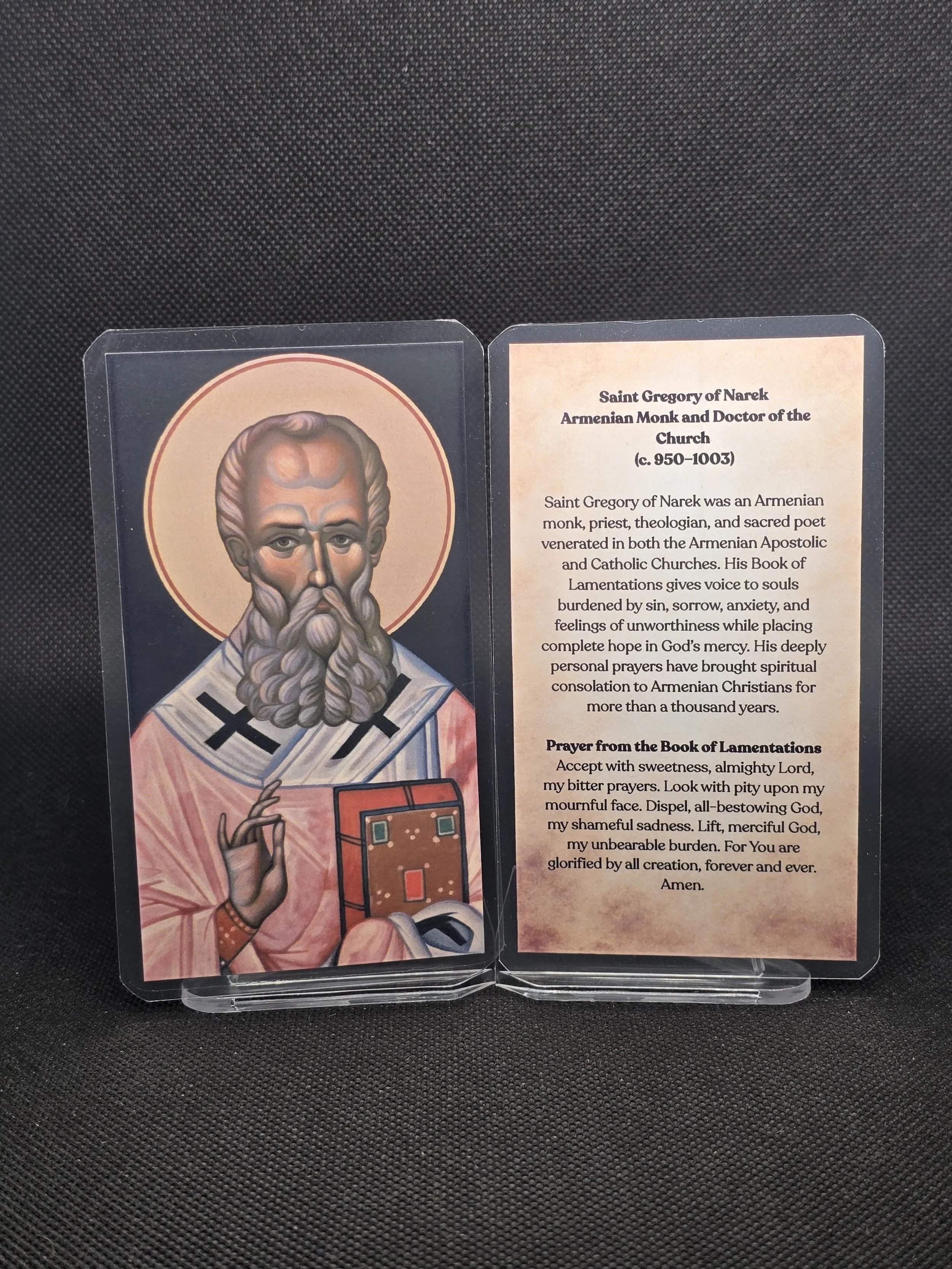
Saint Gregory of Narek was an Armenian monk, mystic, poet, and Doctor of the Church whose tears became theology and whose prayers have comforted broken souls for over a thousand years. He is venerated in the Armenian Apostolic Church and honored by Armenian Catholics and the wider Catholic Church, which proclaimed him a Doctor of the Church in 2015. His principal feast is celebrated on February 27 in the Armenian tradition, with commemorations also observed in the Catholic calendar.
Saint Gregory did not live a dramatic public life.
He lived interiorly.
He was born around 950 near Lake Van and entered monastic life at the monastery of Narek, where he spent his years in study, repentance, and relentless prayer. His most famous work, the Book of Lamentations, is not a treatise. It is a cry. It is the voice of a soul wrestling with anxiety, guilt, fear of judgment, and longing for mercy.
People pray to Saint Gregory of Narek today for depression healing, scrupulosity, and freedom from crushing spiritual despair. He understands what it means to feel unworthy. He understands the ache of overexamining every fault. He understands how heavy the human heart can feel when burdened by shame and intrusive thoughts.
He also understands mercy.
This prayer card is for those battling interior darkness, for believers tormented by spiritual anxiety, and for anyone longing to learn how to pray from the depths rather than from performance. Saint Gregory does not dismiss suffering of the mind. He walks into it and prays from within it.
Each card is handmade in Austin and created to order. We do not keep stock, because every prayer card is treated as a unique devotional offering. They are printed on museum-quality photo paper, not cardstock, and each one is made during prayer. The saints are venerated throughout the entire process, and prayers are intentionally offered for the person who will receive the card. These are not mass-produced items. They are created slowly, reverently, and with spiritual intention, because every soul and every prayer matters.
There is a moment near the beginning of the fifty-first prayer of the Book of Lamentations — the great prayer-poem collection that is the masterwork of Gregory of Narek and one of the supreme achievements of Christian mystical literature in any language — when the author addresses God with a directness so unguarded, so searingly honest, that the reader feels the ground shift slightly beneath them. He writes, in the Armenian that only he could write in quite this way, of being a man "whose heart is a den of wild beasts, whose soul is a battlefield of demons, whose mind is a residence of shadows." And then, in the turn that makes Gregory Gregory, he addresses the God who made this ruined human being, who knows every particular of this ruin, and who is being asked — not tentatively, not with hedging or theological qualifications, but with the absolute confidence of a man who has somehow passed through despair and come out the other side — to come and dwell in it anyway.
This movement — from the most unflinching honesty about human darkness to the most absolute confidence in divine mercy — is the characteristic movement of Gregory of Narek's entire theological and spiritual vision, and it is the reason why Armenians have loved him with an intensity that goes beyond ordinary veneration for sixteen centuries, why his book has been placed under the pillows of the sick and the dying throughout the Armenian world as a physical embodiment of healing power, why his name is spoken with a warmth and an intimacy that most saints are not granted, and why, on February 23, 2015, Pope Francis declared him the thirty-sixth Doctor of the Universal Church — the first from the Oriental non-Chalcedonian traditions, the first Armenian, and one of the most genuinely surprising and theologically significant acts of recognition in recent Catholic history.
Gregory of Narek is not well known outside Armenian Christian circles and the relatively small community of scholars who study medieval Eastern Christian spirituality. He should be. He is one of the great Christian mystics of any tradition, a theological poet of the first rank, a spiritual psychologist of terrifying accuracy and immense compassion, and a figure whose witness to the possibility of encountering God in the extremity of human brokenness is as urgently relevant to the twenty-first century as it was to the tenth. His book — the Narek, as Armenians call it with the easy familiarity reserved for a text that is practically a family member — is one of those rare works that does not so much describe the spiritual life as enact it, drawing the reader into a prayer that is simultaneously the author's and the reader's own, spanning a thousand years with the immediacy of something written this morning.
This article tells the full story of who Gregory of Narek was, how he lived, what he believed, what he wrote, why his church loves him, why the whole church should know him, and where the physical traces of his presence in the world can still be found and venerated.


The World of Tenth-Century Armenia — A Civilization Between Empires
The Bagratid Renaissance
Gregory of Narek was born around 951 AD into an Armenia experiencing one of the most remarkable cultural and political flowerings in its entire history. The Bagratid Armenian kingdom — established in the ninth century by the dynasty of the Bagratuni family, which had skillfully navigated the complex politics of the declining Arab Caliphate and the rising Byzantine power to carve out a substantial degree of Armenian independence — was at or near its zenith. The capital city of Ani, in the region of what is now northeastern Turkey near the modern Turkish-Armenian border, was by the early eleventh century one of the largest and most sophisticated cities in the entire Near East: a city of a hundred thousand inhabitants, of magnificent churches and palaces, of an active intellectual and commercial life, of art and architecture of extraordinary refinement, and of a royal court that patronized learning, theology, and the arts with genuine enthusiasm.
The Bagratid period — sometimes called the Armenian Renaissance or the Silver Age of Armenian culture, in implicit comparison with the Golden Age of the fifth century inaugurated by Mesrop Mashtots — was a time of relative peace, relative prosperity, and intense cultural productivity. Monasteries were founded and expanded throughout the Armenian highlands. Manuscript illumination reached heights of extraordinary beauty. Church architecture developed the sophisticated forms that would culminate in the great monasteries of Haghpat, Sanahin, Tatev, and Geghard. And theological writing — building on the foundations laid by the fifth-century translators and original writers — flowered into a literature of considerable sophistication and depth.
It was into this world — not the world of persecution and catastrophe that had shaped so much of Armenian Christian history before and would shape so much of it after, but a world of relative cultural confidence and creative vitality — that Gregory of Narek was born. He was, in this sense, a man of a cultural renaissance, someone who had access to the full intellectual and spiritual resources of the Armenian tradition at a moment when those resources were being actively developed and celebrated rather than merely defended. The security of the Bagratid period gave him the freedom to go deeper — to explore the interior life of prayer with a thoroughness and a fearlessness that more precarious historical circumstances might not have permitted.
The Lake Van Region — The Geography of His Life
Gregory spent virtually his entire life within a relatively small geographical radius centered on Lake Van — the vast, alkaline lake in the eastern Armenian highlands that sits at the center of the historical Armenian homeland and that gives the region of Vaspurakan (what is now the Van province of eastern Turkey) its distinctive character. Lake Van is one of the largest lakes in the Middle East, a body of water whose immensity and whose quality of light — the high-altitude clarity of the air over the lake, the way the mountains that surround it are reflected in its surface, the particular silence that hangs over it — has struck every observer from antiquity to the present as something beyond the ordinarily beautiful, partaking of the quality that the theological tradition calls the sublime.
The landscape of the Lake Van region shaped Gregory's imagination in ways that are visible throughout the Book of Lamentations — his imagery of mountains and abysses, of deep water and high peaks, of light breaking over a dark horizon, of the silence of wild places in which God's presence is more palpable than anywhere else, all of this reflects the specific geography of the place where he was formed. He was a man of the mountains and the lake, and his mystical geography — the interior landscape he maps in his prayers — bears the imprint of the external geography that shaped his seeing.
The Diocese of Vaspurakan
The ecclesiastical context of Gregory's life was the Diocese of Vaspurakan, one of the major ecclesiastical provinces of the Armenian church, which covered the Lake Van region and its surrounding territories. The diocese was an active and important one in the tenth century, with multiple monasteries, a functioning episcopal hierarchy, and a community of monks and scholars engaged in theological and liturgical work. The Bishop of Vaspurakan during the period of Gregory's formation was a man of learning and piety, and the diocese's intellectual environment was one in which serious theological and literary work was valued and supported.
The Armenian church of the Bagratid period was not simply a survivor maintaining itself against pressure. It was a creative institution, actively developing its theological tradition, expanding its liturgical life, building new monasteries and schools, and producing a generation of writers and thinkers of genuine distinction. Gregory of Narek was the greatest of this generation, but he was not without peers, and the environment in which he worked was one of genuine intellectual vitality.


His Origins, Family, and Formation
His Father — Khosrov Andzewatsi
Gregory's father was Khosrov Andzewatsi — Khosrov of Andzit — a bishop of the Armenian church, a theologian of considerable ability, and a man who combined the roles of ecclesiastical administrator and biblical commentator with a degree of distinction that gave his family a prominent place in the intellectual life of the diocese. Khosrov wrote a commentary on the Divine Liturgy — the Explanation of the Divine Offices — that is still consulted by scholars of Armenian liturgical history, and his theological formation gave Gregory the best possible starting point for his own much more profound intellectual and spiritual development.
The fact that Gregory's father was a bishop is worth noting because it situates the family within the Armenian ecclesiastical tradition of the period, in which clerical and episcopal positions were not entirely separated from family life in the manner that later monastic reform movements would demand. Khosrov was a married priest who had risen to the episcopate — a pattern common in the early period of Armenian Christianity, when the hereditary principle in ecclesiastical appointment had not yet been fully superseded by the monastic reform that would eventually require celibacy for bishops. Gregory himself would become a monk and a celibate priest, but his family of origin was a clerical family in the married tradition, and this gave him from childhood a formation that was simultaneously domestic and theological, liturgical and intellectual.
Gregory had at least one sibling — a brother named Hovhannes (John) who also became a monk at Narekavank (the Monastery of Narek) and who collaborated with Gregory in certain aspects of his literary work. The evidence of sibling collaboration in the monastic life suggests a family in which the commitment to the religious vocation was genuine and deep, not merely conventional.
The Loss of His Mother
Gregory lost his mother at a very young age — possibly in infancy or early childhood. The specific circumstances of her death are not recorded in the sources, but the loss is significant for understanding certain aspects of his spiritual life and his literary output. The Book of Lamentations contains passages of profound reflection on maternal love and on the grief of those deprived of it early, and the absence of his mother from his formation meant that he was raised in an environment shaped entirely by the clerical and monastic masculine world of his father's household and, later, the monastery.
The maternal imagery that appears throughout the Book of Lamentations — Gregory's descriptions of God's love as maternal in its tenderness and its completeness, his reflections on being held and nourished and formed by a love that does not abandon — has been read by some scholars as a sublimation of the specific maternal love he did not receive in childhood. Whether or not this psychoanalytic reading is ultimately persuasive, the warmth and specificity of his maternal imagery of God suggests a man who understood the maternal dimension of divine love with an unusual depth, possibly because its earthly form had been taken from him before he could fully receive it.
The Monastery of Narekavank
Following the loss of his mother, Gregory was placed in the care of his uncle or adoptive father Anania Narekats'i — the abbot of the Monastery of Narekavank, situated on the southern shore of Lake Van in the region of Rshtuni. This placement proved to be the decisive formation of his life. Narekavank was not an ordinary monastery. It was one of the most intellectually and spiritually distinguished monastic houses in tenth-century Armenia — a community with a strong tradition of learning, a substantial library, a school for the formation of monks and priests, and a history of producing figures of theological and literary distinction.
Anania himself was a man of considerable learning — a biblical commentator and theological teacher whose formation of the young Gregory was the foundation on which everything else was built. He taught Gregory Greek, enabling him to read the theological tradition of the Cappadocian Fathers, John Chrysostom, Cyril of Alexandria, and other Greek patristic writers in their original language. He taught him the Armenian theological and literary tradition — the works of the fifth-century translators and original writers whose Golden Age had laid the foundations for all subsequent Armenian Christian culture. He gave him, in short, the complete intellectual formation of a serious Armenian monastic scholar of the tenth century, which was itself one of the richest intellectual formations available anywhere in the Christian world of that period.
Gregory received this formation with a receptivity and a creative energy that quickly surpassed his teacher. He was, from an early age, not merely an excellent student but a genuinely original mind — someone who took in everything that was given to him and transformed it into something that bore the unmistakable stamp of his own vision, his own voice, his own relationship with God.
His Monastic Life at Narekavank
Gregory took his monastic vows at Narekavank and spent essentially his entire adult life there, dying at the monastery around 1003 AD. This extreme geographical stability — the same monastery, the same lake, the same mountains, for a lifetime — is one of the features of his life that most clearly marks him as a man of the monastic tradition, for whom the commitment to stability (stabilitas loci, in the Benedictine formulation) was not merely a practical arrangement but a spiritual discipline.
He was ordained as a priest — the sources suggest this happened in his early adulthood, possibly in his mid-twenties — and he served as both a liturgical minister and a spiritual father within the community. He taught in the monastery's school, forming younger monks in the theological and literary tradition. He participated in the full liturgical life of the community — the daily celebration of the Divine Offices, the weekly celebration of the Badarak (Divine Liturgy), the keeping of the fasts and feasts of the Armenian liturgical year. He prayed. He read. He wrote.
The external life of a tenth-century Armenian monk in a well-established monastic community was, by worldly standards, an extremely restricted one — confined to the monastery's precinct, governed by the rhythms of the liturgical day and year, shaped by the disciplines of fasting and prayer and manual work and study. Gregory never traveled widely, never held ecclesiastical office beyond his monastic priesthood, never played a major role in the great events of his day. He was, in his own understanding and in the tradition's understanding, a hidden man — a man whose entire significance lay in what happened in the interior life that no external observer could directly see.
And yet the Book of Lamentations that emerged from this hidden life is one of the most publicly significant texts in the history of Armenian Christianity — a book that shaped the prayer of millions of people across ten centuries, that was recited by the sick and the dying, that was carried into exile and genocide, that was read by popes and Orthodox patriarchs and Protestant scholars, and that ultimately earned its author a place among the Doctors of the Universal Church. The exterior smallness and the interior magnitude are perfectly proportioned: it is precisely because Gregory went so deep that he has proven so wide.



His Theological Formation and Intellectual World
The Greek Patristic Inheritance
Gregory's theological formation was rooted in the great Greek patristic tradition that the fifth-century Targmanichner had translated into Armenian — the tradition of the Cappadocian Fathers, of Cyril of Alexandria, of John Chrysostom, of Pseudo-Dionysius the Areopagite. This inheritance is visible throughout the Book of Lamentations in both its theological content and its literary method.
From the Cappadocians — Basil of Caesarea, Gregory of Nyssa, Gregory Nazianzus — he inherited a theology of divine transcendence and immanence that holds both poles in tension without collapsing either: God is absolutely beyond all human categories and concepts (apophatic theology), and yet God is absolutely present and accessible to the creature made in the divine image (cataphatic theology). Gregory of Nyssa's concept of epektasis — the soul's infinite, ever-deepening progress into the inexhaustible richness of the divine life — is one of the organizing spiritual principles of the Book of Lamentations, even if Gregory of Narek does not use that specific term.
From Cyril of Alexandria he inherited the Christological emphasis on the complete union of divinity and humanity in Christ that would become the theological foundation of the Armenian church's non-Chalcedonian position — though, as noted in the earlier article on Armenian Christianity, the Book of Lamentations itself is not a polemical Christological text and contains nothing that can be identified as distinctively non-Chalcedonian in its theological content. Gregory's Christology in the Narek is the Christology of the undivided church — fully incarnational, fully committed to the reality of Christ's humanity and divinity, fully oriented toward the saving work of the Incarnate Word.
From Pseudo-Dionysius the Areopagite — the mysterious fifth or sixth-century theologian whose works were translated into Armenian early and were widely read in the Armenian monastic tradition — he inherited a mystical theology of divine darkness and unknowing that deeply shaped his understanding of what prayer ultimately is and where it ultimately leads. The apophatic dimension of the Book of Lamentations — its willingness to push past every human category for God, to confess that the God it addresses exceeds every address — is rooted in the Dionysian tradition of the divine darkness that is more luminous than any light.
The Syriac Mystical Tradition
Alongside the Greek patristic inheritance, Gregory's theological formation was shaped by the Syriac mystical tradition — the tradition of Isaac of Nineveh, John of Dalyatha, Joseph Hazzaya, and other writers of the East Syrian ascetic and contemplative movement whose works circulated in Armenian translation and were read in monasteries like Narekavank. The Syriac tradition brought a dimension of psychological interiority, of attention to the movements of the inner life, that complemented and deepened the more cosmological orientation of the Greek tradition.
Isaac of Nineveh in particular — the seventh-century bishop whose Ascetical Homilies were among the most widely read texts in Eastern Christian monasticism, and who is himself venerated as a saint by the Eastern Orthodox Church despite his East Syrian (Nestorian) ecclesiastical background — exercised a profound influence on Gregory's understanding of prayer, compunction, and the relationship between human weakness and divine mercy. The specific quality of Isaac's teaching — his insistence that the fear of God is transformed through prayer into a love that casts out fear, his meditation on the divine mercy that exceeds all human sin — resonates deeply throughout the Book of Lamentations.
The Armenian Literary Tradition
Gregory was also deeply formed in the specifically Armenian literary tradition established by the fifth-century writers — Mesrop, Sahak, Movses Khorenatsi, Yeghishe, Eznik of Kolb — and continued by subsequent generations of Armenian theological and liturgical writers. He knew the Armenian liturgical poetry tradition — the sharakan tradition of hymn composition — intimately, both as a participant in it (he himself composed sharakans that are still sung in the Armenian church) and as a student of its formal and theological conventions.
The Armenian biblical translation — the Queen of Translations that the Targmanichner had produced in the fifth century — was his primary scriptural text, and his deep immersion in it is visible throughout the Book of Lamentations, which is saturated with scriptural allusion and quotation in a way that presupposes a mind that has absorbed the Bible not merely intellectually but imaginatively and emotionally. He prayed the Armenian scriptures; they became part of the fabric of his interior life; and when he wrote, the biblical language came not as citation but as native speech, the language in which his deepest self thought and felt.
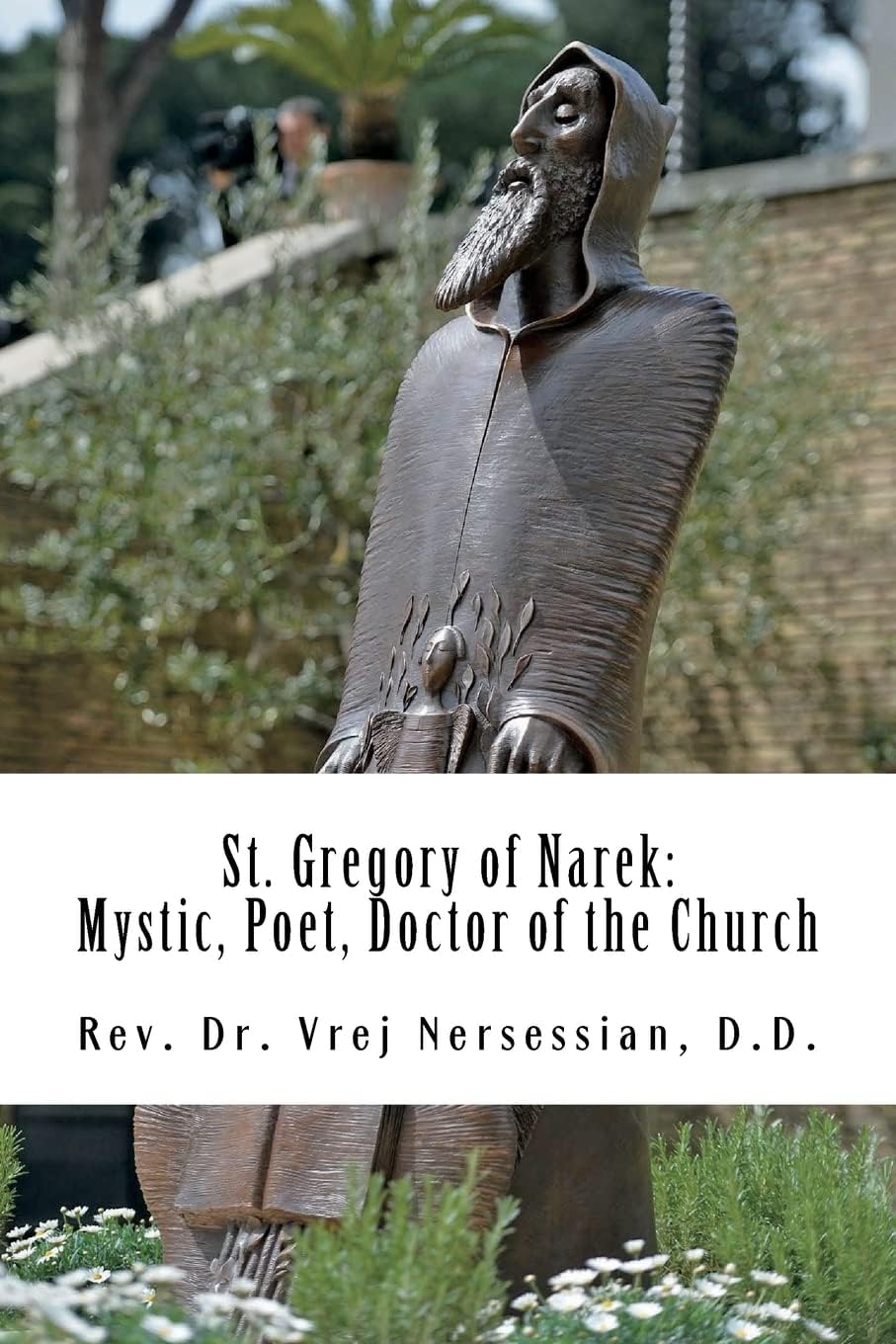


The Book of Lamentations — The Narek
What It Is
The Matean Voghbergutyan — Book of Lamentations in the most common English translation, though the Armenian title is more precisely rendered as Book of Mournful Chants or Book of Sorrowful Songs — is a collection of ninety-five extended prayer-poems, each addressed directly to God, each designated as a ban or word (sometimes translated as speech or discourse), and each exploring some aspect of the relationship between the human soul and the divine reality that is simultaneously the soul's creator, judge, destroyer, and savior.
The work is unlike anything else in the entire Christian mystical and theological tradition. It is not a systematic theology, though it contains theology of the highest sophistication. It is not a rule of life or a manual of spiritual direction, though it illuminates the spiritual life with extraordinary depth. It is not a series of doctrinal meditations, though every doctrine of the church is somewhere engaged, embodied, or implied. It is, at the deepest level, what its title says it is: a book of prayer. But prayer of a kind so total, so psychologically comprehensive, and so theologically radical that the word prayer itself seems insufficient to contain it.
Each of the ninety-five prayers is a complete unit — a self-contained act of address to God that has its own specific focus, its own specific emotional texture, and its own specific movement through darkness toward light. Yet the ninety-five together form a whole that is greater than the sum of its parts — a sustained exploration of every dimension of the soul's relationship with God, covering the heights of mystical union and the depths of spiritual desolation, the experience of divine presence and the experience of utter abandonment, the reality of sin and the miracle of mercy, the terror of divine judgment and the tenderness of divine love, with a comprehensiveness and a coherence that suggests an organizing vision of remarkable clarity and depth.
How Gregory Understood What He Was Writing
Gregory's own preface to the Book of Lamentations is one of the most important texts for understanding what he thought he was doing, and it deserves close reading:
"In the name of the Father, Son and Holy Spirit, I, Gregory, the servant of God, sinner among sinners, having gathered together with labor and toil, having learned from books and from experience, and having reflected in my heart, I have written these prayers for myself and for all the faithful who suffer, for the consolation of the soul, as a memorial of my name before God, with the hope of mercy from him who is ready to forgive all sins."
Several things are worth noticing in this extraordinary self-description. First, the radical self-identification as "sinner among sinners" — not a conventional gesture of humility, as in the formulaic modesty that opens many medieval texts, but a genuine theological claim about where Gregory understands himself to stand before God. The Book of Lamentations is written from the bottom, not from the top. It is the prayer of a man who begins in the place of absolute human poverty and who meets God precisely there, not despite being there but because of it.
Second, the combination of sources: "having learned from books and from experience." This is not the work of a man who theologizes from a purely intellectual position. It is the work of a man who has lived what he writes about, who has prayed these prayers not as literary exercises but as the genuine cry of his own soul, and who offers them to others not as a teacher offering lessons but as a fellow sufferer sharing the resources that have sustained him.
Third, and most remarkable, the stated purpose: "for myself and for all the faithful who suffer." Gregory writes for himself. He makes no pretense of an impersonal or merely didactic purpose. But the prayer that is genuinely his own is also, he understands, the prayer of everyone who suffers — which is to say, everyone. The Book of Lamentations is intensely personal and simultaneously universal, because the soul's address to God from the depths of human weakness is, ultimately, every soul's address.
The Structure and Movement of the Prayers
Each of the ninety-five prayers follows a general pattern that is recognizable across the whole collection, though varied enough in its specific execution that each prayer feels fresh rather than formulaic. The general movement is:
Opening address — a direct invocation of God, often in language of great theological density, establishing both the divine transcendence that makes the address almost presumptuous and the divine love that makes it possible.
Confession and lament — the central and longest section of most prayers, in which Gregory articulates with extraordinary specificity the condition of the human soul in its brokenness, its sinfulness, its confusion, and its suffering. This section is where the Book of Lamentations most clearly earns its title and where its psychological depth is most fully on display.
Theological reflection — woven through the lament, Gregory meditates on the nature of God, the mystery of the Incarnation, the meaning of Christ's death and resurrection, the work of the Holy Spirit, and other theological realities that bear on the soul's situation as he has described it.
Turn toward hope — the pivotal movement of each prayer, in which the lament does not disappear but is placed in a larger context — the context of God's mercy, Christ's sacrifice, the church's sacramental life, the promise of resurrection — that transforms its meaning without denying its reality.
Petition and intercession — the direct request, usually for mercy, forgiveness, healing, and the eschatological fullness of salvation, often extended to include prayer for others — for all who suffer, for the church, for the Armenian people, for the dead.
Doxological close — the prayers typically end in praise, in a brief ascent from the depths of lament to the heights of worship, enacting in their own structure the theological claim that genuine prayer always moves toward praise, however long and difficult the route.
The Voice of the Narek — What Makes It Unique
The quality that most immediately distinguishes the Book of Lamentations from other works of Christian mystical literature — even from works of great beauty and theological depth — is the quality of Gregory's voice. It is a voice of completely unusual honesty.
Christian literature, like all literature, has its conventions — its ways of presenting the spiritual life that balance authenticity with the needs of the genre and the expectations of the audience. Even the greatest spiritual writers tend, in various ways, to present themselves in roles: the humble monk, the wise teacher, the contrite penitent, the ecstatic mystic. Gregory does all of these things, but he does them from inside an honesty so radical and so complete that the role never quite hardens into a pose. He writes about his own sinfulness with a specificity that is astonishing, cataloguing not just generic categories of sin but particular failures of attention, particular habits of the mind and will and imagination that he has observed in himself with the accuracy of a man who has spent decades in careful interior examination.
He also writes about God with a directness that occasionally borders on what a more cautious theological tradition might call impertinence. He argues with God. He expresses something very like frustration at the silence of God in the face of human suffering. He presses his petitions with an urgency that does not rest in pious resignation but insists, with the confidence of a man who knows himself loved, that the love he is invoking is real and that the God he is addressing is capable of more than he has so far shown. This combination of self-knowledge and God-directness — of knowing exactly who he is and exactly who God is and being willing to put them in the most direct possible relationship without softening either — is what makes the Narek unlike any other book of prayer in the Christian tradition.
The Theology of the Narek
The theological content of the Book of Lamentations is not systematic — it is not organized as a dogmatic treatise — but it is comprehensive and of the highest quality. Every major doctrine of the Christian faith is engaged somewhere in the ninety-five prayers, and engaged not as an abstract proposition but as a living reality that bears directly on the condition of the praying soul.
The Trinity — Gregory addresses all three persons of the Trinity throughout the Narek, sometimes separately and sometimes together, and his Trinitarian theology has the full depth of the Cappadocian inheritance. The Father is the ultimate source of all being and all mercy, the ground of the hope that sustains the prayer throughout. The Son is the central figure — the Incarnate Word whose humanity makes possible the soul's approach to divinity, whose death opens the way that sin had closed, whose resurrection is the guarantee of the soul's own ultimate transformation. The Spirit is the interior animator of the prayer itself, the presence within the soul that makes genuine address to God possible at all.
The Incarnation — Gregory's Christology is among the richest dimensions of the Narek's theological content. He meditates at length on the mystery of the Incarnation — on what it means that God has entered human experience completely, has taken on not just human flesh in the abstract but the full particularity of human vulnerability, suffering, temptation, and death. His emphasis on the completeness of Christ's humanity — on the fact that in becoming human, God did not hold anything of the human condition at arm's length but entered it to the very bottom — is theologically significant in the context of the Christological controversies of the Armenian tradition, though the Narek is not, as emphasized above, a polemical text. Its Christology is the Christology of love: God became fully human because only a fully human God could be the complete Savior of fully human sinners.
Sin and Mercy — The central theological dynamic of the Narek is the confrontation between human sinfulness, fully acknowledged and unflinchingly described, and divine mercy, equally fully acknowledged and equally unflinchingly invoked. Gregory does not allow either pole to swallow the other. The sin is real and it is serious — it is not minimized, aestheticized, or resolved too quickly into reassuring formulas. And the mercy is real and it is absolute — it is not qualified, rationed, or made conditional on the soul having first achieved a certain level of self-improvement. The entire dramatic arc of the Book of Lamentations is the arc between these two realities, and the book's power comes from Gregory's refusal to shortcut the drama by giving either side less than its full due.
Prayer and Its Possibility — One of the most theologically profound dimensions of the Narek is its sustained reflection on the nature and the possibility of prayer itself. Gregory is acutely aware that prayer — genuine prayer, prayer that actually reaches God rather than merely circling around the self — is not something the human being can simply decide to do and then do. It is a gift. It requires a capacity that sin has damaged and that only God's prior action can restore. And yet the Book of Lamentations is, in its very existence, an act of that restored capacity — Gregory is praying, and his prayer is reaching God, because God has made it possible for the prayer to be made. The circularity here is not a logical flaw but a theological insight: the prayer that asks for the capacity to pray is itself the evidence that the capacity has already been given.
Eschatology — The final horizon of the Narek is consistently eschatological: Gregory prays with one eye on the end, on the final judgment, on the resurrection of the dead, on the promised fullness of union with God that is the ultimate destination of the soul's journey. His eschatology is neither fearful nor sentimental — he does not minimize the reality of divine judgment, and he does not reduce the hope of resurrection to a comfortable afterlife fantasy. The eschatological horizon gives the present moment of prayer its ultimate weight: these prayers matter because the soul that prays them is a soul heading toward the encounter with God that no intermediary can mediate and no preparation can fully complete.
The Narek as Liturgical Text
The Book of Lamentations occupies a unique position in the Armenian liturgical tradition as a text that straddles the boundary between personal prayer and communal worship, between private devotion and public liturgy. It was never formally incorporated into the Armenian Badarak — it is not a liturgical book in the canonical sense. But its use in the life of the Armenian church has been so pervasive and so continuous that it functions, in practice, as a kind of quasi-liturgical text — a book that is prayed publicly and communally even though it was written in the first person singular.
Certain prayers from the Narek are read or chanted during specific liturgical occasions — during the prayers for the sick, during the services for the dead, during times of communal crisis or national mourning. The entire book is sometimes read aloud in community settings, with different prayers assigned to different readers. And throughout the Armenian world, both in Armenia and in the diaspora, portions of the Narek are used in personal devotion in ways that blur the line between private prayer and participation in the church's communal life: to read Gregory's prayer is to join your voice to the seventeen centuries of Armenian voices that have read it before you, and that community of prayer is itself a form of liturgical participation.


The Controversy — Was Gregory a Heretic?
The Accusation and the Defense
No full account of Gregory of Narek's life can avoid one of the most historically significant and theologically interesting aspects of his story: that during his own lifetime he was accused of heresy by some of his contemporaries, investigated by the church authorities, and either formally acquitted or informally cleared — the sources are somewhat ambiguous about the precise outcome.
The specific charge against Gregory was association with the Tondrakian sect — a movement that flourished in the tenth-century Armenian highlands and that the Armenian church regarded as a dangerous heresy. The Tondrakians are a complex and not fully understood phenomenon in Armenian religious history. They appear to have combined elements drawn from earlier dualist heresies (possibly related to the Paulician movement that had been active in the Armenian region) with social radicalism, rejection of the institutional church, and various antinomian tendencies. They denied the authority of the clergy, rejected the sacraments, and appear to have held doctrines about matter and creation that the church understood as incompatible with orthodox Christianity.
Gregory was accused of sympathy for or connection with the Tondrakians — a charge that, if true, would have placed him in fundamental opposition to the sacramental and ecclesiastical theology that is one of the most important dimensions of the Book of Lamentations. The accusation appears to have been motivated at least partly by the same combination of theological anxiety and personal rivalry that has driven similar accusations against mystical writers throughout Christian history: a man whose prayer was this intimate, this direct, this apparently unmediated by the institutional forms of the church, was necessarily going to attract the suspicion of those who worried that such intimacy bypassed the sacramental economy altogether.
The defense, mounted by Gregory himself and by his supporters, was essentially to point to the Book of Lamentations itself and to the other theological and liturgical works that Gregory had produced. These works are not the works of a Tondrakian sympathizer. They are saturated with sacramental theology — Gregory's understanding of prayer is consistently mediated by the church's sacramental life, his mysticism is ecclesial rather than individualist, and his theological commitments are fully orthodox in every dimension. The specific heresies attributed to the Tondrakians — their rejection of the Eucharist, their denial of the body's significance in salvation, their rejection of the priesthood — are precisely the positions that the Book of Lamentations implicitly and explicitly opposes.
The Resolution and What It Reveals
The historical outcome of the heresy investigation is described somewhat differently in different sources, but the general picture is that Gregory was cleared of the charges and that the accusation did not ultimately damage his standing in the church. He continued to live and work at Narekavank, to write, to pray, and to serve his community until his death, and the veneration that began immediately after his death suggests that the community that knew him best had no doubt about where he stood.
What the controversy reveals, however, is genuinely important for understanding both Gregory and the Book of Lamentations. It reveals that Gregory was a figure of sufficient theological boldness and spiritual intensity to make his contemporaries nervous — that the radical honesty of his prayer, the intimacy of his address to God, the psychological depth of his self-examination, were not universally received as signs of sanctity but were by some experienced as threatening. The mystical tradition has always lived with this tension: its practitioners push to the edges of what institutional religion can comfortably accommodate, and their contemporaries often respond with suspicion before subsequent generations respond with reverence.
The accusation also gives the Book of Lamentations a specific biographical dimension. Some scholars have read Prayer 14 — in which Gregory addresses the question of false accusation and the experience of being misunderstood and condemned by those whose judgment one is subject to — as a direct reflection of the heresy investigation. Whether or not this specific identification is correct, the Narek contains multiple passages that reflect the experience of a man who has been judged falsely and who has learned to bring even that experience into the transformative space of prayer.

His Other Works
The Liturgical Compositions — Sharakans and Canons
Beyond the Book of Lamentations, Gregory of Narek was a prolific composer of liturgical poetry. His sharakans — the hymns sung in the Armenian Divine Liturgy — number in the dozens, and several of them are among the most beloved pieces in the entire Armenian liturgical repertoire. They are sung in Armenian churches to this day, giving Gregory a presence in the weekly and daily worship of the Armenian church that extends far beyond those who have read the Narek and into the experience of every Armenian Christian who attends liturgy regularly.
The sharakans attributed to Gregory display the same qualities as the Book of Lamentations — theological density, linguistic beauty, emotional directness, and a Christological focus that is both doctrinally precise and pastorally warm — but in a compressed and publicly functional form appropriate to liturgical use. Where the Narek is a private room for extended personal encounter with God, the sharakans are windows opening from that private room into the shared space of communal worship.
Gregory also composed canons — structured poetic sequences used in the liturgical offices — on a variety of subjects, including canons for major feasts of the Armenian calendar. His canon for the feast of the Holy Cross is particularly admired for its theological and poetic quality, combining the architectural precision of the liturgical canon form with the characteristic Gregory intensity of theological vision.
The Commentary on the Song of Songs
Gregory wrote a theological commentary on the Song of Songs — the biblical book of erotic love poetry that has been the subject of allegorical and spiritual interpretation in both the Jewish and Christian traditions from antiquity. His commentary, written in the tradition of Origen's great third-century commentary on the same text, interprets the Song as an allegory of the soul's love for God and God's love for the soul, and it is one of the most significant works of Armenian biblical commentary in the entire tradition.
The choice of the Song of Songs as a subject for commentary is itself revealing about Gregory's theological sensibility. In the Christian mystical tradition, the Song of Songs has always been the privileged biblical text for the exploration of the soul's intimate union with God — the text that most directly names, in the language of the most intimate human love, what the soul ultimately desires and what God ultimately offers. That Gregory chose this text for his most sustained work of biblical commentary suggests a man whose theological vision was organized around the category of love — divine love, human love, and the transformative encounter between them — rather than around the categories of law or judgment or institutional authority.
The commentary is also important as a window into Gregory's method of biblical interpretation — his combination of careful attention to the literal text, creative allegorical elaboration, and direct application to the soul's spiritual condition. The method he demonstrates in the Song of Songs commentary is the same method that saturates the Book of Lamentations in a more personal and less explicitly academic form.
The Panegyric on the Holy Virgin
Gregory wrote a panegyric — a formal praise-speech — addressed to the Virgin Mary, developing a Mariology of considerable theological depth and poetic beauty. His Mariological writing follows in the tradition of the great Greek hymnographers who developed the theology of Mary as Theotokos — Mother of God — in the aftermath of the Council of Ephesus (431 AD), and it brings to that tradition the characteristic Gregory intensity of personal address and emotional directness.
His praise of Mary is notable for its theological precision — he is careful to honor her in exactly the ways that her role in the Incarnation justifies, without attributing to her divine prerogatives that belong only to God — and for its warmth, which reflects the personal devotion of a man for whom Mary's intercession was not a theological abstraction but a living reality of his prayer life.
The Elegy on the City of Kars
Among Gregory's less studied but historically significant works is a poem of mourning written for the city of Kars — a major Armenian city in what is now northeastern Turkey — following its destruction by enemies. This poem, written in the tradition of the biblical Lamentations of Jeremiah (from which Gregory's major work takes its title and some of its inspiration), is one of the earliest examples in Armenian literature of the ode of lament for a ruined city — a genre that would be given renewed urgency by the catastrophes of subsequent Armenian history, culminating in the Genocide of 1915.
The Elegy on the city of Kars situates Gregory not only as a mystical theologian but as a man whose spirituality was engaged with the concrete historical suffering of his people — a man for whom the destruction of a city was not a mere occasion for literary exercise but a genuine grief requiring the resources of prayer, lament, and hope that the Book of Lamentations at its largest scale explores.
Saint Gregory of Narek was an Armenian monk, mystic, poet, and Doctor of the Church whose tears became theology and whose prayers have comforted broken souls for over a thousand years. He is venerated in the Armenian Apostolic Church and honored by Armenian Catholics and the wider Catholic Church, which proclaimed him a Doctor of the Church in 2015. His principal feast is celebrated on February 27 in the Armenian tradition, with commemorations also observed in the Catholic calendar.
Saint Gregory did not live a dramatic public life.
He lived interiorly.
He was born around 950 near Lake Van and entered monastic life at the monastery of Narek, where he spent his years in study, repentance, and relentless prayer. His most famous work, the Book of Lamentations, is not a treatise. It is a cry. It is the voice of a soul wrestling with anxiety, guilt, fear of judgment, and longing for mercy.
People pray to Saint Gregory of Narek today for depression healing, scrupulosity, and freedom from crushing spiritual despair. He understands what it means to feel unworthy. He understands the ache of overexamining every fault. He understands how heavy the human heart can feel when burdened by shame and intrusive thoughts.
He also understands mercy.
This prayer card is for those battling interior darkness, for believers tormented by spiritual anxiety, and for anyone longing to learn how to pray from the depths rather than from performance. Saint Gregory does not dismiss suffering of the mind. He walks into it and prays from within it.
Each card is handmade in Austin and created to order. We do not keep stock, because every prayer card is treated as a unique devotional offering. They are printed on museum-quality photo paper, not cardstock, and each one is made during prayer. The saints are venerated throughout the entire process, and prayers are intentionally offered for the person who will receive the card. These are not mass-produced items. They are created slowly, reverently, and with spiritual intention, because every soul and every prayer matters.
His Death and Immediate Veneration
The Death of Gregory of Narek
Gregory died at the Monastery of Narekavank around 1003 AD, having spent essentially his entire adult life in the same monastic community on the shores of Lake Van. He was approximately fifty-two years old — not old by modern standards, but a significant age for a man of the tenth century who had lived the physically austere life of a monk in a monastery at altitude in a harsh climate. The specific causes of his death are not recorded in the sources, and the tradition has not preserved a detailed deathbed narrative comparable to the accounts we have for some other saints.
What the tradition does preserve is the community's immediate response to his death: the recognition, spontaneous and unanimous, that they had been living in the presence of a genuinely holy man, that the grace that had moved through his prayers and his poetry was the grace of a saint, and that the appropriate response was veneration rather than merely grief. The reports of miraculous healings at his tomb began, according to the tradition, almost immediately — the standard sign in the early Christian tradition of genuine sanctity recognized by the community closest to the saint.
He was buried at Narekavank, the monastery where he had lived his entire monastic life, and the monastery subsequently became a pilgrimage site associated with his intercession. The physical proximity of the place of his prayer and the place of his burial — the man who had prayed the ninety-five prayers of the Book of Lamentations in those very walls now resting in the earth beneath them — gave the site a quality of accumulated holiness that drew pilgrims from throughout the Armenian world.
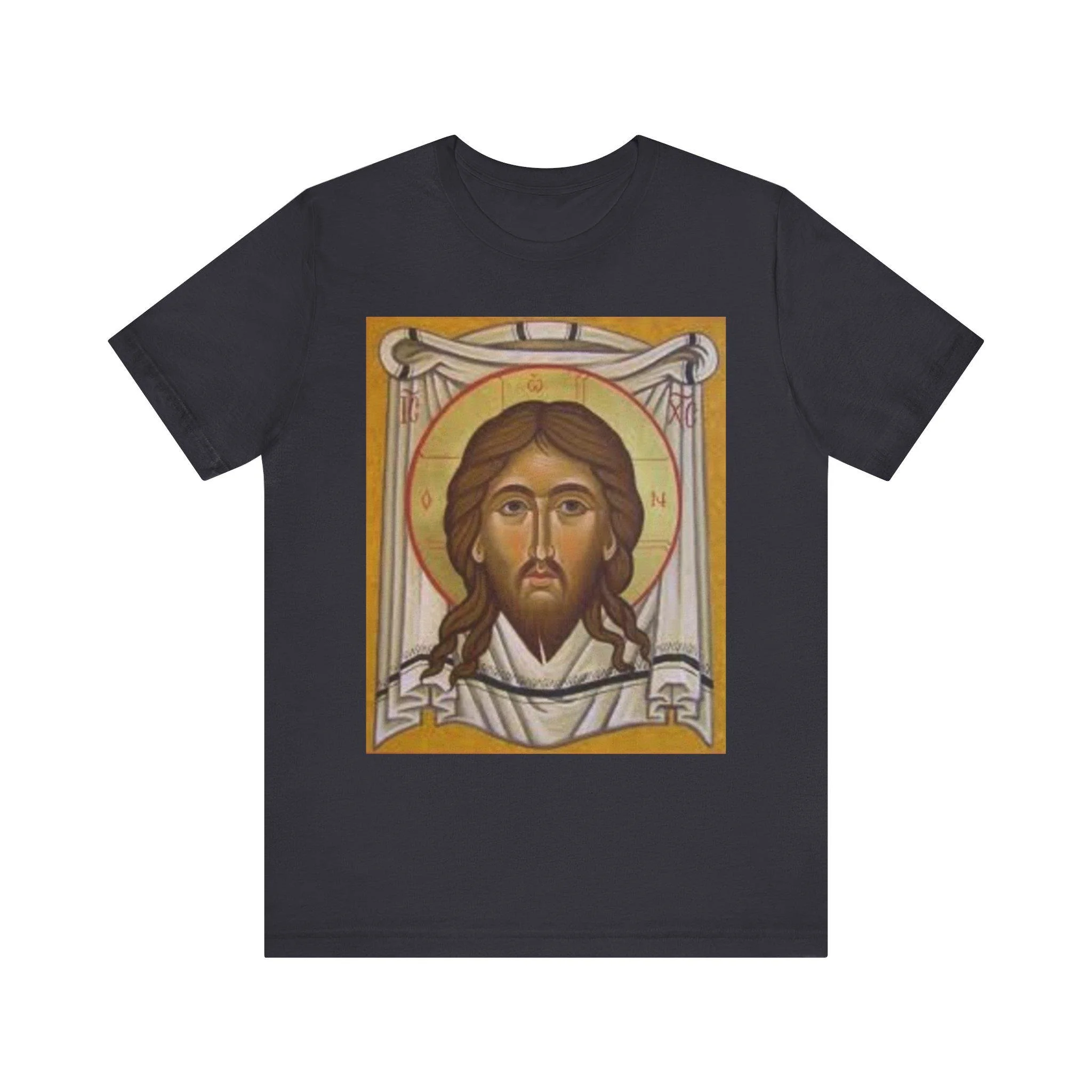
Wearing this image is a bold expression of faith and reverence, connecting modern believers to the ancient Church and its sacred history.
🕊️ Perfect For:
Orthodox Christians and Eastern Catholics
Iconography enthusiasts and lovers of early Church tradition
Feast of the Holy Mandylion (August 16) and other liturgical occasions
Daily wear, prayer, pilgrimages, and spiritual gifts
👕 Product Details:
Features the Holy Face of Christ on the Mandylion in vintage distressed style
Unisex fit with soft, breathable fabric for all-day comfort
Durable, pre-shrunk material that maintains its sacred design
Excellent gift for clergy, seminarians, and faithful Christians
Product features
- Made with 100% Airlume combed and ring-spun cotton for ultimate comfort.
- Designed with side seams for enhanced durability and shape retention.
- Features a ribbed knit collar that retains its shape after multiple washes.
- Printed using high-quality techniques for vibrant colors and detailed designs.
- Ethically manufactured with REACH certification, ensuring sustainable practices.
Care instructions
- Machine wash: cold (max 30C or 90F)
- Non-chlorine: bleach as needed
- Tumble dry: low heat
- Iron, steam or dry: medium heat
- Do not dryclean
Doctor of the Universal Church — The 2015 Declaration
The Path to the Declaration
The declaration of Gregory of Narek as a Doctor of the Universal Church by Pope Francis on April 12, 2015 — the Sunday of Divine Mercy, during a Mass in Saint Peter's Basilica celebrated in Armenian rite to mark the centennial of the Genocide — was one of the most significant ecclesiastical acts of recent Catholic history and one of the most important gestures in the entire history of Catholic-Armenian relations.
The path to the declaration was long and involved multiple actors over several decades. Armenian Catholics — members of the Armenian Catholic Church, in full communion with Rome — had long advocated for Gregory's recognition as a Doctor, arguing that his theological and spiritual gifts placed him in the company of the great teachers of the universal church and that his recognition would honor both Armenian Christianity and the theological tradition he represented. The Pontifical Oriental Institute in Rome, which has long been one of the primary centers of scholarly study of the Eastern Christian traditions, provided the theological and academic groundwork for the declaration through a series of studies and evaluations of Gregory's work.
Pope John Paul II had already expressed admiration for Gregory of Narek and the Armenian spiritual tradition during his visit to Armenia in 2001, and the groundwork laid in that period was developed further under Pope Benedict XVI and ultimately brought to completion by Pope Francis.
The decision to make the declaration on April 12, 2015 — in the context of the Genocide centenary Mass — was not coincidental. Pope Francis simultaneously used the occasion to refer to the Armenian Genocide as "the first genocide of the twentieth century," a formulation that drew strong diplomatic protests from Turkey but that was widely understood as an act of solidarity with the Armenian people and their church. The declaration of Gregory of Narek as a Doctor on the same day as this statement placed the spiritual gift of the Armenian tradition and the historical suffering of the Armenian people in direct juxtaposition, and the theological logic of the juxtaposition was clear: the people who had suffered most could teach the most, and the man whose prayer had emerged from the deepest experience of human darkness had something essential to say to a church and a world still struggling with the reality of darkness in every generation.
What the Title Means
The title Doctor of the Church — Doctor Ecclesiae — in Catholic usage is reserved for those whose theological and spiritual writings are recognized as being of exceptional quality and universal significance, whose lives are marked by genuine holiness, and whose teaching has proven beneficial to the whole church across time and tradition. The thirty-six Doctors of the Church (Gregory of Narek being the thirty-sixth) form a list of extraordinary diversity: Pope Gregory the Great and Bernard of Clairvaux from the Latin West; Basil, Gregory Nazianzus, and John Chrysostom from the Greek East; Thérèse of Lisieux for her discovery of the little way of spiritual childhood; Hildegard of Bingen for her mystical and prophetic writing; and now Gregory of Narek for his Book of Lamentations and the entire theological and spiritual vision it embodies.
For Gregory to be included in this list is remarkable on multiple grounds. He is the first non-Chalcedonian Oriental Christian to be recognized as a Doctor — the first whose church is not in full communion with Rome. He is the first from the Armenian tradition. He is the first whose primary contribution is not systematic theology or doctrinal precision but mystical prayer — the Book of Lamentations is not, in the first instance, a theological treatise but a book of prayer, and its recognition as the work of a Doctor acknowledges that prayer at its deepest is itself a form of theological teaching.
Pope Francis, in his declaration and in the homily he delivered at the Mass, was specific about what he understood Gregory to be teaching: that genuine encounter with God requires total honesty about the human condition, that the depths of human sinfulness and suffering are not obstacles to that encounter but the very place where it most fully occurs, and that the mercy of God is not a theological concept to be thought about but a living reality to be experienced in the most concrete depths of human experience. This is Gregory's teaching. It is, the Pope declared, the teaching of a Doctor of the Universal Church.
The Reaction in the Orthodox World
As discussed in the earlier article on Armenian saints in Eastern Orthodoxy, the declaration of Gregory of Narek as a Doctor of the Universal Church prompted complex reactions in the Eastern Orthodox world. Orthodox scholars who had read the Narek recognized in the Pope's declaration an acknowledgment of what they themselves had experienced in reading it: that this is a work of genuine spiritual and theological universality, that its content is entirely consonant with the Orthodox theological and spiritual tradition, and that the man who wrote it was genuinely holy in a way that transcends the ecclesiastical boundaries of the Chalcedonian/non-Chalcedonian divide.
The parallel with Isaac of Nineveh — the East Syrian mystic universally venerated in Orthodoxy despite his technically Nestorian ecclesiastical background — was immediately drawn by Orthodox commentators, and the same argument applied to both cases: when the spiritual content of a writer's work is genuinely consonant with Orthodox theological and spiritual tradition, the writer's formal ecclesiastical affiliation cannot be the decisive criterion for veneration.
Some Orthodox jurisdictions and theologians have informally begun to use the title Doctor of the Church for Gregory or have suggested that formal incorporation of Gregory into the Orthodox calendar is an appropriate next step. This has not yet happened in any official or canonical way, but the trajectory of the discussion suggests that the distance between Gregory's current unofficial status in the Orthodox world and a formal Orthodox canonization may be narrowing.


The Narek in Armenian Life — Beyond the Church
The Book Under the Pillow
No description of Gregory of Narek's significance for the Armenian people can be complete without attention to the most intimate and most practically significant dimension of his presence in Armenian life: the tradition of keeping the Book of Lamentations under the pillow of the sick and the dying.
This tradition is ancient — it appears to go back to the very earliest period of the book's circulation after Gregory's death — and it is widely and affectionately documented in Armenian literature, memoir, and oral tradition. When an Armenian was seriously ill, when someone was dying, when a woman was in difficult labor, when a child was suffering from a fever that would not break — the Narek was brought and placed under the pillow, or held over the sick person, or read aloud at the bedside. The book was understood to have a healing power that was not merely symbolic but genuinely operative, an efficacy that flowed from the holiness of the man who had written it and from the presence of God who had heard and answered his prayers.
This practice is sometimes treated with a degree of patronizing condescension by modern observers who see it as a superstition to be distinguished from genuine theological understanding. The Armenian theological tradition itself would reject this condescension. The theology of relics — the understanding that the physical objects associated with genuine saints are loci of divine power, that God's grace continues to operate through material things associated with his holy ones — is not a superstition but a fully developed theological position rooted in the theology of the Incarnation, and the extension of this principle to a text is both theologically coherent and deeply personal. The Book of Lamentations is not merely paper and ink; it is the physical embodiment of decades of Gregory's prayer, and the God who heard those prayers continues, in the Armenian tradition's understanding, to hear prayers offered through the medium of that text.
The practical consequence is that the Narek occupies a position in Armenian domestic life that no other text comes close to matching. It is the book that is present at the most extreme moments of human vulnerability — sickness, dying, birth, crisis — and its presence is understood as genuinely protective and genuinely healing. Families that have maintained the tradition for generations can point to specific illnesses survived, specific moments of crisis navigated, specific deaths that were peaceful rather than anguished, and attribute the outcome in part to the presence and the prayer of Gregory's book.
The Narek and the Genocide
The role of the Book of Lamentations in the Armenian experience of the Genocide of 1915 is one of the most profound and most moving chapters in the entire history of this text's reception. Armenians who were being driven from their homes on the death marches that would kill the majority of them carried with them, when they could carry anything at all, the most portable and most precious of their possessions. For many Armenian families, the Narek was among those possessions — carried in a pocket, hidden under clothing, smuggled past Ottoman guards who were confiscating and destroying Armenian books and manuscripts as part of the deliberate destruction of Armenian cultural identity.
The survivors who arrived in the diaspora — in Beirut and Damascus, in Paris and Marseille, in New York and Buenos Aires — brought the Narek with them. In the communities they established in exile, the book served multiple simultaneous functions: as a devotional text, as a connection to the lost homeland, as a testimony to the survival of the Armenian spirit, and as a form of witness to the same truth that Gregory himself had prayed from the depths of his tenth-century darkness — that God can be found in the extremity of human suffering, that prayer is possible from the very bottom of human experience, and that mercy is larger than any catastrophe.
The specific resonance of Gregory's laments with the experience of genocide — his imagery of destruction and survival, of being hunted and hidden, of crying from the depths to a God who seems silent, of finding in that silence not abandonment but the strangest form of presence — was felt by Genocide survivors with an immediacy that transcended the twelve centuries separating Gregory's life from theirs. He had written their prayer before they needed it. The book was ready when they arrived at the place where it was the only language left.
The Narek in Modern Armenian Literature
The influence of Gregory of Narek on modern Armenian literature — both in Soviet Armenia and in the diaspora — is extensive and has been the subject of scholarly study. Armenian poets, novelists, and essayists of the twentieth and twenty-first centuries have drawn on the Book of Lamentations as a formal, theological, and emotional resource, citing it, alluding to it, arguing with it, and finding in it the literary and spiritual vocabulary for addressing the specific conditions of modern Armenian experience.
The great Armenian-American poet Gregory Djanikian, the Armenian poet Hovhannes Shiraz, and numerous other figures have written in the shadow of Gregory of Narek in ways that suggest the Narek functions for Armenian literary culture as something like what Homer functions for Greek literary culture or Dante for Italian literary culture: the foundational text, the origin point to which everything returns, the work that defines the language's deepest possibilities.


Miracles Attributed to Gregory of Narek
Miracles During His Lifetime
The miracle tradition associated with Gregory of Narek during his lifetime is somewhat more restrained than the traditions associated with figures like Gregory the Illuminator or Mesrop Mashtots, reflecting the specifically contemplative and literary character of his vocation. His miracles tend to be miracles of grace rather than of supernatural power — transformations of the interior life of those who encountered him or his work, rather than the dramatic physical interventions that characterize the traditions of the great missionary saints.
The Healing of the Possessed Woman — The most widely cited miracle attributed to Gregory during his lifetime is the healing of a young woman who was suffering from demonic possession and who was brought to Narekavank by her family in desperation after other remedies had failed. Gregory prayed over her and she was restored to her right mind — a miracle of the type associated in the Gospel narratives with Christ's own ministry and attributed throughout the early Christian tradition to the intercession of the saints. The tradition preserves this as a vindication of Gregory's holiness against those who had accused him of Tondrakian sympathies: a man in communion with demonic powers does not heal the demonically afflicted.
The Composition Under Divine Guidance — The tradition holds that the ninety-five prayers of the Book of Lamentations were composed not merely by Gregory's human literary genius but under the direct guidance of the Holy Spirit — that the Spirit moved through Gregory's prayer and directed his writing in a way that gave the resulting text a quality of divine inspiration that explained its extraordinary power and its universal resonance. This understanding of the Narek as in some sense divinely inspired — not in the same technical sense as the canonical scriptures, but in the extended sense of a text produced through the special assistance of the Spirit — is reflected in the tradition of placing it under the pillows of the sick and in the healing power attributed to it.
Visions and Prophetic Knowledge — The tradition attributes to Gregory several instances of prophetic knowledge — awareness of events at a distance or of future developments that he could not have known by ordinary means — and of visions of spiritual realities invisible to ordinary human perception. These accounts are consistent with the hesychast tradition's understanding of the spiritual gifts that accompany advanced contemplative prayer, and they position Gregory within the lineage of the great Christian visionaries from the Desert Fathers through the medieval period.
Miracles After His Death
Healing at the Tomb at Narekavank — The monastery of Narekavank, where Gregory was buried, became from the earliest period after his death a site of pilgrimage and miraculous healing. The tradition preserves accounts of healings of various ailments — physical illnesses, mental suffering, barrenness, the conditions of despair and spiritual desolation — attributed to the intercession of Gregory at his tomb. The pilgrimage tradition at Narekavank continued until the destruction of the monastery and the Armenian community of the Van region in the Genocide of 1915.
Healing Through the Book — The most distinctive category of miracle associated with Gregory after his death is healing accomplished through contact with or reading of the Book of Lamentations — the tradition already mentioned of the book placed under pillows, read at bedsides, held over the sick. The Armenian literary and oral tradition preserves a substantial number of specific accounts of healings attributed to this practice, spanning many centuries and many different communities. The healing power attributed to the book is understood theologically as flowing from Gregory's continuing intercession — the book is the instrument through which his prayer reaches those who need it.
Appearances in Dreams — The tradition includes accounts of Gregory appearing to individuals in dreams, particularly to those who were in spiritual crisis or who were praying the Narek at moments of extreme need. These apparitions follow the standard pattern of post-mortem saint appearances in the Christian tradition — the saint appears to offer guidance, comfort, or warning — but they have a specific character related to Gregory's identity as a man of prayer: he typically appears in the accounts not performing dramatic miracles but simply praying, his presence itself being the miracle that transforms the situation of the person he visits.
The Survival of the Narek Through the Genocide — Within the Armenian tradition, the survival of manuscripts of the Book of Lamentations through the catastrophe of the Genocide — while so much else was lost, while entire communities were annihilated and their libraries burned — is itself understood as miraculous, as evidence of Gregory's continuing protection of the text he had created for the comfort of all who suffer. The Armenian manuscript collections that survived intact through the Genocide period include multiple copies of the Narek, and their survival is attributed in the tradition to Gregory's intercession.
First-Class Relics — Where to Venerate Them
The Challenge of Gregory of Narek's Relics
The question of the physical relics of Gregory of Narek is more complex and more painful than the relic situation of earlier Armenian saints, for reasons directly connected to the catastrophic destruction of the Genocide of 1915. The Monastery of Narekavank — the site of Gregory's entire monastic life, his death, and his burial — was located in the region of Vaspurakan (the Van province of what is now eastern Turkey), an area from which the Armenian population was violently expelled and largely killed during the Genocide. The monastery was destroyed in this period, and the fate of Gregory's physical relics — the bones and other remains that had been venerated at Narekavank for over nine centuries — is not precisely documented in the sources available.
The destruction of Narekavank and the dispersal or loss of its sacred holdings is one of the most grievous cultural and spiritual losses of the Genocide — the destruction not merely of a building but of a sacred site that had been a center of Armenian Christian life for a millennium, the place where the man who wrote the Book of Lamentations had lived and prayed and died, and the location where subsequent generations had come to seek the healing his intercession offered.
The Armenian Patriarchate of Jerusalem
The most likely single location for the veneration of first-class relics of Gregory of Narek that are accessible to pilgrims today is the Armenian Patriarchate of Jerusalem. The Armenian Quarter of the Old City of Jerusalem has maintained the richest and most systematically preserved collection of Armenian Christian sacred objects and relics outside Armenia itself, and the Patriarchate's treasury at the Cathedral of Saint James has historically been a repository for relics of the greatest Armenian saints including Gregory of Narek.
The Armenian Patriarchate of Jerusalem maintained contacts with the Armenian communities of the Van region and the Lake Van area throughout the medieval and early modern periods, and it is plausible that portions of Gregory's relics were transmitted to Jerusalem through these connections — either during the medieval period when the Jerusalem Patriarchate was actively collecting relics of Armenian saints, or during the chaos of the late nineteenth and early twentieth centuries when Armenian communities facing threat sought to preserve their most precious religious treasures by sending them to the relative safety of Jerusalem.
Practical information for pilgrims: The Cathedral of Saint James in the Armenian Quarter of the Old City of Jerusalem is accessed through the Zion Gate. The cathedral is open to visitors during the morning Divine Liturgy (typically beginning around 6:00 AM on weekdays and with more extended services on Sundays and feast days) and during a midday visiting period. Pilgrims specifically seeking to venerate relics of Gregory of Narek should contact the Armenian Patriarchate of Jerusalem in advance, as the specific availability of individual relics for veneration depends on the liturgical calendar and the Patriarchate's current arrangements. The Patriarchate's administration is accustomed to welcoming pilgrims and can provide specific guidance.
Holy Etchmiadzin, Armenia
The treasury of Holy Etchmiadzin, which holds the most comprehensive collection of sacred objects and relics of the Armenian church in existence, may maintain relics of Gregory of Narek among its holdings. The Etchmiadzin treasury has been systematically collecting and preserving relics of Armenian saints for many centuries, and the significance of Gregory of Narek within the Armenian tradition makes it likely that the Mother Church maintains some physical memorial of him.
The specific contents of the Etchmiadzin treasury are not comprehensively published, and pilgrims seeking to venerate Gregory's relics there should contact the cathedral administration directly. The treasury is accessible to visitors on certain occasions and during major feasts of the Armenian calendar, and the feast commemorating Gregory of Narek — February 27 in the Armenian calendar, which has taken on additional significance since the 2015 Doctor of the Church declaration — is a natural occasion for such veneration.
Practical information: Holy Etchmiadzin is located in Vagharshapat, approximately twenty kilometers west of Yerevan, accessible by regular bus and minibus services from the city. The cathedral complex is open to visitors during daylight hours, with the treasury accessible by arrangement with the cathedral administration.
The Catholicosate of Cilicia, Antelias, Lebanon
The Catholicosate of Cilicia in Antelias near Beirut maintains relics and sacred objects from the Armenian Christian communities of historical Cilicia and from other Armenian regions, and it serves as the primary ecclesiastical center for the Armenian communities of Lebanon, Syria, and parts of the diaspora. Relics associated with Gregory of Narek — either first-class relics or significant second-class relics — may be among the holdings of the Cilician Catholicosate, which would be the appropriate contact for Armenians in Lebanon and in diaspora communities served by the Cilician jurisdiction seeking to venerate Gregory's physical memorial.
Armenian Catholic Communities — Pontifex and Rome
Given Gregory's declaration as a Doctor of the Universal Church by the Catholic Church, Armenian Catholic communities and institutions are natural locations to seek first-class relics and devotional objects associated with him. The Pontifical Armenian College in Rome — the primary institution for the formation of Armenian Catholic clergy and for the promotion of Armenian Christian heritage within the Catholic Church — is likely to have obtained or to have access to relics or reliquary objects associated with Gregory in the years since the 2015 declaration.
The Armenian Catholic Patriarchate, headquartered in Beirut, Lebanon, would be the primary contact for Armenian Catholics seeking information about Gregory's relics within the Armenian Catholic tradition. The declaration of Gregory as a Doctor has significantly increased interest in his veneration within Catholic circles, and it is likely that efforts to obtain and make available first-class relics for veneration have been ongoing since 2015.
A Note on the Situation of Gregory's Relics
The honest pastoral observation that needs to be made about Gregory of Narek's relics — in contrast to the situation of Gregory the Illuminator, whose right hand is definitively preserved and venerated at Etchmiadzin, or Mesrop Mashtots, whose relics are definitively housed at Oshakan — is that the primary deposit of his physical remains was lost or displaced in the destruction of Narekavank during the Genocide, and the current location of any first-class relics of Gregory is less precisely documented than for other major Armenian saints.
This situation is itself, in a terrible way, appropriate to Gregory's story and to the tradition he represents. The man who wrote from the depths of human suffering about the God who is present in darkness has his physical memorial partially lost in the greatest darkness the Armenian people have endured. The healing that he promised was available even from the pit — even from Khor Virap, even from the death marches, even from the fires that consumed Narekavank — does not require the physical presence of his bones. His book is his relic, and his book survived.
For pilgrims who wish to venerate Gregory of Narek in the most practically accessible way, reading or praying the Book of Lamentations — ideally in the Armenian, but powerfully even in translation — is itself a form of encounter with the saint, recognized as such by the tradition that has placed his book under the pillows of the sick for ten centuries. Thomas of Celano wrote of Francis of Assisi that Francis was always at prayer because his entire life was prayer. Something similar is true of Gregory of Narek and his book: wherever the book is opened and the prayers are prayed, Gregory is present, offering the same intercession he offered in his lifetime from the shores of Lake Van, from the monastery where he spent his hidden life in the service of the God who inhabits the deepest places of the human soul.
Offer a Dedication
If this page was meaningful to you, you are welcome to dedicate this or any educational page in memory of a loved one, for a prayer intention, or in gratitude for blessings received.
Each dedication is placed permanently at the bottom of the page and remains there indefinitely as a quiet light of remembrance. Everyone who visits this page will see the dedication and remember the person or intention it honors, much like a candle that continues to burn long after it is first lit.
Your dedication also helps support the continued sharing of Eastern Christian history, prayer, and the lives of the saints.
The Feast Days
In the Armenian Apostolic Church
Gregory of Narek is commemorated in the Armenian Apostolic calendar on February 27 (in the New Calendar equivalent), a feast that has taken on additional significance in the years since the 2015 Doctor of the Church declaration as a day recognized not only within the Armenian church but also in Catholic communities worldwide. The Armenian liturgical celebration of his feast includes the full Divine Office and the celebration of the Badarak, with readings from the Book of Lamentations integrated into the service — a beautiful liturgical convention that allows the saint's own words to serve as the primary form of his commemoration.
In the Roman Catholic Church
Since the declaration of 2015, Gregory of Narek has been commemorated in the Roman Martyrology with a feast on February 27, making him the only Armenian saint with a formal feast day in the universal Roman Catholic calendar as a Doctor of the Church. Catholic communities — particularly Armenian Catholic communities but also Roman Catholic communities with an interest in Eastern Christian spirituality — celebrate his feast with liturgical services, readings from the Book of Lamentations, and catechetical programs that introduce his life and teaching to Catholic audiences who may be encountering him for the first time.
In the Eastern Orthodox World
As discussed in the earlier article on Armenian saints in Eastern Orthodoxy, Gregory of Narek does not yet have a formal feast day in the Eastern Orthodox Menaion, though informal veneration of him in Orthodox circles — particularly among monastics and scholars of Eastern Christian spirituality — is real and growing. The possibility of a formal Orthodox feast day for Gregory remains on the theological horizon, particularly in the context of the ongoing Oriental-Orthodox dialogue and the increasingly recognized consonance of the Narek's content with Orthodox theological and spiritual tradition.
Reading the Narek — A Guide for New Readers
The Challenge and the Reward
The Book of Lamentations is not an easy book. It is long, dense, theologically demanding, emotionally intense, and written in a literary form — the extended prayer-poem — that is not common in the modern world and that requires some adjustment from readers formed on more familiar genres. Its ninety-five prayers range from a few pages to many pages each, and the movement within each prayer — through lament, theological reflection, confession, petition, and praise — does not follow a linear argumentative logic but a more musical logic of theme and variation, repetition and development, tension and resolution.
For readers encountering the Narek for the first time, several approaches have been found helpful by those who have made the transition from initial puzzlement to the deep engagement that the book ultimately rewards.
The first is to begin not at the beginning but in the middle — to open the book to one of the shorter, more accessible prayers (Prayers 3, 17, or 35 are often recommended as entry points) and to read it not as a text to be understood but as a prayer to be entered, allowing the rhythm of Gregory's address to carry you into a mode of receptive openness rather than analytical assessment.
The second is to read slowly. The Book of Lamentations does not reward rapid reading. Its density is not the density of compressed information but the density of deep feeling, and feeling requires time. A single prayer read at the pace at which Gregory might have prayed it — which is the pace of genuine contemplative prayer, unhurried, attentive to what arises in the interior space that the words open — yields far more than ten prayers read quickly for comprehension.
The third is to bring your own darkness. Gregory wrote for people who suffer, and the book opens fully only to those who are willing to bring what they are actually carrying — their specific griefs, their specific failures, their specific confusion about God's presence or absence — into the space that the prayers create. The Narek is not a book about Gregory's spiritual struggles in the abstract; it is a book that Gregory wrote to give everyone who suffers a language for their own specific suffering, and it fulfills that purpose only when the reader accepts the invitation and uses it.
Available Translations
The Book of Lamentations has been translated into numerous languages, with the quality of translations varying considerably. The most scholarly and most complete English translation is that of Thomas J. Samuelian, published as Speaking With God From the Depths of the Heart (Vem Press, 2002), which renders the ninety-five prayers in full with facing Armenian text and extensive notes. The translation by Mischa Kudian (Mashtots Press, 1977), titled Lamentations, is older and more poetic in English but less complete.
In French, the translation by Annie and Jean-Pierre Mahé (Grégoire de Narek: La plainte funèbre, Brepols, 2000) is the authoritative scholarly edition with extensive apparatus. Various partial translations exist in Russian, Spanish, Italian, and other languages, with the pace of translation work accelerating significantly after the 2015 Doctor of the Church declaration.
The Depth That Became the Bridge
There is a paradox in the story of Gregory of Narek's reception that deserves to be named and honored at the close of this account. He was a man who belonged to a minority church — a small, non-Chalcedonian, Oriental Orthodox community in a remote corner of the medieval Christian world, separated by a fifteen-hundred-year-old theological controversy from the Greek-speaking church to the west and from the Syriac-speaking church to the south. Everything about his institutional situation marked him as particular, local, specific — the product of a very specific theological and cultural tradition in a very specific historical and geographical location.
And yet it is precisely this deeply particular man, this intensely Armenian monk from the shores of Lake Van, who has proven to be the most universal. His prayers are read and wept over by Catholic nuns in Italy who have never heard of the Council of Chalcedon. They are prayed by Orthodox monks on Mount Athos who are moved by the same Spirit that moved Gregory in his monastery above the Van. They are studied by Protestant scholars who find in them a testimony to divine mercy that resonates with the best of their own tradition. They are carried by secular Armenians for whom the Narek is the last surviving connection to a faith they have formally left but cannot quite abandon.
The universality was always there, latent in the particularity — hidden in the depth of the prayer, in the completeness of the honesty, in the absoluteness of the mercy invoked. It required sixteen centuries for the world outside Armenia to fully recognize what Armenian Christians had known since the year of Gregory's death: that this monk, this poet-theologian, this man of the deep pit of prayer, had done what the greatest spiritual writers always do — descended so far into the particular human soul's encounter with God that he emerged on the other side into the universal.
Pope Francis, in declaring him a Doctor of the Universal Church, said simply: "The writings of Saint Gregory of Narek are a precious treasure not only for Armenian Christians but for all the faithful."
The treasure has been waiting for seventeen centuries. For those who have not yet found it, the invitation remains exactly what it was when Gregory first wrote it, in the language that Mesrop Mashtots had made possible, on the shores of the lake where the mountains hold the silence: "In the name of the Father, Son and Holy Spirit, I, Gregory, the servant of God, sinner among sinners... have written these prayers for myself and for all the faithful who suffer."
That means everyone. He wrote them for everyone.
This article draws on Thomas J. Samuelian's translation of the Book of Lamentations (Speaking With God From the Depths of the Heart, Vem Press, 2002); Annie and Jean-Pierre Mahé's critical French edition and studies of Gregory of Narek; Roberta Ervine's scholarly work on Armenian liturgy and Gregory's liturgical compositions; the studies of Abraham Terian on Armenian biblical scholarship; Bishop Hilarion Alfeyev's comparative work on Eastern Christian mysticism; the Apostolic Exhortation Amoris Laetitia and Pope Francis's homily of April 12, 2015 on the declaration of Gregory's Doctor of the Church status; the publications of the Pontifical Oriental Institute on Oriental Christian saints; and the liturgical texts of the Armenian Apostolic and Armenian Catholic churches.