Saint Paisios the Athonite: Elder of Mount Athos, Spiritual Father and Consoler of Those Who Suffer
A Cappadocian refugee, carpenter and monk who became one of the best loved elders of modern Orthodoxy
At a Glance
- Born
- July 25, 1924 in Pharasa, Cappadocia; named Arsenios Eznepidis
- Died
- July 12, 1994 at Souroti near Thessaloniki, Greece
- Titles
- Venerable, Elder, Athonite ascetic and spiritual father; a monk but not a priest
- Feast
- July 12 in the Orthodox calendar; no feast in the General Roman Calendar
- Veneration
- Glorified by the Ecumenical Patriarchate on January 13, 2015; not canonized by Rome
- Patronage
- No formal patronage verified; linked with spiritual counsel and those who suffer
- Who Was Saint Paisios the Athonite?
- A Refugee Child From Cappadocia
- Soldier, Monk and Hermit
- Counsel, Writings and the Women of Souroti
- Illness, War and Misused Words
- Souroti, July 1994
- Visions, Healings and Devotion
- Sources, Records and Cautions
- Pilgrimage to Souroti and the Feast
- Why He Matters to Eastern Christians
- Frequently Asked Questions
Who Was Saint Paisios the Athonite?
Saint Paisios the Athonite, also called Elder Paisios of the Holy Mountain, is one of the most widely read and visited ascetics of the twentieth century. He was a Greek Orthodox monk who lived most of his life on Mount Athos, though he spent years elsewhere at Stomio near Konitsa and at Mount Sinai. He was never ordained a priest.
He is loved less for dramatic events than for his plain speech about repentance, humility, marriage, suffering and prayer. Thousands visited his small cell near Karyes, and after his death his talks were gathered into books that have been translated into many languages. He is a modern saint with unusually good records, and the Ecumenical Patriarchate glorified him in 2015.
The Church also remembers him for kindness to the poor, to refugees and to people in pain. This article gives his documented life and marks extraordinary stories as TRADITION. It also marks as UNCERTAIN the prophecies attributed to him after his death, which are among the most disputed parts of his modern reputation.
A Refugee Child From Cappadocia
He was born Arsenios Eznepidis on July 25, 1924, in Pharasa, a Greek Christian village in Cappadocia. His father, Prodromos, was a village leader, and his mother, Eulampia, was known for her devotion. The year of his birth was the time of the population exchange between Greece and Turkey, so his family left Asia Minor soon after he was born.
Shortly before they left, the village priest, later Saint Arsenios of Cappadocia, baptized the child. TRADITION: Orthodox biographies say that Saint Arsenios insisted the boy be named Arsenios, not Christos as the family wished, because he foresaw that the child would be a monk. We found no contemporary record of the conversation. The family settled in Konitsa in northwestern Greece.
As a boy in Konitsa, Arsenios read the Gospels and the lives of the saints and sought quiet places in the woods to pray. After elementary school he trained as a carpenter. This trade stayed with him all his life. He used it to repair monastery buildings, to help neighbors and to make small wooden crosses and other devotional objects for visitors.
Soldier, Monk and Hermit
Paisios did not convert from another faith. He was baptized and raised Orthodox, and his story is one of deepening faith and a long search for the monastic life. He served in the Greek army as a radio operator, mainly in the years after the Second World War and during the Greek Civil War. Some popular accounts place his service in the war itself, but this is imprecise.
His entry into monastic life came in stages. Sources disagree about the dates of his first visits to Mount Athos. The Apostoliki Diakonia describes a first visit in 1949, while the Orthodox Church in America places his decisive move to the Holy Mountain around 1953. The exact order of those early visits is UNCERTAIN. He received the monastic name Averkios in 1954 at Esphigmenou and the name Paisios in 1956 at Philotheou.
He later left Athos in 1958 to serve the monastery of Stomio near Konitsa. He spent about 1962 to 1964 at Mount Sinai, then returned to Athos and lived at the Holy Cross cell with Elder Tikhon. In 1979 he moved to the cell called Panagouda near Karyes. His life moved between seeking quiet and serving others, and that pattern is the key to understanding him.
Counsel, Writings and the Women of Souroti
At Stomio he repaired the monastery while teaching and helping the local people. At Sinai, accounts say he gave food and money from his woodwork to Bedouin families. After returning to Athos, he came under the influence of Elder Tikhon, a Russian ascetic. The Holy Cross cell and later Panagouda became places of prayer and also of constant visitors.
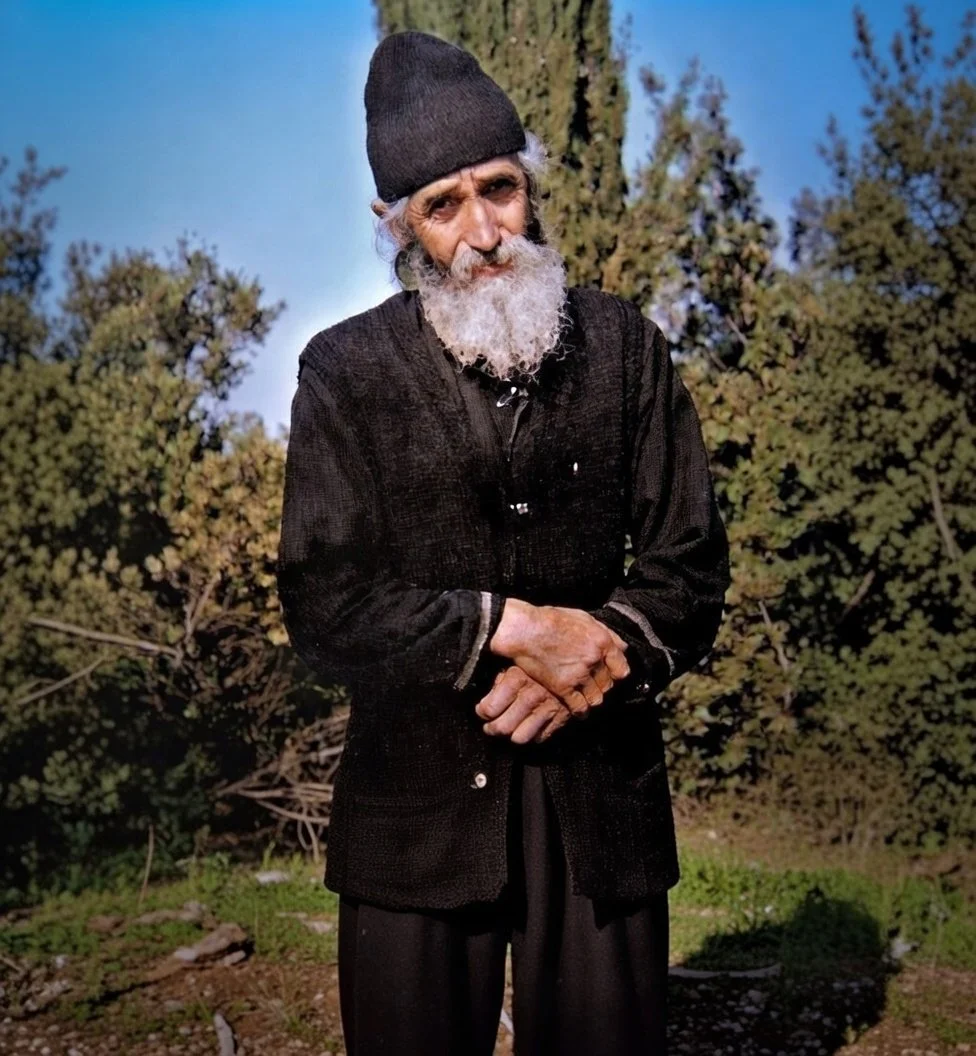
Clergy, monks, married couples, students and people in distress came to him, and he answered with patience, humor and practical advice. After lung surgery in 1966, he became the spiritual guide of women who wished to become nuns. They formed a community at Souroti dedicated to Saint John the Theologian. He is best called its spiritual guide, since it would be wrong to assume he was its sole legal founder.
He wrote books on Saint Arsenios of Cappadocia, Elder Hadji Georgis and Athonite fathers, and left letters. A letter of May 3, 1972, recommends reading the sayings of the Desert Fathers as an aid to prayer. Much of what readers know as his teaching was recorded by his spiritual children and published by Souroti as the Spiritual Counsels series, on topics such as prayer, family life, passions and virtues.
Illness, War and Misused Words
Paisios knew displacement as a child, the violence of the civil war as a soldier and poor health as a monk. Hard fasting at Sinai strained his body. In 1966 he had major lung surgery, and later he suffered stomach and intestinal illness. In his last months he had cancer. These sufferings shaped his teaching on patience and on comfort for the sick.
He also struggled between his love of silence and his duty to help. He sought solitude yet received crowds, and his writings suggest this was not always easy. His teaching is that love for others is part of the quest for God. Many pilgrims noticed that he could be blunt, and he warned visitors against pride and curiosity about miracles.
After his death, many predictions about wars, Constantinople, Russia and Turkey were attributed to him in print and online. UNCERTAIN: Their authenticity and original context cannot be verified. An academic study in Social Compass has examined how such prophecies circulate in Greek and Cypriot religious culture, and some who knew him say they never heard them. The safer course is to treat his documented teaching on repentance as his real legacy.
Souroti, July 1994
In his last illness, Paisios was found to have cancer of the large intestine. He had surgery on February 4, 1994, but the disease advanced. He could not return to Mount Athos and stayed at the Holy Hesychasterion of Saint John the Theologian at Souroti, where the nuns cared for him. He received Holy Communion on July 11, 1994.
He died on July 12, 1994, at about eleven in the morning, according to the Orthodox Church in America. He was buried at the monastery of Souroti near the grave of Saint Arsenios of Cappadocia, the priest who had baptized him. His grave quickly became a place of pilgrimage.
On January 13, 2015, the Holy Synod of the Ecumenical Patriarchate decided to enter him into the register of saints. The announcement is preserved in an English translation. This is a glorification by the Orthodox Church and not a Catholic canonization, and it is not a process with a beatification stage.
Visions, Healings and Devotion
TRADITION: Orthodox biographies report visions of Christ, the Mother of God, angels and saints in Paisios's life. They belong to the Church's memory of his holiness. They cannot be independently verified, and the Church does not ask believers to take every detail as historical proof.
TRADITION: One well known account says that the Great Martyr Euphemia appeared to him on Mount Athos and spoke about a Church concern. Some sources date it to February 27, 1974 by the old calendar. The date and details are UNCERTAIN, because the story rests on personal testimony.
TRADITION: Visitors reported that he knew their troubles without being told and that his prayers helped them. Reports of healings grew after his death. The Church recognizes his holiness, but that is not a medical verification of each story. His best documented miracle is his patience with the thousands who came to him.
Sources, Records and Cautions
The strongest sources are the Ecumenical Patriarchate's 2015 announcement, the Orthodox Church in America's life of the saint, the Apostoliki Diakonia of the Church of Greece, and the Holy Great Monastery of Vatopedi. The Souroti hesychasterion publishes his own writings and the recorded counsels, and Hieromonk Isaac's biography adds Athonite testimony.
The books called Spiritual Counsels are mostly edited from talks recorded by his spiritual children, not written by him alone. For his own written voice, readers should look to his works on Saint Arsenios and Elder Hadji Georgis and to his letters. This matters for any quotation, since many sayings online have no clear source.
Three cautions apply. First, the chronology of his earliest Athonite visits is UNCERTAIN. Second, prophecies credited to him are of doubtful authenticity. Third, an Orthodox glorification should never be described as a Catholic canonization. A careful biography keeps these three points clear and avoids repeating unsourced sayings.
Pilgrimage to Souroti and the Feast
His feast is July 12, the day of his death. The Holy Hesychasterion of Saint John the Theologian at Souroti keeps the feast with the Divine Liturgy and a vigil. Many pilgrims come to pray at his grave there, near the relics of Saint Arsenios.
Pilgrims also visit Athos, though visitors to the Holy Mountain need a special permit and women are not allowed, a rule that applies to everyone. His cell near Karyes is not a public shrine. Many people honor him at home with his icon and by reading his counsels.
People ask his prayers for peace in families, for the sick, for those in despair and for monks and nuns. This is devotion shaped by his own life of care for others. We found no formal patronage declared for him, so readers should treat any named patronage as popular custom and not as an official title.
Lord Jesus Christ, You gave Your servant Paisios a heart that loved silence and a hand that helped the poor. Through his prayers, teach us humility, comfort the sick and the troubled, and make our homes places of patience and peace. Saint Paisios, pray to God for us. Amen.
This is a short original prayer written for this article. It is not an official liturgical text. The Orthodox Church in America publishes the official troparion and kontakion for his feast of July 12.
Why He Matters to Eastern Christians
Paisios is a modern witness to the hesychast tradition of Mount Athos, in which stillness and prayer are never opposed to love. His life shows how a monk who longed for silence kept opening the door to strangers. His teaching echoes the Desert Fathers on repentance, humility and watchfulness over the thoughts.
He was glorified by the Orthodox Church in 2015, long after the separation of East and West. We found no evidence that Rome has canonized him, entered him in the General Roman Calendar or approved a universal Catholic feast. He is therefore an Orthodox saint, and Catholics may read his writings with respect without claiming him as a Catholic saint.
For Eastern Catholics, who share the Byzantine monastic heritage, his example connects to common sources in the Fathers and the Athonite tradition. His writings are loved by many Christians because they speak clearly about marriage, work and suffering. His chief gift is practical wisdom drawn from long prayer.
Frequently Asked Questions
Ask His Prayers
Many Christians ask Saint Paisios for patience, peace in the family and comfort in illness. If you would like a prayer card of Saint Paisios the Athonite, you can find one below. His life reminds us that love for God shows itself in simple kindness to those who come to our door.
View Prayer Card