Saint Peregrine Laziosi: Patron Saint of Cancer, Autoimmune Disease & Miraculous Healing
Canonized 1726 • Feast Day: May 1 • Forlì, Emilia-Romagna, Italy
Saint Peregrine Laziosi
Patron Saint of Cancer, Autoimmune Disease, AIDS, and Every Illness That Makes the Body a Battlefield
This page contains Amazon affiliate links. As an Amazon Associate I earn from qualifying purchases, at no extra cost to you. All store items ship directly from The Eastern Church.
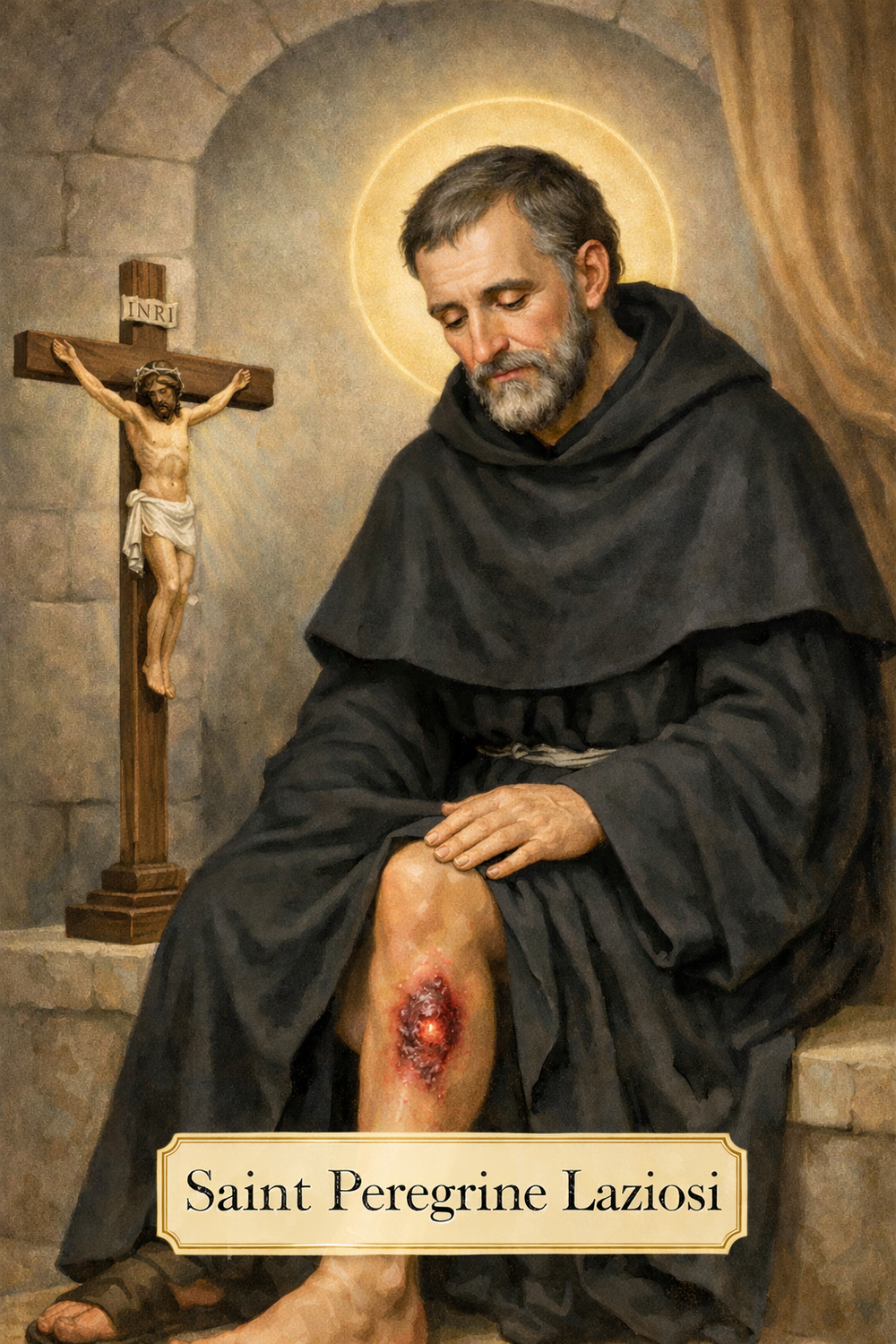
Saint Peregrine Laziosi — At a Glance
- Born
- c. 1260, Forlì, Emilia-Romagna, Italy
- Died
- May 1, 1345, Forlì, Italy (age ~85)
- Religious Order
- Servite Order (Order of Friar Servants of Mary)
- Beatified
- April 15, 1609, Pope Paul V
- Canonized
- December 27, 1726, Pope Benedict XIII
- Feast Day
- May 1
- Patron Of
- Cancer, AIDS, autoimmune disease, chronic illness, hopeless diagnoses
- Miracle
- Overnight healing of cancerous leg; amputation cancelled by surgeon upon arrival
- Known As
- The Cancer Saint, Angel of Good Counsel
- Body
- Incorrupt; enshrined at Basilica of Saint Pellegrino Laziosi, Forlì
- National Shrine (USA)
- Our Lady of Sorrows Basilica, Chicago, IL
- Conversion Catalyst
- Struck St. Philip Benizi in the face; Philip turned the other cheek
Why Saint Peregrine Is the Perfect Patron Saint for Autoimmune Disease
Saint Peregrine has long been the Church's patron for cancer. But the more carefully you look at his story — at what his body endured, how it turned against him, how he lived with that slow destruction across decades — the more clearly he emerges as the right intercessor for every condition in which the body becomes its own enemy. Here are seven reasons why those suffering from autoimmune diseases — lupus, rheumatoid arthritis, multiple sclerosis, inflammatory bowel disease, psoriasis, Hashimoto's, Sjögren's, and the hundreds of conditions that bear the same basic signature — belong to Saint Peregrine as surely as cancer patients do.
His Illness Was Chronic, Invisible, and Came From Within
Peregrine's cancerous leg condition developed slowly from years of physical penance. His body quietly turned on itself over years before anyone could see it — precisely the trajectory of most autoimmune disease.
He Suffered in Joints, Leg, and Circulation
His condition centered in his right leg, caused by circulatory collapse and non-healing ulcers — the same anatomical territory targeted by lupus, rheumatoid arthritis, and vasculitis.
His AIDS Patronage Already Covers Immune Dysregulation
The Church formally recognizes him as patron of AIDS — a disease of immune collapse. Autoimmune disease is the mirror image: an immune system that overreacts rather than fails.
His Healing May Involve an Immune Mechanism
One medical journal has cited his cure as a possible historical case of immune-mediated tumor remission — a phenomenon recognized in modern oncology.
He Lived Decades With No Cure, Only Endurance
Autoimmune diseases are mostly incurable, only managed. Peregrine spent years living with a progressive condition no medicine could solve — and kept serving anyway.
His Miracle Was Total Surrender
He did not pray for a specific outcome. He surrendered to whatever God willed — the exact spiritual posture autoimmune patients are so often called into.
He Was Misunderstood Before He Was Holy
No one would have predicted his sanctity from the outside. Autoimmune patients often live with a condition the world cannot see and refuses to believe.
Carry His Example of Surrender
Two devotional pieces for the waiting room, the treatment chair, or the morning you need to remember you are not carrying this alone.


Forlì: A City at War With the Church
Peregrine Laziosi was born around 1260 in Forlì, a prosperous city in northern Italy's Emilia-Romagna region. He was the only son of an affluent family — wealthy, educated, and politically positioned in exactly the wrong direction for a future saint.
The Italy of Peregrine's youth was convulsed by one of the most bitter structural conflicts in medieval European history: the ongoing war between the papacy and the Holy Roman Emperor over the temporal control of the Papal States. Forlì sat within those contested territories. The city's leading families had thrown in their lot with the anti-papal faction — the Ghibellines — and Peregrine's family was among them.
This was not merely a political affiliation. To be anti-papal in thirteenth-century Forlì was to position oneself actively against the Church's authority. Churches were ordered closed. Sacraments were withheld from entire populations as instruments of political pressure. The faith itself became a battlefield, and Peregrine grew up on the hostile side of it.
By the time he was a young man, Peregrine was not merely indifferent to the Church. He was an active agitator against it — energetic, angry, certain of his rightness, and physically willing to enforce his convictions.
The Strike That Changed Everything: Philip Benizi Turns the Other Cheek
In 1283, the residents of Forlì were placed under interdict — a severe ecclesiastical sanction that suspended all public worship, sacraments, and religious burial in the city because of its defiance of papal authority. The Pope sent an emissary to attempt reconciliation: Philip Benizi, Prior General of the Friar Servants of Mary (the Servites), a man of great holiness who would himself be canonized.
Philip tried to preach in the public square. The crowd heckled him. They threw things. They beat him with clubs. The twenty-three-year-old Peregrine, leading or at least participating in the disruption, struck Philip in the face hard enough to knock him down.
What happened next was not what anyone expected. Philip Benizi did not retaliate. He stood up, turned the other cheek — literally, in the manner of the Gospel — and prayed for the youth who had just assaulted him, aloud, in front of the crowd that had been howling for his humiliation.
He ran after Philip as he was being driven out of the city. He threw himself at the priest's feet and begged forgiveness. Philip received him with the same warmth he had somehow maintained throughout the assault, and told Peregrine to go pray in the cathedral chapel and seek the Blessed Virgin's guidance.
The Virgin's Vision and the Road to Siena
Peregrine did as Philip suggested. He knelt before the image of the Virgin Mary and prayed with the urgency of a man who had just had his entire worldview overturned by a single act of mercy. The Virgin appeared to him and told him to go to Siena, to the Servite community there — the very order of the man he had assaulted — and join them in service to God.
He went. He left his family's wealth, his social position, his political identity, and everything that had constituted his self-understanding as an angry young man. It was Philip Benizi himself who welcomed him into the Servite community and set him on the path to the priesthood. The conversion was total, and it was permanent. He never looked back.
Life as a Servite: Standing Still for Thirty Years
Once inside the Servite Order, Peregrine embraced penance with the same ferocity he had once directed against the Church. He imposed one particular penance on himself that he maintained for approximately thirty years: he would not sit down. When standing was unavoidable, he leaned against the choir stall for support, but he refused to sit. He slept on the floor with a stone for a pillow. He ate little. He kept silence as much as his duties permitted.
Decades of standing had predictable consequences. The veins in his legs became increasingly compromised. Varicose veins developed, became severe, and eventually produced a non-healing ulcer on his right leg. The ulcer worsened. It became infected. The tissue began to die. What had begun as penance had quietly progressed toward a medical catastrophe.
The Angel of Good Counsel: A Ministry of Radical Presence
While his body was failing him privately, Peregrine's public ministry was flourishing in ways that made him one of the most sought-after priests in northern Italy. He was sent back to his hometown of Forlì to found a new Servite house, and he became its founder and shepherd.
He was known above all as a confessor of extraordinary quality. People traveled considerable distances to seek his counsel, and his advice was so precisely tuned to their particular situations that they began to call him the “Angel of Good Counsel.” He preached. He visited the sick and poor. He stood at the monastery door — he served as porter — and received all who came, day and night, while standing, in chronic pain, with a wound on his leg that was not healing.
When the Body Betrayed Him: The Cancer and the Amputation Order
By the time Peregrine was approximately sixty years old, the condition in his right leg had moved beyond what anyone could ignore. What had begun as varicose veins from his decades of penance had progressed through ulceration to a spreading cancerous infection — a gangrenous rot that was consuming the tissue of his leg and threatening his life.
The medieval physician who examined him was unambiguous. There was no treatment available that could address what was happening. The leg had to come off. An amputation was scheduled.
He did not rage against it. He did not complain. He accepted the medical verdict with the same submission to God's will that had characterized his life since his conversion. The surgery was scheduled for the following morning.
The Night in the Chapel: Surrender Before the Crucifix
The night before surgery, Peregrine dragged himself to the chapter room of the Servite house, where a fresco of the Crucifixion anchored the prayer of his entire adult life. He placed himself before it and prayed.
His prayer was not a petition for healing. He did not demand the miracle or strike a bargain with God. He prayed instead with the same posture as Christ in the Garden of Gethsemane: not my will, but yours. He asked for courage to face what was coming. He asked for the grace to endure the amputation without losing faith.
Eventually, exhausted by hours of prayer, he fell into a deep sleep at the foot of the crucifix. While he slept, he saw Christ descend from the cross and touch his leg.
For Anyone Carrying a Diagnosis — Devotional Gifts on Amazon


Morning: The Surgeon Finds Nothing
The physician arrived in the morning to perform the amputation. There was nothing to amputate. The wound had closed. The cancer was gone. The tissue was healthy. The surgeon who had diagnosed the condition, who had arrived with his instruments to take the limb, found absolutely no trace of the disease he had treated as beyond any remedy except surgery.
Word spread through Forlì immediately. The man whose leg had been scheduled for amputation that morning was walking on it by afternoon. His reputation as an intercessor for the sick expanded dramatically, drawing the ill from Forlì and the surrounding region to seek his prayers.
The healing was not an end to Peregrine's suffering so much as a transformation of it. He had been given more time — twenty more years — and he used them exactly as he had used the years before: in prayer, in service, in the ministry of presence for those in pain.
Carry His Prayer With You
The words Peregrine prayed that night, on a shirt or a mug you'll reach for every day.


The Final Years and a Holy Death
Peregrine lived to approximately eighty-five years of age — a remarkable span for any person in the fourteenth century, more remarkable still for a man who had been consuming his body through radical penance for six decades. He died on May 1, 1345, in Forlì.
An extraordinary number of people from Forlì and the surrounding countryside came to honor him at his death, and even in those first hours, some of the sick who came were reported healed. His body was laid in the Servite church where he had prayed and served. When his tomb was later opened for his beatification and canonization investigations, his body was found incorrupt. The church became a basilica in his honor: the Basilica of Saint Pellegrino Laziosi, still a primary pilgrimage destination today.
Beatification, Canonization, and the Incorrupt Body
Pope Paul V beatified Peregrine Laziosi on April 15, 1609 — 264 years after his death. His canonization followed on December 27, 1726, under Pope Benedict XIII. The length of time between his death and his formal recognition reflects the deliberate pace of the canonization process, which requires careful documentation of miracles and sustained popular veneration over time. Both were abundantly present in Peregrine's case.
His incorrupt body remains enshrined in the Basilica of Saint Pellegrino Laziosi in Forlì, displayed in a glass reliquary. It continues to draw pilgrims from Italy and around the world — most of them carrying illness, most of them desperate, most of them bringing to his shrine the same need that brought so many to his monastery door seven centuries ago.
Who Prays to Saint Peregrine — and Why
Saint Peregrine is invoked by any person whose body has become a source of suffering rather than a trustworthy companion. The range of conditions his devotees bring to him has expanded since his canonization, as the Church's recognition of his patronage has grown beyond cancer to include AIDS, chronic illness, and all hopeless medical diagnoses.
Cancer Patients & Families
His primary and official patronage, covering every stage from diagnosis to remission to palliative care.
Autoimmune Disease
Lupus, rheumatoid arthritis, MS, IBD, psoriasis, Hashimoto's, Sjögren's, vasculitis, scleroderma — conditions where the immune system attacks the self.
Chronic Pain
He lived with a worsening, non-healing wound for years — fibromyalgia, neuropathy, and complex regional pain syndrome find a fellow sufferer in him.
Pre-Surgery Fear
He spent the night before his scheduled amputation in prayer. Those awaiting surgery pray with him that night as their specific companion.
Chemotherapy & Biologic Treatment
His willingness to endure medical intervention with trust in God speaks directly to those in aggressive treatment.
AIDS Patients
Formally recognized as his patronage since the AIDS crisis of the late 20th century, when thousands turned to his shrine.
Awaiting Biopsy Results
He is patron of the moment before the verdict is delivered — he has been there.
Hopeless Diagnoses
When medicine runs out of answers, his story is about the moment after that sentence is delivered, and what God can still do in it.
Signs of His Continuing Presence
Saint Peregrine's central miracle — the overnight healing of his cancerous leg on the eve of amputation — is among the most precisely documented miraculous healings in the hagiographic tradition, given the involvement of a physician who examined the leg before and after. But the centuries since his death have added a vast body of reported intercessions, drawing from the shrine in Forlì, the national shrine in Chicago, and more than ninety Saint Peregrine shrines across the United States alone.
The Medical Journal Citation
At least one medical journal has cited Peregrine's case as a potential historical instance of spontaneous tumor remission mediated by bacterial or immune mechanisms — a phenomenon observed in modern oncology where infections or immune responses occasionally trigger the destruction of cancerous cells. Whether or not this was the proximate cause of his healing, the citation places his miracle in conversation with cutting-edge immunology and tumor biology.
At Death: The First Healings Begin
Even on the day Peregrine died, hagiographic accounts note that some of the sick who came to honor his body were healed — consistent with the rapid spread of his cultus in Forlì in the decades after his passing.
The National Shrine's Ongoing Witness
The National Shrine of Saint Peregrine at Our Lady of Sorrows Basilica in Chicago — established by the Servites in the mid-twentieth century and relocated to the basilica in 1991, where Cardinal Joseph Bernardin personally blessed it — holds monthly healing Masses in Spanish (second Saturday) and English (third Saturday) and maintains a phone prayer ministry. The shrine also serves as a distribution hub for relics to more than ninety Saint Peregrine shrines across the United States.
The Character of His Miracles
Those who pray through Peregrine describe a particular texture to the graces they receive. Some report unexpected remission. Many more describe something less dramatic but equally real: a settling of fear before chemotherapy, an ability to face a devastating diagnosis without being destroyed by it, a peace in the waiting room that should not have been available but was. These interior healings — which Peregrine himself would have understood as the more important category — arrive as consistently as the physical ones.
Where to Encounter Saint Peregrine Today
Saint Peregrine's devotion is one of the most geographically distributed of any modern healing saint. His incorrupt body anchors the devotion at Forlì, but his presence has been carried to shrines on multiple continents through the distribution of first-class relics and the establishment of Servite-administered pilgrimage sites.
Primary Shrine — Basilica of Saint Pellegrino Laziosi, Forlì, Italy
The principal shrine of the saint and the location of his incorrupt body, displayed in a glass reliquary in the Servite church that bears his name. His miraculous healing is commemorated annually on May 1.
National Shrine (USA) — Our Lady of Sorrows Basilica, Chicago, Illinois
Located at 3121 W. Jackson Boulevard, Chicago, IL 60612 — one of only three churches in Illinois designated a basilica by the Vatican (1956). Monthly healing Masses are held on the second Saturday (Spanish) and third Saturday (English) at 11 a.m. A phone prayer ministry is available for those who cannot travel.
Our Lady of Sorrows Basilica Website →Diocesan Shrine — St. Peregrine Laziosi Parish, Tunasan, Muntinlupa, Philippines
Houses a first-class relic — a rib bone from his incorrupt body — permanently enshrined in the church's Relic Chapel. It serves as the diocesan shrine for the Philippines and operates a charity clinic in the saint's honor.
St. Peregrine Parish Shrine Website →Shrine — The Grotto, National Sanctuary of Our Sorrowful Mother, Portland, Oregon
A special Saint Peregrine Mass is celebrated on the first Saturday of each month at 12 noon in the Chapel of Mary, with particular devotion offered for those suffering from cancer and serious illness.
Saint Peregrine Cancer Shrine — Christ the King Catholic Church, Mesa, Arizona
Maintains perpetual Eucharistic adoration specifically praying for those affected by cancer and serious illness, under the patronage of Saint Peregrine.
Praying Through Saint Peregrine
Traditional Prayer to Saint Peregrine
Holy Saint Peregrine, powerful intercessor for the sick, pray for us. Obtain healing for those suffering from cancer and serious illness, comfort for the afflicted, and peace for all who trust in your prayers. Amen.
Prayer for Those With Autoimmune Disease
Saint Peregrine, you knew what it meant to have your own body become the source of your greatest suffering. You stood for thirty years in service and penance, and it was that very standing that undid you — that produced the wound, the infection, the death of tissue, the order to amputate. You understand what it is to have the instrument of your offering become the instrument of your destruction.
I bring you my immune system, which has turned against the body it was made to protect. I bring you my inflammation, my pain, my fatigue that never lifts, my joints that swell without reason, my skin that attacks itself, my organs that are caught in a war I did not start and cannot end.
Pray for me — not only for physical healing, but for the grace you yourself received: the grace of surrender. Teach me to place my body in God's hands without demanding a specific outcome. And if it is God's will, ask Him to touch what is broken in me, as He touched your leg in the night. Amen.
Personal Prayer — When Medicine Has Run Out of Answers
Holy Saint Peregrine, faithful servant of Christ and witness to miraculous healing, pray for me. You knew pain. You knew fear. You stood on the edge of surgery and surrendered everything to God.
I bring you my illness. If cancer threatens my body, ask Christ to heal. If treatment overwhelms me, restore peace. If pain persists, grant endurance. If my immune system is my enemy, intercede for peace in my own body.
Stand with us in waiting rooms. Stand with us during test results. Stand with us when hope feels fragile. By your intercession, may Christ touch every wounded place, strengthen every tired heart, and bring healing according to His perfect will. Amen.
The Saint Peregrine Novena
A nine-day novena to Saint Peregrine is traditionally prayed before his feast day of May 1, beginning on April 22. Cancer patients undergoing treatment often pray the novena at the beginning of a new treatment cycle. Those with autoimmune conditions have adopted the practice of praying it at the beginning of each flare, treating each new episode of illness as an occasion to renew their trust in God and their appeal to Peregrine's intercession.
Carrying a Diagnosis Together
Chronic illness — including cancer, autoimmune disease, and long-term pain — is one of the most significant stressors a marriage can face. Saint Peregrine prayed for the sick in his community, but also for the families surrounding them. If illness is straining your marriage, these resources are offered in that same spirit of care.
Frequently Asked Questions
Carry the Cancer Saint With You
Saint Peregrine's prayer card was made for waiting rooms, for chemotherapy chairs, for the hours before test results, for every moment when medicine reaches its limit and prayer is what remains. Handmade in Austin. Printed on museum-quality paper. Prayed over for you.
Get His Prayer Card →