Venerable Takashi & Midori Nagai
Servants of God — Cause for Beatification Opened 2021
Venerable Takashi
& Midori Nagai
The Physician, the Keeper of Hidden Faith, and the Peace of Urakami
Takashi: February 3, 1908 – May 1, 1951 | Midori: c. 1908 – August 9, 1945
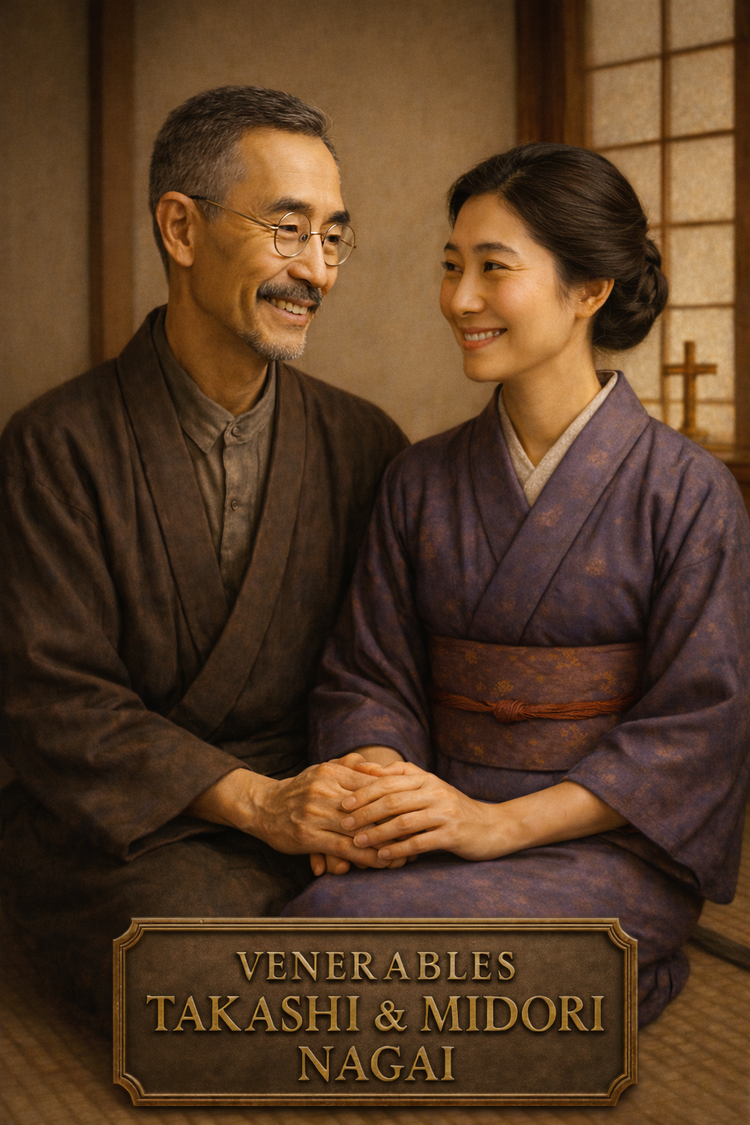
Venerable Takashi & Midori Nagai
Handmade Prayer Card
Each prayer card is created by hand in Austin, Texas — printed on museum-quality photo paper, assembled slowly and prayerfully, with intercessory prayers offered throughout. These are not mass-produced items. They are devotional heirlooms, made one at a time, in silence and intention.
Seek their intercession for trauma, cancer, radiation illness, sudden loss, and rebuilding after total destruction.
View the Prayer Card →Quick Facts
Takashi Born
February 3, 1908
Matsue, Shimane, Japan
Midori Born
c. 1908
Urakami, Nagasaki, Japan
Midori Died
August 9, 1945
Urakami, Nagasaki (atomic bomb)
Takashi Died
May 1, 1951
Nagasaki Medical College Hospital
Cause of Death
Leukemia from radiation exposure
Baptized
June 9, 1934 (Takashi)
Baptismal name: Paul
Married
August 1934
Urakami Cathedral, Nagasaki
Profession
Radiology physician & pioneering researcher; Midori: teacher & community leader
Feast Day
May 1 (Takashi)
August 9 (Midori / Nagasaki Day)
Canonization Status
Servants of God
Cause opened October 2021
Known For
Witnessing peace after the atomic bomb; "The Bells of Nagasaki"
Buried
Sakamoto International Cemetery, Nagasaki
Origins: A Family of Healers and Hidden Faith
Takashi Nagai entered the world on February 3, 1908, in Matsue, on the rugged western coast of Shimane Prefecture. His birth itself was dangerous — a difficult delivery that endangered both his life and his mother's. He grew up in the rural village of Mitoya, raised in the austere spiritual atmosphere of Confucian ethics and Shinto reverence. His family was educated and respected. His father, Noboru Nagai, was among the first generation of Japanese physicians trained in Western medicine; his grandfather Fumitaka practiced the older art of herbal healing; his mother Tsune descended from a samurai lineage. Healing ran in the blood, in every direction, for generations.
The name Takashi means "nobility" in Japanese — a word that would acquire its fullest meaning only in the final years of his life, when nobility had nothing to do with rank and everything to do with how a man endures destruction.
He was a serious, intellectually ambitious boy who excelled in school. By the time he reached Matsue High School, the modern world of science had caught his imagination completely. Western Enlightenment thinking, newly imported to Meiji Japan, was remaking how educated young Japanese understood the universe, and Takashi absorbed it with the fervor of a convert — to rationalism. God was a relic. Science was the truth. Religion was superstition worn by people too frightened to face the void.
In 1928, he enrolled at Nagasaki Medical College. He had no idea that the city he was traveling to would become the landscape of his entire destiny.
The Intellectual's Journey: From Scientific Atheism to Pascal's Wager
In Nagasaki, Takashi threw himself into medicine and into the clean certainties of science. The bells of the nearby Urakami Cathedral rang three times a day for the Angelus. He found them irritating. How crass, he thought, for a modern Japanese to be reminded of a foreign religion at regular intervals, as if ordinary life required interruption by God. The Catholic students around him seemed to him intellectually stunted, tethered to a faith that offered comfort instead of truth.
Then his mother died.
In 1930, Tsune Nagai suffered a brain hemorrhage. Takashi rushed home. He sat by her bed in the terrible hours that followed, and what he witnessed undid something in him. In her last moments, she turned her eyes toward him — and in those eyes he saw something he could not categorize in any medical textbook. Not pain. Not fear. Something that looked, in the deepest sense of the word, like going somewhere. Like a spirit departing, rather than a body failing.
He returned to Nagasaki shaken. He had been so certain there was no such thing as spirit. Now he was not certain of anything.
On the boat home, he opened a copy of Blaise Pascal's Pensées — attracted to the French mathematician-philosopher years earlier in a literature class, then set aside. Now he read it in grief and bewilderment. Pascal's famous argument struck him like a compass needle finding north: that the existence of God cannot be decided by reason alone, and that a rational person should bet on faith, because the stakes are infinite and the cost is finite. Pascal's words cut through the armor of scientific certainty Takashi had spent years forging.
"There is enough light for those who only desire to see, and enough obscurity for those who have a contrary disposition."
— Blaise Pascal, Pensées — the passage that turned Takashi Nagai's conversionHe was not converted yet. But the experiment had begun. True to his scientific temperament, he decided to test the Christian faith the way he would test a hypothesis — by living inside it, observing carefully, and letting the evidence speak.
The Moriyama Household: Where Three Centuries of Hidden Faith Lived
As a medical student needing lodging, Takashi found himself boarding with a family named Moriyama. He could not have known what he was walking into. The Moriyamas were not merely Catholic. For seven unbroken generations, they had served as the chōkata — the hereditary leaders and keepers of the community calendar — among the Kakure Kirishitan, the legendary Hidden Christians of Urakami.
The Hidden Christians were one of the most extraordinary stories in the history of the Church. When Japan banned Christianity in the 1600s under the Tokugawa shogunate, the faithful of Nagasaki did not apostacize. They went underground. For over two centuries — two hundred years without priests, without the sacraments, without any visible church — they preserved the faith in secret, passing prayers from parent to child in whispers, encoding the Virgin Mary into statues of the Buddhist goddess Kannon, keeping liturgical calendars in secret diaries. They were hunted, exiled, tortured, and martyred. They did not break.
When Christianity was finally legalized in 1873, the Hidden Christians of Urakami emerged from the shadows. Pope Pius IX reportedly called it "the miracle of the Orient." The great red-brick Immaculate Conception Cathedral, built by poor Catholic farmers and fishermen with their own savings over decades, opened in 1914. It was the largest church in East Asia.
The Moriyama family had been the keepers of that underground community for every generation of those dark centuries. Takashi boarded with the descendants of people who had chosen death rather than deny Christ. The atmosphere of their house — the quiet joy, the unhurried prayer, the sense of something alive and unhurried — unsettled him in ways he could not explain.
One night, Sadakichi Moriyama invited him to midnight Mass on Christmas Eve. In the cathedral, surrounded by ordinary Japanese people who sang the Credo with full-throated conviction, something in Takashi's chest shifted. Why, he wondered later, could these people take an uncomplicated stand for truth, while he — an educated man, a scientist — remained footloose and ethically evasive? Their simplicity cut him more deeply than any argument.
Midori: The Keeper of Hidden Fire
The Moriyama family had a daughter.
Midori Marina Moriyama was a teacher who lived away from home and returned for the Christmas holidays. She was quietly beautiful, deeply faithful, and possessed of the particular spiritual strength that comes from a lineage that has been tested by centuries of persecution and has not bent. As the firstborn daughter of the house of the chōkata, she had grown up understanding that faith was not comfort. It was identity. It was survival. It was worth dying for.
When Takashi met her that Christmas, he did not immediately understand what he was encountering. But Midori sensed something in him — a soul in motion, turning slowly toward the light. She did not press him. She prayed for him.
Their courtship was gradual and genuine. It deepened when Takashi, one winter night, made a swift diagnosis as Midori collapsed with acute appendicitis. He carried her on his back through the snow to the hospital. The surgery saved her life. There was something in that moment — the physician carrying the woman of faith through the dark — that felt like a parable neither of them yet understood.
When Takashi was conscripted as a military surgeon in 1933 and sent to Manchuria, Midori knitted him wool sweaters and gloves and sent him a catechism. From the front, where he was treating both Japanese and Chinese wounded — having decided early that his role was to heal, not to hate — he read it. He wrote: "I have come to China not to win a war, but to help the wounded, both Japanese and Chinese." Midori's faith was seeping into his bones in ways he was only beginning to recognize.
"Whether you live or die, it is for God's glory."
— Midori Nagai, on learning of Takashi's leukemia diagnosis in 1945She was not a theologian. She was not a mystic who wrote treatises. She was something more fundamental: a person so rooted in God that faith was simply the natural shape of her daily life. Gabriele Di Comite, president of the Roman association devoted to promoting their cause, described Midori this way: "She was a very discreet and silent person, although very strong in faith. She accompanied him through every stage of his life, showing him that life is God's calling."
Baptism, Marriage, and the Life They Built
On June 9, 1934, Takashi Nagai was received into the Catholic Church. For his baptismal name, he chose Paul — after St. Paul Miki, the Japanese Jesuit martyr crucified in Nagasaki in 1597, the first of the twenty-six martyrs of Japan. It was a name that aligned him not merely with an apostle but with the particular history of Japanese Christian suffering. Takashi Paul Nagai had chosen to belong to a people who knew what it cost to believe.
Two months later, on a Wednesday morning in August, at the seven o'clock Mass in Urakami Cathedral — the quiet first Mass of the day, with just a priest and two witnesses — Takashi and Midori were married. No fanfare. Just a man, a woman, and a God they both now served.
They built their home near the cathedral, in the neighborhood where the Moriyamas had lived for centuries on the same ground where the hidden Christian community had once whispered prayers in secret. Midori taught ikebana, sewing, and the tea ceremony. Takashi worked as a radiologist, performing fluoroscopic examinations with the primitive equipment of the era — directly observing X-rays without protective shielding, because in wartime Japan, protective films were not available. He knew the risk. He accepted it. He told Midori when they were engaged that she needed to understand that his work would likely shorten his life. Her answer echoed Ruth's words to Naomi: wherever he went, she would go; whatever came, she would share it.
They had four children: their son Makoto, born 1935; a daughter Ikuko, born 1937 on the very day the Second Sino-Japanese War broke out (Takashi was immediately conscripted again, and Ikuko died of illness while he was gone); a daughter Sasano, who died shortly after birth; and Kayano, born in 1941, who would survive to carry their memory forward. Two children buried before they could speak. Two left to inherit whatever world remained after the fire.
Takashi joined the Society of Saint Vincent de Paul and devoted himself to visiting the sick and poor, carrying food and comfort to those the world had set aside. He had known Maximilian Kolbe, the Polish Franciscan priest who ran a monastery near Nagasaki from 1931 to 1936, and who would later give his life at Auschwitz. The world Takashi moved in was one where saints were not abstractions — they were people he had met, prayed with, argued science with, shared meals with.
War, Leukemia, and the Shadow Before the Fire
By 1945, Japan was being methodically destroyed from the air. Nagasaki had already endured an air raid on April 26, sending hundreds of wounded flooding into the hospital. Takashi worked without rest. He had been performing fluoroscopic X-ray examinations throughout the war years with no shielding and deteriorating equipment, absorbing radiation continuously. His body was paying the price.
In June 1945, he diagnosed himself. The results were unambiguous: chronic myeloid leukemia. His white blood cell count told a story there was no way to misread. He was given three years to live — at most. He was thirty-seven years old.
He told Midori. She was quiet for a long moment. Then she said: "Whether you live or die, it is for God's glory." It was not resignation. It was something harder and more real than resignation — a faith so complete that it absorbed even this without flinching.
Takashi had a somber presentiment about what was coming. He had known since the Americans' entry into the war that Nagasaki was a potential target. The city had military installations, a port, and — though this weighed on him — the largest concentration of Catholics in Japan, gathered precisely in the valley of Urakami where the bomb, if it fell, would be most devastating. He said nothing to alarm anyone. He continued working.
On August 6, 1945, Hiroshima was obliterated. The two children — Makoto and Kayano — were sent to safety in the countryside with Midori's mother. Takashi stayed at the hospital. Midori stayed at home in Urakami. She was in the kitchen that Thursday morning, and she was praying the rosary.
August 9, 1945: The Day Everything Burned
At 11:02 in the morning of August 9, 1945, the American B-29 Bockscar released the atomic bomb known as "Fat Man" over Nagasaki. The planned target had been Kokura, but cloud cover forced the crew south. The bomb detonated approximately 1,650 feet above Urakami — not over the military shipyards, not over the arsenal, but directly over the valley where the Hidden Christians had lived and died and worshipped for three hundred years. The Immaculate Conception Cathedral, the largest Catholic church in East Asia, was at the hypocenter. It was vaporized.
Takashi was at work in the radiology department of Nagasaki Medical College, roughly six hundred meters from ground zero. The blast wave ripped through the building, sending fragments of glass and metal through him, opening a wound in his right temporal artery. He did not lose consciousness. He began treating the wounded immediately, his own blood soaking through improvised bandages, while the hospital filled with the dying. He did not stop for three days.
Approximately 8,500 of the 12,000 parishioners of Urakami Cathedral — the faithful descendants of the Hidden Christians, survivors of two centuries of persecution — were killed in that single instant. Seventy thousand people in Nagasaki died on August 9 and in the days that followed.
Midori was killed instantly. She was at home, which stood on the ancestral Moriyama land — the same ground where seven generations of Hidden Christians had gathered in secret, prayed in secret, and kept the faith alive across centuries of brutal suppression. She was thirty-seven years old. The rosary was in her hands.
Finding Midori: Ashes, Bones, and a Rosary That Survived the Fire
It took Takashi two days to finally leave the hospital — not because he did not want to go home, but because the wounded would not stop coming. He had collapsed from blood loss, woken on an operating table, had his wounds dressed, and returned to work. Only when his legs gave out entirely did he allow himself to stop.
On August 11, he made his way back through the ash fields that had been his neighborhood. The house was gone. The street was gone. The cathedral's twin towers still stood — improbably, hauntingly — but everything else had been reduced to rubble and dust and the particular gray silence of a city that has been annihilated.
He knew where the kitchen had been. He went there. Among the ashes, he found her: a black shape, the charred remains of a pelvis and spine, reduced by atomic fire to the minimal evidence that a person had once existed in that spot. And beside her, in the ash, her rosary — its wooden beads burned away, but the small coral cross intact, its metal fused into a single glowing mass by the heat of twelve hundred degrees. The fire had taken everything from Midori except the cross she was holding.
Takashi gathered her bones. He carried them home. A doctor who had spent his career quantifying the human body through X-rays and radiation measurements now held all that remained of his wife in his hands — a few ounces of calcium that had once been the person he loved most. He did not rage. He did not curse. He prayed. Years later he would write of that moment simply and without self-dramatization, as a man trying to be honest about what faith cost.
"I walked with God in the ghostly desolation of Urakami and finally understood the depth of His friendship."
— Takashi Nagai, on the aftermath of the atomic bombingHe inscribed her grave cross: "Marina Nagai Midori, died August 9, 1945, at age 37." Marina — the baptismal form of Maria, Mary — as if to place her, in death, under the explicit protection of the Mother she had served with such quiet faithfulness all her life.
The Hansai Speech: Offering Nagasaki's Dead to the World
On November 23, 1945, Bishop Paul Aijiro Yamaguchi celebrated a requiem Mass before the ruins of Urakami Cathedral for the eight thousand Catholics killed by the atomic bomb. Takashi Nagai was asked to speak.
What he said that day has been studied, debated, and reverenced ever since. He introduced the concept of hansai — the ancient Hebrew term for a burnt offering, a whole sacrifice consumed entirely by fire for the sake of others. He asked the shattered community gathered in the ash to consider whether Nagasaki had not been, in God's providence, precisely such an offering: a sacrifice accepted, a people given, so that the war might end and the world might be turned back from the path of annihilation.
He was not excusing what had happened. He was not declaring that the American military had done a holy thing. He was doing something far more difficult: finding a frame of meaning within which the dead could rest and the living could continue. He was refusing, as a physician and as a man of faith, to let mass suffering have no meaning at all.
"Was not Nagasaki the chosen victim," he asked, "the lamb without blemish, slain as a whole burnt offering on an altar of sacrifice, atoning for the sins of all the nations during World War II?"
This interpretation was and remains controversial. Some found it redemptive; others found it troubling. Takashi himself never pretended to certainty. He offered it as a meditation, not a decree — as one man's attempt to make sense of a horror so complete that ordinary language had no adequate response. He also knew that he was speaking to people who had survived two hundred years of persecution by finding God in their suffering. He was speaking in a language they already understood.
After the speech, he found the cathedral bell in the rubble. He organized a group of survivors, dug it out, and had it ringing again by Christmas 1945. The sound of that bell over the ash fields of Urakami became one of the most powerful symbols of Japan's postwar recovery.
Nyokodo: The Four-Square-Meter Hermitage
By 1946, Takashi's leukemia had accelerated catastrophically — the radiation from the atomic blast superimposed on the radiation damage already accumulating from years of unshielded X-ray work. In July 1946, he collapsed on a railway station platform. He would never walk normally again. He was bedridden for the rest of his life.
He returned to Urakami — to the same ground where Midori had been born and had died, where the Moriyama family had kept the hidden faith for centuries — and had a small structure built from the ruins of the old house. In 1947, the local St. Vincent de Paul Society built him a new hut: two tatami mats, roughly four square meters. A bed two feet wide. A bookshelf. An incense stand. A window looking out on Urakami.
He named it Nyokodo — literally "As-Yourself Hall," from Christ's commandment to love your neighbor as yourself. He called it his hermitage. He chose to live in it in deliberate poverty, refusing the financial rewards that his bestselling books were beginning to generate. He donated the proceeds to the reconstruction of Nagasaki. He planted 1,000 cherry trees in the ruined valley — funded by a grant from the Kyushu Times newspaper — to transform what he called the "atomic wilderness" into what he hoped would become a "hill of flowers."
From that four-square-meter room, bedridden and dying, Takashi Nagai became one of the most widely read authors in postwar Japan. He wrote in the mornings, when his body permitted, lying flat on his back, often with his two surviving children beside him. He drew sketches. He wrote calligraphy cards bearing the Japanese words for "Peace Forever" — Nagasaki no Kane — and sent them across Japan and eventually around the world.
He received the Emperor of Japan, Cardinal Norman Gilroy of Sydney, and Helen Keller in that tiny room. Hundreds of ordinary people came to him daily. He never turned anyone away. He had decided, apparently, that the purpose of his dying was to be useful in it.
The Books He Wrote Lying Down
Takashi Nagai's literary output from his deathbed is one of the most unusual bodies of work in modern Catholic literature. He wrote not as a professional writer or theologian but as a physician-mystic who had been through the fire and needed to report what he had found there — for Japan, for the Church, for humanity.
The Bells of Nagasaki was his first book and his most famous — completed by the first anniversary of the bombing and eventually a national bestseller, adapted into a major Japanese film. It is his eyewitness account of August 9 and its aftermath, written with the clinical precision of a doctor and the spiritual depth of a man who had watched his city become a sacrifice. His conclusion asked whether humanity would use atomic energy to light homes and advance civilization, or to destroy the world — and whether without "a true religious spirit," the latter was inevitable.
Leaving My Beloved Children Behind (Kono Ko wo Nokoshite) was written as a final letter to Makoto and Kayano — a father dictating his love and wisdom to children who would grow up without him. It was made into a film, and its title song is still sung in Japan as a postwar classic. The book is perhaps his most intimate work: a dying man's attempt to pour everything he knows about love, faith, and endurance into the vessels of his children's futures.
The Rosary Chain, Children of Nagasaki, The Pass of the Virgin, and Thoughts from Nyokodo followed. He also produced essays, medical analyses of radiation sickness in bomb survivors — among the first rigorous clinical studies of atomic bomb illness ever written — and thousands of pieces of calligraphy. He collaborated on academic medical reports while producing devotional literature simultaneously, because to him the two were not separate activities. Science and faith were not in competition. They were two languages for approaching the same truth.
A Saint Dying in Public: The Final Days
By 1951, Takashi Nagai had been dying for six years. He had already survived longer than the three years his doctors had given him at diagnosis in June 1945 — an extension he attributed partly to the intercession of St. Maximilian Kolbe, his old friend from Nagasaki, who had given his life in Auschwitz in 1941. At one point during the worst of his radiation sickness in September 1945, when he had been given last rites and seemed on the threshold of death, he had prayed for Kolbe's intercession (Kolbe had not yet been beatified, let alone canonized) and had recovered. He did not forget it.
As he prepared to die in May 1951, he made one final request: he asked to be transported to Nagasaki Medical College Hospital so that medical students could observe his death. He wanted to provide them, as one final pedagogical act, with the lesson his life had been: how a man prepares to leave it. He waited in the hospital for a gift to arrive — a statue of Our Lady from the Italian Catholic Medical Association. Until evening, his condition seemed stable.
At 9:40 in the evening of May 1, 1951, Takashi Nagai complained of dizziness and lost consciousness. He was given two injections of cardiotonics. He regained consciousness long enough to pray: "Jesus, Mary, Joseph — into your hands I entrust my soul." He took a cross from the hand of his son Makoto, who had rushed into the room. Then he spoke his final words — shouted them, in a voice that still surprises those who read of it — two words directed not at the living but at God, and at anyone who might still be able to do what he no longer could:
"Pray! Please pray!"
He was forty-three years old. He was buried beside Midori in Sakamoto International Cemetery in Nagasaki, on the grave marked simply with her name and his — Marina and Paul, two people who had chosen each other and chosen God, and spent their lives becoming witnesses to the fact that even when cities burn and bodies fail, love does not end.
From The Eastern Church Collection
Byzantine Icons for Your Prayer Space
Takashi Nagai encountered the living Christ through the faith of ordinary people who carried icons, rosaries, and scriptures through centuries of persecution. Bring that same sacred presence into your home.

Christ Pantocrator — Mount Athos Icon
The ancient gaze of the Pantocrator — Ruler of All — rendered in the tradition of Mount Athos. Suitable for home altar, prayer corner, or as a devotional gift.
View on Amazon →
Christ Savior of the World Icon
A luminous rendering of Christ as Savior, offering blessing with one hand and holding the Gospels in the other. A powerful companion for daily prayer.
View on Amazon →
6th-Century Christ Pantocrator — Sinai
Reproduced from one of the oldest icons in existence, preserved at Saint Catherine's Monastery on Mount Sinai. A window into the unbroken tradition of Christian prayer.
View on Amazon →A Marriage That Showed What Love Can Endure
Takashi and Midori Nagai are among the most profound witnesses to holy marriage in modern Catholic history. They married knowing his leukemia would come early. They built their life in the shadow of mortality, and in that shadow they found not despair but clarity. Midori's faith formed Takashi's. His conversion made their union a sacrament in the fullest sense. If their story has touched something in you about what marriage is, or what it could be, we have gathered free resources to support your own journey.
Patronage
Who Prays to Takashi & Midori Nagai — and Why
People come to Takashi and Midori Nagai when trauma has rewritten their story. They come after sudden catastrophic loss, after diagnoses that involve radiation or cancer, after violence that leaves nothing familiar standing. They come when peace feels unreachable and faith must exist in the presence of mass suffering. Takashi and Midori understand this landscape. They lived inside it. Their intercession arrives quietly — as calm after shock, as forgiveness replacing rage, as courage rising when bodies feel fragile.
Radiation Illness & Cancer Patients
Takashi developed leukemia from his radiology work before the bomb ever fell, then received a second wave of radiation in the blast. He treated radiation sickness from his own deathbed. Few saints have more intimate knowledge of what cancer patients carry.
Sudden Spousal Loss
Midori was killed without warning. Takashi found her bones in the ash. Those who have lost a spouse suddenly — in accidents, disaster, violence — find in him someone who knows exactly what that moment looks like and what it costs to continue afterward.
Trauma & PTSD
Takashi witnessed 70,000 deaths in a single morning, treated mass casualties for days while wounded himself, and rebuilt his life in a literal wasteland. Those healing from catastrophic trauma, war, disaster, or the nervous system collapse that follows, find him credible.
Rebuilding After Total Loss
He had nothing — no home, no wife, no health, no neighborhood. He planted cherry trees in the ash. He built a four-meter hut. He wrote books from it. For those who must build a life from zero, his witness is a map.
Forgiveness After Violence
Takashi never expressed hatred for the Americans who dropped the bomb. He explored in writing and prayer whether rage prolonged devastation and whether forgiveness was the only path to actual healing. Those trying to forgive the unforgivable seek him out.
Medical Professionals
He was a pioneering radiologist who died of his own medicine, then used his clinical expertise to document atomic bomb illness for the world's benefit. Physicians, radiologists, nurses, and medical researchers often claim him as a patron.
Writers & Scholars of Faith
He wrote some of the most significant postwar Catholic literature in Japan while bedridden and dying. Those seeking to give form and language to suffering, grief, and faith find in him a model of how the pen can become an act of charity.
Peace Advocates
His most famous cry — "Let Urakami be the last atomic wilderness in the history of the world" — became one of the postwar world's most quoted pleas for peace. Those working for nuclear disarmament and nonviolence claim him fiercely.
Intercessions & Reported Graces
Signs of Their Continued Presence
Takashi and Midori Nagai are Servants of God — their cause for beatification was formally opened in 2021 by the Archbishop of Nagasaki — and the formal investigation of miracles attributed to their intercession is ongoing. In the meantime, those who pray through them report a particular quality of grace: not dramatic or theatrical, but stabilizing. Their intercession arrives in the register of interior peace rather than spectacular cure, though both have been claimed.
Reported Before His Own Death
In September 1945, Takashi was given last rites. His leukemia and radiation injuries had brought him to the threshold of death. He had already written a death poem in the Japanese tradition. In what he later described as an interior experience during his coma — hearing a voice urging him to call upon Fr. Maximilian Kolbe, who had not yet been officially beatified — he prayed, and recovered. He went on to live another six years. Whether this is a miracle in the canonical sense has not been officially determined; Takashi himself reported it with characteristic medical caution as a recovery he could not explain.
Testimonies from Those Who Pray Through Them
Those who invoke Takashi and Midori most commonly report: an unexpected calming of acute anxiety or grief following traumatic events; renewed courage and equanimity during cancer treatment; and the particular grace of being able to grieve a sudden death without being destroyed by it. Several people report an ability to forgive that arrived as a gift rather than an achievement — not a decision they made but something that came to them in prayer.
Some report physical improvement during cancer treatment that their physicians found unexpected. Many more receive what can only be called interior restoration — not the removal of suffering, but a change in the relationship to suffering. The ability to carry it without being consumed by it. This is precisely the grace Takashi himself embodied: not the elimination of pain but its transfiguration.
A Note on the Canonization Process
The Amici di Takashi e Midori Nagai — the Friends of Takashi and Midori Nagai, a canonical committee established in Rome in March 2021 — serves as the official postulator of their cause. The Archbishop of Nagasaki formally recognized the committee on September 8, 2021, and granted canonical approval for a prayer for their beatification. Anyone who believes they have received a grace through their intercession is encouraged to document it and submit it through the Diocese of Nagasaki.
Sacred Sites & Memorials
Where to Encounter Them Today
Because Takashi and Midori Nagai are not yet beatified, there are no formal first-class relics distributed through the Church. However, their presence is deeply embedded in the physical landscape of Nagasaki, and the sites associated with them draw pilgrims from around the world. Several personal objects survive and are displayed at the Memorial Museum.
Nyokodo — The Hermitage Hut (Nagasaki)
The original two-tatami hut where Takashi spent his final years still stands, adjacent to the Nagai Takashi Memorial Museum. This is the most intimate site associated with him — the actual room where he wrote his books, received pilgrims, and died. It remains much as it was in 1951. Pilgrims come here as to a shrine.
Nagai Takashi Memorial Museum →Midori's Melted Rosary — Memorial Museum, Nagasaki
The rosary Midori was holding when the atomic bomb detonated — its wooden beads incinerated, its coral cross fused by the heat into a single glowing mass — is preserved at the Nagai Takashi Memorial Museum. It is displayed alongside photographs and personal belongings. Viewing it has moved countless visitors to tears and to prayer.
Nagai Takashi Memorial Museum →Grave of Takashi & Midori Nagai — Sakamoto International Cemetery
Both Takashi and Midori are buried at Sakamoto International Cemetery in Nagasaki (24-5 Mezamemachi, Nagasaki 852-8105). The grave is a pilgrimage site for Catholics visiting Nagasaki. The epitaph on Midori's cross reads: "Marina Nagai Midori, died August 9, 1945, at age 37."
Urakami Cathedral — Rebuilt on the Ruins
The Basilica of the Immaculate Conception in Urakami (commonly called Urakami Cathedral or Urakami Tenshudo) was rebuilt and reconsecrated in 1959. The rebuilt cathedral preserves fragments of the original destroyed in the bombing. The spiritual home of the Hidden Christians, and the community that formed Midori and sheltered Takashi's conversion, is once again a place of living worship.
Takashi Nagai Memorial Museum — Unnan, Shimane Prefecture
A sister museum in Mitoya-cho, Unnan City, Shimane Prefecture — the village where Takashi grew up — celebrates his early life and heritage. For pilgrims wishing to trace his full journey, from Shinto childhood to Catholic witness, this museum marks the beginning of the story that ended in Urakami.
Monument to X-ray and Radium Martyrs — Hamburg, Germany
Takashi Nagai's name is inscribed on the Monument to the X-ray and Radium Martyrs of All Nations in Hamburg, which honors physicians and medical researchers who died from radiation exposure in the pioneering years of the discipline. He is the only one on the list who also died in an atomic bombing. This monument bears witness to his identity as both a martyr of medicine and a martyr of faith.
Prayers & Devotion
Praying Through Venerable Takashi & Midori
Traditional Prayer
Venerable Takashi and Midori Nagai, witnesses of peace in devastation, pray for us. Intercede for the suffering, heal wounded hearts, and lead us into Christ's mercy. Amen.
Personal Prayer of Intercession
Venerable Takashi and Midori — faithful spouses who endured unimaginable loss — pray for me.
You walked through ashes and chose forgiveness.
You faced cancer and chose service.
You buried loved ones and chose peace.
I bring you my trauma.
If grief feels overwhelming, steady my heart.
If illness has entered my life, give me courage.
If anger rises from injustice, teach me mercy.
Help me rebuild when everything feels broken.
Teach me how to trust God after catastrophe.
Teach me how to love when fear feels louder than faith.
Stand beside survivors.
Stand beside cancer patients.
Stand beside those who lost everything suddenly.
Takashi and Midori — you proved that devastation does not have the final word.
By your intercession, may Christ restore my spirit, strengthen my body, and guide me into peace.
Amen.
Official Prayer for Their Beatification
O God, who moved Takashi Paolo and Midori Marina Nagai to the great love and humble service of their brothers and sisters in the very heart of suffering, grant that through their intercession and following their example, we too may bring the light of the Gospel and the comfort of your love to all men, especially the most suffering. For the glory of your name, may your servant Church recognize in them the perfect disciples of your Son Jesus. Amen.
— Approved by Archbishop of Nagasaki, November 9, 2021Novena Intention
A novena to Takashi and Midori Nagai is traditionally prayed during the nine days surrounding August 9 (the anniversary of the Nagasaki bombing), or during the nine days surrounding May 1 (Takashi's feast day). Those facing cancer treatment, sudden bereavement, or the work of rebuilding after catastrophic loss find these seasons particularly powerful times to seek their intercession.
Frequently Asked Questions
Takashi Nagai was a Japanese Catholic physician who survived the atomic bombing of Nagasaki on August 9, 1945, while already dying of leukemia caused by radiation exposure from his work as a radiologist. His wife Midori was killed in the bombing. Rather than surrendering to despair or bitterness, Takashi devoted his remaining years — lived out in a four-square-meter hermitage hut in the ruins of Urakami — to caring for bomb survivors, writing about peace and faith, and proclaiming the mercy of God in the aftermath of mass destruction. His writings became bestsellers and his life became a defining witness to Christian hope in postwar Japan. Together, he and Midori are known as the Saints of Urakami, and their cause for beatification was officially opened in 2021.
Takashi and Midori Nagai hold the title Servants of God — the first formal step in the Catholic canonization process, signifying that a diocesan investigation into their life and holiness has been officially opened. In October 2021, Archbishop Joseph Mitsuaki Takami of Nagasaki formally accepted and opened the two Causes of Beatification and Canonization for both Takashi and Midori as a married couple. The postulating organization, the Amici di Takashi e Midori Nagai, is based in Rome and coordinates with the Diocese of Nagasaki. The next formal step after Servant of God is Venerable, which requires a declaration by the Pope that the person lived a life of heroic virtue. After Venerable comes Blessed (requiring an approved miracle) and then Saint (requiring a second miracle).
At the November 23, 1945 requiem Mass for the eight thousand Catholics killed in the bombing, Takashi used the Hebrew term hansai — a whole burnt offering, a sacrifice consumed entirely by fire — to frame what had happened to Urakami. He suggested that the Catholic community of Nagasaki, descendants of the Hidden Christians who had endured two centuries of persecution without breaking, had perhaps been chosen as a sacrificial offering for the sins of the world that had produced the war, and that their death had helped bring the war to its end. This interpretation is theologically complex and remains discussed. He did not claim divine certainty about it; he offered it as a meditation for a shattered community that needed some frame of meaning to survive. Takashi did not excuse the bombing or the war that caused it. He was attempting to find, within Catholic theology of redemptive suffering, a reason why the most faithful community in Japan bore so disproportionate a share of the atomic age's first sacrifice.
Midori Moriyama came from one of the most historically significant Catholic families in Japan. For seven generations, the Moriyama family served as the chōkata — the hereditary leader and keeper of the community calendar — of the Kakure Kirishitan, the Hidden Christians of Urakami. The Hidden Christians preserved the Catholic faith in total secrecy for over 250 years, from the early 1600s through Japan's official legalization of Christianity in 1873, passing prayers, baptism rites, liturgical calendars, and articles of faith from parent to child in whispers, in a community that had no priests and no churches. Many were martyred. Midori was born in the ancestral Moriyama home in Urakami — the same building that had served as the spiritual headquarters of the hidden faith for all those generations, and the same ground where she died on August 9, 1945. The UNESCO World Heritage designation of Japan's Hidden Christian Sites in 2018 includes sites directly associated with Midori's heritage.
Takashi Nagai's conversion unfolded across several years through a combination of intellectual reckoning and lived encounter. As a medical student and committed scientific atheist, he was shaken by his mother's death in 1930 — specifically by an expression in her dying eyes that he could not account for within his materialist framework. He turned to Blaise Pascal's Pensées in his grief, and Pascal's argument that rational people should wager on faith made intellectual inroads into his certainty. He began living with the Moriyama family, whose seven-generation Hidden Christian lineage created an atmosphere of lived faith that affected him against his will. He attended midnight Mass for the first time with them and was disturbed — by his own incapacity to commit to truth the way these "ordinary people" could. He went to Manchuria in the military, and while there received a catechism from Midori. He read it. He returned to Nagasaki, met with a priest, continued studying, and was baptized on June 9, 1934. He understood his conversion not as an abandonment of science but as a deepening of it — the same commitment to following truth wherever it led had taken him first to medicine and eventually to God.
Takashi Nagai's relationship with radiation is unique in the history of sainthood. He contracted leukemia from his own medical work — from unshielded direct fluoroscopic examinations, performed throughout the 1930s and early 1940s without protective equipment because films were unavailable. He was diagnosed in June 1945, two months before the bomb fell. Then the atomic bomb gave him a second catastrophic dose of radiation. He lived with cancer, documented cancer in others, wrote about cancer from his deathbed, and died of cancer. He also helped found what became one of the first systematic clinical studies of atomic bomb radiation illness. Those facing radiation-related cancer — whether from medical treatment, occupational exposure, or atomic legacy — find in him someone who understands their situation not in theory but from the inside. His continued peace and productivity while living with terminal illness is a specific form of witness to those undergoing cancer treatment.
Takashi and Midori Nagai are formally recognized within the Roman Catholic Church, where their cause for beatification is proceeding through the Diocese of Nagasaki. Their veneration is overwhelmingly Catholic, and their cause is a Catholic process. However, their witness has attracted deep respect well beyond Catholic circles. Takashi is honored in Japan broadly as a humanitarian, peace advocate, and medical hero — the city of Nagasaki has given the annual Takashi Nagai Peace Award since 1991 to individuals and organizations contributing to world peace. Ecumenically, his message of forgiveness, his testimony about the costs of nuclear weapons, and his witness of hope amid mass destruction resonate across Christian denominations. He is referenced with deep respect in Protestant, Orthodox, and other Christian contexts, even as his formal cause remains within the Catholic Church.
The Nyokodo — literally "As-Yourself Hall," from Christ's commandment to love your neighbor as yourself — is the tiny two-tatami-mat hermitage (roughly four square meters) where Takashi Nagai spent the last years of his life after becoming bedridden in 1946. Built by grateful friends and fellow Catholics in 1947 on the site of his former home in Urakami (the same ground where Midori had been born and died, and where the Moriyama family had led the Hidden Christians for centuries), it served as his bedroom, study, hospital room, and chapel simultaneously. From this four-square-meter room he received the Emperor of Japan, Cardinal Gilroy, Helen Keller, and hundreds of ordinary pilgrims; he wrote multiple bestselling books; he produced thousands of calligraphy pieces; and he died on May 1, 1951. The Nyokodo still stands, adjacent to the Nagasaki City Nagai Takashi Memorial Museum at 22-6 Ueno-machi, Nagasaki. It is open to visitors, is within walking distance of the Nagasaki Peace Park, and is managed by Tokusaburo Nagai, Takashi's grandson. The Memorial Museum houses Midori's melted rosary and extensive personal artifacts.
Carry Their Witness With You
Takashi and Midori Nagai teach that love does not end when cities burn. Their prayer card was made for you — handmade in Austin, printed on museum-quality paper, assembled in prayer, one at a time — because suffering deserves dignity, and every human story matters.
Get Their Prayer Card →