Saint Philopater Mercurius: Soldier Martyr, Abu Sefein and Saint of the Two Swords
The Roman officer who chose Christ over the emperor's favor and is remembered with two swords in the icons
At a Glance
- Born
- Third century; Rome in one Coptic account, Cappadocia in Byzantine accounts, UNCERTAIN
- Died
- About 250 under Decius in Coptic tradition, or under Valerian in another account, UNCERTAIN
- Titles
- Great Martyr, Soldier Martyr, Abu Sefein (Father of the Two Swords)
- Feast
- 25 Hathor (usually December 4) in the Coptic calendar; November 24 or 25 in Byzantine and older Roman calendars
- Veneration
- Coptic Orthodox, Eastern Orthodox and Eastern Catholic; ancient veneration with no formal canonization date
- Patronage
- Soldiers and those in danger of persecution; no formal universal patronage verified
Who Was Saint Philopater Mercurius?
Saint Philopater Mercurius is a martyr of the third century, honored in Egypt as Abu Sefein, which means Father of the Two Swords. He is also called Mercurios or Mercury, and his Greek name Philopater is usually understood to mean Lover of the Father.
He is remembered as a Roman soldier who refused to offer sacrifice to the pagan gods and was beheaded at Caesarea in Cappadocia. The story is the same in its heart across the Churches, but its details differ. Coptic accounts name one emperor, Byzantine accounts sometimes name another, and none comes from an eyewitness.
This article therefore separates the setting that history supports, which is the Roman persecutions of the third century, from the later stories that grew around him. Anything that rests on later hagiography is marked as TRADITION, and anything disputed is marked as UNCERTAIN.
Rome or Cappadocia?
The shorter Coptic Synaxarium says Mercurius was born in Rome to Christian parents who named him Philopater. Byzantine accounts, by contrast, connect him with Cappadocia and speak of a father named Gordian of Scythian descent. The birthplace is UNCERTAIN, and so are his parents' names.
TRADITION: a longer Coptic narrative says his father was a pagan hunter who was delivered from danger and then became Christian with his family. This conflicts with the shorter account, in which the family was Christian from the start. The sources do not settle whether he was baptized as a child or as an adult.
The Coptic Synaxarium says that after he entered the army his superiors gave him the name Mercurius, and that he rose in favor with the emperor. We have no reliable information about his schooling, brothers and sisters, or the age at which he enlisted, and no Roman military record names him.
The Soldier Who Would Not Sacrifice
There is no story of a sudden conversion. The key turning point is a decision to stay faithful to Christ when loyalty to the emperor demanded a pagan sacrifice. All the main traditions share this moment, even though they tell the surrounding events differently.
TRADITION: in the Coptic Synaxarium, Mercurius encourages the emperor to trust in God during a hard battle. A heavenly messenger in white clothes appears and gives him a sword, telling him to remember God after the victory. The messenger is called an angel in the shorter text and Archangel Michael in some Coptic teaching.
After the victory the emperor ordered sacrifices of thanks to the gods, and Mercurius refused. This cost him his rank, his freedom and finally his life. His story belongs to the group of soldier martyrs who teach that honor to an earthly ruler can never replace the worship of God.
A Soldier, Not a Scholar
Mercurius was not a bishop, a monk or a teacher, and no authenticated writing by him has survived. His whole witness is his faith and his death. Prayers and hymns that bear his name were composed by later believers who honored him.
TRADITION: the lives describe a brave officer who won promotion by victory in war, and some versions give him a very high command. His exact rank, unit and battles are UNCERTAIN. The stories use his military career to show a man who has public honor yet keeps Christ first.
His real foundation is the veneration that followed him. The church and monastery of Abu Sayfayn in Old Cairo are an important witness to this cult, and the Coptic Encyclopedia describes how the church was rebuilt in the Middle Ages and reopened in 1175. The church did not exist in his lifetime, and he is not its founder.
Decius, Valerian and the Sources
The reign of Decius, from 249 to 251, is a believable setting for his story. That emperor ordered all inhabitants of the empire to offer sacrifice, and surviving certificates on papyrus show how the order worked. A Christian who refused could be punished, imprisoned or killed.
UNCERTAIN: the Coptic Synaxarium places his martyrdom under Decius, while the Greek Orthodox summary names Valerian, who ruled from 253 to 260. A longer Orthodox account mentions both rulers. For this reason the traditional year of about 250 should be taken as a possibility and not a proven date.
The literary evidence is also layered. Greek passion texts survive in several forms, and a Coptic praise text attributed to a bishop named Acacius has an uncertain author. These later texts may borrow from other soldier saints. The historical setting is real, but the exact scenes cannot be checked.
Beheaded at Caesarea
According to the Coptic Synaxarium, the emperor had Mercurius beaten and then feared unrest among the soldiers and citizens who admired him. He was sent in chains to Caesarea, where he was beheaded. Caesarea in Cappadocia, near modern Kayseri in Turkey, is the place named in the main Eastern accounts.
TRADITION: the Byzantine life adds terrible tortures, a healing in prison and a vision before his death. These are devotional details, not court records. No exact date of death can be given, and the exact circumstances are UNCERTAIN.
Relics: the Coptic Church reports that relics were brought from Caesarea to Old Cairo in 1488, during the time of Pope John XIII. This is a Church account and not a scientific verification. Other relics are said to be kept at a monastery near Naqada. He was never given a modern canonization date, and his veneration is ancient.
Swords, Healings and Julian
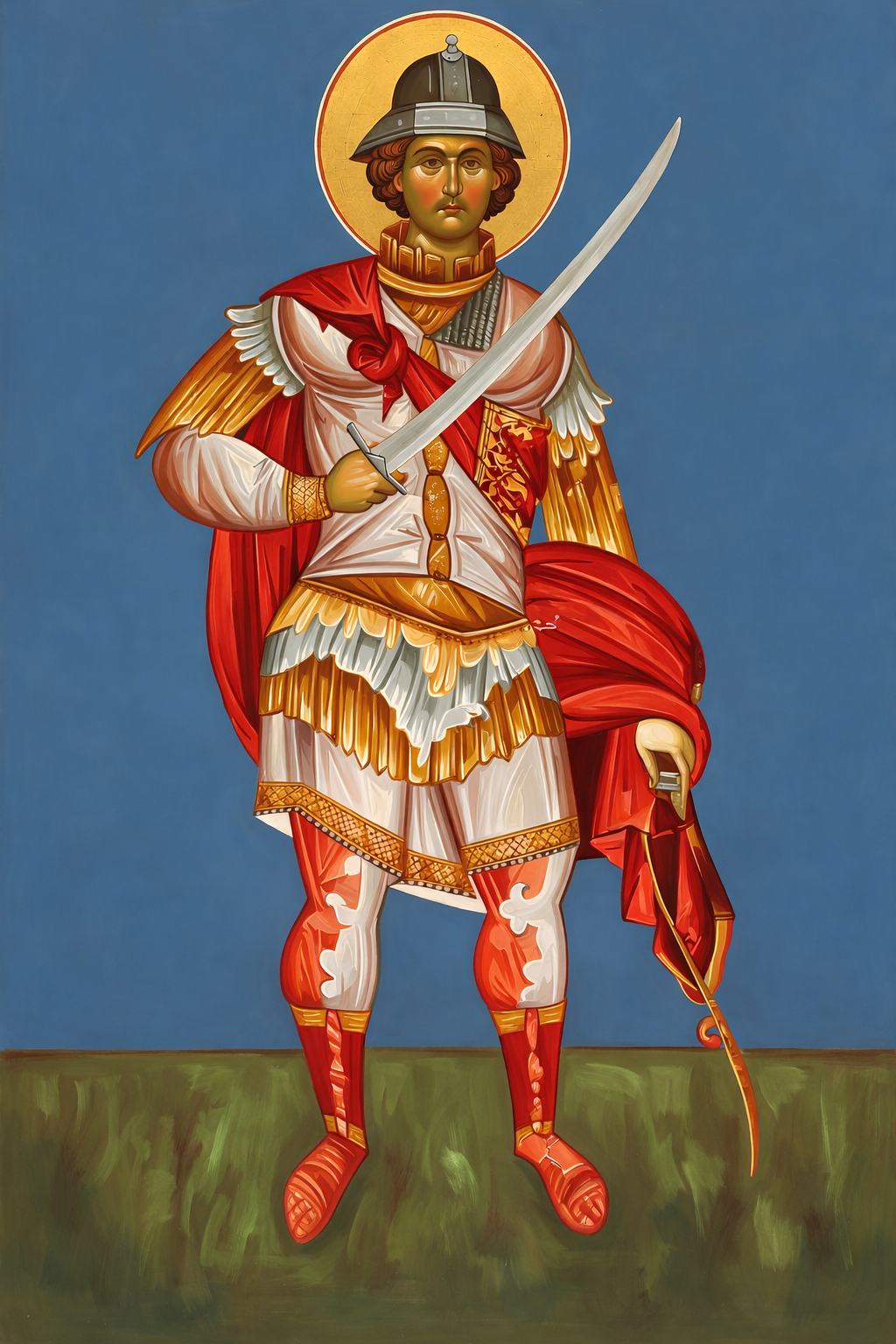
TRADITION: the two swords. One sword stands for his soldier's weapon and the other for the sword given by the heavenly messenger. This is why icons show him as a mounted soldier with two blades, and why Egyptians call him Abu Sefein. The image explains the name well even if the story itself cannot be checked.
TRADITION: the Orthodox life says that he was healed of his wounds in prison and that healings were worked at his tomb. These are accounts of faith that have been told for centuries. They are not medical cases, and they should be read as the way the Church remembers his protection.
TRADITION: a famous story says that Saint Basil prayed against the emperor Julian the Apostate, and that Mercurius then struck the emperor. Julian really died in 363, but the story of the saint's part in it appears much later, in writings from about 570, and the life of Basil that tells it is thought to be apocryphal. It is a legend, not history.
Texts and Studies
The scholarly study of Mercurius begins with his passion texts. The manuscript catalogue Pinakes lists several Greek works under Bibliotheca Hagiographica Graeca numbers 1274 to 1277a, showing that the story was written and rewritten over many centuries.
The Coptic Encyclopedia gives the history of the church of Abu Sayfayn and discusses the uncertain attribution of a Coptic encomium. Studies of the Decian persecution, such as those by J. B. Rives and Paul Schubert, explain the sacrifice order that forms the background of his story.
A modern note on Mercurius and the death of Julian traces how the legend developed. Together these works show that the cult is certain and the setting is credible, while the personal biography remains thin. This is why a careful article uses the words tradition and uncertain so often.
Where to Honor Him
The main place of veneration is the church of Abu Sayfayn in Old Cairo, the ancient Coptic quarter, where relics attributed to him are honored. The church is part of a larger Christian enclosure and is a lively place of prayer on his feast.
A monastery of Saint Philopater Mercurius near Qmula, in the Naqada and Qus diocese in Upper Egypt, also keeps his memory. Many other Coptic churches and monasteries in Egypt and abroad carry his name, and his icon is among the best known in Coptic homes.
Readers elsewhere can keep his feast with a short prayer for soldiers, police and those who face pressure to deny their faith. On 25 Hathor, usually December 4, Copts celebrate him with the liturgy. Byzantine Christians remember him around November 24 or 25.
Lord Jesus Christ, You gave strength to Your servant Mercurius to put You before every earthly honor. Through his prayers, protect all who serve in danger, and give us courage to be faithful to You in small and great trials. Amen.
This is a short original prayer written for this article. It is not an official text of any Church.
Mercurius Among the Eastern Churches
For Coptic Orthodox Christians, Mercurius is a beloved martyr and the best known of their soldier saints. His story is told in the Synaxarium, painted on church walls and carried in family devotion. Of all the Churches, the Coptic tradition shows the strongest popular love for him.
He is also honored by Eastern Orthodox Christians as a Great Martyr, with feast days on November 24 or 25 depending on the calendar and listing. Greek and American Orthodox sources include him in their liturgical books and describe his life in similar words, though with the differences noted above.
For Catholics, he appears in the older Roman Martyrology under November 25. Some Eastern Catholic calendars also name him. UNCERTAIN: he is not on every Catholic calendar, so his Catholic observance varies by place. His story, though, is shared across the divisions of East and West.
Frequently Asked Questions
Ask His Prayers
Coptic, Orthodox and Catholic Christians ask Saint Philopater Mercurius to pray for soldiers, for those who face persecution, and for faithfulness in danger. A prayer card of Saint Mercurius is a quiet reminder to keep Christ first.
View Prayer Card