Saint Abanoub of Nehisa: Child Martyr of Egypt, Almsgiver and Witness of the Coptic Church
The boy who gave away his inheritance and confessed Christ before the governor
At a Glance
- Born
- Nehisa near Talkha in the Nile Delta; about 291, UNCERTAIN
- Died
- Traditionally about 303 in Alexandria; exact date and place UNCERTAIN
- Titles
- Child Martyr, Martyr of Nehisa, Abanoub the Youth
- Feast
- 24 Abib in the Coptic calendar, usually July 31
- Veneration
- Coptic Orthodox; ancient local veneration with no formal canonization date
- Patronage
- No formal patronage verified; loved by Coptic children and families
Who Was Saint Abanoub?
Saint Abanoub is one of the best loved young saints of the Coptic Church. His name appears in English as Abanoub, Apanoub, Anub and Abba Nob. He is remembered as a boy who gave away his inheritance, confessed Christ in public and was put to death for the faith.
The setting is the persecution begun by the emperor Diocletian, which struck Egypt hard in the early fourth century. But the story of Abanoub himself comes from a Coptic Passion written centuries later, so the details are tradition and cannot be checked with any record from his own day.
This article follows the Coptic Synaxarium and the work of the scholar Tito Orlandi. Anything that rests on later hagiography is marked TRADITION, and anything that is disputed or unproven is marked UNCERTAIN, so readers can tell what is well supported from what is devotion.
A Child of Nehisa
The Coptic Synaxarium says Abanoub was born in Nehisa, a village near Talkha in the Nile Delta. His parents were Christians who raised him in prayer, charity and obedience to God. The scholarly encyclopedia names his home with a different spelling, so even the place name is UNCERTAIN.
A longer devotional account names his parents Makara and Mary, and says he lost them both while still a child and inherited their wealth. Another Coptic text calls him their only son. The shorter Synaxarium gives none of these names, so they are best treated as later tradition and not as family records.
The traditional age at martyrdom is twelve, which would put his birth about 291 if the date of 303 is accepted. UNCERTAIN: no baptism, property or family record survives. What the sources agree on is that he was raised a Christian and that his faith came before the persecution began.
The Sermon and the Gift
There was no conversion from another religion. The turning point in the Synaxarium comes at church, where a priest urges the people to stay faithful to Christ and not to offer sacrifice to idols, even if it costs their lives. The boy Abanoub hears this and is deeply moved.
He goes home and thinks about the wealth he has inherited. Remembering the words of Saint John that the world and its desires pass away, he gives his goods to the poor. He then sets out for Samanoud, a town in the Delta, so that he can confess his faith in front of the governor.
TRADITION: on the road, the Archangel Michael appears and encourages him to endure what lies ahead. The story cannot be verified, but it shows what the Church sees in him: a layperson, not a priest or monk, who chose the poverty of Christ and went to meet suffering with open eyes.
A Witness Without Books or Buildings
Abanoub left no writings. No letter, sermon or hymn can be traced to him, and no church, school or monastery is said to have been founded by him in his lifetime. His whole work is a short life of almsgiving and a refusal to deny Christ.
TRADITION: the later Passion says that his courage strengthened the Christians in prison and led soldiers and officials to the faith. These conversions are part of the martyrdom story and are not documented missionary work, but they express a truth the Coptic Church loves: even a child's witness can bring others to Christ.
The Passion links him with Julius of Aqfahs, who is said to have visited him and kept his story. Orlandi shows that the surviving text belongs to the later cycle of Julius, so it is not an eyewitness account by Julius himself. The saint's work is thus carried by memory and worship.
The Great Persecution
The background is solid. Diocletian became emperor in 284, and in 303 he began the Great Persecution with orders to destroy churches and Scriptures and to force Christians to sacrifice. Eusebius of Caesarea describes how heavily the persecution struck Egypt. The sources we have, however, do not name Abanoub among the known victims.
The Synaxarium and the longer Passion tell of interrogations at Samanoud, Athribis and Alexandria. The official who questions him is called Lucianus or Lysias in scholarly accounts. TRADITION: on a boat he is hung from the mast, a cup in the governor's hand turns to stone, an angel frees him, and a wind drives the ship to Athribis.
Scholars point out that the only surviving Passion is a Bohairic text in the Vatican Library, dated by Orlandi to the seventh or eighth century. It uses patterns common in Coptic martyr stories, such as repeated trials and miracles. This does not prove that no boy named Abanoub died, but it limits what can be known about him.
Alexandria and the Relics
The Synaxarium says that Abanoub died after torture in Alexandria. Longer devotional lives say that he was beheaded. The traditional year is 303, linked in one Coptic text to the nineteenth year of the Martyrs. UNCERTAIN: the exact date and the way of his death are not independently documented.
TRADITION: Julius of Aqfahs is said to have wrapped his body and taken it to Nehisa. The Synaxarium later places the relics in Samanoud, and modern Coptic accounts say they were moved to the Church of the Virgin Mary there in 960. No contemporary document for that move has been found, and the identity of the remains is not scientifically verified.
No formal canonization date is known. As with many early martyrs, his sainthood is recognized by his place in the Synaxarium, his feast and the long devotion of the people. The lack of a decree in the modern Roman style does not take away his standing in the Coptic Church.
Angels, Serpents and Apparitions
TRADITION: the Archangel Michael appears to Abanoub, strengthens him and in longer accounts restores him after severe torture. In some versions even severed limbs are healed. These are the signs through which the Coptic Church tells of God's protection of the weak, not events that can be confirmed.
TRADITION: Abanoub is placed among poisonous snakes and is not harmed, and when a serpent threatens an official, the boy saves him. Soldiers and onlookers who see such wonders become Christians, and some are later put to death. Such tales are typical of Coptic martyr stories.
TRADITION: some local reports say that Abanoub appears as a young boy who helps or plays with children, and that these appearances increased after prayers by Father Abanoub Louis in 1974. UNCERTAIN: the reports have not been independently checked. A separate story that the Holy Family visited the site of the Samanoud church is a different tradition and not about Abanoub.
What Scholars Say
The key scholarly source is Tito Orlandi's article in The Coptic Encyclopedia. It identifies the one Bohairic manuscript of the Passion, Vatican Library Copto 66, and notes that the text was published by Balestri and Hyvernat in 1908. It dates the composition to the seventh or eighth century.
Studies of the Great Persecution, such as the work on papyri from that time, help readers see what is documented about the general period. The study of Coptic martyr literature by Baumeister and later notes on medieval Coptic hagiography explain how such stories were shaped and why they need careful reading.
From these works a careful picture emerges. A martyr named Abanoub was certainly venerated in Egypt and had a feast, a church and a Passion. The age of twelve, the family names, the boat scene and the date of the relics belong to tradition. This is why a fair article keeps both parts in view.
Visiting Samanoud
The best known place of devotion is the Church of the Virgin Mary and Saint Abanoub in Samanoud, in the Nile Delta, where his relics are traditionally kept. Pilgrims come there especially around the feast on 24 Abib, which usually falls on July 31.
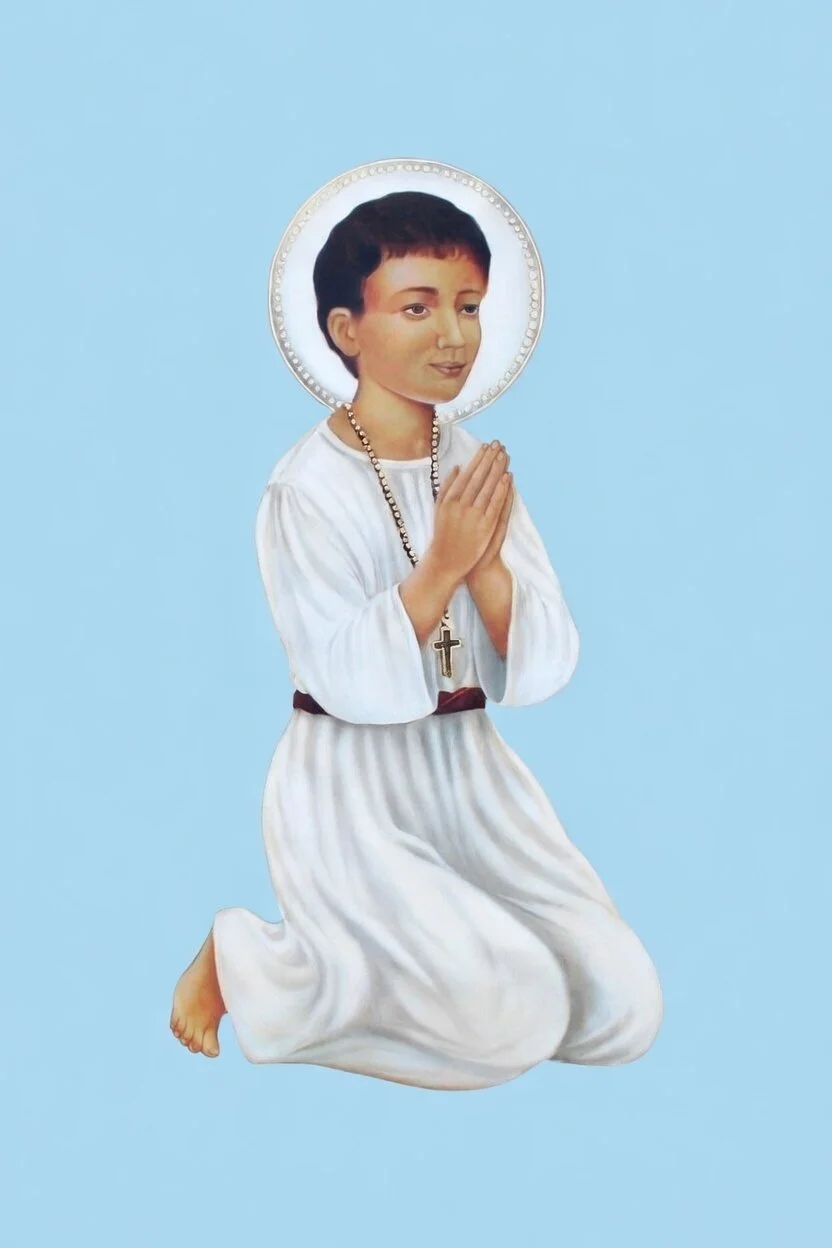
Churches and parishes named for Saint Abanoub can be found in Egypt and in Coptic communities abroad, and his icon often shows a boy with a martyr's cross. Many Coptic parents give the name Abanoub to their sons and ask the saint to watch over their children.
A simple way to honor him is to give something to the poor in his memory, as he is said to have done. Read the short account in the Synaxarium on his feast, and pray that children may grow in faith. Such acts of charity fit the saint as the Coptic Church remembers him.
Lord Jesus Christ, You welcome the little ones and give courage to the weak. Through the prayers of Saint Abanoub, bless the children of Your Church, teach us to share what we have with the poor, and make us faithful to You in every trial. Amen.
This is a short original prayer written for this article. It is not an official text of any Church.
Abanoub Among the Eastern Churches
Abanoub belongs most clearly to the Coptic Orthodox Church, whose Synaxarium reads his story on 24 Abib. The Ethiopian tradition has a closely related commemoration of Abba Nob on 24 Hamle, which shows how widely the story traveled in the Alexandrian Christian world.
The Coptic Catholic Church shares the Alexandrian heritage, and Catholic readers can honor him as part of the martyr tradition of Egypt. UNCERTAIN: the sources checked do not show a feast for him in the current Coptic Catholic calendar or in the universal Roman calendar.
For Byzantine Orthodox readers, he may be less familiar, since the evidence for devotion is strongest in Egypt. His life teaches truths that all Christians share, that holiness does not wait for adulthood, that wealth is for the poor, and that Christ comes before every earthly power.
Frequently Asked Questions
Ask His Prayers
Coptic Christians ask Saint Abanoub to pray for children and for generous hearts. A prayer card of Saint Abanoub is a gentle reminder that a young person can be a brave witness to Christ.
View Prayer Card