Saint Shenouda the Archimandrite: Abbot of the White Monastery, Coptic Writer and Monastic Father
The stern abbot of Upper Egypt whose Coptic sermons and rules fill thousands of surviving pages
At a Glance
- Born
- About 347 or 348 in Upper Egypt, near Akhmim; UNCERTAIN
- Died
- Traditionally 465; other scholars propose 450 to 452 or 466, UNCERTAIN
- Titles
- Archimandrite, Abba, monastic father, Coptic writer
- Feast
- 7 Abib in the Coptic calendar, usually July 14
- Veneration
- Coptic Orthodox; ancient veneration with no formal canonization date
- Patronage
- No formal patronage verified; linked to monks and Coptic literature
- Who Was Saint Shenouda the Archimandrite?
- A Shepherd Boy and His Uncle
- Taking Up the Rule
- The White Monastery Federation
- Zeal, Severity and Controversy
- A Contested Date of Death
- Girdles, Visions and Voices
- Reading Shenouda Today
- The White Monastery Today
- Shenouda Among the Eastern Churches
- Frequently Asked Questions
Who Was Saint Shenouda the Archimandrite?
Saint Shenouda the Archimandrite, whose name is also spelled Shenoute or Shenute, led a great monastic community in Upper Egypt in the late fourth and fifth centuries. The word archimandrite means the head of a monastery or group of monasteries. He is also called Abba Shenouda and Shenouda of Atripe. His long life bridged the age of Pachomius and the years after the Council of Ephesus.
Unlike many saints of his age, he has left us his own words. Scholars count about 4,350 surviving pages from roughly 100 parchment books, scattered among more than 30 collections around the world. These writings are the largest body of original work by any Coptic author.
This article uses those writings, modern studies and the Coptic Synaxarium. The Synaxarium and the old Life of Shenouda are devotional sources. Anything that rests on them is marked as TRADITION, and anything that is disputed among scholars is marked as UNCERTAIN.
A Shepherd Boy and His Uncle
The Synaxarium says that Shenouda was born in Shandaweil, in the district of Akhmim in Upper Egypt, to a farming family with sheep. One modern reconstruction places his birth about 347 or 348. UNCERTAIN: the year, his parents' names and his schooling are not firmly established.
His uncle Pgol, also written Pigol or Bgoul, founded the monastic community that later became the White Monastery federation. The family link between Shenouda and Pgol is accepted by modern scholars. Pgol is the one who gave the young man a place in a life of prayer.
TRADITION: the Synaxarium describes the boy as a faster who gave his food away, and tells how his father brought him to Pgol for a blessing. Pgol is said to have placed the child's hands on his own head and asked to be blessed in return. The scene shows the community's belief that his calling was clear from childhood.
Taking Up the Rule
There is no conversion from paganism in the sources. Shenouda grew up in a Christian setting and was drawn to the ascetic life. A scholarly reconstruction says he entered his uncle's monastery about 371 or 372. These are estimates and not fixed anniversaries.
The same reconstruction says that he became leader about 385. The story of the succession is more complicated than the old tradition suggests. Archaeological and textual work points to a second leader named Ebonh between Pgol and Shenouda, whose memory seems to have been suppressed after some crisis.
TRADITION: the Synaxarium tells of a heavenly voice that announced Shenouda's office as archimandrite. This belongs to the devotional story and cannot be checked. What the sources do show is a leader who, once in charge, built a strict rule and a larger federation.
The White Monastery Federation
Shenouda ruled three linked communities, the White Monastery, the Red Monastery and a women's monastery at Atripe, near modern Sohag. Excavations and inscriptions found in the women's buildings give physical evidence of female monastic life and of the way food and water were supplied.
His rules demanded obedience, chastity, limits on private goods and accountability for wrongdoing. He taught that a monk's sins could harm the whole community, so discipline was a shared concern. His surviving works are mostly the Canons, which govern monastic life, and the Discourses, which address wider audiences on faith and conduct.
The monastery was also a center of charity. His writings tell of sheltering refugees and caring for the sick in times of crisis. UNCERTAIN: later Church accounts give very exact numbers, such as thousands of refugees and counts of births and deaths, but these figures are not independently checked, though the charity itself is well supported.
Zeal, Severity and Controversy
Shenouda lived when Egypt was changing. The old religion lingered in some places, and arguments about Christ divided the Church. His writings record raids on the homes of people who kept old cult objects, and archaeologists have found reused temple stones in the White Monastery church. Some of his zeal took forms that we should not simply praise.
His government of the monks was strict. Public correction and punishment were part of it, as modern studies of his rule by scholars such as Caroline Schroeder and Rebecca Krawiec show. A fair biography keeps this side in view, since it helps us understand both the strength and the cost of his reform.
The Synaxarium places him with Saint Cyril of Alexandria at the Council of Ephesus in 431, and modern surveys say there is some evidence for his presence. UNCERTAIN: the famous scene of his rebuking or striking Nestorius is not supported by independent contemporary evidence. His support for the Alexandrian view of Christ, however, is well established.
A Contested Date of Death
Shenouda is remembered on 7 Abib. The year of his death is UNCERTAIN. One scholar favors 465, others have argued for about 450 to 452, and 466 also appears in books. The old tradition that he lived to 118 is not believed by scholars.
The Synaxarium describes his last hours as a time of prayer and teaching for the monks. This belongs to the traditional life and cannot be rebuilt in detail. The White Monastery has a funeral chapel with an underground tomb, but that alone does not prove that his remains lie there.
Relics: UNCERTAIN. No authenticated list of his relics, or history of their moves, was found. There is no formal canonization date either. His holiness has been recognized through the Coptic Church's long remembrance, its hymns and the many churches and monasteries that bear his name.
Girdles, Visions and Voices
TRADITION: the old Life says that his uncle recognized his greatness when he was still a boy, and that a heavenly voice named him archimandrite. The Life attributed to his successor Besa developed over time and includes memorial speeches, so it cannot be treated as one eyewitness record.
TRADITION: the Synaxarium tells of a general who borrowed Shenouda's girdle before a battle and then defeated his enemies. This tale, like others of its kind, shows the people's trust in the prayers of a holy man. No outside source confirms it. Such stories were told and retold in the monastery for generations.
TRADITION: Coptic devotion also speaks of visions of Christ granted to Shenouda in prayer, and the traditional doxology praises his closeness to the Lord. These are testimonies of faith and not events that can be proved, but they explain why Copts love him as a father in prayer.
Reading Shenouda Today
The best modern guide is the article by Heike Behlmer in the Claremont Coptic Encyclopedia, which sums up debates on his dates, writings and monastic order. Stephen Emmel has written on the extraordinary extent of the manuscripts, and Bentley Layton has translated and studied the Canons.
English readers can find selections in Selected Discourses of Shenoute the Great by David Brakke and Andrew Crislip, and a study of discipline and community in Caroline Schroeder's Monastic Bodies. Stephen Davis has written on the inscriptions from the women's monastery.
Much of his work still survives only in fragments and is being edited. This is one reason scholars say his dates and life are not yet fully settled. For the reader, the lesson is humility about what we know, together with joy that so many of his own words remain.
The White Monastery Today
The White Monastery, called Deir Anba Shenouda, stands near Sohag in Upper Egypt, and its great church still shows the scale of the old federation. The Red Monastery nearby has been studied and restored in recent years, and its paintings draw visitors.
Coptic Christians keep his feast on 7 Abib, usually July 14, with the liturgy and hymns. Monasteries and churches named for him exist in Egypt and in Coptic communities abroad, and some of them have been dedicated in recent years. Local parishes can say how they keep the day.
A pilgrim who cannot go to Egypt can still honor him. Read a short passage from his sermons in translation, give help to a refugee or neighbor in need, and ask that the Church be both strict in love and gentle in judgment. In this way the old abbot's work of charity goes on.
Lord Jesus Christ, You called Your servant Shenouda to lead many monks in prayer, labor and charity. Through his prayers, teach us obedience without hardness, zeal without cruelty, and care for the poor and the stranger. Amen.
This is a short original prayer written for this article. It is not an official text of any Church.
Shenouda Among the Eastern Churches
For Coptic Orthodox Christians, Shenouda is a major monastic father, preacher and writer. He is a pillar of Coptic identity, because his writings show that the Coptic language could carry deep teaching and public argument as well as prayer.
For Coptic Catholics, he is part of the shared Egyptian heritage. UNCERTAIN: the sources checked do not show his exact place in the current official Coptic Catholic calendar, and he has no verified entry in the universal Roman calendar. His historical importance should not be mistaken for proof of an observance.
For Byzantine and Latin readers, his work gives a window on the world of Pachomius and the Desert Fathers. He also raises hard questions about authority and coercion. His life lived before the later divisions, so he belongs to the early Church that East and West both inherit.
Frequently Asked Questions
Ask His Prayers
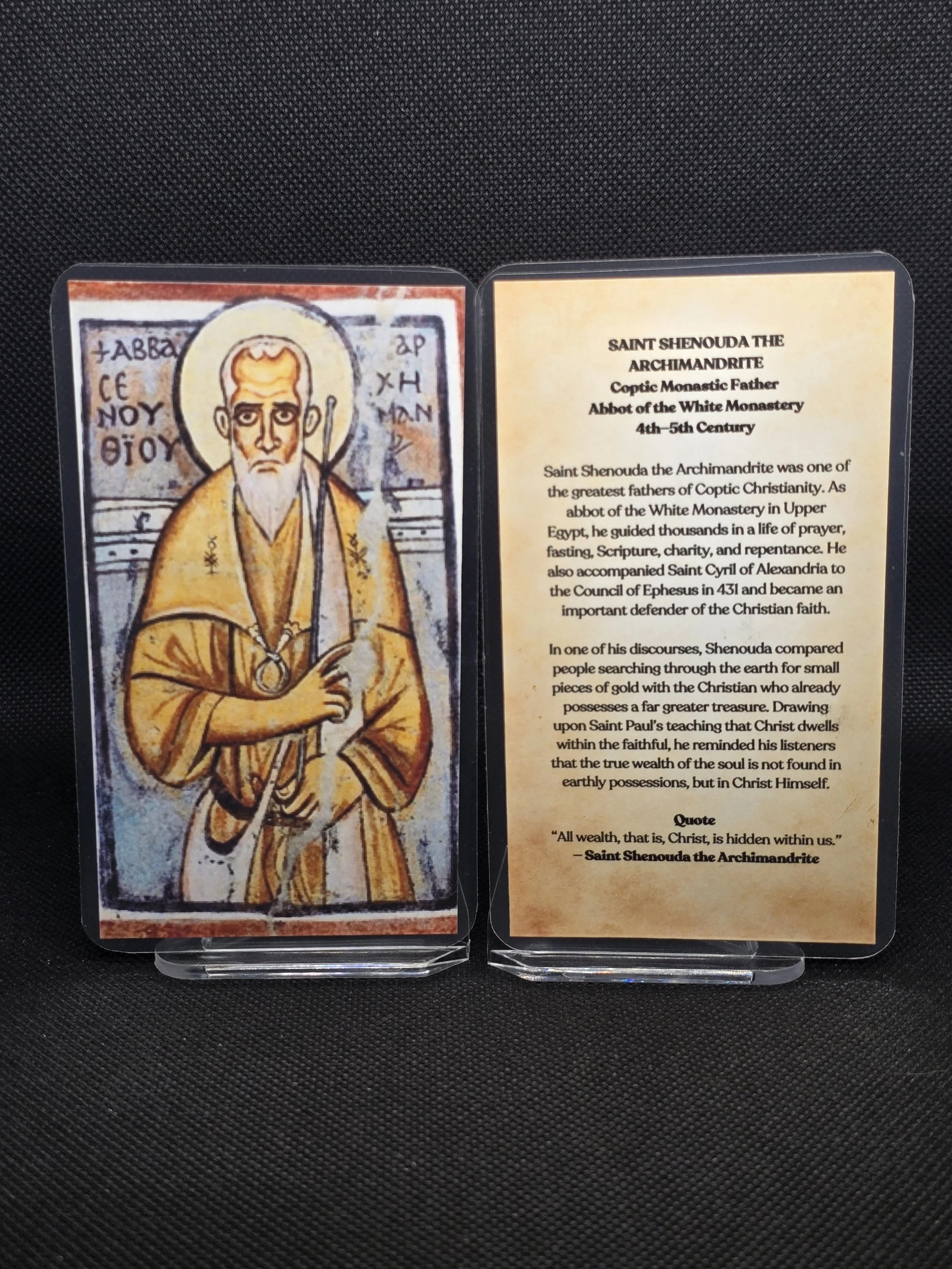
Coptic Christians ask Saint Shenouda to pray for monks, for the poor and for faithful teaching. A prayer card of Saint Shenouda is a reminder to bring love and order together.
View Prayer Card