Saint Cyril of Alexandria: Patriarch, Doctor of the Church and Defender of the Mother of God
The Alexandrian patriarch who taught that the Son of Mary is truly the Son of God, and whose record is not without shadows
At a Glance
- Born
- About 370 to 380, probably Alexandria; UNCERTAIN
- Died
- June 27, 444, in Alexandria
- Titles
- Patriarch of Alexandria, Church Father, Doctor of the Church (1882)
- Feast
- June 27 (optional memorial, Roman); June 9 and January 18 (Byzantine); 3 Abib (Coptic)
- Veneration
- Catholic, Eastern Orthodox and Oriental Orthodox; ancient veneration, no formal canonization date
- Patronage
- No formal universal patronage verified
- Who Was Saint Cyril of Alexandria?
- Nephew of a Powerful Bishop
- From Oak Synod to Bishop's Throne
- One Christ, Mother of God
- Violence in Alexandria
- The Death of a Patriarch
- Relics, Shrines and Devotion
- Reading Cyril Today
- Where to Remember Him
- Cyril Among the Eastern Churches
- Frequently Asked Questions
Who Was Saint Cyril of Alexandria?
Saint Cyril of Alexandria was bishop of the great Egyptian city for thirty-two years, from 412 to 444. He is one of the most influential teachers of the early Church, because he defended the truth that Jesus Christ is one person, the eternal Son of God made man. In the Coptic list of Popes he is the twenty-fourth.
He is honored by three families of Christians. Catholics count him a Doctor of the Church, a title given by Pope Leo XIII in 1882. Eastern Orthodox keep his memory on June 9 and with Saint Athanasius on January 18. Coptic and other Oriental Orthodox Christians love him as Pope Cyril the Pillar of the Faith.
A fair account must also say that his time as bishop was marked by conflict and violence in Alexandria. This article uses early historians, Church sources and modern scholars. It marks tradition as TRADITION, and it marks disputed or uncertain points as UNCERTAIN.
Nephew of a Powerful Bishop
Little is certain about his youth. Pope Benedict XVI said that he was probably born between 370 and 380, and that he was the nephew of Theophilus, Bishop of Alexandria from 385. UNCERTAIN: the sources disagree on whether he was the son of Theophilus's sister or of his brother, and his parents' names are not known.
Alexandria was a center of Greek learning, biblical study and philosophy, and Cyril received a thorough education there. The Coptic Synaxarium adds that he was sent to the monastery of Saint Macarius, where an elder named Sarabamon taught him. TRADITION: this detail is from Coptic hagiography, and the length of his stay is not independently established.
There is no sign of a dramatic conversion. He grew up in the Church and was prepared for service in it. His first firm appearance in history is at his uncle's side, which tells us as much about the politics of the Church as about his own faith.
From Oak Synod to Bishop's Throne
In 403 Cyril went with Theophilus to Constantinople for the Synod of the Oak, which deposed Saint John Chrysostom. That event placed the young man in the middle of a rivalry between the sees of Alexandria and Constantinople, a rivalry that would mark his whole career.
Theophilus died on October 15, 412, and a contested succession followed. The historian Socrates Scholasticus says that supporters of Cyril and of the archdeacon Timothy contended, and that Cyril won. Socrates says he took the throne on the third day, which tells us how tense the city was.
A later turning point was a quiet one. Around 417 or 418, according to Benedict XVI, Cyril agreed to restore the name of John Chrysostom to the Church's prayers. Then came the dispute with Nestorius, who became Bishop of Constantinople in 428, and that dispute defined the rest of his life.
One Christ, Mother of God
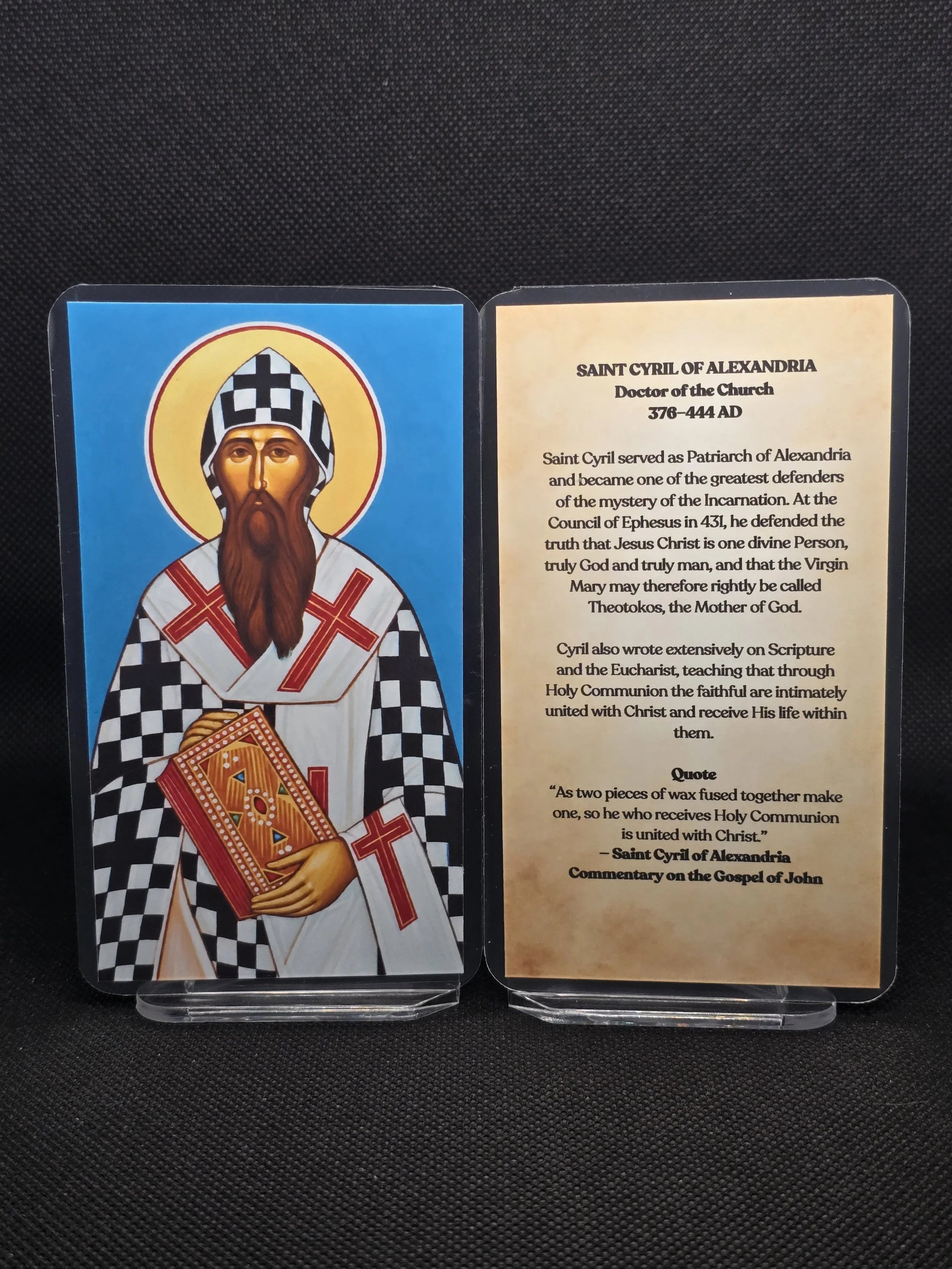
Cyril's central idea was that the Word of God truly became man without ceasing to be God. Christ is not two persons joined together but one Son. For this reason Mary may be called Theotokos, Mother of God. The title does not mean she gave birth to the divine nature, but that the child she bore is the eternal Son.
In 430 Cyril gained the support of Pope Celestine I and wrote his Twelve Anathemas against Nestorius. At Ephesus in 431 the bishops approved Cyril's Second Letter to Nestorius as faithful to the creed of Nicaea, and Nestorius was condemned and deposed. The title Theotokos was older than Cyril, and the council defended it rather than invented it.
In 433 Cyril made peace with John of Antioch in the Formula of Reunion, which affirmed both the full divinity and the full humanity of Christ in one person. His writings include commentaries on John, Luke and Isaiah, the Thesaurus and Dialogues on the Trinity, Against Nestorius and Against Julian. No major monastery or church can be safely credited to him.
Violence in Alexandria
Cyril's time as bishop was not only a time of theology. Socrates reports that soon after he took office, he closed the churches of the Novatians, took their sacred vessels and stripped their bishop of his property. This was an act of power by a bishop in a city where Church and state were closely joined.
Around 414 and 415 there was serious violence between Christians and Jews in Alexandria. Socrates says Cyril took over the synagogues and drove the Jews out of the city. UNCERTAIN: how many were expelled and how many came back cannot be established. Socrates is a nearly contemporary witness, and he was a Christian.
In March 415 the philosopher Hypatia was murdered by a Christian mob led by a reader named Peter. Cyril was in conflict with the prefect Orestes at the time. UNCERTAIN: no surviving evidence shows that Cyril ordered her death, but Socrates saw the crime as a disgrace to the Church. A fair account neither blames him without proof nor excuses the violence.
The Death of a Patriarch
Cyril died in Alexandria on June 27, 444, after thirty-two years as bishop. Both Vatican sources and the Coptic Synaxarium agree on the year. TRADITION: the Synaxarium speaks of a short illness before his death, and later memory adds details that cannot be checked.
Relics: UNCERTAIN. The place of his first burial and the present whereabouts of any relics could not be firmly established. Readers should be careful not to confuse him with Saint Cyril the Apostle of the Slavs, brother of Methodius, whose tomb is in Rome.
No date of canonization exists, because his veneration grew in the early Church before modern procedures. His title of Doctor of the Church, given by Leo XIII in 1882, is a separate recognition of his teaching. The Catholic feast was once January 28 and is now an optional memorial on June 27.
Relics, Shrines and Devotion
Cyril's holiness is remembered mostly through his teaching, not through a long list of miracles. No documented collection of healings or visions during his life could be verified, and none are told here as fact.
One event is better supported than most. Cyril promoted the cult of the martyrs Cyrus and John, and their relics were moved to Menouthis, a place near Alexandria linked with older pagan worship. John McGuckin has studied this, and some sermons of Cyril on the occasion survive in fragments. TRADITION: stories of divine guidance and healing at that shrine are devotional accounts.
TRADITION: the Coptic and Orthodox hagiographies picture him as a zealous ascetic and teacher who suffered for the faith. These portraits express how the Churches remember him, but they add details that are not found in contemporary evidence. They are best read as praise, not as records.
Reading Cyril Today
Good places to begin are the audience of Pope Benedict XVI on Cyril from October 3, 2007, and the article by Matthew Crawford in the Oxford Classical Dictionary. John McGuckin's book, Saint Cyril of Alexandria and the Christological Controversy, gives the history, theology and texts in detail.
His own letters are available in English, including the Second Letter to Nestorius and the Letter to John of Antioch. The acts of the Council of Ephesus and the history of Socrates Scholasticus give the main early narrative. The older Catholic Encyclopedia is useful but its calendar notes are out of date.
Scholars warn that Cyril's words about the one incarnate nature of the Word must be read in his own setting. He also affirmed that Christ is truly God and truly man. This makes him a source for Chalcedonian and non-Chalcedonian Christians alike, even though they read later formulas differently.
Where to Remember Him
There is no firmly identified shrine of Saint Cyril that can be named with certainty. The great city of Alexandria, where he served, is the place most tied to his memory, and the Coptic Church there still honors his name as part of the line of Popes.
His feast days give the best way to remember him. Catholics keep June 27 as an optional memorial, the Byzantine Churches keep June 9 and January 18, and Copts keep 3 Abib, ordinarily July 10 in the modern calendar. Local parishes can say which day they use.
A simple devotion is to pray the ancient title with care. Say a Hail Mary or a prayer to the Mother of God, and think of Cyril's belief that she bore Christ truly God and truly man. A reader may also read the short Letter to John of Antioch as a model of peace after a bitter quarrel.
Lord Jesus Christ, true God and true man, born of the Virgin Mary, You gave Your Church Saint Cyril to teach the faith of the Incarnation. Through his prayers, keep us faithful to the truth, make us gentle where he was harsh, and give peace among all who confess Your name. Amen.
This is a short original prayer written for this article. It is not an official text of any Church.
Cyril Among the Eastern Churches
For Eastern Orthodox and Byzantine Catholic Christians, Cyril is a pillar of the doctrine of the Incarnation and of the Council of Ephesus. His June 9 memory and his joint January 18 feast with Athanasius show his place in the liturgical year, and hymns praise him as a guide of true faith.
For Coptic Orthodox Christians he is Pope Cyril I, and his defense of the incarnate Word is a base of their theology. For Roman Catholics, his naming as Doctor of the Church shows the respect given to the Greek Fathers. He belongs to all three traditions, because he lived before the divisions.
His story is also useful for Christian dialogue. Churches that parted over later language about Christ both read Cyril. UNCERTAIN: common reverence does not mean all disagreements are solved. His letter to John of Antioch is a reminder that peace needed careful explaining, and that it is a work of patience.
Frequently Asked Questions
Ask His Prayers
Catholic, Orthodox and Coptic Christians ask Saint Cyril of Alexandria to pray for a faithful understanding of Christ and for peace among Christians. A prayer card of Saint Cyril is a reminder to hold the faith with both firmness and charity.
View Prayer Card