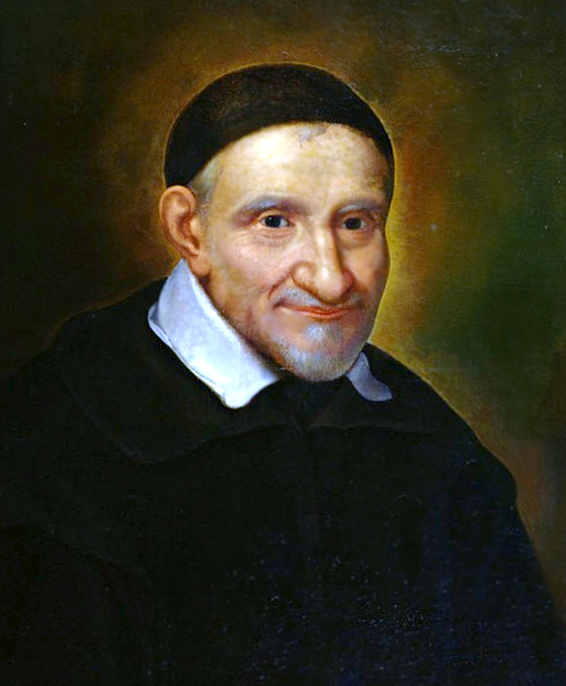
Saint Vincent de Paul: Priest, Founder and Apostle of Charity
A Gascon farm boy who first sought a comfortable career in the Church, then gave his life to rural missions, the formation of priests and the organized care of the poor, the sick, abandoned children and prisoners.
At a Glance
- Born
- Pouy, near Dax, Gascony, France. The year is disputed: conventionally April 24, 1581, though many scholars favor about 1580
- Died
- September 27, 1660, Saint-Lazare, Paris
- Ordained
- September 23, 1600, by Bishop François de Bourdeille
- Beatified
- August 21, 1729 (Benedict XIII)
- Canonized
- June 16, 1737 (Clement XII)
- Feast day
- September 27 (current Roman Catholic calendar); formerly July 19
- Patron of
- Charitable works and associations, declared by Leo XIII in 1885
- Best known for
- The Congregation of the Mission, the Daughters of Charity (with Louise de Marillac), the Confraternities of Charity
- A Birth Date in Doubt
- Pouy, Dax and Toulouse
- A Priest Seeking Security
- The Disputed Captivity
- Folleville and Châtillon
- The Congregation of the Mission
- Louise de Marillac and the Daughters of Charity
- Foundlings, Galley Prisoners and War Relief
- Court, Controversy and Writings
- Death, Relics and Canonization
- Legends and the Vincentian Family
- Frequently Asked Questions
A Birth Date in Doubt
Even the most basic fact about Vincent de Paul is uncertain. The date usually printed is April 24, 1581, but it should not be presented as settled. His earliest biographer, Bishop Louis Abelly, wrote that Vincent was born on the Tuesday after Easter in 1576. Pierre Coste, whose research did much to place Vincent's life on a documentary footing, favored 1581. Other Vincentian scholars, among them José María Román, studied what Vincent himself said about his age and concluded that about 1580 is more persuasive. The change between the Julian and Gregorian calendars adds further complication.
A fair biography therefore uses 1581 as the conventional date and says plainly that it is disputed. This habit of separating what is documented from what has been handed down is useful for Vincent's whole life, because the first life of him was written as a work of devotion and later scholars have corrected it in several places.
Pouy, Dax and Toulouse
Vincent was born in the rural parish of Pouy, near the cathedral town of Dax in southwestern France. The village was later renamed Saint-Vincent-de-Paul in his honor. His family held a modest farm in the hamlet of Ranquines and lived from crops and livestock. His mother was Bertrande de Moras. His father is named Jean de Paul in Abelly and Coste, though another early biographer, Pierre Collet, gives the name as Guillaume. The family is usually counted as six children, among them Jean, Bernard, Gayon, Marie and Marie-Claudine.
The word "peasant" needs some care. Studies of the family's property suggest they held some land and customary rights, so they were not necessarily destitute laborers. They were nevertheless far below the wealthy families and senior clergy Vincent would later deal with, and that gap shaped him.
As a boy he helped with the animals. His ability was noticed, and he studied the humanities at Dax with the Franciscans, called Cordeliers in French sources. He went on to study theology at Toulouse, and older accounts also mention time at Zaragoza. His later habit of speaking humbly about himself sometimes hid how well educated he was. Legal documents show he held real academic qualifications.
One well-known episode says Vincent was ashamed when his poorly dressed father came to see him at school. The scene has early biographical support, but its details are a transmitted recollection and not a documented event. It is best used with restraint. It does not prove he scorned his family. Documents show that later in life he stayed in touch with relatives and dealt with family land and inheritance.
A Priest Seeking Security
Vincent was ordained on September 23, 1600, by Bishop François de Bourdeille. That date and the bishop are confirmed in Pope John Paul II's letter of September 19, 2000, marking the four hundredth anniversary of the ordination. He was young for a priest by the standards later set by the Council of Trent.
The same letter is candid about the early priesthood. Vincent looked for a post that would give him a secure, respectable livelihood. His mission did not appear in a flash in childhood. It developed slowly, through spiritual direction, pastoral work, responsibilities he accepted and encounters with suffering people. Historians disagree about whether to call the change a sudden conversion or a gradual development, and no single moment can be pointed to as the day his mature outlook appeared.
Along the way he came into contact with leaders of the French Catholic renewal, among them Pierre de Bérulle and Saint Francis de Sales. In 1612 he became pastor of Clichy near Paris, where he learned the daily realities of parish work. He then entered the household of the de Gondi family as tutor to their children and spiritual adviser. Philippe-Emmanuel de Gondi held high office in the royal establishment, and his wife Marguerite de Silly took an active part in charitable and religious projects. On the family's country estates Vincent saw that people lacked sound instruction, access to confession and well-prepared priests.
The Disputed Captivity
The most famous story about Vincent's early priesthood is his capture by pirates. In the traditional account he was sailing from Marseille toward Narbonne in 1605, was taken to Tunis and sold into slavery, served several masters, helped persuade a former Christian who had become a Muslim to return to the faith, and escaped with him across the Mediterranean to France in 1607.
For generations this was told as plain history. Modern scholarship is more cautious. The main evidence is Vincent's own account, written to explain his absence, and independent documents confirming the capture and escape are lacking. DePaul University's special collections describe serious doubts, including questions about how the escape could have worked and inconsistencies with other accounts of Mediterranean captivity. The honest summary is this: Vincent reported that he was enslaved in North Africa, and whether it happened substantially as described cannot be established.
This should not be confused with his later work for captives, which is thoroughly documented in letters and administrative records. Nothing about his sanctity depends on the pirate story.
Folleville and Châtillon
Two events in 1617 are the roots of his mature work. At Folleville, on lands tied to the de Gondi family, a dying peasant's confession reportedly revealed how little religious preparation the country people had. On January 25, 1617, Vincent preached at Folleville about the need for a sincere general confession, and the response convinced him that rural populations needed organized missions. The Congregation of the Mission later traced its spiritual beginning to that sermon. The congregation did not yet exist as an institution, but the conviction behind it did.
Later that year Vincent left the de Gondi household and became parish priest of Châtillon-les-Dombes, now Châtillon-sur-Chalaronne. A parishioner told him of a family that was sick and desperately poor. He spoke of their need from the pulpit and the response was generous, but he saw a practical problem: a sudden flood of food would help for a day and then stop. He asked local women to set up a regular system of visiting and caring for the sick poor. A foundation document dated August 23, 1617, set up the association, with a rule that cared for both bodily and spiritual needs. It received ecclesiastical approval in November and was solemnly established in December.
The Châtillon group became the model for the Confraternities of Charity, later linked to the Ladies of Charity and to the International Association of Charities. The surviving document is valuable because it shows Vincent's method at first hand. He held that the poor must be served as members of Christ's body, and he also knew that good intentions need organization if they are to last.
The Congregation of the Mission
On April 17, 1625, Vincent and the de Gondi family set up the legal foundation of the Congregation of the Mission. It was meant to evangelize neglected country people. Its priests would preach missions, teach Christian doctrine, hear confessions and strengthen parish life. It was not a contemplative monastic order but an apostolic community whose members lived together in order to work. Vincent did not aim to replace parish priests. He wanted to supplement them where instruction was poor.
The congregation received papal approval in 1633. Its members became widely known as Lazarists because their headquarters was the former priory of Saint-Lazare in Paris. Alison Forrestal's scholarly study shows that Vincent's success depended on networks of patrons, clergy, lay helpers and Church authorities, as well as on his own energy and organizing skill.
Vincent also saw that the state of the people depended on the state of the clergy. In seventeenth-century France many priests were poorly trained and some looked on the priesthood mainly as a living. He answered with retreats for candidates preparing for ordination, continuing instruction for priests and eventually seminaries, and he organized the Tuesday Conferences, where priests met to discuss pastoral duties and spiritual discipline. John Paul II described the formation of priests as one of the lasting parts of Vincent's vocation.
Louise de Marillac and the Daughters of Charity
One of the most important partnerships in Vincent's life was with Saint Louise de Marillac, a widow with a deep faith and a gift for administration. They were not alike, and the Daughters of Charity's own history admits there were differences and tensions between them, alongside a trust that grew through the work. Louise traveled to charitable groups, visited communities, trained women and wrote to the sisters. It would be wrong to describe her as only Vincent's assistant. She gave essential leadership to the formation and spiritual growth of the community.
On November 29, 1633, a small group of women began living together in Paris under Louise's guidance. This was the beginning of the Company of the Daughters of Charity. The Confraternities had shown that organized help worked, but constant care of the sick and poor needed women who gave their lives to it. The Daughters were not an enclosed community. Their calling took them into homes, hospitals and streets. They ran schools for poor girls, nursed the sick, helped abandoned children and worked in hospitals. Their rules took definitive form over several stages involving both founders and Vincent's successors.
Foundlings, Galley Prisoners and War Relief
The treatment of abandoned infants in Paris was a grave problem. Children were received into institutions and informal arrangements that did not always protect, feed or treat them, and babies died from neglect and disease. From the late 1630s the Daughters of Charity and their supporters took on foundlings in a more organized way, which needed shelter, nursing, clothing and money. Vincent appealed to wealthy donors and had to face how unstable charitable funding could be.
In 1619 he was named chaplain-general of the French royal galleys. Galley prisoners, convicted criminals and other men under forced labor, suffered from confinement, disease, filth, harsh punishment and exhausting work. Vincent and his helpers visited them, offered spiritual help, pressed for better conditions and arranged care for the sick, including at a hospital in Marseille. These facts are well documented. It would be wrong, however, to describe him as a campaigner against the galley system itself. His recorded efforts were aimed at the care and spiritual needs of men inside the system.
His concern also reached across the Mediterranean. The Congregation of the Mission worked among French captives in North Africa and in the wider system of captivity, ransom and exchange. A surviving letter to Firmin Get, dated December 1658, about prisoners from Tunis, shows how closely Vincent handled the practical details. That same system held people of every faith, so it cannot be reduced to a simple story of Christian victims and Muslim captors.
The Thirty Years' War and the civil conflicts of the Fronde brought displacement, hunger and disease to many parts of France. Vincent gathered relief through correspondents, local clergy, religious communities and wealthy benefactors, and aid reached places such as Lorraine. This was not a substitute for modern government relief, which did not exist, but it was an organized answer to emergencies that individual parishes could not meet. During his lifetime the Congregation also worked beyond France, in countries including Italy, Poland, Ireland and Scotland, and Vincent supported a mission to Madagascar.
Court, Controversy and Writings
Vincent's reputation brought him to the center of power. In 1643 he attended King Louis XIII in his final illness. After the king's death Queen Anne of Austria named him to the Council of Conscience, which advised on church appointments, and this gave him a say in choosing bishops. It also exposed him to the realities of patronage and conflict. His charity was not a withdrawal from public affairs.
He also took part in the controversy over Jansenism, a movement tied to debates about grace and human freedom. Vincent opposed positions he thought endangered Catholic doctrine. Forrestal's study suggests that he was moved both by doctrine and by concern for the credibility of his congregation. A responsible account should not paint all his opponents as malicious, nor claim that he stood apart from the political side of the quarrel. Like every saint he was also a man of his age. His theology was that of a seventeenth-century French Catholic priest, and his kindness to suffering individuals does not show that he held modern views on religious pluralism.
Vincent wrote no systematic theological treatise. His surviving writings are letters, conferences to his communities, rules and instructions. The modern English collection, Correspondence, Conferences, Documents, is based on the editorial work of Pierre Coste. The Common Rules of the Congregation of the Mission were formally given to its members on May 17, 1658. He prized simplicity, humility, gentleness, mortification and zeal for souls, and he tied these virtues to the concrete work of serving people who were poor, sick or powerless. He urged the imitation of Christ, practical humility, prayer, obedience and charity.
A word about sources. Abelly's early biography is indispensable but it was written as a work of devotion, and Coste and later scholars have corrected parts of it. The disputed birth date and the captivity story show why it is better to treat Abelly as an early witness than as an infallible record.
Death, Relics and Canonization
In his last years Vincent was badly disabled, especially in his legs. He found it hard to walk, stand or say Mass, but he went on directing his communities and answering letters as he could. In 1660 he lost two close collaborators: Antoine Portail, an early companion in the Mission, died on February 14, and Saint Louise de Marillac on March 15. Vincent died at Saint-Lazare in Paris on September 27, 1660. Material collected by Coste says he died early in the morning, seated because of his condition. The popular accounts of his last words are unreliable, and no particular wording should be quoted.
He was first buried at Saint-Lazare. His bodily relics were moved to the chapel of the Congregation of the Mission on the Rue de Sèvres in Paris in 1830. The reliquary shows what looks like a complete figure, but this is a wax representation over his skeletal remains, so it should not be cited as evidence that his body is incorrupt. His heart is kept separately in the chapel of the Daughters of Charity on the Rue du Bac in Paris.
The cause advanced through the work of the communities he founded. Pope Benedict XIII beatified him on August 21, 1729, according to the Vatican's Dicastery for the Causes of Saints. Some older reference works give August 13, so the Vatican date is the one to use. Pope Clement XII canonized him on June 16, 1737. His feast is now kept on September 27, the day of his death, and was formerly July 19. In 1885 Pope Leo XIII declared him patron of Catholic charitable works. A historical study by Edward R. Udovic says four reported miracles had been accepted by the time of the beatification, with more examined before the canonization. These are the Church's judgments in the cause, and they should not be treated as modern medical findings.
Saint Vincent de Paul, you saw Christ in the poor and served him with patience and good order. Pray for those who care for the sick, the hungry and the forgotten. Give us open eyes, steady hands and humble hearts, that our charity may last beyond a single day. Amen.
This is a short devotional prayer written for this page, and it is not an official text of the Church. A traditional prayer is printed on his prayer card. A traditional litany to him, printed in Sadlier's Golden Manual in 1851, includes the invocation "Saint Vincent, patron of all charitable associations, pray for us."
Legends and the Vincentian Family
Two stories about Vincent must be marked as tradition. The first says he once took the place of a galley prisoner so that the man could go home to his family. DePaul University's exhibition states that no evidence shows Vincent did this, so it is a devotional legend. His real ministry to the prisoners is a sufficient witness without it. The second is the miraculous escape from slavery, which depends on a captivity that is itself unproven.
Vincent's influence spread mainly through the groups that adopted his idea of charity. The Congregation of the Mission carried his missions and priestly formation abroad. The Daughters of Charity grew into a large body serving the sick, poor children and schools. The Confraternities developed into an international tradition of lay service. Vincent did not found the Society of Saint Vincent de Paul. It was founded in Paris on April 23, 1833, by a group of young Catholics linked to Blessed Frédéric Ozanam, who took Vincent as their model. Sister Rosalie Rendu, a Daughter of Charity, helped guide the first members. Saint Catherine Labouré, a Daughter of Charity, belongs to the later history of the family. The apparitions associated with the Miraculous Medal in 1830 are part of that later devotion and should not be placed in Vincent's own lifetime.
For Eastern Christian readers the position needs to be stated honestly. Vincent was a Latin Catholic and his canonization was an act of the Catholic Church alone. The Orthodox Church in America's calendar for September 27 commemorates the martyr Callistratus and his companions, not Vincent. The Byzantine Catholic calendar sources consulted do not establish a universal Eastern Catholic commemoration either, so no one should claim that he is liturgically honored throughout the Eastern churches. There is still real common ground in the Gospel of Matthew, chapter 25, where service to the hungry, the stranger, the sick and the imprisoned is service to Christ. Eastern Christians have their own long tradition of charity, in the work of Saint Basil the Great and Saint John Chrysostom, and the comparison is fair at the level of shared teaching. No source shows that Vincent borrowed from them or that he influenced Orthodox spirituality, and he should not be described as a hesychast or a teacher of the Philokalia.
Frequently Asked Questions
Charity With Good Order
Vincent began by looking for a comfortable post and ended by organizing missions, seminaries, hospitals and relief for people nobody else was reaching. His example is that love for the poor lasts when it is patient, practical and shared. His prayer card is a small reminder for anyone who serves others.
View Prayer Card